Connecting Technology, Talent and Execution for Better Business Results!
Latin American organizations have spent years gaining access to better software, stronger infrastructure and increasingly advanced technology. Yet one difficult question remains: what happens when a company has the technology, but lacks the talent and guidance to turn it into something useful for the business?
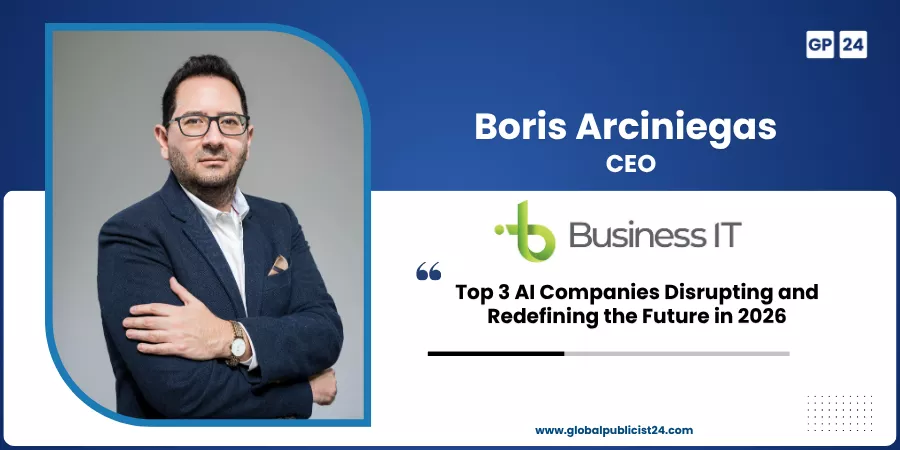
That question sits at the center of Boris Arciniegas’ journey.
As the Founder and CEO of Business IT, Boris entered the sector after seeing this gap across the region. Many organizations could access technology yet struggled to connect it with the people, knowledge, and direction required to deliver real business results. His motivation came from wanting to change that reality and help companies across Latin America compete globally by bringing innovation and execution together.
That belief formed Business IT from the beginning in Ecuador in 2009. Boris founded the company with a simple belief: organizations needed more than licenses or infrastructure. They needed a partner that could understand the business problem, implement the right solution, prepare their people and remain involved after the project was completed.
For him, technology was never about technology for its own sake. It was about closing the distance between acquiring a solution and gaining real value from it.
Today, that purpose holds even greater weight as artificial intelligence expands what companies can achieve. AI brings extraordinary opportunities, while demanding greater responsibility from those who put it into practice. Boris believes that responsibility matters because innovation only creates lasting value when it is paired with thoughtful execution.
Through Business IT, his original motivation persists, guiding the work: helping organizations across the region turn technology into meaningful business progress.
A Wider Ambition
Every growing technology company eventually reaches a stage where expanding into new markets changes the questions its leadership has to consider. Latin America presents a particularly varied landscape, with countries differing in regulation, culture, business practices, technological maturity, and adoption patterns. For a company operating across these markets, regional growth can influence how its leadership thinks about the business and its future.
At the beginning, Boris’s ambition was to prove that a company born in Ecuador could execute world-class technology projects. As Business IT grew, he learned that Latin America is not a single market. Countries differ in regulation, culture, technological maturity, and speed of adoption.
His vision evolved from exporting services to building regional capabilities with local proximity. Today, he wants Business IT to connect global technology ecosystems with the reality of Latin American organizations and help them move from experimentation to sustainable operations.
What Change Really Means
The idea of change takes on different meanings inside a technology business. It can involve adopting a new system, changing a process, learning a new skill, or redesigning the way an organization operates. For Boris, “Make the Change” determines the kind of adaptation he expects from the company and the organizations it works with.
Boris sees “Make the Change” as the ability to adapt faster than the environment. For clients, this means turning technology into business capability. For his teams, it means continuous learning and a willingness to redesign how they work.
For Business IT, this means integrating people, data, cloud, cybersecurity, automation, and AI around a measurable outcome. He believes change matters when it improves how an organization decides, operates, or serves its customers.
Where It Begins
AI gives organizations an expanding range of possible applications, from automating repetitive tasks to improving knowledge-intensive processes and modernizing older systems. With so many possibilities available, deciding where to begin becomes an important part of the implementation process. Boris approaches that decision by looking at the business problem first.
Business IT prioritizes problems where AI can remove friction between intention and execution. This includes manual knowledge-intensive processes, legacy applications that limit innovation, fragmented information that delays decisions, and AI adoption without sufficient governance.
Boris starts with a relevant business problem, rather than a tool. For him, the strongest use cases have a clear owner, an observable baseline, and a realistic path from pilot to production. This keeps the conversation focused on value, adoption, and risk rather than novelty.
When AI Becomes Disruption
AI has made disruption a common part of the technology conversation. New demonstrations and AI-powered products can attract attention quickly, but Boris looks for evidence that goes deeper than a successful demonstration. He considers the effect AI has on how an organization actually operates.
For Boris, disruption is not a chatbot, a demonstration, or a press release. A company becomes transformative when AI changes its operating model: how quickly it launches initiatives, how consistently it delivers, how effectively it learns, and how responsibly it makes decisions. He uses a simple test: would the organization’s performance materially change if that AI capability disappeared?
Genuine transformation, in his view, leaves evidence in cycle times, quality, customer experience, revenue, cost, risk, or employee effectiveness. Everything else may be interesting, but it is not yet disruption.
A Larger Opening
The ability to implement AI effectively also creates a larger opportunity for Latin America. The region has a growing technology workforce and businesses operating in complex environments, while global AI platforms are becoming increasingly accessible. This creates room for Latin American companies to develop expertise around the practical application of these technologies.
Boris believes Latin America has the opportunity to move from being primarily a consumer of technology to becoming a center for high-value implementation and engineering. The region has technical talent, proximity to customers, and a deep understanding of complex operating environments.
What is sometimes underestimated, in his view, is the knowledge required for implementation: connecting models with processes, data, regulation, security, and human behavior. Companies that master that layer, he believes, will be able to create value locally and export it globally.
Keeping It Practical
Technology adoption can become complicated when multiple systems, teams, data sources, security requirements, and operational processes have to work together. For organizations using technology services, the challenge is therefore often as much about implementation as it is about selecting the technology itself.
Boris starts with the business problem. His team identifies the decision, process, or customer experience that needs to improve, establishes a baseline, selects a limited set of use cases, validates data, security requirements, and ownership, deploys in controlled stages, and measures adoption and value.
He also believes the approach has to reflect each organization’s maturity. A universal model can create unnecessary complexity when businesses have different levels of readiness. As Boris puts it, “Complexity grows when technology arrives before purpose, accountability, and operational discipline.”
Earning Trust
As AI becomes part of business operations, organizations also have to deal with questions around data, accountability, security, and oversight. These concerns become more important as systems move from experimentation into processes that employees, customers, and decision-makers rely on.
Boris believes trust has to be designed into an AI project from the start. Clients need to know what data a system uses, what actions it can take, how its outputs are validated, who is accountable, and how performance and risk will be monitored after deployment.
For Business IT, the responsibility extends beyond making AI useful. Boris wants its solutions to be understandable, governable, and sustainable as well. Without trust, he believes adoption remains superficial, and scaling becomes dangerous.
Where Demand Is Rising
The demand for AI varies across industries, particularly because organizations have different regulatory requirements, technology environments, customer expectations, and operational pressures. Business IT is seeing strong interest from sectors where these factors often come together.
Boris sees particularly strong interest from financial services, insurance, and education. These organizations often face a demanding combination of legacy systems, regulation, large volumes of data, and pressure to improve customer experience.
He has also seen their requests evolve. They are moving beyond isolated copilots and asking more frequently about modernization, automation, governance, integration, security, adoption, and continuous operation. They want innovation, but they also expect evidence and reliability.
Finding the Right Pace
AI creates pressure for businesses to move quickly, particularly as new capabilities appear at a rapid pace. Enterprise environments, however, can involve significant consequences when new systems affect sensitive information, business processes, customers, or important decisions. Boris therefore sees speed as something that has to be managed according to the circumstances.
He does not see speed and reliability as opposites. The objective is to move quickly where experimentation is safe and more deliberately where the consequences are significant. Business IT uses controlled pilots, human validation, architecture and security reviews, and measurable criteria before scaling.
Boris also makes a distinction between a promising demonstration and a production-ready service. For him, responsible speed enables learning without transferring uncontrolled risks to the client.
The People Behind AI
Successful AI implementation is not just about developing the technology. It requires the right capabilities to come together across the journey, from understanding the business need to deploying a solution and making it part of everyday operations.
Boris believes modern technology companies must be able to connect business strategy with engineering and architecture, data, cybersecurity, governance, change management, and the ability to operate and measure solutions after deployment.
He also places strong importance on multidisciplinary delivery models. The strongest organizations, in his view, will connect business leaders, engineers, security teams, data professionals, and change agents around the same outcome. Continuous learning also needs to become an organizational capability rather than an occasional training activity.
Four Forces Ahead
Enterprise AI is moving into a new phase, with technologies increasingly influencing business processes, application development, monitoring, and ongoing service delivery. Boris expects several developments to have a particularly strong effect on enterprise services.
He expects four forces to transform enterprise services: agents that execute parts of business processes, AI-assisted application modernization, AI-native observability and managed services, and commercial models increasingly linked to outcomes.
Business IT is preparing by embedding AI into delivery, strengthening governance, building multidisciplinary teams, and moving from isolated projects toward services that can be monitored and continuously improved. Boris wants the company to combine global platforms with regional implementation knowledge and long-term operational support.
Beginning Before Certainty
For business leaders, the pace of AI development creates a difficult timing question. Waiting can mean missing opportunities to build experience, while moving too quickly can expose an organization to risks it has not prepared to manage. Boris believes leaders need to begin while still approaching the process carefully.
His advice is direct: “Do not wait for absolute certainty.” In technology, he believes certainty often arrives when the advantage has already disappeared. At the same time, he warns leaders against confusing urgency with improvisation.
He encourages them to start with a relevant problem, choose a business owner, protect their data, establish a baseline, and learn during implementation. The future, he believes, will not be defined by who talked most about AI, but by who learned fastest to use it responsibly and turned that learning into a repeatable capability.
Turning Opportunity into Results
The conversation around AI in Latin America ultimately comes back to what organizations can achieve with the technology available today. New breakthroughs will continue to emerge, but businesses also have immediate opportunities to build experience, improve operations, and develop the capabilities required to use AI responsibly.
Boris puts the regional opportunity simply: “Latin America does not need to wait for the next AI breakthrough. It needs to become exceptionally good at turning today’s AI into measurable, trusted, and scalable business outcomes.”
For him, the opportunity lies in connecting global technology ecosystems with the realities of Latin American organizations and helping them move from experimentation to sustainable operations.