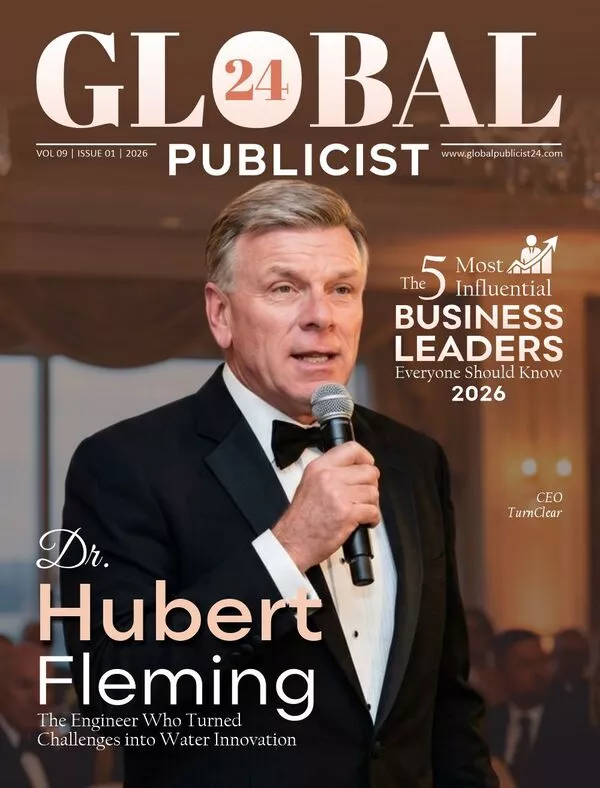
How do you build a successful career when you grow up with almost none of the comforts people take for granted? For Dr. Hubert Fleming, the answer began long before his professional life, on a mountain farm in West Virginia where hard work was simply part of getting through the day.
Hubert grew up very poor, born and raised in a log cabin with no running water, phone, television, or bathroom. The family home had a dirt floor, and life revolved around working hard to survive. Yet, those circumstances also gave him something that stayed with him for life: a close family and strong role models.
His parents, grandparents, and extended family taught him lessons that could never be learned from a textbook. He learned the value of hard work, discipline and focus, along with the importance of setting goals and following through on them. These values became part of how Hubert approached challenges and looked for solutions in his professional life.
Education held a special place in that journey. Hubert saw it as his way to a better life, giving him a clear reason to keep learning and moving forward. The lessons from that small mountain farm continued to guide him as he built his career, faced challenges in his industry, and worked towards creating better solutions.
Character Under Pressure
A long career rarely unfolds without moments that test a person’s judgment, patience, and ability to keep moving. For leaders who have worked across complex industries and major organizations, adversity can take many forms, from unexpected career decisions to situations that demand difficult action. Hubert’s approach to such moments was formed early and carried into his professional life.
How one overcomes adversity really is how character is defined. Having had to overcome considerable adversity in his early years, Hubert learned to cope with it throughout his professional career. He never lets it get to him. He addresses it in small, manageable steps, keeps his eye on the objective, and has confidence in himself to overcome.
A Scientific Beginning
Long before Hubert was making decisions as a business leader, his interests were rooted in science. The choice of a professional discipline came down to finding a field where his scientific interests could be applied to practical problems and where the results could be seen beyond the laboratory.
Hubert was always science-based, but he wanted to be practical and see the results of his endeavors. That meant engineering. Chemical engineering was natural for him because he was more chemistry- and physics-focused than biological or mechanical. It also turned out to be a great choice, as chemical engineering is an incredibly broad base from which to build a career.
The Decisions That Changed Direction
Academic choices provided the foundation, but professional development brought a different set of decisions. Careers can change through promotions, new responsibilities, changes in ambition, or opportunities that reveal abilities a person had not previously considered.
There was never a single seminal turning point in Hubert’s professional career, but rather a series of key steps. The most significant was, of course, the decision to attain a PhD in chemical engineering at Cornell. That set the stage for all that was to come.
Another important step came at Alcoa. There, Hubert realized he had potential for senior leadership and that he wanted more than to be a researcher. He wanted to be a business leader. His goals changed somewhat at that point.
When the Path Gets Difficult
Moving from research into leadership meant taking on a different kind of responsibility, and Hubert’s career soon brought decisions that could not be approached as technical problems alone. Some involved his own future, while others involved serious issues within organizations operating across multiple countries.
There were several very difficult professional moments. The first was the decision to leave Alcoa. Hubert never expected to, but it became necessary, including moving his family with four young children.
Another came at Severn Trent, where criminal activity by some of its subsidiaries, on an international scale, required addressing. There were others along the way, as there always are in large, complex businesses.
Influence Through Standards
Leadership became an increasingly important part of Hubert’s career, bringing with it a question that goes beyond responsibility for an organization. A senior position can give a person authority, but influence depends on what they do with that position and the standards they establish through their work.
For Hubert, influence comes through actions and by setting standards. Setting goals, articulating them, and executing on them over a long career, while achieving meaningful improvements that benefit society on a US and global basis, means quite a lot to him. Having others recognize that is very rewarding.
A Simple Leadership Philosophy
Years of leadership experience can produce elaborate theories about managing organizations, yet Hubert’s own philosophy remains direct. He focuses on what needs to be achieved, who is capable of delivering it, and how a leader can help those people succeed.
His leadership philosophy comes down to three principles: “Set goals, select leaders who can execute, support them.”
More Than Execution
Managing an organization effectively requires strong execution, but Hubert draws a clear distinction between people who can deliver a plan and leaders who can determine what the plan should be. The difference becomes especially important when businesses face complicated problems that cannot be solved by simply following an established process.
There are many good business executives. Hubert has seen plenty who are very good at executing plans, managing operations, and handling the details. However, there are few true leaders.
Leaders innovate, think outside the box, process complex information, and find a way to communicate a plan to those who can execute.
Learning the Human Side
The shift from technical work to leadership also exposed a skill that could not be developed through engineering expertise alone. Managing people requires understanding different personalities, interests, expectations, and relationships across an organization and its wider network.
The longest lesson for Hubert was learning how to manage people. He was a technologist, a technical type, not a business person. His people skills were not developed, and he did not appreciate the complexities of successfully managing people, including employees, partners, clients, politicians, and others.
It was a skill that could not simply be picked up from a textbook or formal training. It had to be acquired.
From Advanced Materials to Water
Hubert’s technical interests eventually brought him into an area where scientific knowledge could be applied to one of the world’s most fundamental resources. His work with advanced materials and membranes focused on controlling what could pass through a material, creating possibilities for treating different types of water.
He was highly interested in advanced materials and how to make them do specific tasks. Designing membranes to selectively pass certain things, like water, and reject other things, like salts, was intellectually fascinating to him.
That interest naturally developed into a practical focus on developing membranes and systems that could desalinate seawater and brackish water, as well as industrial wastewater.
Why Water Matters So Much
Desalination and wastewater treatment sit within a much larger question about how societies secure the resources needed to support human life and economic activity. Water is closely connected to energy, agriculture, sanitation, industry, and the continued development of communities.
Hubert considers the relationship highly complex. His view is that water supply and wastewater management are critical, along with power and food supply, to further human habitation. Water is further necessary for power and definitely for growing food.
“Everything in life flows from water,” he says.
The Reality Behind Water Security
Having the technology to treat or produce water does not automatically mean every region can secure a sustainable supply. Physical availability is one challenge, while the cost of developing and maintaining infrastructure can create another, particularly in areas with limited financial resources.
Hubert sees water security today as generally being a function of one or two factors. First, it may simply be geography, particularly in parts of the world where water is scarce. Second, economics. Many regions simply do not have the funds to source water sustainably.
There is no shortage of technology, in his view.
Where Entrepreneurs Should Begin
The gap between technological possibility and practical deployment creates opportunities for entrepreneurs, but it also makes the fundamentals of building a business particularly important. A new water technology needs to solve something customers genuinely need, create enough value to justify adoption, and have a realistic route into the market.
Hubert’s advice to entrepreneurs is straightforward and simple. First, make sure they are solving for a real problem. Second, make sure they have a real value proposition, not an imagined one. And third, find commercialization partners.
He does not expect entrepreneurs to do it on their own.
Looking Beyond the Business Plan
The same complexity that makes water technology difficult to commercialize also makes the industry challenging for investors. Financial projections can provide useful information, but they cannot fully capture the technical, regulatory, operational, and market realities surrounding a water business.
Successful investors, in Hubert’s view, learn about the industry they are investing in, rather than simply focusing on the financials or business plan of a potential investment. Water is a complex industry, with complex dynamics. Successful investing requires a real understanding of the pitfalls and the real opportunities.
Technology’s Growing Role
Water infrastructure is now being influenced by technologies that can improve everything from engineering and risk assessment to maintenance and asset management. AI and advanced analytics are becoming part of a broader shift towards smarter infrastructure and more informed operations.
AI is rapidly changing all industries, water included. For Hubert, its value can already be seen in areas such as engineering design, risk management, operations, preventive maintenance, and asset management costs.
The same can be said for advanced instrumentation and advanced infrastructure. Ultimately, these technologies can help the industry make better use of the water resources it has while finding and developing new ones.
Seeing the Whole Picture
As technology becomes more deeply embedded in industries such as water, the expectations placed on business leaders are changing as well. Technical knowledge remains important, but leaders also have to understand commercial realities, financial considerations, market behaviour, and how different parts of an industry influence one another.
Hubert considers one key capability for new business leaders to be the development of a broad, holistic view of their field. A mix of a strong technology base, business and financial acumen, and commercialization skills is key to addressing complex market dynamics.
The Knowledge He Had to Build
Hubert’s own experience provides a clear example of why that broader perspective matters. His technical background gave him a strong foundation, but moving into business leadership required him to develop capabilities that were outside his original area of expertise.
He was highly limited by his lack of business knowledge because he was a technocrat. He had to learn business, financial management and analysis, marketing, and product development.
Looking back, Hubert believes a business background would have been “super helpful.”
Recognition After the Work
Recognition becomes particularly meaningful when it follows a long body of work. By this stage of a career, professional acknowledgement reflects years of decisions, projects, innovation, and the perspective developed through experience.
Being recognized as a business leader, and more importantly as an innovative and influential one, is highly rewarding to Hubert. He values knowing that his peers recognize some of his accomplishments and value his insight and perspective.
He considers it probably as rewarding as many of the actual water projects he has executed, of which he is proud of many.
Staying With Your Compass
After decades of professional experience, Hubert’s final advice is less about a specific business technique and more about maintaining a sense of direction. Emerging leaders have to navigate competing expectations, changing markets, professional pressures, and a constant flow of outside opinions.
His advice is to stay in touch with yourself and remain continually guided by a strong internal compass. The world is complex enough, and the external noise is considerable.
For Hubert, the answer is to stay focused and stay true to yourself.