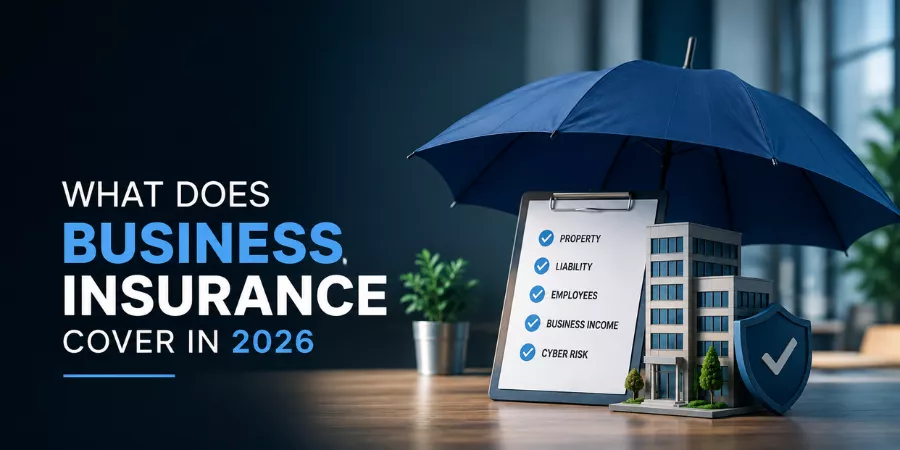
If you own a business, business insurance can protect you from some of the financial consequences of property damage, customer injuries, lawsuits, professional mistakes, product claims, cyber incidents and an interruption to normal operations. But there is no single policy that covers everything. The protection you actually receive depends on the policies you buy, coverage limits, exclusions, deductibles, your business activity and the laws where you operate.
That last part is worth remembering because insurance can look deceptively simple from the outside. You pay a premium, something goes wrong and the insurer pays. In reality, business insurance coverage is much more specific than that.
What Does Business Insurance Typically Cover?
Business insurance typically covers physical business assets, third-party liability, certain professional errors, product-related claims, business interruption and other risks specifically included in the policy.
Think about your business in terms of what could actually go wrong.
A fire could destroy your equipment. A customer could be injured on your premises. A client could claim your advice caused a financial loss. A cyberattack could stop your systems from working.
These are different problems, and they can require different forms of insurance.
What does business insurance cover for property and business assets?
Property coverage can protect physical assets such as:
- Buildings
- Machinery and equipment
- Furniture
- Computers
- Inventory
- Fixtures
- Business contents
- Tenant improvements
Depending on the policy, covered causes of loss can include events such as fire, lightning, theft, storms, vandalism and other specified perils. The NAIC describes commercial property insurance as coverage for a business’s location and physical property, including equipment, inventory and furniture.
So, if a fire damages the computers, furniture and inventory inside a shop, property insurance may respond to the covered physical loss.
What does general liability insurance cover?
General liability insurance can cover certain third-party bodily injury, property damage and related legal claims.
A simple example makes this easier.
A customer walks into your store, slips on a wet floor and suffers an injury. The customer subsequently makes a claim against your business.
That is the sort of situation business liability insurance is designed to address.
General liability can also cover certain legal defence costs, settlements and judgments, subject to the policy terms. The NAIC identifies bodily injury and property damage claims among the central areas of general liability coverage.
Does business insurance cover product liability?
Product liability insurance can cover certain claims alleging that a product caused bodily injury or property damage.
This is important to more businesses than manufacturers alone.
Beyond manufacturers, retailers and distributors, importers and even online marketplaces can get sued for an adverse event involving a product, if they are the ones who supplied it to the end consumer.
Take a hypothetical case where a digital storefront sells a device which, the user says, triggered an electrical fire in their house. The lawsuit stemming from this incident may cover damaged belongings, personal injuries and lawyer bills.
Whether the policy responds depends on its wording and the circumstances of the claim.
What does professional liability insurance cover?
Professional liability insurance covers certain claims arising from professional errors, omissions or negligence.
It is particularly relevant to businesses that sell expertise rather than physical products.
That can include:
- Consultants
- Accountants
- Lawyers
- Architects
- IT professionals
- Designers
- Healthcare professionals
- Marketing and advertising agencies
Imagine a consultant advises a client to implement a particular system. The client later claims that the advice caused significant financial losses.
That is fundamentally different from a customer slipping in your office. Professional liability exists for this kind of professional-risk exposure.
Does business insurance cover employee-related risks?
Employee-related risks are generally handled through specific employee injury or employer-liability policies, depending on the jurisdiction.
Coverage can relate to:
- Workplace injuries
- Occupational illness
- Disability
- Death
- Employer liability
The legal requirements vary from one country to another, so this is one area where you should never assume that advice written for another market applies to your business.
In India, for example, the Insurance Regulatory and Development Authority of India lists workmen compensation alongside public and professional liability among the types of insurance available to SMEs.
Does business insurance cover business interruption?
Business interruption insurance can cover certain lost income and continuing expenses when a covered event forces a business to suspend or reduce operations.
This is one of those coverages that can become extremely important after a disaster.
Property insurance can help repair the physical damage. But what happens while the doors are closed?
Business interruption coverage may help with things such as:
- Lost income
- Continuing rent or lease payments
- Employee wages
- Certain taxes and loan payments
- Relocation costs
- Additional expenses required to keep operating
The NAIC says business interruption insurance commonly works alongside commercial property coverage and can address lost revenue and certain fixed expenses following a covered event.
There is a useful real-world example here.
Abergavenny Fine Foods, a UK food manufacturer, suffered a factory fire in 2015. The company had reviewed its insurance before the incident and had extended its business interruption period to 24 months. Its factory reopened roughly a year after the fire. The case illustrates something business owners often overlook: the recovery period matters just as much as the value of the physical property.
Does business insurance cover cyber risks?
Cyber insurance can cover certain losses arising from cyber incidents, depending on the policy.
Potential areas include:
- Data breaches
- Ransomware
- Cyber extortion
- Data restoration
- Incident response
- Cyber-related business interruption
- Certain third-party claims
For a business that depends almost entirely on cloud systems, customer databases or online transactions, cyber risk can quickly become an operational risk as well as a technology problem.
Does business insurance cover commercial vehicles?
Commercial auto insurance is generally used for risks involving vehicles used for business purposes.
That can include:
- Cars
- Vans
- Trucks
- Delivery vehicles
- Company-owned vehicles
A business should not assume that a personal auto policy provides the same protection when a vehicle is being used commercially.
What Does Business Insurance Usually Not Cover?
Business insurance does not automatically cover every financial loss a company experiences.
Depending on the policy, exclusions or limitations can apply to:
- Intentional acts
- Normal wear and tear
- Poor maintenance
- Certain forms of fraud
- Certain natural disasters
- Contractual liabilities
- Uninsured vehicles or locations
- Losses above policy limits
- Events outside the policy period
- Risks specifically excluded by the policy
This is why the word “covered” matters.
For example, business interruption insurance does not simply mean “my revenue fell, therefore my insurer pays.” The interruption normally has to arise from a covered event and satisfy the policy’s conditions. The NAIC specifically notes that business interruption coverage commonly depends on covered physical property damage.
What Determines What a Business Insurance Policy Covers?
The coverage is determined by the business’s activities, location, assets, employees, revenue, contracts, selected policies, limits and exclusions.
There is no universal business insurance package because businesses do not face universal risks.
Consider these factors:
- Type of business: A restaurant does not have the same exposure as a software company.
- Industry and professional activity: An architect has professional liability exposure that may not exist in the same way for a retailer.
- Business location: Property risks and legal requirements vary by location.
- Number of employees: The size and nature of your workforce can affect insurance requirements.
- Property and equipment value: A manufacturing company with ₹10 crore worth of machinery has a very different property exposure from a freelancer working from home.
- Revenue and turnover: Revenue can influence underwriting and the potential financial impact of an interruption.
- Vehicles: Businesses making deliveries or transporting goods may need commercial auto coverage.
- Customer and supplier contracts: A customer, landlord or lender may require specific insurance limits.
- Data and technology: A company handling large volumes of personal or financial information may have greater cyber exposure.
This is why small business insurance should be built around the actual business rather than a generic checklist.
Why Is Business Insurance Important for a Business?
Insurance is a shield against loss for business owners in the sense that it is a contract that covers their losses against various risks including: property damage, injury, and legal claims. For example, if a business gets burned down due to fire or water damage, then that company will still be able to operate thanks to business insurance, mainly their business interruption policy. This can also give a lot of business owners peace of mind when dealing with unexpected or dangerous situations.
Instead of considering it just another cost of doing business, a business can recognize it as a means of transferring some financial risk exposure to an insurance carrier. That can be very helpful for smaller businesses in particular if they have limited working capital or cash flow to manage sudden loss.
Key reasons business insurance matters include:
- Protecting business assets: the policy can protect buildings equipment inventory, furniture and other business property against damage from the events covered.
- Managing liability risks: General liability insurance may handle specific claims about third-party injuries or damage to property.
- Supporting business continuity: Business interruption coverage might allow recovery of lost income and continuing expenses after a covered disruption.
- Protecting employees: employee-related insurance might be required legally based on the location.
- Meeting contractual requirements: before being a party to a contract landlords lenders, customers, or business partners may ask for certain coverage.
- Reducing financial uncertainty: Insurance can help businesses better predict the financial consequences of certain risks.
For example, the U.S. Small Business Administration notes that accidents, natural disasters and lawsuits can create costs serious enough to threaten a business.
What are the Benefits of Business Insurance?
The major reasons for purchasing business insurance, apart from the obvious of course, include securing financially from unexpected situations, managing potential risks, guarantee a continuous flow of business, being protected from liabilities and gaining the necessary confidence to run and expand business.
Depends on the policies chosen, the advantages will be different, but the basic idea behind purchasing insurance for your business is to shield the commercial enterprise from those specific hazards
Some of the most practical benefits include:
- Financial protection after unexpected losses: A covered fire, theft, accident or liability claim can create costs far beyond a company’s normal operating budget. Appropriate insurance can shift some of that financial burden to the insurer.
- Protection against lawsuits and claims: Business liability insurance can help with covered third-party claims and associated legal costs, subject to the policy terms and limits.
- Business continuity after disruption: If an insured event temporarily stops operations, business interruption insurance may help cover eligible lost income and continuing expenses.
- Protection for employees: Employee-related coverage can provide protection for certain workplace injuries or illnesses, with requirements varying by jurisdiction.
- Protection for professional services: Professional liability insurance can be particularly useful for consultants, accountants, architects, technology companies and other businesses where an alleged professional error could lead to a financial claim.
- Cyber risk protection: Businesses handling customer information and digital systems can consider cyber insurance for certain losses associated with data breaches, ransomware and other covered cyber incidents.
- Greater credibility: Insurance can also reassure customers, landlords, lenders and business partners that the company has considered some of the risks associated with its operations.
The important point is that business insurance benefits depend on the actual policy. Having insurance does not mean every business loss will automatically be covered.
What are the Advantages and Disadvantages of Business Insurance?
The main advantage of business insurance is that it can protect a company from potentially damaging financial losses; the main disadvantages are premiums, deductibles, coverage limits, exclusions and the possibility of paying for protection the business may rarely use. The decision therefore comes down to matching coverage with the risks the business can realistically afford to retain.
Advantages of business insurance
- Reduces financial exposure: A major covered loss does not necessarily have to be paid entirely from business cash reserves.
- Protects business continuity: Certain policies can help a company recover financially after an insured disruption.
- Helps manage liability: Coverage can provide protection against specified third-party claims.
- Can satisfy legal requirements: Some forms of insurance are mandatory depending on the jurisdiction, industry and circumstances.
- Protects valuable assets: Property and equipment can represent a substantial portion of a company’s investment.
- Supports business relationships: Certain customers, landlords and lenders may require evidence of insurance.
- Provides risk-management flexibility: Businesses can select coverage according to their industry, assets, employees and exposure.
Disadvantages of business insurance
- Premium costs: Insurance adds a recurring expense to the business.
- Deductibles or excesses: The company may still have to pay an agreed amount before the insurer contributes to a covered claim.
- Coverage limits: An insurer generally pays only up to the applicable policy limit.
- Exclusions: Certain risks may be excluded unless additional coverage is purchased.
- Complex policy wording: Understanding conditions, exclusions and sub-limits can require careful review.
- Potential overinsurance: Buying coverage that does not correspond to the company’s actual risks can unnecessarily increase costs.
- No guarantee that every claim will be paid: Coverage depends on the circumstances of the loss and the terms of the policy.
The sensible approach is therefore not to buy the most insurance possible, but to buy the right insurance for the risks that could materially damage the business. That distinction makes the section more useful than a generic list of advantages and disadvantages.
What are the Main Types of Business Insurance?
The main types of business insurance include general liability, property, business interruption, professional liability, product liability, employee-related coverage, cyber insurance and commercial auto insurance.
| Insurance type | What it can cover | Who may need it |
| General liability | Third-party injury and property damage | Customer-facing businesses |
| Property insurance | Buildings, equipment and inventory | Businesses with physical assets |
| Business interruption | Certain lost income and continuing expenses | Businesses dependent on continuous operations |
| Professional liability | Professional errors and negligence claims | Consultants and professional firms |
| Product liability | Certain product-related claims | Manufacturers, sellers and distributors |
| Workers’ compensation / employers’ liability | Work-related employee injuries or illness | Businesses with employees, depending on jurisdiction |
| Cyber insurance | Certain cyber and data-related losses | Businesses handling digital systems |
| Commercial auto | Business vehicle risks | Businesses using vehicles |
| Crime insurance | Certain theft and fraud losses | Businesses exposed to financial crime |
| Key person insurance | Financial impact of losing a critical individual | Businesses dependent on key employees |
These are the main types of business insurance, but not every business needs every policy.
The better question is which risks could cause serious financial damage if they happened tomorrow.
What is Usually Included in a Business Insurance Package?
A business insurance package can combine several types of coverage, commonly including property, liability and business interruption protection.
One example is a Business Owner’s Policy, or BOP.
The NAIC says a BOP typically combines commercial property, business interruption and liability insurance and can be a less expensive option for many small businesses than buying individual policies separately.
Additional protection can be added depending on the business, including:
- Cyber
- Professional liability
- Crime
- Equipment breakdown
- Commercial vehicles
- Employee-related coverage
But a package policy is not a magic umbrella.
It does not mean every possible business risk is covered.
How Do Business Insurance Limits and Deductibles Work?
A coverage limit is the maximum amount an insurer may pay for a covered loss, while a deductible is the amount the business pays before the insurer responds.
These five terms are worth knowing:
- Coverage limit: Maximum amount payable for a covered loss.
- Deductible: Amount paid by the business before insurance responds.
- Premium: Amount paid for the policy.
- Sub-limit: A smaller limit applying to a particular category of loss.
- Policy period: The period during which the policy applies.
Suppose your policy has a $1 million liability limit. That does not mean every claim is automatically worth $1 million.
The claim must first fall within the policy’s coverage, and other conditions, exclusions and limits can apply.
Is Business Insurance Required by Law?
There is no single worldwide rule requiring every business to carry the same insurance.
Requirements can depend on:
- Country
- State or province
- Industry
- Number of employees
- Vehicle use
- Professional licensing
- Contracts
For example, the UK generally requires employers’ liability insurance for businesses employing staff, subject to specific exemptions. The minimum required cover is generally £5 million.
The situation is different elsewhere.
So, if you are researching business insurance for your company, check the requirements in the jurisdiction where your business actually operates rather than relying on a generic international checklist.
What Business Insurance Does a Small Business Need?
The insurance a small business needs depends on what it sells, what it owns, how it operates and which risks could cause a financially serious loss.
| Business model | Coverage to consider |
| Freelancer or consultant | Professional liability + general liability |
| Retail business | Property + liability + product liability |
| Restaurant | Property + liability + product-related risks + employee coverage |
| Ecommerce business | Product liability + cyber + property/inventory |
| SaaS company | Professional liability + cyber + general liability |
| Manufacturer | Property + product liability + equipment + interruption + employee coverage |
The NAIC notes that a BOP can be particularly useful for smaller businesses and says insurers may customise these packages for different types of businesses.
Again, these are starting points rather than rules.
How Do You Choose the Right Business Insurance Coverage?
Start with the losses your business could not comfortably absorb, then identify the policies that can address those risks.
We would approach it in this order:
- List the assets you could lose.
- Identify who could make a claim against you.
- Look at risks specific to your industry.
- Check what insurance the law requires.
- Read customer, landlord and lender contracts.
- Calculate how long your business could survive without revenue.
- Compare limits, deductibles and exclusions.
- Review the policy whenever the business changes.
That last step is easy to overlook.
Your insurance should change when your business changes.
If revenue doubles, you hire 50 employees, move into a larger facility, start exporting products or begin storing large amounts of customer data, the insurance you bought two years ago may no longer reflect the business you operate today.
What Does Business Insurance Cover in a Real-World Example?
Consider a small retailer whose warehouse catches fire.
The immediate problem is obvious: inventory and equipment are damaged.
But there are actually several financial problems behind that one event.
Property insurance may address covered physical damage to the inventory and equipment.
Business interruption insurance may address certain lost income and continuing expenses while the business is unable to operate.
If the retailer’s products subsequently cause an injury to a customer, product liability insurance could potentially address that separate claim.
A real case illustrates how complicated business interruption can become.
In a case involving Manglam Organics, a fire affected one manufacturing block of its facility. The company had a loss-of-profit policy, and the dispute ultimately involved how the interruption and loss of profit should be calculated under the policy. The case demonstrates an important point: business interruption claims are not simply a matter of looking at the company’s total revenue and writing a cheque. The policy wording, affected operations, turnover and indemnity period can all matter.
There is an even more straightforward lesson from another case study.
A business that suffered a fire had property damage but did not have business interruption coverage. The resulting financial pressure came not only from the physical damage but from being unable to continue operating normally.
That is the part many business owners discover too late.
The building can be insured. The equipment can be insured.
But what happens to the business while everything is being repaired?
Frequently Asked Questions About Business Insurance
What does business insurance cover?
Business insurance can cover property damage, third-party liability, professional errors, product claims, business interruption, cyber incidents and other specified risks. The exact coverage depends on the policies purchased and their limits and exclusions.
Does business insurance cover theft?
It can cover theft when theft is included under the applicable policy. Property or crime coverage may respond depending on what was stolen and the circumstances.
Does business insurance cover fire damage?
Property insurance can cover fire damage when fire is a covered event under the policy. Business interruption coverage may also address certain resulting income losses.
Does business insurance cover employee injuries?
Employee injuries are generally addressed through workers’ compensation or employers’ liability coverage, depending on the jurisdiction. General liability insurance is primarily designed for third-party claims.
Does business insurance cover customer injuries?
General liability insurance can cover certain customer injury claims. A customer slipping and being injured on business premises is a common example.
Does business insurance cover lawsuits?
Certain liability policies can cover legal defence costs and covered settlements or judgments. Whether a lawsuit is covered depends on the type of claim and policy wording.
Does business insurance cover business interruption?
Business interruption insurance can cover certain lost income and continuing expenses after a covered event interrupts operations. The NAIC notes that this coverage commonly works alongside commercial property insurance.
Does business insurance cover cyberattacks?
Cyber insurance can cover certain costs associated with cyber incidents. Depending on the policy, this can include incident response, data restoration, liability and cyber-related business interruption.
Does business insurance cover professional mistakes?
Professional liability insurance can cover certain claims involving professional errors, omissions or negligence. It is particularly relevant to consultants and other professional service businesses.
Does business insurance cover product liability?
Product liability insurance can cover certain claims alleging that a product caused injury or property damage. Manufacturers, distributors and retailers can all face this type of exposure.
Does business insurance cover lost income?
Business interruption insurance can cover certain lost income following a covered interruption. A normal decline in sales is not automatically an insured loss.
Is business insurance mandatory?
Some forms of insurance are mandatory in particular jurisdictions and industries, while others are optional. Employee-related and commercial vehicle insurance are common examples.
How much business insurance does a small business need?
There is no universal amount. The appropriate limits depend on the business’s assets, revenue, industry, contracts, potential liability and ability to absorb a major loss.
What does business insurance exclude?
Business insurance can exclude or limit risks such as intentional acts, wear and tear, certain natural disasters, contractual liabilities and losses exceeding policy limits. The exact exclusions are found in the policy wording.
Conclusion
The easiest way to misunderstand business insurance is to think of it as one policy protecting the company from everything that can go wrong.
It isn’t.
A fire, customer lawsuit, professional mistake, cyberattack and prolonged shutdown are different risks. They can require different forms of protection, different limits and sometimes entirely different policies.
And that is really the question a business owner should be asking.
Not simply “What insurance should I buy?”
But:
“What could seriously hurt my business financially, and do I have the right coverage if it happens?”
Once you look at insurance that way, the long list of types of business insurance becomes much easier to understand.
Insurance coverage, exclusions and legal requirements vary by policy and jurisdiction. This article is for general educational purposes and is not a substitute for professional insurance, legal or financial advice.