You’ve probably read that leadership needs to change. Empathy, psychological safety, growth mindset, the terms are everywhere. But knowing what good leadership looks like and actually building it into how you manage people are two different things.
Satya Nadella figured that out the hard way. When he became CEO of Microsoft in 2014, the company was stagnating. Teams hoarded information. Internal competition had replaced collaboration. The culture rewarded knowing things, not learning them, and it was costing Microsoft dearly.
During Steve Ballmer’s time as CEO, Microsoft’s overall value dropped by about 30% over 14 years.
After Satya Nadella became CEO, the company’s performance improved a lot. About 12 years later, Microsoft was earning $331.8 billion in yearly revenue, its GAAP net income increased by around 31% compared to the previous year, and its cloud service (Azure) was making over $100 billion per year.
That big improvement happened because of a completely different way of managing. Satya Nadella Leadership Skills show how he changed the company’s culture from a rigid “know-it-all” mindset to a more open “learn-it-all” approach. This change helped turn slow, stuck teams into highly productive ones, and it’s a style any manager can use.
Who is Satya Nadella?
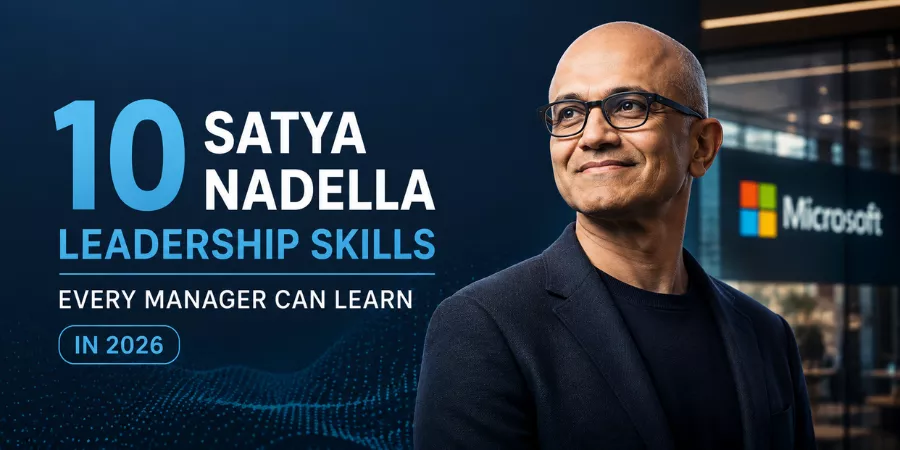
Satya Nadella is the Chairman and CEO of Microsoft, a role he has held since February 4, 2014. He was only the 3rd CEO in the company’s history, following Bill Gates and Steve Ballmer. Before taking the top job, he led Microsoft’s cloud and enterprise division, which gave him an unusually clear view of where the industry was going before most people saw it.
Under his leadership, Microsoft didn’t just grow. It transformed.
| Milestone | What Happened |
| Market cap | Grew from ~$300B in 2014 to over $3 trillion (TechSpot, 2024) |
| Azure | Surpassed $100B in annual revenue for the first time (Fortune, 2026) |
| AI business | $37B annual run rate in Q3 FY2026, up 123% YoY (Microsoft earnings, 2026) |
| Full year revenue | $331.8B in FY2026, up from $281.7B in FY2025 (Microsoft, 2026) |
| Microsoft 365 Copilot | Reached 30 million+ paid seats (Microsoft, 2026) |
| Fortune 500 penetration | More than 80% now use Azure AI services (Value Add VC, 2026) |
None of that happened by accident. It happened because Nadella changed how 100,000+ people thought about their work, their teammates, and their capacity to learn.
Why Satya Nadella Leadership Skills Matter for Managers Today
Satya Nadella’s leadership at Microsoft transformed corporate culture by replacing a rigid “know-it-all” mindset with a curious “learn-it-all” approach.
For managers today, his focus on empathy and clarity proves that driving sustainable results requires empowering teams, encouraging psychological safety, and viewing failure as an essential engine for continuous learning and innovation.
1. Put Empathy Before Authority
When Satya Nadella sent his first company-wide memo as CEO, he didn’t lead with strategy or targets. He led with empathy, framing it not as a virtue, but as a driver of better outcomes. He wrote: “Our industry does not respect tradition, it only respects innovation. But innovation comes from empathy: understanding unmet, unarticulated needs.”
In 2019, Nadella rolled out the Model-Coach-Care management framework across all 16,000 leaders at Microsoft, a system built around role modelling, coaching teams, and genuinely caring about people’s development.
The idea was simple: when managers understand what their people are dealing with, those people do better work. It sounds obvious. Most companies don’t do it.
What you can do: In your next one-on-one, spend the first half asking, not telling. Ask what’s getting in the way, not just what’s getting done. The answers will tell you more than any status update.
2. Replace “Know-It-All” With “Learn-It-All”
This is probably the most well-known of Satya Nadella leadership skills, and for good reason. It changed everything about how Microsoft operated internally.
When Nadella took over, Microsoft’s culture rewarded being the smartest person in the room. He replaced that with a growth mindset, inspired by Stanford psychologist Carol Dweck’s research. He told Wharton professor Adam Grant: “The person who has less innate capability, but is a learn-it-all, will ultimately become better. That applies to CEOs, and that applies to companies.”
Teams stopped competing to be right and started learning together. That shift, more than any single product decision, is what made Microsoft’s renaissance possible.
What you can do: The next time someone on your team admits they don’t know something or tried something that didn’t work, treat it as a win. Cultures that penalise not-knowing end up with people who pretend to know. That’s worse.
3. Create Safety for Experimentation
Before Satya Nadella, Microsoft used stack ranking, a system where employees were evaluated on a curve against each other. It sounds rational. In practice, it meant that helping a colleague could hurt your own rating.
So, people didn’t help each other.
Satya Nadella replaced internal rivalry with collaboration by making curiosity and experimentation the things that got rewarded, not just outcomes. Stack ranking was removed. Psychological safety became a leadership priority, not an HR talking point.
The result: teams started sharing knowledge, trying new approaches, and admitting mistakes early, before they became expensive.
What you can do: Look at your team’s incentives. Are people rewarded for trying things that don’t work out, as long as they learn something? If the answer is no, your team is probably playing it too safe to innovate.
4. Think Further Out Than the Next Quarter
When Satya Nadella committed Microsoft to cloud computing, it meant deliberately cannibalising its own highest-margin desktop software business. That was not a comfortable call. It was the right one.
Azure’s quarterly revenue growth accelerated to 43% in Q4 FY2026, pushing full-year revenue past $100 billion for the first time. That milestone was the payoff from a bet placed years earlier, when the easier move would have been to protect what already worked.
Long-term thinking is harder than it sounds in organisations driven by quarterly targets. It requires managers to hold two things at once: delivering on today’s goals and building toward something beyond them.
What you can do: In your next goal-setting conversation with your team, add one question: “What are we building this year that we’ll still be proud of in three years?” It changes the texture of the planning conversation.
5. Listen Before You Decide
Satya Nadella didn’t arrive at Microsoft in 2014 with a transformation plan. He spent his first months in conversation, with employees, customers, partners, and critics. The strategy that emerged from those conversations was sharper for it.
The “listening before acting” approach wasn’t just good optics. Satya Nadella believed empathy, which starts with listening, could unlock innovation faster than pressure ever could.
Most managers do the opposite. They come into meetings with conclusions already formed and use the conversation to confirm them. That produces compliance, not commitment.
What you can do: In your next team meeting, try not proposing a solution until everyone else has spoken. It’s harder than it sounds. It’s also more effective than you expect.
6. Give People Ownership, Not Just Tasks
There’s a meaningful difference between delegating a task and delegating ownership. The first transfers work. The second transfers accountability, and with it, motivation.
The Model-Coach-Care framework embedded across Microsoft’s leadership was built around delivering results through empowerment and accountability, not top-down instruction. Managers were expected to develop their people, not just direct them.
The practical effect: team members who own outcomes perform differently than team members who execute instructions. They surface problems earlier, invest more in the result, and need less managing.
What you can do: The next time you delegate something, hand over the decision-making authority alongside the task. Be explicit about it: “This is yours. Come to me if you hit a wall, but the call is yours to make.”
7. Stay Curious About Things Outside Your Industry
Satya Nadella reads widely, and attributes a meaningful part of his leadership philosophy to books that have nothing to do with business. He has cited Carol Dweck’s Mindset, Marshall Rosenberg’s Nonviolent Communication, and Richard Feynman’s physics writing as genuine influences on how he thinks and leads.
He told Fortune: Microsoft must “stay humble, stay hungry, and exhibit a growth mindset.” He applies this personally, not just organisationally.
Curiosity is one of those Satya Nadella leadership qualities that’s easy to overlook because it’s not a process or a framework. It’s a habit, one that keeps leaders relevant in fast-moving environments.
What you can do: Read one book outside your field every couple of months. Bring one idea from it into a team conversation. Curiosity from the top is contagious in a way that few other behaviours are.
8. Communicate the Why, Not Just the What
When Microsoft makes a major strategic shift, Nadella doesn’t just announce it. He explains the reasoning behind it, to employees, to investors, and in public.
His quarterly earnings communications consistently frame Microsoft’s direction in plain, confident language that makes the strategy clear, not just the results. In Q3 FY2026, he said: “We are focused on delivering cloud and AI infrastructure and solutions that empower every business to eval-max their outcomes in the agentic computing era.” (Microsoft, April 2026)
Teams that understand why a decision was made execute it differently than teams that were just told what to do. The context shapes the effort.
What you can do: The next time you make a decision that affects your team, share the reasoning out loud, even if it’s imperfect. “Here’s what we know, here’s what we don’t, here’s why we’re going this direction anyway” builds more trust than a polished announcement.
9. Lead on AI Ethically, Not Just Efficiently
As Microsoft has deepened its AI investments, spending $145.3 billion in capital expenditure in fiscal 2026 alone (Microsoft FY2026 earnings), Satya Nadella has been consistent about one thing: efficiency is not the only goal.
He talks regularly about responsible AI, ethical deployment, and keeping humans at the centre of technology decisions. In his FY2026 earnings statement, Nadella said Azure’s growth reflects “the trust customers place in us as they drive AI transformation,” framing technology adoption as a relationship built on trust, not just a technical capability.
For managers introducing new tools and AI into their teams, this framing matters. Employees who trust that technology is being introduced to help them, not monitor or replace them, adopt it faster and use it better.
What you can do: When you introduce a new tool or workflow to your team, lead with what it does for them, not just what it does for the business. And be honest about what it doesn’t do.
10. Share the Credit Loudly and Specifically
One of the quieter but most important Satya Nadella leadership qualities is how rarely he positions himself as the story. He consistently credits his team, his framework, and the culture, not his own vision.
Satya Nadella has said: “Ultimately you have to take accountability and responsibility… for the 100,000+ people of Microsoft, I need to make sure we have a sense of purpose.” That’s a leader describing their job as serving their people, not the other way around.
Public recognition is one of the highest-return leadership behaviours available to managers. It costs nothing and builds more genuine loyalty than most incentive programmes ever will.
What you can do: In your next all-hands or team update, name specific people and be specific about what they did. “Great job everyone” lands differently than “Sarah identified the client issue three weeks before it became a problem, and that saved us a lot of pain.”
Satya Nadella Quotes Every Manager Should Keep
These Satya Nadella Quotes determines a genuine leadership principle Nadella has applied consistently across his tenure.
- “Our industry does not respect tradition, it only respects innovation. But innovation comes from empathy.” – First CEO memo, 2014
- “The learn-it-all does better than the know-it-all.” – Interview with Adam Grant, Wharton
- “Being a leader is a privilege you have. If you have empathy for your people, they will do their best work.” – HelloMonday podcast, LinkedIn
- “Stay humble, stay hungry, and exhibit a growth mindset.” – Fortune interview
- “Cloud and AI is the driving force of business transformation across every industry and sector.” – Microsoft FY2026 earnings call
Case Study: How Nadella Rebuilt Microsoft’s Culture from the Inside
In 2014, Microsoft’s cultural problems were structural. Stack ranking had turned colleagues into competitors. Teams operated in silos. Information was hoarded because sharing it could cost you your rating.
Satya Nadella’s response wasn’t a restructuring announcement. It was a philosophical reset, replacing “know-it-all” with “learn-it-all,” grounded in Carol Dweck’s growth mindset research.
In 2019, he formalised that philosophy into the Model-Coach-Care framework, rolled out across all 16,000 leaders at Microsoft, a system built on role modelling, coaching, and genuine care for people’s development.
The business results followed the cultural shift:
- Azure’s AI business hit a $37 billion annual run rate in Q3 FY2026, up 123% year over year (Microsoft earnings, 2026).
- Full year FY2026 revenue reached $331.8 billion, with net income up 31% (Microsoft FY2026 earnings).
- Microsoft’s stock rose more than 1,000% under Nadella’s tenure, versus 185% for the broader S&P 500 (TechSpot, 2024).
The sequence matters here. Culture changed first. Revenue followed. That’s the model.
Satya Nadella Leadership Skills Summary
| Skill | Why It Matters | How to Apply It |
| Empathy | Unlocks honest communication and better work | Start one-on-ones by asking, not telling |
| Learn-it-all mindset | Replaces fear of failure with curiosity | Reward learning out loud, not just results |
| Psychological safety | Enables real experimentation | Remove penalties for thoughtful failure |
| Long-term thinking | Builds resilience over quarterly pressure | Set goals your team will still value in three years |
| Listening first | Creates stronger decisions | Don’t propose solutions before everyone has spoken |
| Delegating ownership | Increases accountability and investment | Hand over the decision, not just the task |
| Curiosity | Keeps leaders relevant | Read outside your industry and bring ideas back |
| Transparent communication | Builds trust in difficult moments | Share the reasoning, not just the outcome |
| Ethical tech leadership | Drives genuine adoption | Lead with what technology does for people |
| Public recognition | Builds loyalty that incentives can’t buy | Name people and be specific about what they did |
FAQs
What is Satya Nadella leadership style?
Satya Nadella leadership style combines servant leadership, empathy-driven management, and a growth mindset philosophy. He is known for listening before acting, prioritising long-term thinking over short-term wins, and building cultures where learning is rewarded over knowing. Satya Nadella servant leadership style is probably the most consistent thread across his entire tenure.
Why is Satya Nadella considered a successful leader?
Because the results under his leadership are measurable and sustained. Microsoft grew from a ~$300 billion company in 2014 to a $3 trillion one. Azure crossed $100 billion in annual revenue. His AI business is running at $37 billion annually. But the financial story reflects a deeper cultural shift, which is what makes his approach worth studying.
What makes Satya Nadella a good leader?
His willingness to take genuinely difficult long-term bets, like cannibalising Microsoft’s desktop software business to build Azure, while simultaneously focusing on the human side of leadership. He held both. That combination is uncommon.
How did Satya Nadella transform Microsoft?
He shifted the culture from “know-it-all” to “learn-it-all,” eliminated stack ranking, introduced the Model-Coach-Care management framework, committed Microsoft to a cloud-first strategy, and partnered early with OpenAI. Each of those moves built on the previous one.
What are Satya Nadella management principles?
Empathy, growth mindset, long-term thinking, psychological safety, transparent communication, and servant leadership. These themes appear consistently across his book Hit Refresh (2017), his public interviews, and his internal communications at Microsoft.
Conclusion
Satya Nadella’s leadership approach is rather understandable. He mainly focuses on listening over talking. Instead of simply employing people who know how to work, Satya builds a team of learnings ones. He has a visionary perspective that goes far beyond his business goals.
What makes it hard is beyond understanding it, it’s doing it consistently, under pressure, in a real organisation with real constraints.
Microsoft’s stock rose more than 1,000% under Nadella’s tenure, compared to 185% for the broader S&P 500. That gap is the compounded result of leadership decisions that prioritised culture, curiosity, and long-term thinking over short-term comfort.
Every manager can apply these Satya Nadella leadership skills, not all at once, but step by step through everyday actions like conversations, team meetings, and delegation decisions.