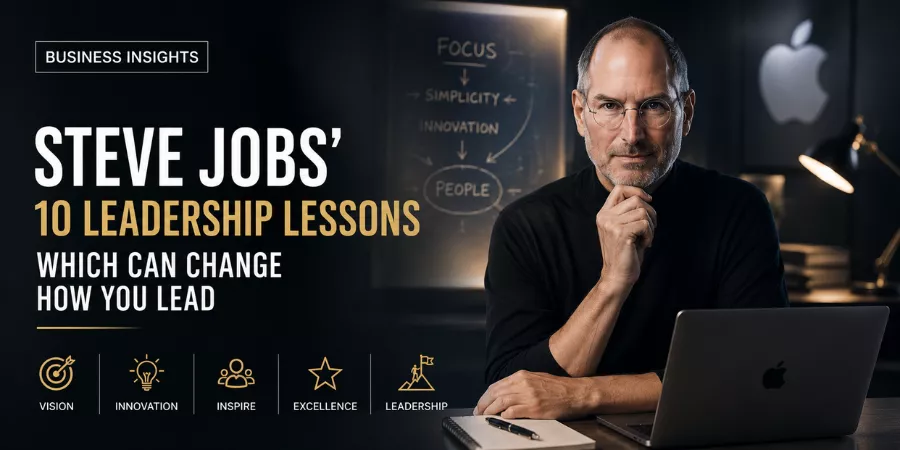
Steve Jobs’ leadership legacy comes down to 10 principles: focus relentlessly on what matters, simplify until it hurts, build teams of exceptional people, demand excellence in every detail, start with the customer experience, communicate vision so clearly people can feel it, challenge assumptions about how things are supposed to work, learn to say no as often as yes, anticipate what customers need before they can articulate it, and treat failure as curriculum rather than conclusion.
Steve Jobs’ career also proves that extraordinary results do not make every leadership behaviour worth importing into your own company.
Steve Jobs co-founded Apple in 1976, was pushed out in 1985, built NeXT, helped build Pixar into a studio that would sell to Disney for $7.4 billion, returned to Apple in 1997, and proceeded to launch the iMac, iPod, iTunes, iPhone, and iPad, products that reformed music, mobile computing, and retail. He died in October 2011 at 56.
The man who returned to Apple was not the same leader who left it. Understanding how he changed is more useful than simply cataloguing what he believed.
What Were Steve Jobs’ Most Important Leadership Lessons?
1. Focus on a Few Things Which Matter
When Steve Jobs returned to Apple in 1997, the company had dozens of products across multiple confusing product lines. He cut them to four. The decision was not driven by budget pressure, it was a philosophical position about where attention should go.
“Deciding what not to do is as important as deciding what to do,” Jobs said. He applied this to products, features, partnerships, and meetings.
The lesson for founders is very uncomfortable: most teams have too many priorities, which means they effectively have none. Focus is not a personality trait. It is a resource allocation decision made repeatedly, under pressure, against the instinct to say yes to good-sounding opportunities.
2. Make Simplicity a Leadership Discipline
The iPod launched in 2001 with a single scroll wheel and one thousand songs in your pocket. That simplicity was fought for internally against every engineer who wanted to add features and every product manager who wanted more options.
Simplicity, as Steve Jobs practised it, requires more decisions than complexity. Removing things is harder than adding them. The discipline shows up in product design but also in how Apple communicated, how it structured its retail stores, and how it ran its product line. Every unnecessary thing competes for attention with the things that matter.
3. Build Teams of Exceptional People
Steve Jobs spent extraordinary effort recruiting. His early partnership with Steve Wozniak gave Apple its engineering foundation. His later work with Jony Ive gave Apple its design identity. His willingness to recruit Jon Rubinstein, Tim Cook, and others during his return gave Apple the operational infrastructure it needed to scale.
The younger Jobs tried to control too much himself. The Jobs who returned had learned, partly from the failure of NeXT, that exceptional outcomes require exceptional people given real authority. He became a better delegator, not by loosening his standards, but by raising the bar for who he hired.
4. Demand Excellence in Every Detail
Steve Jobs famously cared about the inside of the original Macintosh’s circuit board, components customers would never see. He cared about the packaging. He cared about the font rendering on screen. He cared about the screws.
According to a 2011 Forbes profile, Jobs believed that the product experience extended to every surface, visible or not, because the people who made it would know. That belief produced extraordinary attention to manufacturing quality, retail design, and interface detail.
Demanding high standards from work is transferable. Humiliating people to get there is not. Jobs’ behaviour toward colleagues was frequently cruel. The standard is worth keeping. The method is not.
5. Start With the Customer Experience and Work Backwards
“You’ve got to start with the customer experience and work backwards to the technology,” Jobs said at the 1997 Apple Worldwide Developers Conference. He was explaining why Apple had cancelled several projects, not because the technology was wrong, but because it did not improve anything a real person actually needed to do.
This approach formed everything. Hardware and software were designed together. Retail stores were designed around the product experience rather than around conventional retail logic. Support was integrated. Packaging was considered part of the product.
6. Communicate Vision So Clearly People Can Feel It
Jobs’ product launches were not presentations. They were structured arguments about why something mattered. He would establish the problem, explain why existing solutions were inadequate, and then, after careful pacing, reveal the answer.
When he introduced the iPhone in 2007, he spent considerable time explaining why smartphones at the time were frustrating. The audience understood the problem before they ever saw the solution. That is not a presentation technique. It is a leadership skill, the ability to make other people care about the same things you care about.
A 2015 Forbes analysis of Jobs’ communication style noted that he consistently translated technical specifications into human consequences. Not “5 gigabytes of storage” but “one thousand songs in your pocket.”
7. Challenge Assumptions and Redefine the Rules
Steve Jobs did not usually try to beat competitors at their own game. He looked for ways to change what the game was.
The iPod entered a music market dominated by CD players and early MP3 devices. Apple did not build a better MP3 player. It built a complete music ecosystem, device, software, and store, at a time when the music industry was fighting digital distribution rather than enabling it. By 2010, iTunes had sold over 10 billion songs.
The iPhone did not compete with Nokia on call quality. It made the touchscreen interface the new basis of competition, at which point Nokia’s advantages became irrelevant.
How did Steve Jobs approach competition? He consistently looked for ways to change the basis of competition rather than outperforming rivals within categories they had already defined.
8. Learn to Say No (Repeatedly and Seriously)
Steve Jobs once told a graduating class that focus means saying no to a hundred other good ideas. This is harder to practise than it sounds because most organisations reward people for saying yes, for taking on more, shipping more, pursuing more.
Every yes consumes resources that cannot go somewhere else. Apple’s product line remained deliberately narrow even as the company grew into one of the most valuable businesses in history. That narrowness was a choice, made against constant pressure from partners, carriers, and internal teams who wanted more SKUs, more configurations, more features.
The discipline of saying no is not pessimism. It is resource management.
9. Build for What Customers Need Before They Know It
Steve Jobs was sceptical of conventional market research, not because customer insight was irrelevant, but because customers describe problems using the vocabulary of solutions that already exist.
“It’s really hard to design products by focus groups,” he told Business Week in 1998. “A lot of times, people don’t know what they want until you show it to them.”
The iPhone is the clearest example. In 2006, most mobile users believed they were satisfied with their phones. The problem Jobs was solving, a touchscreen computer that happened to make calls, was not a problem anyone had articulated. He was solving for a future behaviour pattern, not a current complaint.
This approach works when vision is combined with deep understanding of how people actually live. Jobs spent enormous time studying how people interacted with technology. His scepticism of research was not a rejection of customer understanding, it was a preference for observing behaviour over collecting stated preferences.
10. Learn From Failure and Change as a Leader
The first Apple era produced remarkable products and also produced a leader who was frequently difficult to work with, unwilling to listen, and prone to creating chaos. His departure from Apple in 1985 was partly the result of those tendencies. NeXT, for all its technical ambition, was a commercial failure, too expensive, too late, and too focused on Jobs’ aesthetic preferences over what customers would actually buy.
What Jobs brought back to Apple in 1997 was the vision, the standards, and the communication ability, plus something he had not carried in his first stint: the knowledge of what happens when those things are not matched by operational discipline and team trust.
His Steve Jobs transformational leadership style changed. He became more selective about which battles to fight, more willing to build around people who exceeded his own technical knowledge, and more focused on the customer outcome than the internal process.
What Leadership Style Did Steve Jobs Have?
Jobs’ leadership style combined elements of transformational leadership, inspiring people toward a shared vision, with intense personal control over product decisions, high-performance expectations, and selective but genuine delegation to people he trusted completely.
He was not a consistent leadership archetype. He was a leader who evolved, most visibly between his first departure and his return. The transformational leadership qualities, vision, communication, the ability to make people believe in an audacious goal, were present throughout. The management qualities improved with experience and, arguably, with failure.
The Steve Jobs Leadership Lesson Most People Get Wrong
What to carry forward from Jobs:
- Vision that is clear enough to guide decisions
- Focus maintained under pressure
- Standards defined around the customer experience
- Communication that connects technology to human consequence
- Willingness to make large, uncomfortable bets
- Talent recruited at the highest possible level
What not to carry forward:
- Public humiliation of colleagues
- Taking credit for others’ work
- Creating fear as a motivational tool
- Dismissing people whose technical depth exceeded his own
- Treating cruelty as a leadership style rather than a character flaw
The results Jobs achieved were real. The behaviour that accompanied them was frequently damaging to the people around him. Those two facts are both true, and any honest Steve Jobs advice before dying about leadership should acknowledge both.
What Can Modern Leaders Learn from Steve Jobs?
| Jobs’ Principle | Modern Application |
| Focus | Reduce the number of active priorities by half |
| Simplicity | Remove one layer of complexity from your product or process |
| Exceptional teams | Raise hiring standards; one A-player outperforms three average hires |
| Excellence in detail | Define what quality means specifically, not generally |
| Customer obsession | Map the complete customer journey, not just the product |
| Vision | Explain why the work matters before explaining what it is |
| Say no | Audit current commitments and eliminate the weakest ones |
| Challenge assumptions | Ask which inherited processes exist because they once worked, not because they still do |
| Future needs | Identify problems your customers have learned to tolerate |
| Learn from failure | Change strategy when evidence demands it, not when it becomes comfortable |
Frequently Asked Questions About Steve Jobs’ Leadership
What was Steve Jobs’ greatest leadership strength?
The ability to hold an ambitious vision of a product experience and communicate it clearly enough that exceptional people wanted to help build it. His product launches were studied for years afterward not as presentation technique but as examples of vision made tangible.
What were Steve Jobs’ biggest leadership weaknesses?
His treatment of colleagues was frequently cruel and sometimes publicly humiliating. He had difficulty acknowledging others’ contributions, took credit in ways that damaged relationships, and created a culture of fear alongside a culture of excellence. These are not small footnotes, they affected real people for years.
Why was Steve Jobs so focused on simplicity?
He believed complexity was the enemy of user experience. Every feature added to a product competes for a user’s attention. Every unnecessary option creates friction. Simplicity was not an aesthetic preference, it was a strategic position about where value actually lives.
Why did Steve Jobs value small teams?
Jobs believed that large teams diffuse accountability and slow decision-making. He preferred small groups of exceptional people with clear ownership. This belief shaped how Apple organised product development throughout his tenure.
How did being fired from Apple affect Steve Jobs as a leader?
It forced a confrontation with his own limitations. NeXT was commercially difficult precisely because Jobs’ instincts were not balanced by strong operational discipline or market feedback. By the time he returned to Apple, he had learned which of his instincts to trust and which ones needed to be checked by people around him.
What can CEOs learn from Steve Jobs in 2026?
Primarily: that focus is a competitive advantage, that vision without communication is irrelevant, and that the quality of a team determines the ceiling of what any organisation can achieve. Also: that the personality traits Jobs exhibited are separable from the leadership principles. The principles transfer. The behaviour does not have to.
Should leaders copy Steve Jobs’ management style?
No. Not entirely. The vision, focus, customer obsession, and communication are worth studying seriously. The management behaviour, the intimidation, the credit-taking, the public humiliation, produced real harm to people and is not a requirement for exceptional results. The Steve Jobs life lessons that transfer are the ones about strategy and standards, not temperament.