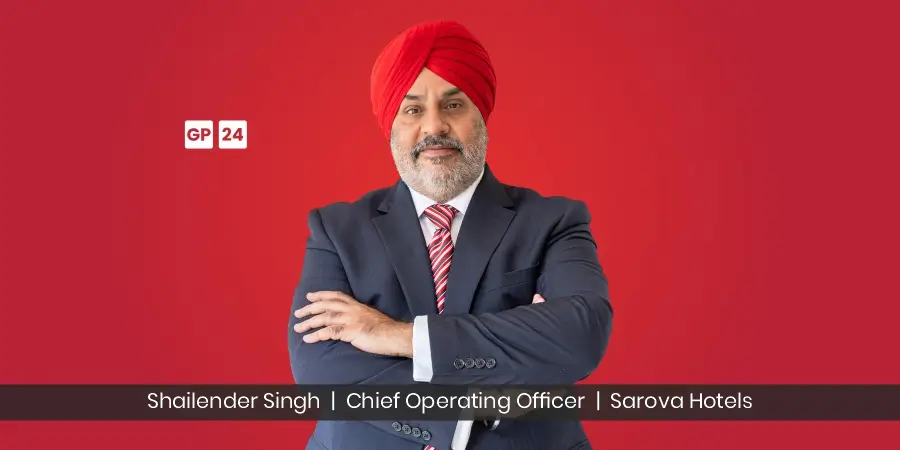
Every great kitchen has a pass. It is the narrow strip of counter where dishes pause for a final check before they leave the heat of the back of house and enter the world of the guests. For Shailender Singh, that invisible boundary has always been more than a physical space. It is where craft turns into experience, where standards turn into trust, and where what is written in a recipe becomes something guests remember.
He began his working life on the hot side of that pass, in the precise, high-pressure world of professional kitchens. Today, as Chief Operating Officer of Sarova, he stands at a very different kind of pass, one that connects business hotels and safari lodges across Africa, institutional hospitality and standalone food and beverage, and a growing home-grown brand that has learned to compete on a global stage while staying anchored in African realities.
His journey has never been a straight leap from kitchen to boardroom. It is a path that runs through years of training, countless service hours, and a deliberate choice to keep learning long after most people would have settled. The same discipline that once went into tempering chocolate and calibrating ovens now goes into building teams, designing systems, and shaping a culture that treats people, learning and sustainability as everyday disciplines rather than slogans.
From Kitchen Heat to Continental Horizons
Mr. Singh, also popularly known as Sheally, exudes a story that starts with professional craft, not corporate strategy. After completing his education in hotel management, he undertook a two-year Kitchen Executive training course at ITC Hotels, which was affiliated with the Paris School of Hotel Management. He started as a patissier, then moved into overall kitchen operations, and eventually became an Executive Chef with ITC Hotels in India, which is today affiliated with Marriott. During this period, Mr. Singh opened several award-winning restaurants, served many heads of state and managed prestigious events at the group’s top luxury hotels while honing his skills in international cuisines and food and beverage management.
After around fourteen years with ITC Hotels in different Indian cities, Mr. Singh moved to Southeast Asia as an Executive Chef with IHG. That role widened his exposure to new markets and new teams, and it eventually created the bridge that took him to Africa. About twenty years ago, he moved to Kenya to join Sarova Hotels, first as Group Corporate Chef, then as Group Director for Food and Beverage Operations, and now as Chief Operating Officer.
Looking back, he frames this not as a dramatic career twist but as a series of consistent choices. Each move opened a slightly wider field of responsibility. Each step took him a little further away from the stove and a little closer to the full canvas of hospitality operations. Over time, his vantage point shifted from plate presentation to brand reputation, from managing a brigade to shaping a company and influencing an entire regional industry.
People and Learning as The Core Recipe
If there is a single belief that runs through Sheally’s leadership, it is that hospitality is built on people before it is built on real estate or technology. He describes his core philosophy in two prongs. The first is that, in his words, “people are the most important aspect of a hospitality business and if we get our ability to create, manage, motivate and lead teams right, we can be a successful and differentiated hospitality business.” The second is that leaders have to keep learning and developing new skills, competencies and sometimes even behaviours if they want their teams to grow.
Mr. Singh applies that idea personally. Over the years he has invested in skill-based training across different aspects of operations and has completed management courses from universities such as Cornell. He has also made a habit of exposing himself to new products, experiences and trends through travel and meeting people. For him, staying relevant is not a one-time event. It is a professional discipline that mirrors the constant refinement of a menu.
At Sarova, this philosophy translates into visible structures. Sheally has strengthened an ethos of learning and development by introducing apprenticeship and structured kitchen and management training programs. He has also crafted exposure trips where chefs and managers travel to more developed markets to experience new trends and products first hand. These experiences do more than upgrade technical skills. They reinforce the idea that a career in hospitality can keep expanding, provided people stay open to learning.
A Humane Culture with A High-Performance Spine
When Mr. Singh joined Sarova, he found a work culture that felt familiar for all the right reasons. The founders had instilled a humane, family-oriented environment, and he recalls that it resonated deeply with him. Years later, he is pleased that the same spirit still runs through the company. His contribution has been to give that culture a sharper development edge without losing its warmth.
As Chief Operating Officer, he thinks about leadership in a highly competitive market through the lens of both people and performance. It starts with a clear view of where Sarova stands in the competitive landscape and a firm grasp of its differentiators and strengths. For the company, this has also meant entering new business areas such as institutional hospitality and standalone food and beverage, building on its established strengths in food and beverage.
Sheally then anchors that strategic intent in what he calls the people management cycle. This includes clear brand standards and standard operating procedures, unambiguous policies, appropriate training and development, reskilling and upskilling, effective communication, accessibility, empowerment and structured feedback and performance measurement systems.
In his view, effective leadership begins with having the right systems in place and then deploying them with objectivity, transparency and empathy, always guided by Sarova’s core culture and values to bring out the best in everyone.
Turning Culinary Excellence into A Growth Engine
When Mr. Singh joined Sarova as Corporate Chef, it was, in his own words, “a tremendous opportunity” to bring international expertise and standards in food and beverage to the group and to hospitality in Kenya more broadly. He began by upgrading restaurants, renovating kitchens and back areas, introducing HACCP and other international standards, developing vendors to supply new requirements and training people for what he describes as a new paradigm.
The results gradually reshaped both the business and the brand. Sarova reached a level where it became the official food and beverage provider for the State House, catering for Presidential functions, prestigious state visits and important corporate and other events. Mr. Singh’s endeavor has been to make Sarova known for its food and beverage experience in both business hotels and safari lodges. He notes that the culinary experience is not always seen as the primary differentiator in hospitality, yet in Sarova’s case it became a major driver of guest preference for the brand. Rooms and overall operational excellence complement culinary excellence, and together they give Sarova a distinctive position.
Within seven years of joining Sarova first as Corporate Chef and soon after as Group Director for Food and Beverage, the revenue contribution of food and beverage surpassed that of rooms revenue. That milestone became the first tangible recognition that Sarova’s food and beverage business had been established as a strong force in its own right. Traditionally, hospitality is rooms revenue driven. In Sarova’s case, food and beverage emerged as a twin engine for growth, with contribution margins higher than the norm and a significant influence on brand reputation in a dynamic business environment.
This impact extends beyond balance sheets. Many people who have worked with Mr. Singh at Sarova over the years now work with other companies and hotels across Africa and internationally. He sees them as powerful brand ambassadors for Sarova and is humbled when they acknowledge how their time with the company shaped them.
Operational Excellence Rooted in African Realities
Behind the guest experience that visitors see on property lies an operating model that Mr. Singh has helped refine into three interlocking elements. The first is a set of brand standards, standard operating procedures, policies and procedures that are designed specifically for Sarova.
These take local culture, market conditions, available resources and people skills into account while still aiming to deliver at a level expected by international and local guests. Sarova has its own definition of what makes for an exemplary guest experience in Africa, and its operational processes are uniquely Sarova while reflecting the African ethos.
The second element is backward integration. Sarova has built vendor development, local and international sourcing, warehousing and cold chain transportation into its operations with a strong focus on sustainability. The third is people development in all its forms, from apprenticeships to structured training and ongoing skills development. Taken together, these elements create an operating spine that supports the company’s growth into new business areas without losing control of quality.
Sheally’s early career challenges also influence how he leads operations today. Working in different parts of India, then in Southeast Asia and later in Africa, he had to learn to work with people from very diverse cultural backgrounds, ethnicities and nationalities. He points out that there are many subcultures in India alone and that each move exposed him to different ways of working and different expectations.
Over time, this taught him to respect differences, to understand that people are shaped by their cultures and to remain open minded and adaptable. That outlook is reflected in his leadership style and in Sarova’s emphasis on building systems that can flex around people rather than forcing them into rigid molds.
Sustainability As Everyday Discipline
For Mr. Singh and Sarova, sustainability is not a separate project. It is part of how the business is run. He states clearly that “Sustainability is integral to our business and something we take very seriously.” That statement shows up in practical measures across the portfolio.
Sarova has incorporated sustainable practices in all aspects of its operations. These range from reducing waste and recycling to avoiding single use plastic and using solar power. The company has invested in its own water bottling plants to avoid plastic bottle use, effluent treatment facilities at game lodges, organic gardens in almost all properties and composting of kitchen waste. It also prioritizes local sourcing and supports communities in all its locations.
Mr. Singh emphasizes that the company takes a long-term strategic view of sustainability. Sarova does not believe in cutting corners to save costs today. Instead, it chooses to invest now and do as much as possible to minimize impact. Over time, that stance has also been reflected in guest preference for the brand, as more travelers look for hospitality partners whose practices align with their values.
Leading Through Crisis and Guiding the Next Generation
Leadership is often tested most during downturns and industry shocks. Mr. Singh believes that “During challenging times, what works is clarity of vision and direction on how we will handle the crisis or challenge followed by transparent communication that fosters confidence.” In practice, this means involving teams in discussing solutions and arriving at consensus, particularly when hard measures are required. This approach allows Sarova to take necessary decisions without losing the trust of its people.
His advice to aspiring hotel leaders, especially those looking to make their mark in Africa, stays true to the themes that run through his own career. He notes that “One of the success factors I can share is that instead of simply adopting international brand standards make local culture and resources as the base to customize and create unique offerings.” He also encourages leaders to empower learning and support industry programs that mentor youth into hospitality and build skill levels to ensure business continuity.
For Mr. Singh, this is not purely theoretical. He has spent years building apprenticeship programs, training structures and exposure journeys precisely so that young professionals can see a future in the industry beyond their first role. In his view, a strong African hospitality sector depends on leaders who understand both international standards and local realities and who are committed to developing the next generation.
A Home-Grown Brand with A Global Vision
Looking ahead, Mr. Singh sees Sarova as a home-grown African brand with room to grow across the region and into adjacent business areas. The company has already created a niche for itself, and his vision is to continue that trajectory through regional expansion and new lines such as hospitality management for institutions, standalone food and beverage, wellness and meetings, incentives, conferences and exhibitions.
More broadly, he believes that hospitality in Africa is ready to move ahead from a traditional emphasis on leisure and wildlife and intra continental business travel. In his view, the continent can offer a unique destination for wellness and global business events, and these are the areas where he expects new growth to happen. He would also like to see more indigenous African hospitality brands gain global recognition. That aspiration connects back to his own work at Sarova, where the focus has been on creating distinctly African experiences that still meet international expectations.
Legacy Of a Chef in the Boardroom
When he reflects on his legacy, Sheally returns once again to the arc that took him from the kitchen to the boardroom. “My journey started as a Chef moving on to overall F&B operations from where I got involved with new areas such as projects and sourcing and now, I oversee all operations. It has been a journey that demonstrates the opportunities that the hospitality industry offers if you are passionate about your work and willing to take on new challenges.”
In 2013, Sheally received a lifetime achievement award from the then Minister of Tourism in Kenya for raising food and beverage standards in the country, mentoring his teams and inspiring youth. He has continued to build on that foundation and hopes he has inspired others to share the same passion for learning and for taking up new challenges.
Recognition on a magazine cover is gratifying for him, but he frames it as a shared achievement. On a personal level he is pleased, yet he is quick to point out that he has not reached this point through personal effort alone. He credits the teams and people he has worked with over the years and the support of his family.
In that sense, Shailender Singh’s story is less about a single individual and more about what can happen when a company bets on people, builds its own systems and standards, and chooses to treat learning and sustainability as core business practices. It is the story of a chef who never stopped standing at the pass, checking every plate before it goes out, even when the plate became a hotel, a brand and an entire African hospitality ecosystem.