AI has become the headline act in every strategy meeting. It promises reinvention, yet many leaders walk away more dazzled than informed. Boardrooms fill with competing pitches, teams juggle dashboards that no one fully trusts, and jargon quietly drowns out judgment.
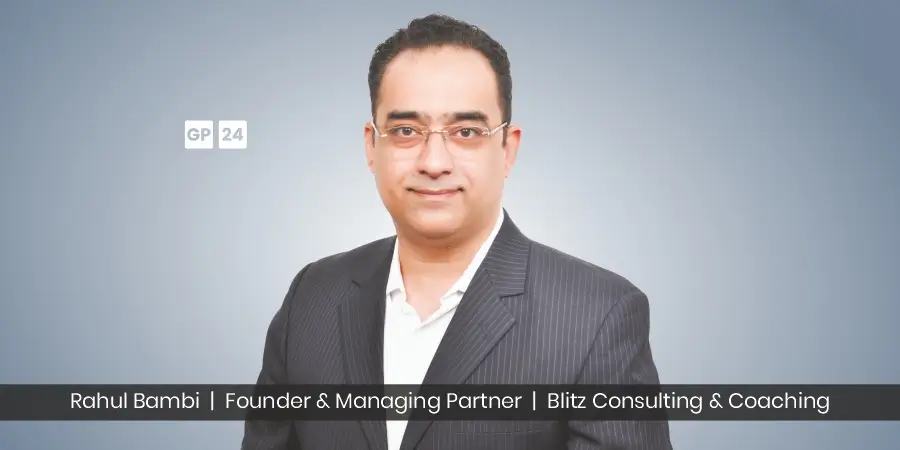
In that noise, Rahul Bambi, Founder and Managing Partner of Blitz Consulting & Coaching, has built his work around a simple conviction. Clarity is the highest form of intelligence, and trust is the most valuable currency in business. For him, AI is not a spectacle. It is a tool that must earn its right to exist every single day by serving people first and systems second.
From his vantage point, the world is standing at a critical threshold. The internet and smartphones democratized information. Generative AI and large language models are now democratizing knowledge. That shift can either deepen inequity and opacity or unlock a more inclusive, intelligent society. The difference, he believes, will be determined by whether leaders build AI that is responsible by design and human first at its core.
A Journey Across Industries and Data Dialects
Rahul did not arrive at AI through a purely academic path. His understanding of data, systems, and human behavior was forged in the field, across industries that rarely sit in the same room. Over the years, he has held roles in FMCG, real estate, media, telecom, technology, hardware, retail, and supply chain. Each sector spoke a different dialect of data. Together, they taught him that numbers are not abstract. They are stories about people, incentives, and trade-offs.
Early in his career at PepsiCo, he led a high performing sales’ team as one of the youngest leaders in that environment. It was an arena where frontline execution, territory realities, and disciplined measurement had to come together every day. Later, in telecom, he led an all-women product manager team at Idea. That experience reinforced his belief that diverse teams, trusted with real responsibility, can build more grounded, thoughtful solutions than any top-down directive.
In the media space, Rahul helped build advanced pricing and analytics systems. These were not vanity tools. They were designed to improve decision making by making complexity transparent and actionable. Across these roles, a pattern emerged. When data is treated as a checklist item, it adds noise. When it is embedded into clear, well-designed systems, it becomes a force multiplier for human judgment.
From Hype to Responsibility
Blitz Consulting & Coaching is an AI consulting and coaching firm focused on responsible, human centric adoption of artificial intelligence, helping enterprises design practical, trustworthy solutions that blend technology with business realities.
The inflection point that led Rahul to founding Blitz emerged around mid-2024. He saw two realities unfolding side by side. On one hand, AI models were becoming astonishingly capable. On the other, real-world performance inside enterprises often fell short of the promise. In many boardrooms and leadership conversations, he saw the same obstacles repeat. Confusion about what AI could truly do. Fear of being left behind. Myths and unrealistic expectations. Operational complexity that went unaddressed. High stakes investments made without an equally high investment in responsibility and human centric design.
Rather than treating this as a consulting opportunity alone, he decided to deepen his commitment to the field. He pursued a Doctorate in AI, not to collect a credential, but to bridge the gap between cutting edge developments and the practical realities of businesses and communities.
Rahul began to shape Blitz as an answer to a very specific question. How do you build an AI consulting and training firm that rejects hype, respects human intelligence, and treats trust and responsibility as non-negotiable design principles?
For Rahul, AI is not simply a technical revolution. It is a societal transition that requires new forms of leadership, new governance structures, and a shared understanding of what ethical power looks like in a digital age.
The Translator at The Table
Rahul believes that leadership in the AI era is less about control and more about context. The leaders who will matter most are not those who know every algorithm, or those who delegate every technical decision. They are the translators who can move fluently between technical, business, and human languages. They understand enough about neural networks, data pipelines, and architectures to ask the right questions. They understand enough about markets, risk, and operations to ground those questions in reality. Most importantly, they understand enough about people to anticipate resistance, fear, and the conditions necessary for genuine adoption.
In his view, the strongest leaders in AI driven environments display curiosity over certainty, vulnerability over hollow confidence, and passion over positional authority. They are willing to say, “I do not know yet, but I am willing to learn.” They frame AI not as a threat to human relevance but as an amplifier of human potential when used responsibly.
Human intelligence, Rahul emphasizes, is multi-dimensional. It includes empathy, moral reasoning, experiential judgment, and contextual awareness that no model can fully mimic. AI can augment this intelligence, never replace it. When organizations forget this, they build brittle systems that may be efficient in the short term yet fragile and risky in the long run.
Designing Responsible AI By Default
If there is one theme that runs through Rahul’s work, it is Responsible AI. For him, Responsible AI is not a slogan, or a voluntary add on. It is the foundation on which every meaningful AI initiative must stand. He defines it as the practice of designing, building, and deploying AI systems that are safe, ethical, trustworthy, and aligned with societal and community goals. These systems must respect fairness, reliability, transparency, and accountability, not only in theory but in daily operation.
He often uses a simple litmus test. If a model decision hurt someone you know, would you still be comfortable deploying it? If the answer is no, then the system has not been designed responsibly enough to deserve real world power.
Rahul has taken this commitment beyond client work. He has submitted a detailed report on Responsible AI to the Institute of Directors. He has submitted a technical paper to the AAAI community. He has written about integrating Responsible AI into enterprise risk management frameworks, arguing that AI risks should sit alongside financial, operational, and strategic risks at the board level. In all of these contributions, the message is consistent. Responsible AI is a discipline, not a checkbox.
Ethics Engineering and The Four Checkpoints
For Rahul, one of the most dangerous risks in AI is opacity. As models become more capable and systems more complex, decision paths often become harder to trace. That opacity is not only a technical concern. It creates an ethical blind spot. When organizations deploy AI in hiring, lending, healthcare, or public services without fully understanding its behavior, unintended discrimination can scale faster than it can be detected.
He believes that the world is on the cusp of a new discipline. Ethics engineering. In this discipline, ethical foresight is not an afterthought or an external audit. It is built into the design and implementation of systems from the very beginning. Every decision about data, models, and workflows is tested against questions of harm, fairness, and long-term social consequences.
At Blitz, this philosophy is embedded in what he calls a “Responsible by Design” framework. It rests on four practical checkpoints. First, data provenance. Teams must know where data comes from, how it was collected, and what biases or gaps it may carry. Second, model explainability. If a model cannot be explained in language that business leaders can understand, it is not ready for high stakes use.
Third, human oversight. People remain responsible for critical decisions and must have the tools and authority to override automated outputs when needed. Fourth, outcome auditability. Organizations must be able to trace and audit decisions after the fact, especially in domains that affect lives and livelihoods.
These checkpoints are aligned with evolving frameworks and regulations such as India’s Digital Personal Data Protection Act, the EU AI Act, and the NIST risk management framework. Yet Rahul insists that Compliance is the floor, not the ceiling. True responsibility begins where legal obligations end, in the space where organizations choose to do more than the minimum because they value trust.
AI For Public Good and A Viksit Bharat
Rahul’s vision for AI is not confined to corporate boardrooms. He situates his thinking in the wider context of India’s journey toward Viksit Bharat. He sees AI as a public good that should function more like electricity or clean water than an exclusive advantage for a few. The question, therefore, is not only how businesses can gain competitive advantage, but also how AI can strengthen the foundations of healthcare, education, energy, and public infrastructure.
India has already demonstrated how digital infrastructure can transform everyday life. Aadhaar reshaped identity verification, and the UPI payments revolution changed how millions transact. Rahul believes AI can create a similar leap, but only if it is designed for India’s diversity and complexity rather than imported as a generic model.
He points to possibilities such as district level forecasting for agrochemical stock, which can help minimize waste and better target distribution for farmers. Similar forecasting can support healthcare systems, where predicting demand for critical medicines and supplies can mean the difference between scarcity and timely care. He is also deeply interested in how AI can accelerate the renewable energy transition, from optimizing grids and storage to modeling demand and supply patterns at a granular level.
Blitz is exploring applications across MSMEs, renewable energy, and other domains where AI can be a force for resilience. Rahul’s ongoing research includes authoring a book on AI in the context of renewable energy, with a focus on making AI impactful, greener, and a genuine ally of energy transition instead of an overlooked source of new consumption and emissions.
Human First, Technology Next
Inside Blitz, every AI initiative starts with a human need, not a technology pitch. The first questions are always about pain points, sub optimal processes, and ineffective execution. The team asks who is struggling today, where friction exists, and what a better reality would look like for people on the ground. Only after that context is clear do they explore models, architectures, and tools.
Rahul is blunt about his view on hype driven projects. Vanity deployments, fear of missing out programs, and AI projects launched for headlines rather than impact are not aligned with Blitz’s ethos. For him, technology is an enabler. It takes its shape and meaning from the human and institutional intentions that wield it.
This philosophy translates into a set of leadership principles for AI adoption. Simplify before scaling. Measure what matters, not what flatters. If a solution cannot be explained to a ten-year-old, it is not ready. Favor processes and people over unnecessary sophistication and buzzwords. Above all, keep humans first and technology next.
Within projects, Blitz practices maker-checker reviews of AI pipelines to ensure that outputs are thoroughly examined and validated before they are trusted at scale. The team runs “Foresight Workshops” with clients to simulate the social and economic consequences of decisions under different scenarios. These sessions explore who benefits, who might be harmed, and what unintended ripple effects a decision could create. It is a disciplined attempt to look around corners before committing to a path.
Building an Ecosystem of Simpler Intelligence
Rahul’s leadership does not stop at client engagements. Throughout his journey in sales, digital systems, and AI frameworks, mentorship has been an invisible signature. He has invested in communities that bring together students, founders, and professionals who want to understand AI without being intimidated by it. In these spaces, he focuses on simplifying complex concepts, translating theory into practice, and helping people see where AI genuinely fits into their lives and work.
Blitz is being built as more than a consulting firm. It is evolving into an ecosystem that includes communities, academies, mentoring programs, masterclasses, whitepapers, and guest lectures. Corporate training and advisory work are important pillars, but they sit alongside a broader mission. To make AI simpler, more pragmatic, and truly responsible for as many people as possible.
The philosophy is captured in a line that runs through everything Rahul and his team do. AI Simplified, Zero Hype, 100% Impact. It is both a promise to clients and a standard against which they judge their own work.
Looking Toward 2030
When Rahul looks ahead to 2030, he sees several trends that will define the next chapter of AI. One is agentic AI, where systems can act with greater autonomy based on high level goals. He has submitted a chapter to an upcoming global book, exploring how such agents can be designed and governed in ways that remain aligned with human values and organizational objectives.
Another is the rise of AI governance at the board level. In his writing on integrating Responsible AI into enterprise risk management, he argues that AI decisions cannot sit in isolation within technology or innovation teams. They carry strategic, reputational, and societal implications that demand oversight at the highest levels. Boards will increasingly need to develop AI literacy and governance structures that match the power of the tools they approve.
He also foresees a future where Domainized AI becomes the norm. Instead of generic, all-purpose models trying to solve every problem, sector specific models tailored to domains such as healthcare, energy, finance, or logistics will dominate. His own work on AI and India’s energy transition is an example of that focus, connecting deep domain understanding with technical capability and ethical foresight.
Legacy, Advice, and Momentum
For entrepreneurs entering AI and consulting today, Rahul’s advice is grounded and direct. Start small, stay real, and scale fast only after proving genuine value. Focus first on local problems you can see and touch. Learn to listen to people who live with those problems every day. Do not chase every shiny tool or trend. Chase problems that matter to customers and communities.
He challenges founders to ask a hard question of their own work. If a sophisticated AI pipeline does not change the experience or outcomes for real people, what is it really worth? In his view, the answer is often less than the marketing suggests. He reminds leaders that clients are not only buying a solution or a slide deck. They are buying the brand, the confidence, and the trust that the team behind that solution will be there when it matters.
Rahul hopes his legacy will be simple and substantial. If one generation of leaders can make AI decisions, they are proud of, decisions that they would be comfortable explaining to their children, then his work will have been worthwhile. He wants to be remembered for making AI simpler, more pragmatic, more responsible, and more human centered.
Being featured as a leading AI voice is, for him, both humbling and energizing. He often says that “Awards recognize moments, Impact recognizes momentum”. The recognition around his work and Blitz is not a finish line. It is a checkpoint that reminds him and his team of the responsibility they carry. To keep building AI that serves people, strengthens institutions, and honors the trust that others place in their judgment.
While the world is rushing to automate everything, Rahul Bambi has chosen a slower, more deliberate path. One where clarity replaces noise, ethics shape architectures, and human intelligence remains the north star that every algorithm must learn to follow.