
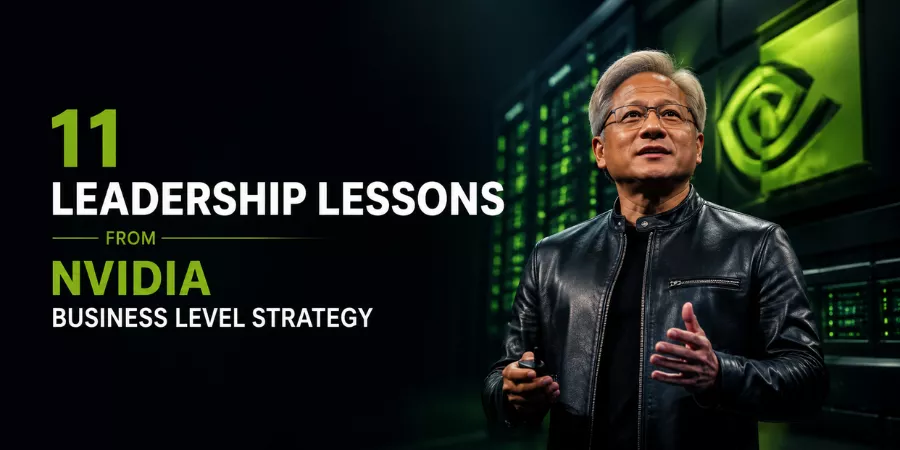
In 1993, three engineers started a company to make graphics chips for video games. 30 years later, that company became the first in history to cross a $5 trillion market cap, according to Axis Intelligence.
For the full fiscal year 2025, NVIDIA posted $215.9 billion in revenue, a jump of 65% from the prior year. Just three years ago, the company’s annual net income was $4.4 billion. In its most recent quarter, it generated that same amount in less than 10 days.
That is what happens when a long-term strategy finally meets the moment it was built for.
The NVIDIA business level strategy is studied in business schools, quoted by investors, and copied, unsuccessfully, by competitors. Below is what it actually teaches, through Jensen Huang’s own words and decisions.
What this article covers:
- 11 leadership lessons from NVIDIA’s rise
- A direct Jensen Huang quote grounding each lesson
- FAQs on NVIDIA competitive advantage, business model, and leadership style.
What is NVIDIA’s Business Level Strategy?
Before the lessons, the foundation matters.
NVIDIA’s business level strategy rests on three pillars:
| Pillar | What It Means |
| Platform over product | Build an ecosystem, not just a chip |
| Developer-first | Win the people who build things |
| Long-term bets | Invest before markets become obvious |
Jensen Huang described the CUDA X library ecosystem as NVIDIA’s “crown jewel,” calling it one of the company’s most significant strategic investments and an insurmountable moat against competitors. Everything else in the NVIDIA success story follows from that single strategic choice.
Below are the 11 Leadership Lessons from NVIDIA Business Level Strategy
1. Build for the Future Before the Market Demands It
Jensen Huang’s words: “The future doesn’t wait for anyone.”
NVIDIA’s AI strategy was not a pivot. It was a two-decade setup. Years before AI became the headline story, Huang made a decision that looked questionable, doubling down on GPUs when they seemed niche. There was no guarantee, no applause, no immediate payoff. Just a signal.
When the smartphone boom exploded, everyone expected NVIDIA to chase it. Instead, the company stepped away and focused on building the architecture for accelerated computing. At the time, it looked like walking away from a huge opportunity. Years later, that decision placed NVIDIA at the center of the AI wave.
Leadership lesson from Jensen Huang: Invest before demand becomes obvious. The best bets rarely look obvious when you make them.
2. Create an Ecosystem Instead of Selling Products
Jensen Huang’s words: “The single most important thing for any processor is getting adoption by software developers.”
“CUDA is a rich ecosystem. If you want to build on any computer first, building on CUDA first is incredibly smart. Because the ecosystem is so rich, we support every framework… The combination of the richness of the ecosystem, the expansiveness of the install base, and the versatility of where we are makes CUDA invaluable.” — Jensen Huang, Dwarkesh Podcast, April 2026
This is the heart of the NVIDIA competitive advantage. Competitors copied chips. Nobody could copy the ecosystem. Over 5 million developers worldwide use CUDA for AI development. All the code they have written is locked into NVIDIA’s ecosystem, switching to AMD or another vendor means the entire codebase needs to be rewritten. At large AI labs, the cost of that migration often runs into hundreds of millions of dollars.
Leadership lesson from Jensen Huang: Own the platform. Products get copied. Ecosystems compound.
3. Make Developers Your Most Powerful Salespeople
Jensen Huang’s words: “My goal is to create the conditions where amazing people come to do their life’s work.” — Jensen Huang, via Antoine Buteau
NVIDIA outlined its unique flywheel effect: a unified architecture amasses a vast installed base, which attracts developers; those developers create breakthrough applications; those applications open new markets; and those new markets further expand the installed base, the entire cycle is now accelerating.
When developers are drawn to your platform, the companies are not far behind. NVIDIA took a major bet on nurturing an strong ecosystem with programs such as the NVIDIA Developer Program and the GPU Technology Conference, which is a yearly gathering of developers, researchers, and industry leaders that has turned into almost a rite of passage for the field itself.
Leadership lesson from Jensen Huang: Developers are not a support channel. They are a distribution channel. Treat them that way.
4. Stay Exceptionally Good at One Core Strength
Jensen Huang’s words: “Smart people focus on the right things.”
NVIDIA never tried to become everything. It became the world’s best at accelerated computing and built everything else around that. Estimates from TrendForce (2024) put NVIDIA’s share at 80% to 95% of the market for AI accelerators. That dominance did not come from spreading thin. It came from going deep.
NVIDIA’s gross margins sit around 75% to 80%, numbers that reflect what happens when you lead a category rather than compete inside one.
Leadership lesson from Jensen Huang: Depth beats distraction. Becoming the best at one thing is more defensible than being decent at 10.
5. Think in Decades, Not Quarters
Jensen Huang’s words: “Lead with urgency, but never lose sight of the long-term vision.”
Annual R&D expenses for fiscal year 2025 were $12.914 billion, a 48.86% increase from 2024. That is not a company optimising for the next earnings call.
The acceleration from FY2023 to FY2024 was the steepest single-year revenue jump on record for any company in the S&P 500. Every dollar of that growth traces back to investments made years before they paid off.
This is the NVIDIA growth strategy in its simplest form: plant seeds before others see the soil.
Leadership lesson from Jensen Huang: Long-term R&D is not a cost. It is compounding interest on future market leadership.
6. Expand Into Adjacent Markets Without Losing Identity
Jensen Huang’s words: “It’s very clear that AI is going to impact every industry.”
NVIDIA’s expansion followed a clear logic, always from existing strength:
| Market Entered | Foundation Used |
| Data centers | GPU compute from gaming |
| AI training | Data center infrastructure |
| Automotive (DRIVE) | AI compute and sensor processing |
| Healthcare & robotics | AI platform and simulation tools |
NVIDIA’s automotive sales reaching the $2.35 billion mark in FY2026 will serve initially as a revenue line for its DRIVE platform which will grow by 39% per year. As for the NVIDIA ecosystem strategy, it is no coincidence. It consists of moving into targeted areas adjacent to the business without making a sudden change. It goes for markets where the current platform offers a major competitive edge instantly.
Leadership lesson from Jensen Huang: Expand from strength, not from trend-chasing. Adjacent markets are won with existing moats, not new ones.
7. Make Difficult Strategic Bets and Commit to Them
Jensen Huang’s words: “I think that’s what’s thrilling about leadership, when you’re holding onto literally the worst possible hand on the planet and you know you’re still going to win.”
Huang bet NVIDIA’s future on GPUs becoming the backbone of AI computing, a decision met with skepticism. AI was still nascent, the risks were enormous, yet Huang’s conviction was unshaken.
In 2003, at a Stanford talk, he explained that large companies should “keep it simple” with confined project scopes for flawless execution, iterating toward long-term vision.
Strategy requires choosing a direction and accepting the tradeoffs that come with leaving other opportunities behind. Half-committed bets rarely pay off. NVIDIA’s leadership strategy has always been about picking the right hill and refusing to leave it.
Leadership lesson from Jensen Huang: Bold decisions are not reckless. They are the cost of staying relevant.
8. Build Competitive Moats That Are Hard to Copy
Jensen Huang’s words: “If we didn’t create it, nobody would.” — Dwarkesh Podcast, April 2026
In a wide-ranging interview, Huang detailed how NVIDIA’s ecosystem, spanning hundreds of millions of deployed GPUs, the CUDA software stack, and deep supply chain partnerships, creates a compounding moat that competitors have failed to breach despite significant investment.
NVIDIA’s moat is not a single-point advantage, but a self-reinforcing flywheel. The greater the downstream demand, the more willing the upstream supply chain is to invest; the thicker the ecosystem, the less willing developers are to migrate; the faster algorithm innovation moves, the higher the value of programmability.
NVIDIA’s competitive strategy is not built on one thing. It is built on five things that reinforce each other:
- Software (CUDA, CUDA-X libraries)
- Hardware (H100, Blackwell architecture)
- Partnerships (every major cloud provider)
- Developer community (5 million+ active developers)
- Continuous research (new architecture every two years)
Leadership lesson from Jensen Huang: One moat is copyable. 5 interlocking moats are not.
9. Learn Faster Than Your Competitors
Jensen Huang’s words: “Never stop asking questions and seeking answers. Curiosity fuels progress.”
Inside NVIDIA, strategy shows up in daily behavior, not just slide decks. Jensen reads hundreds of short “Top Five Things” emails each day, where employees share what they are working on, what they are noticing, and what they are learning. Those messages act as a live view of how well the long-term vision is translating into action.
He also looks for what he calls Early Indicators of Future Success, signals that work is unlocking something important, long before revenue confirms it.
This is what sets the NVIDIA case study apart from most business stories. The company does not just move fast. It learns fast. Those are different things.
Leadership lesson from Jensen Huang: Build systems that surface learning early, not after results arrive.
10. Keep Reinvesting After You Win
Jensen Huang’s words: “The buildout of AI factories, the largest infrastructure expansion in human history, is accelerating at extraordinary speed.” — Statista, May 2026
NVIDIA expects revenue of $91 billion for the current quarter, representing a 95% growth rate. At that scale, most companies would slow down on R&D and protect margins. NVIDIA accelerated investment.
By comparison, Apple took 18 years to grow from $5 billion in annual profit to $112 billion. Microsoft took 27 years. NVIDIA hit that milestone in under three years.
The NVIDIA business model rewards continuous reinvestment. The companies that stop investing after winning are the ones that eventually get disrupted by the companies that did not.
Leadership lesson from Jensen Huang: Market leadership is a starting point for the next bet, not a reason to slow down.
11. Stay Curious as a Leader
Jensen Huang’s words: “Clarity of purpose is the foundation of great leadership.” — AI Gift / Alibaba
Jensen Huang’s leadership philosophy is characterised by a flat management structure, continuous learning, intellectual honesty, leading by example, first-principles thinking, open communication, and a balance of empathy with high expectations.
He has 60 direct reports and does not do one-on-one meetings, by design. This approach ensures that information flows freely and everyone works from the same context.
NVIDIA’s culture places strong emphasis on learning and executive engagement with AI adoption. Huang himself stays deeply involved in the technical details of the company’s products, not because he has to, but because curiosity is how he spots what is coming next.
Leadership lesson from Jensen Huang: Leadership is not about having all the answers. It is about asking better questions than anyone else, consistently, over years.
What Every Business Can Learn from NVIDIA’s Strategy
| Lesson | Practical Takeaway |
| Build before demand | Invest in what the market will need, not what it wants now |
| Ecosystem over product | Platform stickiness outlasts any single product cycle |
| Developer community | People who build with your tools become your biggest advocates |
| Long-term R&D | Compounding investment beats reactive spending |
| Adjacent expansion | Grow from strength, not from trend-chasing |
| Reinvest after winning | Market leadership is the start of the next bet |
Industry analysts predict the global AI hardware market will reach $341 billion by 2032, according to Allied Market Research (2025), with NVIDIA expected to retain leadership through 2030.
NVIDIA became successful because it spent years building the technology, ecosystem, culture, and leadership discipline that positioned it to benefit when AI demand accelerated. The timing looked lucky from the outside. From the inside, it was preparation, 30 years of it.
That is the real NVIDIA success story, and the most transferable lesson for any business leader watching it unfold.
FAQs
What is NVIDIA’s business level strategy?
NVIDIA’s business level strategy is built on platform ownership, developer ecosystem investment, and long-term bets on emerging compute markets. Rather than selling chips, NVIDIA built the infrastructure, hardware, software, and community, that AI runs on.
Why is NVIDIA so successful?
NVIDIA posted $215.9 billion in revenue in FY2025, a 65% jump from the prior year. That success traces back to two decades of early AI investment, CUDA ecosystem building, and a leadership culture that reinvests aggressively rather than protecting margins after winning.
What is NVIDIA’s competitive advantage?
NVIDIA’s competitive advantage spans hundreds of millions of deployed GPUs, the CUDA software stack, and deep supply chain partnerships, a compounding moat that competitors have failed to breach despite significant investment.
What leadership style does Jensen Huang use?
Huang uses a flat management structure with radical transparency, first-principles thinking, and direct engagement across all levels of the organisation. He prioritises continuous learning over hierarchy and long-term vision over short-term results.
What companies can learn from NVIDIA?
Any company building a product can learn from NVIDIA’s ecosystem strategy, own the platform, invest in the people who build on it, and reinvest after winning rather than slowing down.
How did NVIDIA become an AI leader?
By investing in CUDA a decade before AI went mainstream, building a developer community that became the default for AI research, and expanding into adjacent markets from a position of hardware and software strength.
What makes NVIDIA different from AMD and Intel?
AMD’s MI-series GPUs have long suffered from hardware without ecosystem, and that is the true reason NVIDIA maintains an 80% share in the AI accelerator market. AMD and Intel compete on chip specs. NVIDIA competes on infrastructure.