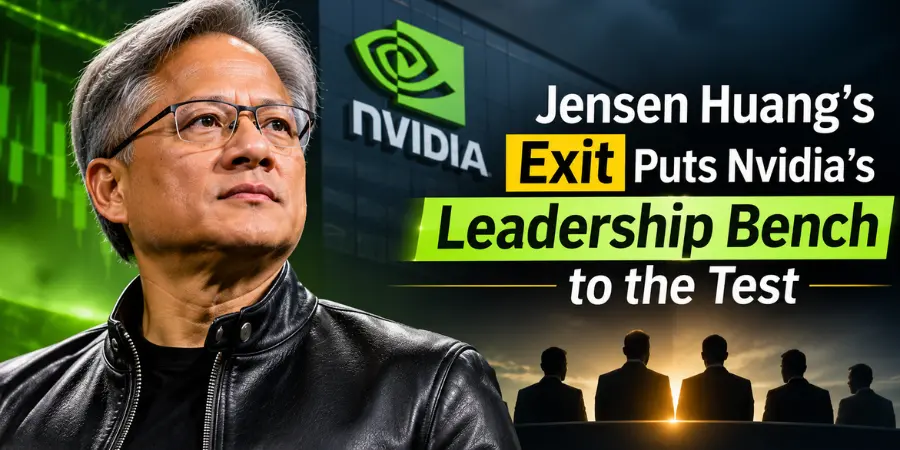
The departure of Nvidia’s co-founder after 33 years places succession planning, corporate governance and leadership continuity under scrutiny at a defining moment for the AI chipmaker.
Jensen Huang’s exit is the resignation of Nvidia’s co-founder as president and chief executive officer after 33 years with the company. It puts the “leadership bench” to the test, which is the group of executives and directors prepared to run a company when its top leader leaves. Nvidia’s board accepted the resignation effective immediately on November 12, named Chief Financial Officer Colette Kress as interim CEO, and appointed longtime director Harvey C. Jones as the company’s first-ever board chair.
The short answer for anyone trying to understand where Nvidia stands is this. The company has a functioning leadership team, but it has no permanent CEO, no announced timeline for finding one, and a CFO who now holds two senior jobs. Its next earnings report arrives on November 17.
Huang’s departure follows mounting scrutiny over reported personal relationships, allegations involving a business executive suspected by US officials of having links to Chinese intelligence, and questions about the company’s business dealings in China. For an organisation at the centre of the global artificial intelligence industry, the immediate challenge is to keep the confidence of employees, customers, investors and government stakeholders while its leadership structure changes.
The article below set out what happened, who holds authority now, and which signals will show whether Nvidia’s succession planning holds up.
How Did the Controversy Reach Nvidia’s Boardroom?
The controversy reached Nvidia’s boardroom through a series of reports about Huang’s personal relationships and the company’s dealings in China, and each report added pressure on the board to act.
The developments drew wider attention in late October, when reports linked Huang to Alice Huang, a former executive at Megaspeed, a Singapore-based company that purchased Nvidia chips. The two share a surname but are not related. US intelligence officials reportedly suspected Alice Huang of having connections to Chinese intelligence and of gathering information that could influence Nvidia’s position on technology exports to China. Nobody has established these allegations as fact.
On November 8, Huang acknowledged being unfaithful to his wife in a message to Nvidia employees. He apologised to his family and colleagues and said he would cooperate with an independent investigation started by the company’s board. The board stated at the time that it had no reason to believe Nvidia’s confidential information or national security interests had been compromised, although the inquiry was meant to examine all available information.
Later reporting raised additional allegations involving another Nvidia executive, which increased scrutiny of the company’s internal governance and executive conduct.
| Date | Event |
| Late October | Reports link Huang to Alice Huang of Megaspeed |
| November 8 | Huang acknowledges infidelity and agrees to cooperate with the board’s independent investigation |
| November 12 | Board accepts his resignation, names Kress interim CEO and Jones board chair |
| November 17 | Third-quarter fiscal 2027 results and earnings call, scheduled for 2 p.m. PT |
One detail deserves attention because many summaries leave it out. According to Nvidia’s Form 8-K filed with the SEC on November 12, Huang left the board of directors as well as the executive roles. The company therefore lost its founder from both management and the boardroom on the same day.
Can Colette Kress Take Charge During a Critical Transition?
An interim CEO is an executive who runs a company for a limited period while the board looks for a permanent leader. Kress is well placed for that role, but the arrangement has limits that the board has not yet explained.
Kress steps into the position after more than 13 years as Nvidia’s CFO. She joined the company in September 2013, having held senior finance positions at Microsoft and Cisco, with earlier experience at Texas Instruments. Her appointment gives investors and business partners continuity at a time when Nvidia needs to show that its operational priorities have not changed.
Jones, a board member since 1993 and a former CEO and executive chairman of the chip-design firm Synopsys, said in the filing that the board has “full confidence” in Kress and the existing leadership team.
Kress will keep her CFO responsibilities while serving as interim CEO. The board has said it will consider both internal and external candidates for the permanent role, and the filing sets no deadline for that search.
In my assessment, a finance chief is a sensible steward for the first few weeks, because the early demands are guidance, investor questions and customer reassurance. The dual role becomes harder to defend if the search runs for months. The finance function needs a full-time leader during a period of heightened scrutiny, and the interim CEO’s attention will be divided between the two jobs.
Huang’s departure matters so much because of how closely he was tied to Nvidia’s product strategy, industry relationships and public advocacy for accelerated computing. He spoke for the company in discussions with policymakers, technology firms and investors. The board now has to show that Nvidia’s institutional capabilities extend beyond one person’s leadership.
Why Does the Leadership Change Matter Beyond Nvidia?
The leadership change matters beyond Nvidia because semiconductor technology now sits at the point where economic competitiveness, national security and international trade meet, and Nvidia supplies the chips that drive the AI industry.
Nvidia’s relationship with China has been especially sensitive. Huang has repeatedly argued that American semiconductor companies should keep access to the Chinese market, and he has warned that restricting sales could push Chinese competitors to build their own alternatives.
The reported connection to Alice Huang has drawn fresh attention to the company’s customer relationships and to the strength of the safeguards around advanced chip distribution. Nvidia has previously said that it follows applicable US export-control requirements, and the independent board investigation will be central to answering questions about executive conduct, business relationships and possible exposure to sensitive information.
My own analysis points to a less obvious risk, which I call founder-attached policy. This is any strategic position that people identify with one individual and that no board document has formally recorded. China export advocacy is one example. Open-source strategy is another. Huang was Nvidia’s most visible champion of open-weight AI, a position linked to the company’s Nemotron model family and to its pending acquisition of the open-model hub Hugging Face, which TechCrunch has reported at $12.9 billion.
TechCrunch framed his exit as an open question for Nvidia’s open-source posture, because the advocacy belonged to Huang personally and not to a published board policy. Neither Kress nor Jones addressed open-source strategy in the filing, and the Hugging Face deal has not closed. Developers who build on Nvidia’s open models have only a general assurance of continuity for now.
The change also puts more responsibility on the board. Its decisions must address shareholder confidence, regulatory expectations and the need for a credible long-term leadership structure. Creating a dedicated board chair on the same day as the CEO change gives that effort a visible owner, and it also means the company never had a separate chair before this week.
Is Leadership Continuity the Next Test?
Leadership continuity is the ability of a company to keep its strategy, customer commitments and execution steady while the person at the top changes. For Nvidia, it is the next test, and the first public checkpoint comes within days.
The company has said that operations and product plans will continue without interruption under Kress and the existing leadership team. It will report third-quarter fiscal 2027 results on November 17 at 2 p.m. PT, which gives the interim leadership an early chance to state its priorities to investors.
Four signals will show how well the transition is going:
- The search timeline. A stated timeframe, or a clear statement on internal versus external candidates, would show that the board has a plan.
- The chair’s role. Published governance changes, such as how the board and the investigation will report, would show what Jones’s new position means in practice.
- The tone on export controls. Any statement on the November 17 call about China sales and compliance will show whether the policy outlasts its most vocal advocate.
- The Hugging Face deal. Progress toward closing, or a delay, will show whether Huang’s open-model strategy continues unchanged.
The longer-term question concerns succession. Nvidia’s rise shows how much influence a founder-led organisation can carry, but the current transition shows why leadership depth, independent oversight and clear succession arrangements matter just as much.
Jensen Huang’s departure does not erase the business he helped build. It does create a new test for the organisation, which must show that its strategy, culture and technological ambitions can stay steady through a change at the very top. For other technology leaders, the episode shows that corporate leadership carries responsibilities beyond business performance. Executive accountability, board independence and succession preparedness are what allow an organisation to sustain its success.