Choosing between an LLC, an S Corporation, and a C Corporation is one of the biggest financial decisions a small business owner makes. The short answer: most small businesses save the most with an LLC taxed as an S Corp once profits pass roughly $60,000 to $80,000 per year. Below that level, a standard LLC is usually simpler and cheaper.
Here is how each structure works, what it costs in taxes, and when switching makes sense.
How Each Structure Is Taxed
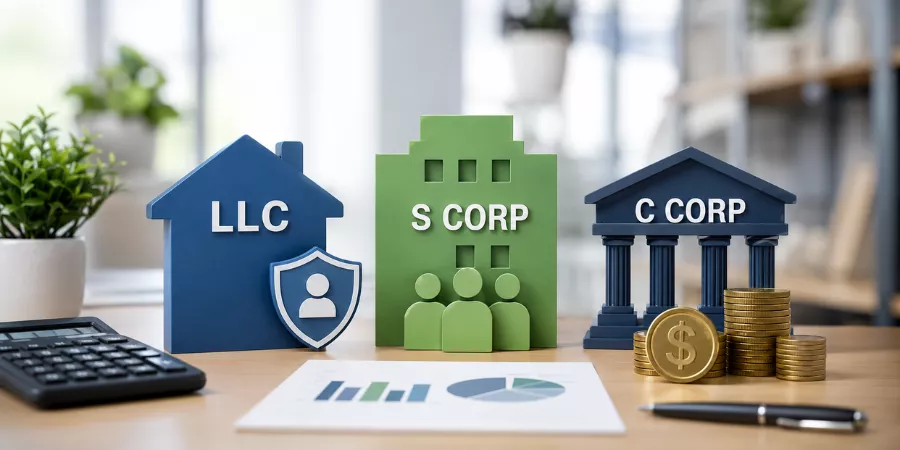
LLC (default taxation). A single-member LLC is taxed like a sole proprietorship. All profits pass through to your personal return. You pay regular income tax plus self-employment tax of 15.3% on the full profit. That self-employment tax covers Social Security and Medicare.
S Corporation. An S Corp is also a pass-through entity, so there is no corporate-level federal income tax. The difference is how owners get paid. You take a reasonable salary, which faces payroll taxes, and the remaining profit comes as a distribution that avoids the 15.3% self-employment tax. This split is where the savings live. The IRS explains the rules on its S corporations page.
C Corporation. A C Corp pays a flat 21% federal corporate tax on profits. If the company then pays dividends to owners, those dividends are taxed again on personal returns. This is the double taxation problem. C Corps make sense mainly for startups raising venture capital or businesses reinvesting heavily instead of distributing profits.
A Simple Example of the Tax Difference
Imagine your business earns $120,000 in profit.
As a standard LLC, the full $120,000 faces self-employment tax. That is roughly $18,360 in self-employment tax before income tax even begins.
As an S Corp, suppose you pay yourself a reasonable salary of $65,000 and take $55,000 as a distribution. Payroll taxes apply only to the salary. The distribution escapes the 15.3% tax, saving you roughly $8,000 per year compared with the standard LLC.
As a C Corp, the company pays 21% on profits, and you pay tax again on any dividends. For a small owner-operated business that distributes its earnings, this usually costs more than either pass-through option.
When a Standard LLC Is the Right Choice
A standard LLC wins when your profit is modest or unpredictable. If you earn under about $60,000, the S Corp savings often disappear into payroll costs, bookkeeping fees, and a separate tax return. An accountant, payroll software, and compliance work can easily cost $2,000 to $3,000 per year.
The LLC also offers maximum flexibility. There are no ownership restrictions, no required payroll, and minimal paperwork.
When the S Corp Election Saves Real Money
The S Corp election becomes attractive when three things are true. Your profit consistently exceeds $60,000 to $80,000. You can justify a reasonable salary below your total profit. And you are willing to run formal payroll.
One key point many founders miss: you do not need to form a corporation to get S Corp taxation. An LLC can simply file Form 2553 with the IRS and elect to be taxed as an S Corp. You keep the LLC’s legal simplicity while gaining the tax benefit.
The IRS does watch salary levels. Paying yourself $20,000 while taking $150,000 in distributions invites an audit. Your salary must match what similar professionals earn for similar work.
When a C Corp Makes Sense
C Corps fit a narrow but important group. Venture capital firms almost always require a Delaware C Corp before investing. Businesses planning to retain large profits inside the company can benefit from the flat 21% rate. And C Corps can offer Qualified Small Business Stock treatment, which may allow founders to exclude significant capital gains when they sell, subject to holding period and other requirements.
For a local service business, agency, or e-commerce store, the C Corp usually creates more tax cost and paperwork than benefit.
Ownership and Restriction Differences
S Corps come with strict rules. They allow no more than 100 shareholders, all must be US citizens or residents, and only one class of stock is permitted. LLCs and C Corps have no such restrictions, which is why foreign founders and venture-backed startups avoid the S Corp.
Which Should You Choose?
Start with profit level. Under $60,000, keep a standard LLC. Between $60,000 and $80,000, run the numbers with an accountant. Above $80,000 in steady profit, the S Corp election usually pays for itself many times over. Raising venture capital, choose a Delaware C Corp from day one.
Tax rules change and every situation differs, so confirm your choice with a CPA before filing. The right structure, chosen early, can save a small business tens of thousands of dollars over just a few years.