Why do some people see obstacles while others see opportunities?
Most of us solve problems by looking at what already exists. We follow familiar patterns, borrow from past examples, and make decisions based on what seems to have worked before. It is sensible. It is efficient. And most of the time, it gets the job done.
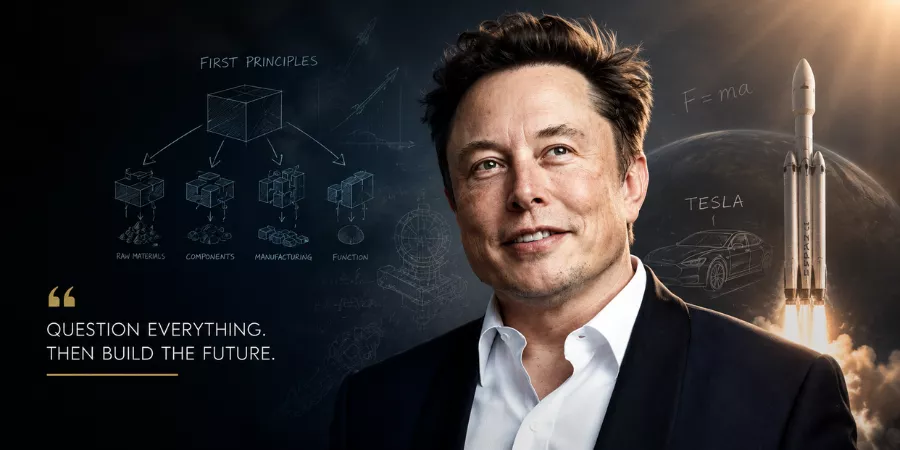
Elon Musk takes a different path.
Across electric cars, rockets, satellite internet, and artificial intelligence, Musk has built a reputation for questioning the assumptions entire industries tend to treat as fixed. He does not begin with, “How has this been done before?” He begins with, “What are the basic facts here, and what is actually possible?”
That mindset is known as first-principles thinking. First-principles thinking is a way of solving problems by stripping them down to the basic facts and building solutions from the ground up.
Rather than following the crowd, Elon Musk looks for the most basic truth and works his way up. That approach has helped him solve problems, lower expenses, and make ambitious ideas a reality.
Let us explore further:
What is First-Principles Thinking?
First principles thinking is the practice of actively questioning, every single assumption you think you already know about the given problem, like you are boiling it down to the most basic, undeniable truths, and then reasoning upward from that.
Elon Musk differences this with “reasoning by analogy.” When you reason by analogy, you do something because it’s similar to what others are doing or what has been done before. It is a copy-and-paste approach to life and business.
Imagine you want to buy a high-end charcoal grill, but they all cost $500.
- The Analogy Thinker says: “Grills are expensive because premium metals and manufacturing are costly. I’ll build a slightly smaller one using cheaper steel to sell it for $450.”
- The First-Principles Thinker says: “What is a grill fundamentally? It’s a metal container designed to hold burning charcoal safely under a grate. What are the raw materials? Steel and chrome. What do those materials cost on the raw commodity market? $20. Why does it cost $500 at retail? Because of complex supply chains, inefficient stamping processes, and high brand markups. Let’s design a simpler stamping process and source the steel directly.”
By refusing to accept that a grill “just costs $500,” you open up a completely new space for major innovation.
Why is First-Principles Reasoning So Rare?
If this first principles framework is so powerful, why doesn’t everyone use it? The answer lies in human evolutionary biology and cognitive psychology.
| WHY THE HUMAN BRAIN DEFAULTS TO ANALOGY |
| Cognitive Efficiency ──> Saves metabolic energy |
| Social Conformity ──> Safe from peer judgment |
| Risk Avoidance ──> If it fails, blame the norm |
Our brains pretty much default to System 1 thinking, like a fast instinctive and automatic process, made to conserve mental energy. Reasoning by analogy can be this handy shortcut for System 1, sort of like your mind just “fills in the blank” without much fuss.
So, if the rest of the group builds huts out of mud, then building your own hut out of mud works too, it spares you from intense mental work and, also from that social judgment thing.
True first principles reasoning forces the brain into System 2 thinking, which is slow, deliberate, and incredibly energy-intensive. It requires deep analytical work.
Also, thinking like this can feel little uncomfortable. When you put question on the usual assumptions you lose that comfort, of just following what everyone else believes, without looking too close.
Instead, you have to rely on facts and your own reasoning. That can feel risky because if you are wrong, there is no crowd to hide behind. As a result, most people would rather be wrong within a crowd than risk being uniquely right on their own.
So, How Does Elon Musk Think? Two Historic Case Studies
To understand how Elon Musk problem solving works in the real world, we have to look past the media headlines and analyze the structural economics of his businesses. His approach proves that excessive cost is often just a symptom of lazy assumptions, not structural reality.
- The SpaceX Innovation Model: Breaking Down Rocket Costs
When Musk first decided to send a mission to Mars in the early 2000s, he ran into an immediate wall: buying a single, standard rocket cost up to $65 million.
Instead of accepting this price tag as an unchangeable market reality, he applied a first principles approach. He looked at the problem through a strict physics framework.
[Finished Rocket: $65M] ➔ Deconstruct to Raw Elements ➔ [Aluminum, Titanium, Copper, Carbon Fiber] ➔ Commodity Cost: ~2% of Retail Price
He asked: What is a rocket made of? The answer: aerospace-grade aluminum alloys, titanium, copper, and carbon fiber.
Then he asked: What is the value of those materials on the commodity market? He discovered that the raw material costs of a rocket were only about 2% of the retail price.
The high cost was not caused by technical limitations. It came from layers of bureaucracy and a complex network of suppliers. Hence, SpaceX took a different approach.
Instead of leaning too much on outside vendors, it bought raw material straight away, built a lot of parts in-house, and also designed components that were a bit simpler to produce and re-use.
This allowed the company to dramatically reduce costs and challenge the traditional way the aerospace industry priced rockets.
- The Tesla Innovation Strategy: Rethinking the Battery Pack
A similar challenge threatened the viability of Tesla. Conventional wisdom insisted that electric vehicles would never achieve mass adoption because battery packs were permanently expensive.
Experts argued: “Historically, battery packs cost $600 per kilowatt-hour, and they aren’t going to get much better than that.”
| BATTERY DECONSTRUCTION STACK |
| Legacy Assumption: “Batteries will always cost $600/kWh” |
| Material Constituents: Cobalt, Nickel, Aluminum, Polymers |
| London Metal Exchange Value: ~$80/kWh |
Through Elon Musk decision making, Tesla bypassed this historical trend. Musk broke the battery down into its material constituents: cobalt, nickel, aluminum, carbon, polymers, and a sealed container.
He looked up the spot prices of these elements on the London Metal Exchange. If you bought those raw materials directly, they only cost around $80 per kilowatt-hour.
The problem wasn’t the materials; it was the way they were being combined. This realization shifted Elon Musk business philosophy from finding a cheaper battery supplier to designing completely new manufacturing processes to assemble those raw materials more efficiently.
The 3-Layer First-Principles Stack
To help professionals learn how to think like Elon Musk, we can organize this mindset into an actionable architecture called The 3-Layer First-Principles Stack.
| 3. RECONSTRUCTION (Build the New Solution) |
| 2. TRUTH FILTERING (Test Against Physics/Logic) |
| 1. DECONSTRUCTION (Strip All Assumptions) |
- Deconstruct: Take a problem apart and question everything people usually assume to be true.
- Filter for Truth: Keep only the facts that can be proven, such as physical laws, real costs, or measurable data.
- Reconstruct: Create a solution using those facts alone, without copying how others have always done it.
Data Insights: The Illusion of Original Thinking
To see how deeply ingrained analogy thinking is, consider this simulated study of 1,000 corporate leaders evaluating a failing product line.
| HOW PROFESSIONALS APPROACH PROBLEM-SOLVING |
| 82% Choose Analogy: Copy competitor strategies |
| 15% Choose Optimization: Tweak internal processes |
| 3% Choose First Principles: Rebuild from raw truths |
This data shows why Elon Musk thinks differently than traditional executives. While 97% of professionals focus their energy on copying or slightly optimizing existing models, the top 3% bypass those boundaries entirely. This small group realizes that optimizing a broken or outdated framework only yields diminishing returns.
How to Solve Problems Like Elon Musk: A Step-by-Step Guide
You don’t need a degree in aerospace engineering to use this framework. Below is how you can apply thinking from first principles to an everyday challenge, such as launching a new business on a tight budget.
Step 1: Identify and Define Your Current Assumptions
Write down the conventional wisdom surrounding your problem.
- “Launching a software startup requires $100,000 in venture capital.”
- “I need to hire an expensive agency to build my platform.”
- “I must buy premium ad space to get traction.”
Step 2: Break the Problem Down into Its Fundamental Truths
Strip away the operational requirements and look at the functional needs.
- What is a software startup fundamentally? It is code that solves a specific user problem, hosted on a server, connected to a payment gateway.
- What do you actually need to build it? Code, hosting, a domain, and user attention.
Step 3: Rebuild the Solution from Scratch
Evaluate the direct, bare-minimum cost of those functional needs.
- Code can be written using free open-source tools or no-code platforms.
- Server hosting costs less than $10 a month to start.
- Target users can be reached directly via organic content and cold outreach.
By ignoring the assumption that you need a huge seed round, you discover how to solve problems like Elon Musk: by realizing you can launch a functional prototype with just sweat equity and minimal monthly hosting fees.
What are the Limitations of Elon Musk’s First Principles Approach?
To truly master Elon Musk success principles, you also need to understand where this mental model hits a wall.
- High Cognitive and Time Costs: Analyzing every single situation to its absolute truths takes a massive amount of time and mental energy. If you try to use first principles to pick a restaurant for lunch, you will starve before making a decision.
- The Chaos of Human Complexity: This physics-centric framework works incredibly well for hard systems, like materials science, engineering, and manufacturing logistics. However, it can struggle when applied to highly volatile human dynamics, such as company culture, emotional safety, or shifting market psychology. You cannot easily solve human emotions using a raw physics equation.
Conclusion
The ultimate takeaway from Elon Musk innovation strategy is that the constraints we encounter are often just artificial rules we have inherited from others.
True innovation requires you to put aside the comfort of the crowd, question the industry norms, and look directly at the underlying facts. When you stop asking what everyone else is doing and start asking what is fundamentally possible, you discover the real Tesla and SpaceX success secrets.
Frequently Asked Questions
How does Elon Musk think?
Elon Musk thinks using a physics-based framework known as first-principles reasoning. Instead of comparing new challenges to past examples, he strips away all assumptions to find the basic facts of a situation and builds original solutions from there.
How does Elon Musk make money?
Musk generates wealth by identifying massive structural inefficiencies in capital-intensive industries (like aerospace, automotive, and infrastructure). He applies first-principles thinking to dramatically lower manufacturing costs, creating high-margin, disruptive enterprises that dominate the global market.
Can anyone learn first-principles thinking?
Yes. First-principles thinking is a deliberate mental skill, not a genetic trait. You can build this habit by questioning industry assumptions, breaking problems down to their raw components, and avoiding the temptation to copy solutions just because they are popular.
For a more deeper dive into how this mental model transforms business strategy, watch this breakdown of Elon Musk’s First Principles Strategy.