You spent hours writing a detailed article. You checked the facts. You formatted it well. And it still sits on page four.
Meanwhile, a thinner piece from a competitor ranks above it. No better information. No stronger argument. Just more visible proof that someone credible wrote it.
That is the E-E-A-T problem in a sentence. Google does not just reward good content. It rewards content that looks credibly created, by someone who demonstrably knows their subject, on a site that has earned trust over time.
According to Google’s own documentation, their systems focus on the “Who, How, and Why” of your content, who created it, how it was produced, and why it was made. Most content fails not because the information is wrong, but because there is no visible proof that the right person wrote it.
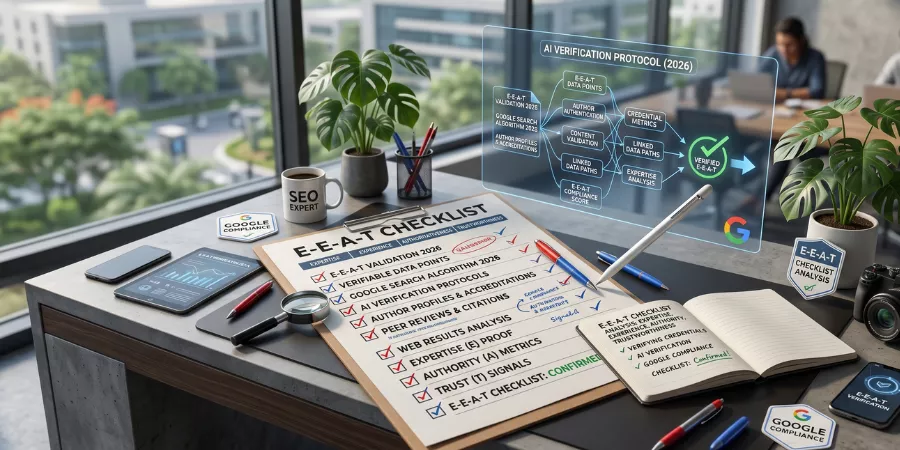
This article gives you a working E-E-A-T checklist you can use before publishing anything.
5 things to know right now:
- E-E-A-T stands for Experience, Expertise, Authoritativeness, and Trustworthiness.
- It is a quality evaluation framework, not a single ranking signal.
- The strongest trust signal is a real author with a real, verifiable background.
- Google rewards content that answers clearly, cites sources, and proves firsthand knowledge.
- Trust is the most important pillar, untrustworthy pages have low E-E-A-T regardless of how experienced or authoritative they may otherwise seem.
What E-E-A-T Means?
E-E-A-T is Google’s framework for evaluating whether content is genuinely good, not just keyword-rich.
- Experience means the author has actually done the thing they are writing about. A review from someone who bought and used the product carries more weight than one written from a product description.
- Expertise means the author understands the topic at a professional or deep level. A financial article written by a certified planner signals expertise. A health article written by a practicing doctor signals expertise. A marketing article written by someone who has managed real campaigns signals expertise.
- Authoritativeness means the website and its authors are recognized as reliable sources within their niche. Other credible sites link to them. They are mentioned in industry publications. Their content is consistent and topically focused.
- Trustworthiness means the site is honest, transparent, accurate, and safe. Google added the extra “E” for Experience to the existing E-A-T framework in December 2022 to better evaluate the authenticity of content, distinguishing theoretical content from content based on concrete real-world experience.
These 4 signals work together. You cannot compensate for weak trust with strong expertise. They all have to be present.
Why Google and AI Systems Look for Proof
Here is the core issue. Search quality raters are trained to understand if content has strong E-E-A-T, and they do this using criteria outlined in Google’s Search Quality Rater Guidelines. Their evaluations are used to help train and refine Google’s search algorithms.
That means E-E-A-T signals do not just affect how humans perceive your content. They shape how algorithmic systems are trained to rank it.
AI summarization tools, including Google’s AI Overviews, face the same challenge. They need to pull answers from reliable sources. AI Overviews and other AI-powered summaries look for clear, structured, fact-based answers. Content structure matters, clear headings and lists are what these systems actually read.
So the question is always: what proof can a machine or a human verifier actually find on your page?
The Full E-E-A-T Checklist for Content That Looks Credible
This is the practical section. Work through each area before you publish.
Show Who Wrote the Content
This is the single most common E-E-A-T failure. Pages either have no author, a vague “editorial team” credit, or a bio that says nothing useful.
| What to Include | Why it is Important |
| Real full name | Makes the author verifiable |
| Relevant credentials or title | Signals subject matter expertise |
| Brief bio tied to the topic | Shows firsthand context |
| Link to author page or LinkedIn | Enables off-page verification |
| Photo | Increases trust with human readers |
Google wants to know: Who created this? Their systems look for name, photo, position, a short bio with qualifications and experience, and links to social profiles or other publications.
A bio that says “Jane writes about health topics” tells Google almost nothing. A bio that says “Jane is a registered dietitian with 12 years of clinical experience who has contributed to three peer-reviewed journals” tells Google a great deal.
Prove Firsthand Experience
This is the newest and increasingly important part of the E-E-A-T checklist. Google evaluates experience by asking whether the author has real-world interaction with the topic they are writing about.
A product review from someone who has actually used the device includes more valuable detail than text based solely on a press release.
Ways to show firsthand experience:
- Include original screenshots, results, or photos from your own work.
- Share specific outcomes with numbers (“I tested this tool for 60 days and saw X result.”)
- Reference actual client work or case studies with named outcomes.
- Describe mistakes or unexpected findings, generic content never includes these,
- Use before-and-after comparisons that only someone with real experience would know.
Vague claims like “this strategy works great” signal nothing. Specific observations like “after using this approach on three different client accounts over six months, we saw an average 34% increase in organic traffic” signal real experience.
Use Strong Sources
Unsupported claims are one of the fastest ways to weaken your E-E-A-T signals. Every factual claim should have a source.
Source quality hierarchy:
| Source Type | Strength |
| Primary research (your own data) | Strongest |
| Government or official documentation | Very strong |
| Peer-reviewed academic studies | Very strong |
| Industry reports from recognized firms | Strong |
| Established trade publications | Moderate |
| Blog posts without attribution | Weak |
Use citations inline. Link directly to the source, not a page that links to the source. And when you reference a statistic, name who produced it. Ahrefs studied 600,000 pages and found a near-zero correlation (0.011) between AI content and ranking penalties, that is how a credible citation looks. It names the source, the sample size, and the specific finding.
Make Trust Visible
Trust signals are easy to overlook because many of them feel like housekeeping. They are not.
Trust checklist:
- All factual claims are accurate and verifiable
- Statistics include the year and source
- Medical, legal, or financial content includes an expert review note
- Content has a visible last-updated date
- The site has a clear About page with real company or team information
- Contact information is present and functional
- Disclaimers are included where content could be misapplied
- The site has a privacy policy and terms of service
A YMYL page with weak expertise or trustworthiness signals is not just a content problem, it is a potential safety issue, and Google treats it accordingly. YMYL stands for Your Money or Your Life: any content touching health, finance, safety, or legal topics. If your content falls into those areas, the trust checklist becomes non-negotiable.
Build Authority Over Time
Single pages do not rank on authority. Sites and authors do.
What authority looks like:
- You consistently publish on the same topic cluster, not random subjects
- Other credible sites link to your content naturally
- You are mentioned or quoted in industry publications
- Your author page shows a track record of relevant work
- Your internal links connect related articles in a meaningful way
Topical authority matters. Google evaluates author and content expertise through signals including author bios, links to verified sources, and the author’s presence in professional communities.
A site that publishes three strong articles a month on a narrow topic builds more authority than one that publishes 30 scattered articles covering different industries.
Reduce Doubt
This is the checklist item most writers skip. Strong E-E-A-T content does not just make claims, it shows how conclusions were reached.
How to reduce doubt:
- Explain your methodology, even briefly (“I analyzed 50 support tickets to identify the most common issue.”)
- Acknowledge limitations or caveats where they exist
- Define technical terms the first time you use them
- Show your reasoning, not just your conclusion
- Include counterpoints or alternative perspectives where relevant
- Use examples that are specific, not hypothetical
Generic content sounds polished but proves nothing. Content with visible reasoning sounds like someone who actually thought it through.
How to Make Expertise Easy for Google and AI to Verify
Structure matters as much as content. A page that contains strong E-E-A-T signals but buries them in unstructured text will still underperform.
Structural signals that help both Google and AI systems:
| Element | What It Does |
| Clear H1, H2, H3 hierarchy | Helps machines parse topic structure |
| Author schema markup | Connects author identity to content |
| Article schema | Signals content type and publication date |
| Breadcrumb navigation | Establishes topical context |
| Internal links to related content | Shows topical depth |
| Outbound links to credible sources | Signals trust and transparency |
| FAQ section | Directly surfaces for AI Overviews |
Schema markup is underused. Adding Person schema to your author page, Article schema to your posts, and FAQ schema to question-based sections gives Google structured data it can verify against other signals. It is not a ranking hack, it is a verification shortcut.
What are the Common E-E-A-T Mistakes That Destroys the Rankings?
Most of these are fixable within an hour per article once you know what to look for.
Mistake 1: Generic author bios: “The editorial team” or “a content writer” signals nothing. Google has no way to verify expertise from a vague credit line.
Mistake 2: Unsourced statistics: Claiming “70% of customers prefer personalized experiences” without a source is worse than not using the stat at all. It actively reduces trust.
Mistake 3: Thin content with no proof: A 500-word article that covers a complex topic at surface level signals either low effort or low knowledge. Neither helps rankings.
Mistake 4: Overstated claims: Phrases like “the best strategy ever” or “guaranteed to work” flag content as untrustworthy. Real expertise includes nuance.
Mistake 5: No editorial accountability: Health and finance articles with no mention of expert review or professional credentials look irresponsible to Google’s quality systems.
Mistake 6: Content that sounds polished but proves nothing: The most common problem is that AI-assisted content fails E-E-A-T not because it was produced by AI, but because it is generic, covering the same ground as hundreds of other pages without adding original insight, scenarios, or expertise. That applies to human-written content too.
E-E-A-T Checklist by Content Type
The E-E-A-T standards vary depending on what you are publishing.
Blog Posts
- Named author with relevant background
- Firsthand examples or original data
- Sources cited for any factual claims
- Updated date visible
Health Content
- Author credentials prominently displayed (MD, RN, RD, etc.)
- Medical review noted by a qualified professional
- Links to clinical sources (NIH, Mayo Clinic, peer-reviewed studies)
- Clear disclaimer about seeking professional advice
Finance Content
- Author with financial credentials or professional background
- Sources from recognized financial institutions or regulators
- Clear disclosure of any affiliations or conflicts of interest
- Content reviewed by a qualified financial professional
Product Reviews
- Proof the reviewer actually used the product (photos, specific observations, usage period noted)
- Honest discussion of limitations alongside positives
- No incentive disclosure hiding in fine print, state it clearly
B2B Thought Leadership
- Author’s professional title and company context
- Specific data, outcomes, or case studies from real work
- Original perspective, not just a summary of industry news
Local Service Pages
- Named team members or practitioners
- Local credentials, licenses, or certifications
- Real customer testimonials with verifiable details (first name, city, service used)
Practical Examples: Weak vs. Strong E-E-A-T Content
Vague claim vs. verified claim:
- Vague: “Studies show that personalization increases revenue.”
- Verified: “According to McKinsey’s 2024 personalization report, companies that excel at personalization generate 40% more revenue than average competitors.”
Generic bio vs. credibility-rich bio:
- Generic bio: “Sarah writes about digital marketing topics.”
- Credibility-rich bio: “Sarah is a senior PPC strategist with nine years of experience managing Google Ads accounts across B2B SaaS and e-commerce. She has managed over $4 million in annual ad spend and contributes regularly to Search Engine Land.”
Surface commentary vs. firsthand expertise:
- Surface commentary: “AI tools can help with content creation.”
- Firsthand expertise: “After running a six-month test using AI drafting tools on our blog, we found that articles with human editorial review and original data added performed 3x better in organic traffic than raw AI drafts published without modification.”
The difference in each case is specificity. Anyone can write the first version. Only someone with real experience can write the second.
Does Google Rank AI Content Lower?
This is one of the most searched questions in SEO right now. The direct answer is no.
Google evaluates AI-generated content using the same quality signals as human-written content. Their systems focus on rewarding helpful, reliable, people-first content regardless of whether it was produced by humans or AI. The Ahrefs study of 600,000 pages found a near-zero correlation (0.011) between AI content and ranking penalties.
Can Google detect AI-generated content? Yes, Google has detection technology, but Google does not use detection for ranking purposes. Their policy explicitly focuses on content quality rather than how content was produced.
Is Google penalizing AI-generated content? Google penalizes low-quality content, not AI content. The penalty is for the output, not the tool. Content created for ranking manipulation, content without original value, and content that fails E-E-A-T standards get penalized, whether a human or an AI wrote them.
The March 2026 core update data shows that websites relying on generic AI output without human editorial oversight saw traffic drops between 60% and 80%, while websites using original data saw a 22% increase in visibility. The pattern is clear: AI assistance is fine. AI as a replacement for human expertise and original thought is not.
Final E-E-A-T Audit Checklist
Copy this and run it before every publish.
Author & Identity
- Real author name visible on page
- Author bio is specific and relevant to the topic
- Credentials or lived experience mentioned
- Author page or LinkedIn linked
- Author schema markup added
Experience Proof
- Original examples, screenshots, or data included
- Case study or personal observation referenced
- Specific numbers or outcomes mentioned
- Limitations or caveats acknowledged
Source Quality
- Every factual claim has a source
- Sources are named (not just hyperlinked)
- Sources are primary or high-authority
- Statistics include year and origin
Trust Signals
- Accurate and up-to-date information
- Last-updated date visible
- Disclaimers present for YMYL content
- Expert review noted (for health/finance)
- Contact and About information accessible
Authority Signals
- Article fits a consistent topic cluster
- Strong internal links to related content
- External links to credible sources
- Content would be recognized as authoritative in the niche
Structure for Verification
- Clear heading hierarchy (H1, H2, H3)
- FAQ section included where relevant
- Schema markup added (Article, Person, FAQ)
- Page loads fast and is mobile-friendly
Frequently Asked Questions
What is an E-E-A-T checklist?
An E-E-A-T checklist is a set of quality signals that confirm your content demonstrates Experience, Expertise, Authoritativeness, and Trustworthiness, the four criteria Google uses to evaluate content quality through its quality rater framework.
How do you show expertise on a website?
You show expertise through named authors with relevant credentials, specific examples from real work, accurate sourcing, and consistent publishing in a defined niche. A detailed author bio with verifiable professional background is the fastest single improvement most sites can make.
What does Google look for in expert content?
Google looks at who created the content, how it was produced, and why it was created. Signals include author credentials, firsthand examples, citation of credible sources, transparency about methodology, and consistency of topic coverage.
How can AI systems verify credibility?
AI tools, including Google’s AI Overviews, pull content from pages that are clearly structured, factually cited, and authored by identifiable people or organizations. FAQ sections, schema markup, clear headings, and sourced claims all make it easier for AI systems to extract and surface your content.
What are the strongest trust signals for SEO?
The strongest trust signals include a named and credentialed author, accurate sourced statistics, an expert review note on YMYL content, a visible last-updated date, transparent About and contact information, and consistent niche-specific publishing history.
Does E-E-A-T directly improve rankings?
E-E-A-T is an evaluation framework, not a direct ranking factor. But it shapes how Google’s algorithms are trained through quality rather than feedback. Content that consistently demonstrates strong E-E-A-T signals earns higher positions over time because those signals correlate with what Google’s systems are trained to reward.
Does E-E-A-T matter more for certain topics?
For YMYL topics, health, finance, safety, and since September 2025, elections and civic institutions, every element of E-E-A-T becomes critical. A YMYL page with weak expertise or trustworthiness is treated as a potential safety issue by Google’s systems.
Conclusion
Expertise is not something you claim in a headline. It is something you prove across every paragraph, every source, every author credit, and every specific example you include.
The E-E-A-T checklist exists because Google’s systems, and the human quality raters who train those systems, need visible evidence that your content comes from someone who actually knows the subject. A well-structured, clearly sourced, credibly authored article does not just rank better. It earns the kind of trust that keeps readers coming back.
Go back through your top ten pages right now. Run them against this E-E-A-T checklist. Most will have at least three items missing. Fix those, and you will see the difference.