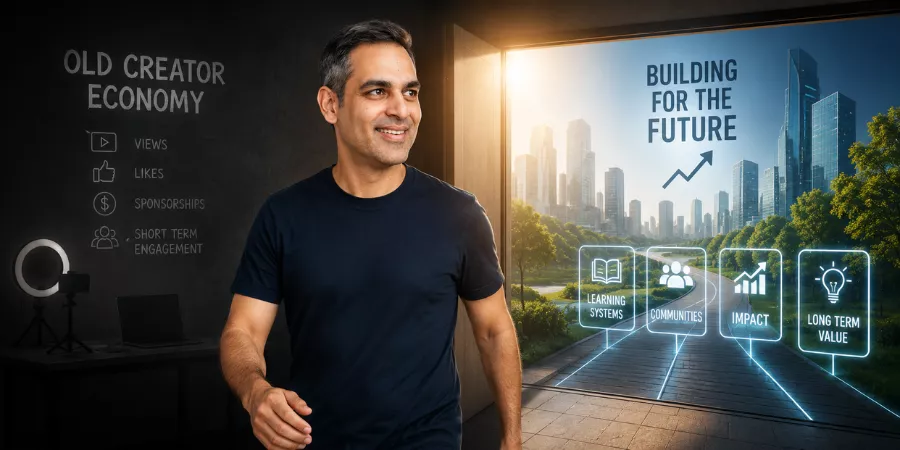
Ankur Warikoo shut down a ₹100 crore course business called WebVeda in 2025, not because it was failing, but because the model itself was becoming obsolete. He sold courses to over 5 lakh students, made ₹25 crore in profits, and walked away anyway.
Here is what actually happened, and why it matters for anyone in online education.
5 things you need to know upfront:
- WebVeda generated ₹100 crore in sales with strong margins before closing.
- Warikoo cited AI as a major reason recorded courses are losing value.
- He is moving to a subscription model, not exiting education.
- Standalone course businesses across the industry are under pressure.
- This decision demonstrates a broader shift from one-time purchases to recurring memberships.
What Exactly Did Ankur Warikoo Shut Down?
WebVeda was Warikoo’s course business. It sold recorded learning programmes on topics like personal finance, productivity, and career growth. Over its run, it crossed ₹100 crore in cumulative sales, served more than 5 lakh students, and reportedly made ₹25 crore in profits. By any measure, that is a successful business.
So why close it?
Warikoo explained it himself: the model stopped making sense. Recorded courses, sold once, at a fixed price, with no ongoing relationship, that structure is cracking. He is now building WebVeda as a subscription product, where learners pay monthly for ongoing access, community, and updated content.
More than just a shutdown, it is a rebuild.
The Real Problem with Online Courses Today
Recorded courses made sense when information was scarce. You paid ₹5,000 for a structured guide on personal finance because finding that knowledge elsewhere took weeks. That world no longer exists.
The core problem:
- ChatGPT answers beginner questions in seconds – for free.
- YouTube has millions of hours of free educational content on every topic imaginable.
- Course completion rates are terrible, industry data shows only 5-15% of learners finish a paid online course.
- Audience acquisition costs have jumped – paid ads for course funnels are significantly more expensive than they were three years ago.
- Learners are choosing community over content – Discord servers, Reddit threads, and peer groups are replacing passive video modules.
The EdTech sector as a whole felt this. According to Tracxn, Indian EdTech funding dropped from $4.7 billion in 2021 to under $600 million in 2023. That is not a correction. That is a structural signal.
Warikoo saw this clearly. His courses were still profitable, but the trajectory was pointing in one direction.
Why Subscription Models Are Replacing One-Time Course Sales
| Old Model | New Model |
| One-time course purchase | Monthly or annual membership |
| Static video content | Continuously updated material |
| Information-only | Community + accountability + access |
| Launch-dependent revenue | Predictable recurring income |
| Creator as teacher | Creator as community operator |
| High-ticket funnels | Retention-focused ecosystems |
The subscription model solves several problems at once.
For creators:
- Revenue becomes predictable instead of launch-dependent
- Retention matters more than acquisition
- Lifetime customer value multiplies
- Less pressure to manufacture viral moments every few months
For learners:
- Lower upfront commitment
- Ongoing updates instead of frozen content
- Access to a peer community
- Accountability structures that recorded courses simply cannot offer
This is sometimes called the “Netflixification” of education. People stopped buying DVDs. They subscribed. The same psychology is now moving through online learning.
Warikoo’s pivot to WebVeda as a subscription product is, strategically, the right response to this environment.
Why AI Tools Like ChatGPT are Replacing Beginner Online Courses
Warikoo said directly that the impact of AI was huge in his decision. That comment deserves more attention than it received.
Here is what AI is actually doing to the course business:
- AI tutors and chatbots can now walk a learner through a concept interactively, something a recorded module cannot do.
- Personalised learning paths generated by AI tools adapt to individual gaps, static courses do not.
- Instant summaries and roadmaps from tools like ChatGPT, Gemini, and Perplexity reduce the perceived value of beginner and intermediate content.
- AI-generated course content is flooding the market, driving prices down and making it harder to differentiate.
The moat around “I made a well-structured course” is shrinking fast. What AI cannot easily replicate is a living community, a real relationship with a creator, and access to a curated peer group. That is exactly what subscription models are designed to deliver.
According to a McKinsey report on EdTech, AI-assisted learning tools are expected to reduce the perceived value of static course content by 30-40% over the next three years. That alone justifies a model change.
Is Ankur Warikoo’s Business Shutdown a Marketing Strategy?
It would be dishonest to ignore the skepticism online.
Several people pointed out the obvious: shutting down a profitable business publicly, with detailed numbers, generates enormous attention. And that attention seeds the launch of the new subscription product perfectly.
The skeptics have a point worth considering:
- The announcement was high-visibility and well-timed.
- Creator-led launches often use “endings” to create emotional urgency.
- Warikoo is experienced in content strategy and audience psychology.
The shift from courses to subscriptions keeps him in that same space, like the same audience really, and it feels pretty connected.
But here is the other side:
- The business model shift is real and happening across the industry.
- Continuing to sell courses while the category declines would eventually hurt his brand.
- Subscription models genuinely require a different operational setup.
- Moving early is smarter than moving late.
Both things can be true. The structural reasoning is sound, and the announcement also served as effective marketing. That does not make it dishonest. It makes it smart.
What Other Creators and EdTech Businesses Can Learn from Ankur Warikoo’s Strategic Subscription-based Move
If you run a course business right now, here is what this signals:
- Diversify your revenue early – single-product, single-format businesses are fragile.
- Build community alongside content – information alone has declining pricing power.
- Invest in retention – one subscriber who stays 18 months is worth more than three one-time buyers.
- Update your content regularly or do not charge for it – static courses feel increasingly dishonest in a world where knowledge changes fast.
- Use AI to enhance your product, or AI will become your competition
Why Creators are Moving from Courses to Subscriptions (And What It Means for Online Education)
The information economy is maturing and information itself is no longer scarce.
What people are genuinely willing to pay for now:
- Structure – someone has curated what matters
- Accountability – someone checks if you did the work
- Access – to a creator, a peer, an opportunity
- Community – people at the same stage facing the same problems
- Updates – knowledge that stays current
This is the real shift underneath the Ankur Warikoo course business closure story. It is less about one creator’s decision and more about a fundamental change in what learners value.
Creators who understand this early will build subscription products, membership communities, and ongoing relationships. Creators who do not will keep launching courses into a market that is slowly tuning out.
Warikoo appears to understand this clearly. Whether WebVeda’s subscription model succeeds depends on execution. But the direction is right.
Quick Summary
| Question | Short Answer |
| Did Warikoo shut down education entirely? | No. He changed the monetization model. |
| Why did he shut down WebVeda courses? | AI, commoditisation, and structural decline in course value |
| What is he moving to? | A subscription-based learning model |
| Is this a marketing stunt? | Partly, but the structural reasons are real |
| Should other course creators pay attention? | Yes. This is an early signal of a broader shift. |