Turning People Strategy into Real Workplace Experience!
Why do so many organisations invest heavily in hiring talent, yet struggle to keep people engaged a year later? The answer often sits in plain sight. Systems grow faster than understanding, and people begin to feel like parts of a process rather than contributors with purpose. This gap between structure and human experience has become one of the most pressing challenges in the way people function today.
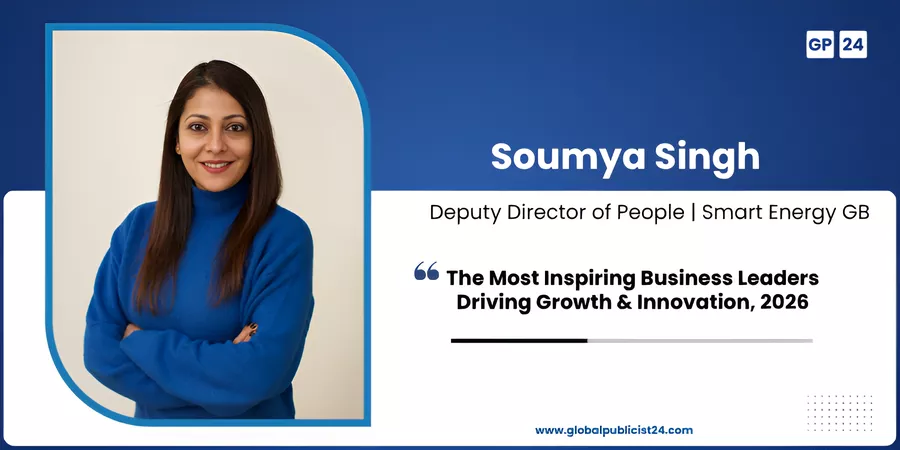
Soumya Singh has chosen to work right at this fault line, where expectations, emotions, and business priorities meet. As Deputy Director of People, she views her role through a simple yet demanding lens: it is ultimately about People, what drives them, and what motivates them. Her thinking draws from the ability, opportunity, and motivation model, which looks at how individuals perform when they are equipped, supported, and inspired in equal measure.
Her journey demonstrates a deep interest in understanding how workplaces can bring out the best in individuals. For Soumya, the work goes far deeper than frameworks or policies. It is about creating conditions where people feel steady enough to contribute meaningfully, whether their efforts are visible or form outcomes in the background. She often describes her role as building an ecosystem, one that allows both individuals and teams to grow while maintaining balance in moments that feel uncertain.
There remains a persistent belief that human resources centres around recruitment and exits. Soumya challenges that view through her everyday work. She operates in the space where People advocacy meets business clarity, where decisions must honour both human needs and organisational goals. It requires careful judgment, a strong sense of fairness, and the ability to apply policies thoughtfully rather than rigidly.
What keeps her anchored in this field is its complexity. People-related decisions rarely offer clear lines or easy answers. They exist in a space formed by context, ethics, and competing priorities. Soumya approaches this with patience and reflection, weighing each factor carefully before arriving at a decision that balances integrity and intent.
Today, at Smart Energy GB, Soumya brings together these experiences to form workplaces where people feel understood and supported. Her focus remains steady: building cultures that hold meaning, developing leaders who listen with intent, and ensuring that strategy demonstrates real human needs. In a world where many employees still feel disconnected, her work stands as a reminder that change begins with how people are seen and heard each day.
A Journey from Technology to People Leadership
Soumya grew up in India, where she completed her bachelor’s in computer science before starting her career in an IT company. Early on, she realised that while she appreciated the logic and structure of technology, it was not where she saw herself long term. What drew her in far more was people, what drives them, what motivates them, what leadership really means, and how teams come together to achieve meaningful outcomes.
She became increasingly curious about the dynamics of collaboration, the ingredients of effective leadership, and the environments that enable people to do their best work. Over time, it became clear that this was the direction she wanted to pursue.
She moved to the UK in 2009 during the global recession. It was not the easiest time to relocate, and her career did take a few steps back. Looking back now, that period gave her the space to reflect more intentionally on what she truly wanted to do. After taking on a few stopgap roles, she decided to invest in herself and pursue a master’s in human resource management at Kingston University.
That became a turning point. From the moment she entered the HR profession, she felt an increasing sense of alignment, with each role reinforcing that she had found the right path.
Her first role after completing her studies was with a learned society, an experience that gave her a solid foundation in the profession and a deeper appreciation for purpose-led organisations.
From there, she gradually moved into the start-up and consultancy space, working in fast-paced and constantly evolving environments. Those experiences pushed her to become adaptable, commercially aware, and comfortable with ambiguity, while also exposing her to a wide range of people and challenges.
Over time, she progressed into more senior leadership roles, taking on increasing responsibility for shaping People strategies and supporting organisational growth. That journey eventually led her to Smart Energy GB, where she now serves as Deputy Director of People and as part of the Senior Leadership Team.
The role allows her to bring together everything she has learned over the years, from building inclusive cultures and strengthening leadership capability to aligning People strategy with organisational goals.
Leading with Inclusion, Fairness, and Perspective
One of the strongest influences on Soumya’s leadership style has been the idea of including people and not leaving anyone behind. When she moved to the UK, she found herself genuinely inspired by how often workplace policies, practices, and discussions centred around people who might unintentionally be at a disadvantage. That experience reshaped her understanding of what leadership actually means.
For her, leadership has never been only about delivering organisational goals or driving business success. It also carries responsibility towards people, understanding what motivates them, recognising the challenges they face day-to-day, and helping them navigate those challenges effectively.
Another important influence came from observing leaders who took the time to stress test decisions from every possible angle. What stood out to her was how thoughtful leaders did not stop at the what or the how. They spent time understanding the why, why change was necessary, what the business rationale was, and how decisions would ultimately affect people. Watching leaders approach decisions with that level of integrity reinforced her view that leadership is shaped as much by the process behind decisions as by the final outcomes themselves.
That perspective has also been strengthened through her governance and advisory work outside executive leadership roles. Soumya serves as a Non-Executive Director at Impact Hub London, Trustee at Anti-Slavery International, and Co-opted Member at UnLtd. These roles have deepened her understanding of accountability, ethical leadership, and inclusive decision-making across different organisational contexts.
Working closely with boards and mission-led institutions has further shaped her belief that leadership is not only about outcomes, but also about responsibility, governance, and the long-term impact decisions have on people and communities.
Those experiences naturally shaped her own approach to decision-making, particularly around fairness and consistency. Rather than trying to retrofit inclusion later, she prefers building it into decisions from the beginning.
Coming from an ethnic minority background also gave her personal insight into how workplace decisions and systems can sometimes overlook different lived experiences or fail to account for what matters to people from diverse backgrounds. She acknowledged how demotivating that can feel in professional environments and how strongly it reinforced the importance of inclusion in practice, not just in principle.
She also reflected on the way organisations often encourage employees to bring their whole selves to work, while overlooking the fact that people can only do that when workplaces create conditions where they genuinely feel safe, valued, and supported.
To Soumya, attracting talent is only one part of the equation. Retaining people requires building ecosystems where employees feel understood and respected over time.
That broader lens, more than anything else, continues to shape both her leadership style and the way she approaches decision-making.
Defining Leadership in a Rapidly Changing Workplace
Alongside her leadership work across organisations, Soumya has also spent many years teaching undergraduate and postgraduate students in Human Resources and Organisational Behaviour as Visiting Faculty at Kingston University. That experience has added another dimension to her understanding of leadership, particularly around forming future leaders and helping emerging professionals navigate increasingly complex workplaces.
She described leadership in today’s workplace as increasingly challenging. Technology is growing rapidly, the way people work continues to shift, and employee expectations of leadership are changing alongside it. In her view, leaders today are operating in environments that move far faster than they did even a decade ago.
For her, inspiring leadership is about consistently getting the best out of people while creating the conditions that allow them to succeed. The overall purpose of leadership may not have changed, but the way leaders achieve that purpose has become far more nuanced.
A major part of that, she explained, comes down to understanding people deeply, their motivations, their needs, and the type of support they require to perform at their best. She often returns to the idea that there is no such thing as over-understanding a team. Because of that, leadership today requires deliberate effort to stay connected to people through conversations, feedback loops, surveys, and regular engagement.
Although workplace dynamics continue to evolve, she does not see the core principle of leadership as fundamentally different. At the centre of it still sits the relationship between leaders and their people. Building trust, adapting leadership styles when needed, and showing up consistently, even during uncertainty, remain central to effective leadership.
Her years in the classroom have reinforced many of those beliefs. Teaching future HR and business professionals has given her a front-row view into how younger generations think about leadership, inclusion, flexibility, and purpose at work. It has also strengthened her commitment to helping future leaders develop the emotional intelligence and adaptability modern organisations increasingly demand.
She also spoke about the importance of curiosity and continuous learning. For Soumya, inspiring leadership is rooted in a genuine hunger for knowledge, growth, and staying relevant. Leaders who are unwilling to evolve alongside the changing world risk becoming outdated over time.
That mindset is reflected in her completion of the Program for Leadership Development (PLD) at Harvard Business School. For Soumya, learning has never been a one-time milestone tied to qualifications or career stages. She sees it as an ongoing responsibility, particularly in a world where leadership expectations, technology, and workforce dynamics continue progressing rapidly.
Exposure to different perspectives, industries, and leadership frameworks has further reinforced her belief that strong leaders remain adaptable, self-aware, and willing to keep growing alongside changing times.
Whether it is understanding the impact of AI, recognising how work itself is being redefined, or helping teams remain relevant through those changes, she sees continuous learning as non-negotiable. More importantly, she stressed that leaders carry responsibility not only for adapting themselves, but also for ensuring their people are supported through periods of transformation.
That, to her, is what makes leadership truly inspiring today.
Turning Employee Feedback into Meaningful Action
At the centre of Soumya’s approach to People strategy is a simple idea. People want to be seen, heard, and reassured that their feedback will lead to meaningful action.
For her, listening only becomes meaningful when there is a genuine intent to act on what employees communicate. Listening without visible action, she noted, can become deeply frustrating, especially when people take the time to articulate barriers, blockers, and challenges affecting their ability to do their best work. When nothing changes afterwards, trust, motivation, and engagement begin to erode quickly.
Because of that, one of the key strategies she has championed throughout her career has been creating strong feedback loops that focus not just on gathering insight, but also on acting on it meaningfully.
Her approach has consistently involved identifying what is already working well and preserving that, while focusing attention on a smaller number of high-impact areas that genuinely require improvement. She does not subscribe to the idea of trying to solve everything at once. In her experience, prioritisation creates far greater impact.
Taking visible action on the issues employees care about most is often far more valuable than launching multiple disconnected initiatives. She pointed out that this principle remains universal regardless of geography, organisation, or industry.
Another area she considers critical is internal communication. Any people or engagement strategy, in her view, needs to be supported by strong internal communication, particularly during periods of uncertainty or organisational change.
People want clarity. They want to understand not only what is happening around them, but also what those changes mean for them personally. Translating complex or abstract organisational decisions into language that feels simple, relatable, and clear is not always easy, but she sees it as essential.
When communication is handled well, it strengthens trust, brings strategies to life, and creates stronger alignment between employees and organisational direction.
Building Employee Experience Through Accountability and Context
For Soumya, improving employee experience begins with understanding what employee experience actually means within a specific organisational context.
Throughout her work, she has relied on engagement surveys, forums, and feedback channels to gain a clearer understanding of how employees genuinely experience the workplace. At the same time, she acknowledged that employee experience is never homogeneous. It differs significantly depending on someone’s role, background, seniority, and personal circumstances.
One of the approaches she has implemented involves breaking employee experience down into its core elements and then designing more targeted and meaningful interventions around those realities. That means understanding what workplace experience looks like for different groups of people, whether someone is early in their career, from an underrepresented background or stepping into leadership for the first time.
From there, her focus extends beyond collecting feedback. Equal importance is placed on how feedback is reviewed, who has visibility of it, and what actions are ultimately taken as a result.
In practice, this has meant ensuring insights are discussed at the senior leadership level, translated into clear action plans, and owned collectively across the organisation rather than sitting solely within the People team.
One of the biggest shifts she has championed is treating employee experience as a shared organisational responsibility. When leaders themselves take accountability for acting on insights within their teams, she has seen more meaningful and sustainable cultural change emerge over time.
That emphasis on shared accountability has also been shaped by her experience working within governance structures outside the corporate environment, where transparency, stewardship, and collective responsibility remain central to long-term impact.
The same thinking forms her approach to wellbeing.
Before introducing wellbeing initiatives, she prefers first understanding the reality employees are navigating, what pressures exist, what is already working, and where the actual gaps lie. While interventions such as employee assistance programmes or wellbeing campaigns are common, she pointed out that even well-intentioned initiatives can feel generic when organisations fail to understand the real causes of stress or disengagement.
That is why her approach has focused heavily on grounding wellbeing strategies in the organisational context before designing solutions.
This has included offering one-to-one support through qualified counselling psychologists, providing employees access to relevant resources, and, importantly, upskilling line managers.
Because, as she put it, most people experience the workplace primarily through their line manager rather than through the people function itself. Equipping managers to support their teams effectively has remained one of the most sustainable and impactful ways of improving both employee experience and wellbeing.
Aligning People Strategy with Business Goals
Soumya sees People strategy and business strategy as inseparable. In her experience, effective People initiatives must begin with a clear understanding of where the organisation is heading, whether that direction is long-term, mid-term, or immediate.
That does not mean becoming an expert in every aspect of organisational strategy. What matters more, she explained, is taking a genuine business partnering approach and consistently linking people’s decisions back to business outcomes.
To do that effectively, she spends time understanding how organisational goals translate into capability requirements, skills development, performance expectations, and team priorities. Being part of the Senior Leadership Team allows her to remain closely connected to strategic discussions while continuously assessing what those decisions mean for teams, leadership capability, and workforce planning.
A major part of her role also involves horizon scanning. She constantly thinks ahead about where upskilling may be needed, where risks around talent or leadership stability could emerge, and how those factors may eventually influence delivery of the broader business strategy.
She described the process as continuously joining dots, assessing engagement levels, understanding whether people are genuinely motivated or simply present, and recognising how those realities affect organisational performance over time.
For her, alignment is never static. It requires ongoing reassessment, adaptation, and honest conversations.
Maintaining strong relationships with senior leaders plays an important role in that process. Open dialogue, trusted partnerships and the willingness to raise risks early, even when they do not yet appear critical, allow organisations to respond more effectively before problems escalate.
Sometimes those signals lead nowhere. Other times, they become critical decision-making inputs. That ability to anticipate issues, think ahead, and speak candidly is what she sees as the foundation of strong alignment between People strategy and long-term organisational goals.
Creating a Future-Ready Workplace Culture
When discussing future-ready workplace cultures, Soumya consistently returns to the importance of learning, adaptability and openness to change.
For her, organisations need to embrace technology as an enabler rather than treating it as a threat. Speaking specifically about AI, she noted that artificial intelligence itself may not replace people, but people who know how to use AI effectively will inevitably hold an advantage.
That mindset shift, she explained, is becoming increasingly important.
Agility is another quality she considers essential. In an increasingly volatile and uncertain environment, organisations need the ability to shift direction quickly when required. Those unable to adapt risk being left behind.
Building agility, however, is not something that happens accidentally. She stressed the importance of consciously developing agile mindsets across organisations so that employees and leaders alike are better equipped to respond to uncertainty and rapid change.
Leadership itself also plays a defining role in shaping culture. Strong cultures, in her view, are built by leaders who recognise that leadership is never a finished product. The most effective leaders remain open to feedback, willing to grow and prepared to evolve continuously alongside the environments around them.
When leaders demonstrate that openness themselves, it creates space for others to do the same.
Alongside adaptability and learning, inclusion and diversity remain fundamental to her understanding of future-ready workplaces. Diversity of background, experience and thinking consistently leads to stronger outcomes, particularly when organisations genuinely integrate different perspectives into decision-making processes.
For Soumya, that is not simply about representation. It is essential to long-term organisational success.
Words of Wisdom
For aspiring HR and people leaders, Soumya’s advice begins with courage. She encourages professionals not to be afraid of challenging constructively, not to doubt their voice and not to lose confidence in their judgement. Throughout her career, she has seen how people professionals can often become the lone voice in a room, advocating for People-related considerations while others remain focused elsewhere.
Being willing to hold that position matters.
At the same time, she acknowledged that meaningful change requires far more than confidence alone. It also requires planning, collaboration and clarity.
Understanding stakeholders, identifying sponsors and allies, and approaching change as a shared organisational responsibility can significantly strengthen the likelihood of meaningful progress.
She also challenged the assumption that change necessarily creates negative outcomes. In her experience, change can absolutely be managed thoughtfully and effectively, but doing so requires effort, alignment and working with the right people at the right time.
Finding Purpose in the People Function
For Soumya, the people function occupies a uniquely central position within organisations, and she sees that as both a privilege and a responsibility.
It remains one of the few functions with a genuine helicopter view of the organisation, understanding talent, leadership capability, strengths and gaps through both data and direct organisational insight.
That positioning, she noted, is only becoming more important as AI and new ways of working continue reshaping workplaces globally.
What motivates her most is the growing opportunity for the people function to operate as a true strategic partner to the business, advising, coaching, influencing and sometimes helping organisations navigate difficult but necessary decisions that future proof long-term capability.
As long as businesses are made up of people, she argued, there will always be a need to think actively and intentionally about people themselves.
While many organisational leaders naturally focus on metrics, performance, and outcomes, the people function continues bringing attention to culture, sustainability, talent and long-term organisational health.
She also admitted that HR has historically often been viewed as a support function, and changing that perception takes time.
But real impact, in her experience, happens when people leaders confidently take their seat at the table, contribute constructively and influence decisions in meaningful ways. That opportunity to advocate, challenge and shape workplaces continues to keep her engaged and driven.
The Progressing Role of People Leadership
Soumya believes people’s leadership is only going to become more critical over the next decade. In her view, the pace of change driven by AI, geopolitical shifts, and increasing focus on employee rights and legislation will force organisations to rely far more heavily on strong people leadership to navigate complexity.
She expects the role will continue evolving towards a deeper business partnership and influence. At the same time, she feels people leaders will need to become much clearer about the value they bring, without confusing visibility with impact.
According to her, much of the most important work in people leadership happens quietly behind the scenes through influencing, coaching, guiding, and advising in moments that are not always visible or easily measurable, but still remain critical to organisational success.
Stakeholder understanding and close collaboration, she believes, will continue to sit at the heart of the function. Referencing the thinking of Dave Ulrich, she reflected on the idea that HR still begins with understanding the business itself, understanding organisational challenges, removing blockers, and enabling stronger outcomes.
For her, the core purpose of making organisations more effective and efficient for people is unlikely to change, even as the workplace itself continues evolving.
Technology, however, will shape the function significantly. She believes embracing technology rather than resisting it will become essential, not only for maintaining personal relevance but also for helping teams and organisations adapt to entirely new ways of working. In her view, people, technology, and business outcomes are becoming increasingly interconnected.
Alongside technological change, she also believes people leaders will need to maintain a forward-looking mindset, continuously scanning for what comes next, anticipating future skills requirements, understanding shifting workforce dynamics, and ensuring diverse perspectives remain part of decision-making processes.
For Soumya, the ability to connect those dots across people, business, and technology will define effective people leadership over the next decade.
The Legacy She Hopes to Leave
When reflecting on legacy, Soumya approaches the idea cautiously. She admitted that legacy is a big term and not one she necessarily fully aligns with. Instead, she measures her impact in a far more grounded way, through the difference she has made within the workplaces she has been part of.
For her, the question is simple: has she added value to the organisation, and more importantly, have people actually felt that difference?
She recognises that HR impact is not always easy to measure and that assessing one’s own contribution can often feel difficult. But she believes that if people feel greater trust, if outcomes feel more balanced or more positive because she was involved, even in a small way, then that work matters.
Recognition itself is not what motivates her. She does not frame success around awards or titles. Instead, she places value on individual moments, moments where someone reflects on their experience at work and can identify something that genuinely improved it. Sometimes that might be an initiative. Sometimes it could be a conversation or a decision that changed the direction of an experience.
If she has contributed to making those moments better for someone, she considers that meaningful.
That, ultimately, is the impact she hopes to be known for.
She also acknowledged that working at the intersection of business and people can often feel misunderstood from both sides. Yet despite that complexity, she believes the work matters most in the moments where people need support, fairness or someone willing to advocate thoughtfully within organisational systems.
And if, in those moments, she has been able to make things even slightly better for someone, then she believes that is the contribution worth leaving behind.