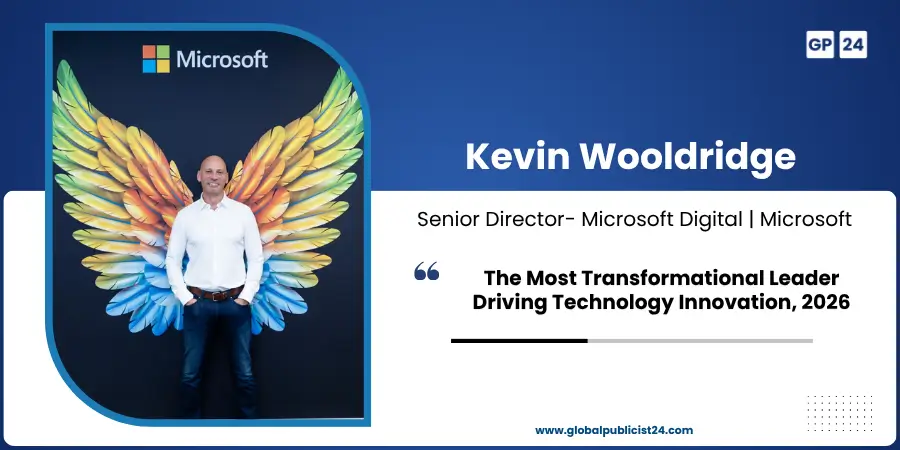
In the heart of Microsoft’s global operations, Kevin Wooldridge stands at the forefront of the AI revolution. As Senior Director at Microsoft Digital, he leads the Customer Zero initiative where his team becomes the first enterprise user of Microsoft’s own technologies. But what makes Kevin truly transformational isn’t just his technical role. It’s his unwavering belief that great leadership shows up in how you serve your community, not just how you deliver results.
Through his work with MOJOE supporting athlete career transitions, Fair Game UK advocating for sustainable football systems, and Access Sport expanding opportunities in underserved communities, Kevin proves that transformational leadership extends far beyond corporate walls.
Where It All Started
Kevin’s journey into technology leadership began long before “digital transformation” became the buzzword it is today. His career started in operational roles at Oracle and Pink Elephant, where he learned a foundational truth: reliability, service, and human trust are the real foundations of technology.
“What kept pulling me forward was a simple motivation: solving meaningful problems at scale,” Kevin reflects. Over more than two decades, he watched technology evolve from productivity tools to cloud platforms and now to AI-first ways of working.
But the real insight came gradually. “I realized that technology leadership is never just about the tech,” he explains. “It’s about shaping environments where people can do their best work. When you combine clear purpose with the right platform, you can unlock capability across thousands, sometimes hundreds of thousands of colleagues. That’s a privilege I don’t take lightly.”
Customer Zero: Testing Innovation at Global Scale
As Senior Director at Microsoft Digital, Kevin leads a global team with a unique charter: Customer Zero. This means Microsoft Digital is the first and most demanding enterprise user of Microsoft’s own technologies.
The role breaks down into three critical functions. First, his team helps envision and implement the AI-powered workplace, grounded in real workflows, not just feature demos. Second, they drive adoption and measurable impact by connecting technology rollout to behavior change, enablement, and governance. Third, they create a feedback loop into engineering so learnings from global enterprise scale improve product readiness for customers.
“That ‘live it first, learn fast, improve continuously’ cycle is where innovation becomes real,” Kevin emphasizes. It’s the difference between innovation theater and innovation that actually transforms how hundreds of millions of people work.
What Transformational Leadership Really Means
When asked about transformational leadership in today’s rapidly evolving landscape, Kevin offers a perspective shaped by years navigating constant change.
“Transformational leadership today is the ability to create momentum through ambiguity without losing your values,” he says. “AI is accelerating the pace of change in a way that’s both exciting and destabilizing. In that context, leadership isn’t about having all the answers. It’s about building the conditions where teams can learn faster than the environment is changing.”
For Kevin, transformation is fundamentally a human journey. “Technology can change processes, but only people change outcomes. So you need clarity on the ‘why,’ discipline on the ‘how,’ and empathy in the ‘way’ you lead. That’s how you earn trust, and trust is the real currency of transformation.”
From AI as Tool to AI as Capability
Under Kevin’s leadership, Microsoft Digital is driving a fundamental shift: moving from “AI as a tool” to AI as a capability embedded into workflows, and increasingly into agents that can take on multi-step tasks.
“Innovation, for us, is not innovation theater,” Kevin states clearly. Instead, it’s built on three pillars:
Adoption at scale: Making AI practical and habitual, not occasional and experimental. This means moving beyond impressive pilots to systematic rollout with the change management infrastructure to make new behaviors stick.
Governance that enables innovation: Creating guardrails so people can move fast without breaking trust, security, or compliance. Good governance isn’t bureaucracy. It’s what makes scaling possible.
A learning loop with engineering: Real-world friction becomes product improvement, not user frustration. When Customer Zero encounters problems, those problems get resolved for all Microsoft customers.
“One of the most important things we’ve learned is that the ‘secret sauce’ isn’t just model capability,” Kevin shares. “It’s the operating model around it: data readiness, change management, and measurement.”
The Fundamentals of Successful Transformation
Drawing from decades of experience, Kevin has identified fundamentals that remain surprisingly consistent across industries:
Start with outcomes, not tools. “If you can’t describe the human problem you’re solving, you’ll end up deploying technology that adds noise.”
Treat change management as a core capability. Adoption doesn’t “happen” because a tool exists. It happens because leaders create the time, training, and social proof for new habits.
Invest in governance early, especially for AI. Guardrails aren’t bureaucracy. They’re what make scaling possible.
Measure what matters. Use telemetry, sentiment, and business outcomes to learn what’s working, what’s not, and where to focus next.
“If I had to sum it up: transformation is a system. Vision, culture, execution, and learning all working together,” Kevin concludes.
The Future: Agentic AI Reshaping Work
Looking ahead, Kevin sees agentic AI as the technology that will have the greatest impact. “We’re moving beyond asking AI questions to delegating outcomes: drafting, summarizing, orchestrating tasks, and in some cases running workflows end-to-end. That will redefine productivity, but it will also redefine roles, skills, and governance.”
But he’s clear about the foundation this requires. “Cloud and data remain the foundation. Without strong data infrastructure and responsible controls, AI will amplify inconsistency rather than value. The organizations that win will be the ones that combine modern data platforms, secure identity, and disciplined measurement with a culture that learns quickly.”
Leading High-Performing Teams
Kevin’s leadership principles are simple but powerful:
Clarity over chaos. People can move fast when priorities are clear.
Psychological safety fuels innovation. “If people don’t feel safe to challenge, you get compliance, not creativity.”
Accountability with humanity. High standards and real care are not opposites.
Learn-it-all mindset. In an AI era, the best teams are the ones that learn, unlearn, and relearn fastest.
“I’m also a big believer in storytelling,” Kevin adds. “Data informs, but stories align and mobilize, especially across global teams and complex change.”
Learning Through Challenge
One of Kevin’s most formative experiences was leading transformation across commercial platforms at enormous scale. “The technical work was complex, but the real challenge was coordinating change across stakeholders, geographies, and competing priorities. You quickly learn that large-scale change is less about perfect plans and more about building trust, aligning incentives, and staying relentlessly focused on the outcome.”
That experience shaped how he leads today. “I’m more intentional about the human side of transformation: listening loops, clear narratives, and creating space for teams to raise concerns early. When the pace is high, ‘slow is smooth and smooth is fast.’ Investing in alignment up front prevents chaos later.”
Building Innovation Culture
Kevin’s approach to innovation culture is grounded in a key insight: “Culture is built through what you reward and repeat.”
His practical strategies include making experimentation safe with guardrails, celebrating small wins because momentum matters, connecting people to purpose so they understand who they’re helping, and keeping the feedback loop tight to learn and improve fast.
Drawing inspiration from sport, Kevin notes: “The best teams review performance honestly, learn quickly, and come back stronger without blaming. That mindset transfers directly into technology transformation.”
Leadership Beyond the Workplace
What sets Kevin apart from typical technology executives is his deep commitment to community service. He believes firmly that “your leadership is most authentic when it shows up in how you serve your community, not just how you deliver results.”
Through MOJOE, he supports professional athletes transitioning to post-playing careers. With Fair Game UK, he advocates for a fairer and more sustainable football system. Through Access Sport, he works to expand inclusive opportunities in underserved communities.
“Sport teaches you what inclusion really looks like: who gets the opportunity, who gets the coaching, who gets the confidence to try again,” Kevin reflects. “Through my work with MOJOE, Fair Game UK, and Access Sport, I try to live the values I talk about: fairness, resilience, and unlocking potential.”
This community engagement makes him a more effective technology leader. Working with diverse populations and understanding barriers to access informs how he thinks about technology adoption, change management, and ensuring digital transformation creates opportunity rather than widening divides.
Advice for Aspiring Leaders
Kevin’s guidance for those wanting to drive meaningful innovation is characteristically grounded:
First: stay curious. “You don’t need to be ‘ready.’ You need to be willing to learn.”
Second: anchor your work in outcomes and people. “Tools are temporary. Trust and capability endure.”
Third: build your change muscle: storytelling, stakeholder alignment, and adoption strategy. “That’s where transformations succeed or fail.”
Finally: lead beyond the workplace. “Your leadership is most authentic when it shows up in how you serve your community, not just how you deliver results.”
The AI-Powered Enterprise: Opportunity and Responsibility
Kevin envisions enterprises where “AI is present in the flow of work: summarizing, drafting, analyzing, and increasingly orchestrating tasks through agents. That will compress cycle times for many processes, reduce the cost of complexity, and create more room for higher-value work, if implemented responsibly.”
But this future also raises critical questions. “As agents become more capable and autonomous, enterprises will need unified controls, clear policies, and strong measurement so innovation scales with confidence.”
This is why Microsoft Digital emphasizes control planes like Agent 365 and Copilot controls to govern usage, security, and outcomes. Without these frameworks, enterprises face impossible choices between restricting AI adoption to prevent risk or deploying it widely without controls.
A Legacy of Impact and Inclusion
When Kevin considers his legacy, his aspiration is both humble and profound: “I’d like my legacy to be simple: that I helped make technology more human and helped people believe they belonged in the future we’re building.”
Inside Microsoft, this means shaping the Customer Zero journey to improve products through lived experience and measurable outcomes. Outside Microsoft, it means using leadership to create access and opportunity.
“If there’s one thing I hope people say, it’s this: he delivered results, but he did it in a way that lifted others.”
In an era when technology leadership is often measured purely by metrics, Kevin Wooldridge reminds us that the most transformational leaders deliver results while developing people, drive innovation while building community, and embrace the future while ensuring everyone has a place in it.
His work at Microsoft Digital is defining how enterprises will adopt AI at scale. His community involvement is expanding opportunity for those who need it most. Together, they demonstrate what transformational leadership looks like when technical excellence meets human purpose.
This isn’t just the story of a successful technology executive. This is the story of leadership that understands technology’s highest purpose: expanding human capability and creating opportunity for all.