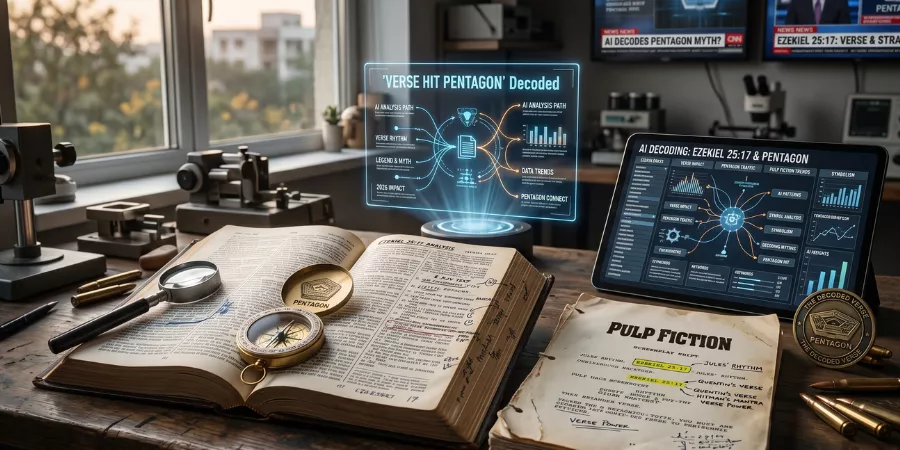
Millions of people have quoted Ezekiel 25:17 thinking it comes straight from the Bible. Most of them heard it from Samuel L. Jackson in a 1994 crime film. And this week, the US Secretary of Defense read a version of it at a Pentagon prayer service, without mentioning it came largely from a Quentin Tarantino screenplay.
That is a lot of layers for one Bible verse reference to carry.
Here is what you actually need to know, fast:
- Ezekiel 25:17 is a real Bible verse, but it is short, and it says nothing about “the path of the righteous man.”
- The famous speech in Pulp Fiction is mostly invented by Tarantino; only the last two lines are loosely based on the actual verse.
- The verse comes from the Old Testament Book of Ezekiel, directed at the Philistines.
- Samuel L. Jackson’s character Jules Winnfield recites a version of it before every kill.
- On April 15, 2026, Pete Hegseth read a military-adapted version of the Pulp Fiction quote, not the Bible, during a worship service at the Pentagon.
This article explains the real Ezekiel 25:17, how Tarantino rewrote it, why it became one of the most quoted movie lines in history, and why it is suddenly in the news again.
What Ezekiel 25:17 Actually Says
The real Ezekiel 25:17 verse, from the King James Bible, reads:
“And I will execute great vengeance upon them with furious rebukes; and they shall know that I am the LORD, when I shall lay my vengeance upon them.”
That is the whole verse. One sentence. God, speaking through the prophet Ezekiel, promises divine punishment on the enemies of Israel, specifically the Philistines and the Cherethites.
The NIV version puts it this way: “I will carry out great vengeance on them and punish them in my wrath. Then they will know that I am the LORD, when I take vengeance on them.”
The Ezekiel 25:17 meaning is about divine justice, not personal righteousness. The verse is a warning, God declaring that those who wronged his people would come to recognize his power through the consequences they faced.
It is powerful. It is sharp. And in the right setting, yes, it is memorable.
Is Ezekiel 25:17 a Real Bible Verse?
Yes, and no, depending on what version you have heard.
The verse itself exists as a genuine text. The Hebrew Bible which contains the Old Testament reaches its conclusion with Ezekiel chapter 25. The Book of Ezekiel was composed by the prophet Ezekiel who served as both priest and prophet during the Babylonian exile in the 6th century BC.
The famous speech most people associate with Ezekiel 25:17, the one that starts with “The path of the righteous man is beset on all sides…” – is largely fictional. Quentin Tarantino and co-writer Roger Avary created those lines for Pulp Fiction. They borrowed the ending from the real Bible verse and built several invented sentences around it.
So when someone asks “is Ezekiel 25:17 a real Bible verse?” – the answer is: the reference is real, the full famous speech is not.
Ezekiel 25:17 in the Bible – The Full Context
To understand the Ezekiel 25:17 explanation properly, you need to know what Ezekiel chapter 25 is actually about.
The chapter is a series of prophecies directed at four nations: the Ammonites, Moabites, Edomites, and Philistines. Each group is condemned for celebrating or exploiting the fall of Israel and Judah.
The Philistines, targeted in the final verses, were condemned for acting out of “old enmity,” essentially centuries of stored-up hostility and revenge against the people of Judah.
Verse 17 is God’s direct response to that. It closes the chapter with a declaration: those who acted against Israel with malice would face divine retribution. They would not just be punished, they would be made to know through their punishment who exactly was behind it.
This is the Ezekiel 25:17 context: not a personal code of righteousness, but a prophetic announcement of collective judgment on a nation that wronged another.
Pulp Fiction and Ezekiel 25:17
How the Speech Appears in the Film
In Pulp Fiction (1994), Samuel L. Jackson plays Jules Winnfield, a hitman who recites what he calls Ezekiel 25:17 before executing his targets. The speech appears three times across the film.
The full Pulp Fiction Ezekiel 25:17 speech goes:
“The path of the righteous man is beset on all sides by the inequities of the selfish and the tyranny of evil men. Blessed is he who, in the name of charity and good will, shepherds the weak through the valley of the darkness, for he is truly his brother’s keeper and the finder of lost children. And I will strike down upon thee with great vengeance and furious anger those who attempt to poison and destroy my brothers. And you will know my name is the Lord, when I lay my vengeance upon thee.”
Only the last two lines connect to the real scripture. Everything before them was written for the film.
Jules himself admits near the end of the movie that he had been reciting it for years without fully understanding it, and then explains he has started thinking about what it actually means.
That scene, where the Ezekiel 25:17 movie quote transforms from a pre-murder ritual into a moment of moral reckoning, is the emotional core of the film.
Where Did Tarantino Get the Idea?
The Ezekiel 25:17 origin as a dramatic pre-violence speech actually traces back to Japanese cinema. Wikipedia and Tarantino researchers have documented that the primary inspiration came from Sonny Chiba’s character in the 1976 martial arts film Karate Kiba (known as The Bodyguard in the US).
Chiba’s character would lecture villains about why the world had to be rid of evil before killing them, a clear structural ancestor to Jules Winnfield’s ritual.
Tarantino lifted that dramatic shape, found a real biblical reference that fit the tone, and wrapped invented lines around it. The result landed as one of the most recognizable pieces of film dialogue ever written.
Why the Ezekiel 25:17 Quote Became So Famous
A few things combined to make this particular speech stick the way it did.
- Samuel L. Jackson’s delivery. The speech is performed with complete conviction, slow pacing, and controlled intensity. Jackson has said the role changed his career. The Ezekiel 25:17 Bible quote scene became a reference point for dramatic monologue delivery for years afterward.
- The film’s cultural weight. Pulp Fiction won the Palme d’Or at Cannes, earned seven Academy Award nominations, and is consistently listed among the greatest films ever made. Anything associated with it carried significant cultural reach.
- The speech sounds genuinely biblical. The rhythm, the references to righteousness and darkness, the closing invocation of divine identity, it reads like scripture. Casual listeners had no reason to question it, so the Ezekiel 25:17 misquotation spread widely and honestly.
- It appeared three times in the film. The repetition of the Ezekiel 25:17 reference across different scenes gave it a structural significance inside the story, not just a single iconic moment.
The Difference Between the Bible Verse and the Movie Quote
| Real Ezekiel 25:17 | Pulp Fiction Version | |
| Speaker | God (through Ezekiel) | Jules Winnfield, hitman |
| Length | One sentence | Approx. 80 words |
| Audience | The Philistines | A terrified young criminal |
| Source | Hebrew Bible, ~6th century BC | Tarantino/Avary screenplay, 1994 |
| Meaning | Divine judgment on Israel’s enemies | Pre-execution ritual, later a moral reflection |
| “Path of the righteous man” | Not in the Bible | Invented for the film |
The Ezekiel 25:17 significance in the film lies not in biblical accuracy but in dramatic irony. Jules is a hitman pretending to be an instrument of divine justice, until he starts to wonder whether he actually is one.
Pete Hegseth, the Pentagon, and the Pulp Fiction Prayer
This week the Ezekiel 25:17 reference moved into a genuinely unexpected setting.
On April 15, 2026, Defense Secretary Pete Hegseth read a prayer during a worship service at the Pentagon. Before reading it, he explained it was titled “CSAR 25:17,” Combat Search and Rescue, and said he believed it was “meant to reflect Ezekiel 25:17.”
The prayer he read was not the actual Ezekiel 25:17, which simply reads: “And I will execute great vengeance upon them with furious rebukes; and they shall know that I am the Lord, when I shall lay my vengeance upon them.” Instead, it closely echoed the fictional Pulp Fiction version of the speech, with words substituted to fit a military context.
Hegseth read: “The path of the downed aviator is beset on all sides by the iniquities of the selfish and the tyranny of evil men. Blessed is he who in the name of comradery and duty shepherds the lost through the valley of darkness, for he is truly his brother’s keeper and the finder of lost children. And I will strike down upon thee with great vengeance and furious anger those who attempt to capture and destroy my brother.”
Hegseth explained the prayer had been recited by “Sandy 1,” one of the US Air Force Combat Search and Rescue teams, before missions, including the recent rescue of a downed American airman in Iran.
He did not mention the more direct link to the film. The situation drew criticism from religious figures, including Archbishop Reinhard Marx of Munich, who called it “shameless blasphemy.”
Whether Hegseth knew the speech originated in a Tarantino film is unclear. The Pete Hegseth Pulp Fiction moment quickly circulated online, with a Reddit post about it gathering over 22,000 upvotes within hours.
Common Misunderstandings About Ezekiel 25:17
“The path of the righteous man is beset on all sides…” is in the Bible: It is not. Those lines were written by Tarantino and Roger Avary for Pulp Fiction. The real verse contains none of that language.
The whole Pulp Fiction speech is a quote from scripture: Only the final section connects to the real Ezekiel 25:17 verse. The rest is invented film dialogue.
Ezekiel 25:17 is about personal righteousness or a code of ethics: The actual verse is about collective divine judgment on a nation. It is not a personal philosophy, it is a prophecy of punishment directed at Israel’s historical enemies.
Jules Winnfield is quoting the Bible accurately: Jules even says near the film’s end that he had been reciting it for years without questioning what it meant. The movie itself acknowledges the speech is more performance than scripture.
Where the Ezekiel 25:17 Reference Shows Up in Culture
The Ezekiel 25:17 significance has spread well beyond the film:
- Video games: Characters in Grand Theft Auto and other crime games reference or parody the speech.
- Music: Hip-hop and rap artists have sampled or quoted the speech across multiple tracks.
- Memes: The opening lines regularly appear in internet meme formats.
- Tattoos: It is one of the more common scripture-style tattoos, often by people unaware the majority of it is not in the Bible.
- Military culture: As the Hegseth story shows, a version of the speech has apparently entered at least some corners of US military tradition.
- Religious discussions: Theology forums regularly debate whether the speech’s misattribution matters, and what the real verse actually means.
What the Real Book of Ezekiel is About
The Book of Ezekiel is one of the major prophetic books of the Old Testament. Ezekiel was a priest who was taken to Babylon as part of the first deportation of Jews in 597 BC. He wrote and prophesied during the Babylonian captivity.
The book is known for vivid, sometimes unsettling imagery, visions of wheels within wheels, dry bones coming to life, and extended prophecies of judgment and eventual restoration.
Chapter 25 is specifically dedicated to oracles against nations that had shown hostility or contempt toward Israel during its period of weakness. The Ezekiel 25:17 explanation sits at the end of one of those oracles, the final word in God’s condemnation of the Philistines.
The verse carries real weight in its original context. It is not a threat from a human character. In the scripture context, it is a divine declaration: you will know who I am by what I do to you.
Tarantino recognized the power in that structure and built an entirely new speech around it. His version works because it borrows the rhythm and authority of the original without requiring the audience to know what the original actually says.
Key Takeaways
- Ezekiel 25:17 is a real Bible verse from the Old Testament, dating to around the 6th century BC.
- The actual verse is a single sentence about divine vengeance against the Philistines.
- The famous Pulp Fiction speech attributed to Ezekiel 25:17 is mostly invented by Quentin Tarantino; only the closing lines reflect the real scripture.
- Samuel L. Jackson’s delivery turned the Ezekiel 25:17 movie quote into one of the most recognized pieces of film dialogue ever written.
- On April 15, 2026, Pete Hegseth read a military-adapted version of the Tarantino speech, not the actual Bible verse, at a Pentagon prayer service during the Iran conflict, drawing widespread attention and criticism.
- The speech has embedded itself into internet culture, music, gaming, and now apparently US military tradition, often completely detached from its biblical origins.
FAQ: Ezekiel 25:17
What does Ezekiel 25:17 mean in the Bible?
In its original context, it is God declaring judgment on the Philistines, Israel’s historic enemies. It closes a chapter of divine oracles against nations that wronged the Israelite people. The meaning is essentially: those who acted with malice against God’s people will face punishment, and that punishment will reveal who is behind it.
Is the Pulp Fiction Ezekiel 25:17 speech real scripture?
Mostly no. Tarantino and Roger Avary wrote the majority of the speech for the film. The final two lines borrow from the real King James Version of the verse, but the rest, including “the path of the righteous man,” is fictional.
Why did Jules recite Ezekiel 25:17?
Jules explains in the film that he recited it because he thought it was “a cold-blooded thing to say” before killing someone. Later in the film he reflects on what it actually means and begins to interpret it differently, it becomes a turning point in his character.
Did Pete Hegseth quote Pulp Fiction at the Pentagon?
Effectively yes. On April 15, 2026, he read a prayer called “CSAR 25:17” that closely mirrors the fictional Pulp Fiction version of the speech, with military-specific language substituted. He attributed it to Ezekiel 25:17 but did not mention the film connection.
Where is Ezekiel 25:17 in the Bible?
It is the final verse of chapter 25 in the Book of Ezekiel, part of the Old Testament / Hebrew Bible. Ezekiel is one of the major prophetic books, written during the Babylonian exile period around 593–571 BC.
What is the actual full text of Ezekiel 25:17?
King James Version: “And I will execute great vengeance upon them with furious rebukes; and they shall know that I am the LORD, when I shall lay my vengeance upon them.”
Why do people think the Pulp Fiction quote is a real Bible verse?
Tarantino wrote it in biblical rhythm, used real scriptural language in the closing lines, and had the character deliver it with total conviction. The speech sounds authentic enough that many people never question it, and it has been shared and repeated for over 30 years as though it is genuine scripture.