
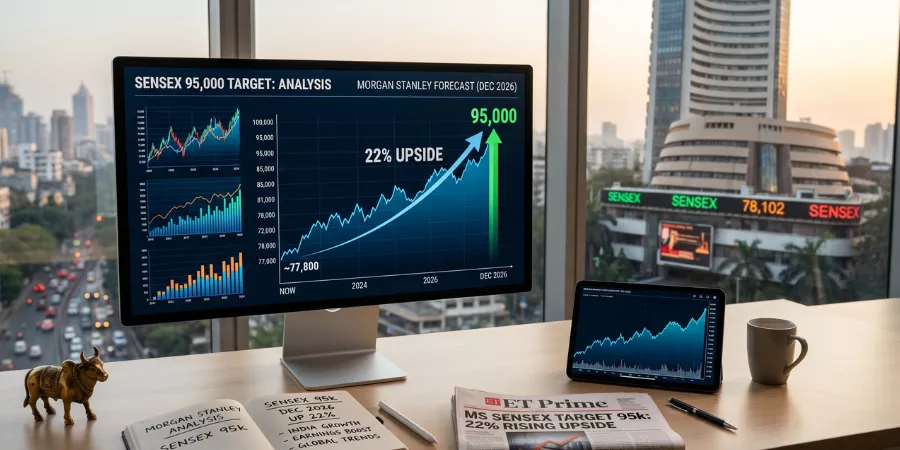
A lot of Indian investors spent 2025 nervous. The Sensex underperformed. Foreign investors pulled money out for months. Valuations looked stretched, earnings disappointed, and sentiment stayed cautious well into 2026. So when a firm like Morgan Stanley steps forward and calls a 22% rally from here, it stops people.
The Morgan Stanley Sensex target for December 2026 is 95,000, based on its latest India Equity Strategy Playbook released in April 2026. Here is what the report actually says, why the firm believes it, and whether it holds up under scrutiny.
Quick Summary: What is the Morgan Stanley Sensex Target for 2026?
- Base Case Target: 95,000 by December 2026 (~50% probability)
- Bull Case Target: 1,07,000 if crude oil falls below $70 per barrel (~30% probability).
- Bear Case Target: 76,000 if crude stabilises at $100 (~20% probability)
- Implied Upside: ~22% from current Sensex levels near 78,000
- Key Driver: Earnings compounding at 17% annually through FY28
The Morgan Stanley Sensex Target – Three Scenarios Explained
Morgan Stanley’s India equity strategy team, led by Ridham Desai, has laid out three clear paths for where the Sensex goes by the end of 2026. Each one depends on a different set of conditions playing out.
Base Case: Sensex at 95,000 (50% Probability)
This is Morgan Stanley’s central forecast and the one the report builds its entire thesis around.
The base case assumes India’s macro environment holds steady, moderate global growth, no major oil shock, continued policy stability in New Delhi, and the RBI maintaining a supportive liquidity environment.
Under these conditions, the Morgan Stanley Sensex target of 95,000 works out to a price-to-earnings multiple of roughly 23.5x, slightly above the long-term average, but justified by India’s superior earnings trajectory compared to other emerging markets.
Sensex earnings are expected to compound at 17% annually through FY28. High-frequency data across consumption, services, and investment already shows that trend building. The report says India’s share in global corporate profits now exceeds its index weight by the widest margin ever recorded.
Bull Case: Sensex at 1,07,000 (30% Probability)
The bull case gets to 1,07,000 primarily through one variable: a sustained fall in crude oil prices below $70 a barrel. India imports roughly 87% of its oil. Lower crude directly improves the current account, controls inflation, gives the RBI room to cut rates further, and boosts margins across sectors from aviation to paints to FMCG.
In this scenario, foreign portfolio investors, currently at historically low positioning in India, rotate back in aggressively. That rotation alone, the report suggests, could be a “pain trade” for global fund managers who are currently underweight India.
Bear Case: Sensex at 76,000 (20% Probability)
The bear case is largely an oil story too, but in reverse. If crude settles around $100 a barrel due to a sustained Middle East conflict or supply disruption, India’s macro picture deteriorates fast. The current account widens, the rupee comes under pressure, inflation picks up, and rate cuts get delayed or reversed.
The Morgan Stanley India outlook in this scenario turns cautious, with the Sensex target falling to 76,000, still above where the market sat during its worst recent correction, but a meaningful downside from current levels.
Why Morgan Stanley is Bullish on India Right Now
1. Valuations Are at Historically Attractive Levels
The Sensex forecast 2026 from Morgan Stanley rests heavily on a valuation argument that is actually harder to dismiss than it sounds. The firm points out that the Sensex is currently trading at its cheapest level against gold since records began, and gold is one of the most reliable long-term benchmarks for real value. Price-to-book multiples are near previous historical troughs, even as India’s macroeconomic stability has improved.
Simply put, the market got cheap while the underlying economy stayed strong. That combination historically precedes a recovery.
2. The Earnings Upcycle Has Resumed
For most of 2025, earnings disappointed and estimates kept getting cut. That appears to have changed. Morgan Stanley says high-frequency indicators across consumption, investment, and services are showing genuine strength, even as market expectations remain subdued.
This divergence, improving reality, cautious expectations, is exactly the setup that tends to produce earnings upgrades, which in turn drive share prices higher.
The India equity market outlook from the firm assumes Sensex earnings grow at around 17% per year through FY28. That is not wishful thinking, it aligns with the broader earnings CAGR India has delivered during previous growth cycles.
3. Domestic Investors Are Holding Firm
One of the most important structural changes in Indian markets over the past five years is how domestic retail and institutional money has behaved. SIP flows into mutual funds have stayed broadly resilient even through the recent correction, absorbing a significant chunk of the selling pressure from foreign investors. Morgan Stanley calls this the “retail bid keeping its nose ahead of supply.”
This domestic liquidity cushion limits the downside and supports a faster recovery when sentiment turns.
4. Foreign Investors Are Near Their Lowest Positioning Ever
FPI exposure to India has weakened consistently over the past several months. From a contrarian standpoint, this is good news. Every percentage point of position rebuilding by global funds, should India’s earnings story continue to strengthen, translates into significant inflows into a market that, while large by Asian standards, is still smaller than many individual US sectors.
5. Policy Stability Reduces Uncertainty
One of the consistent themes in Morgan Stanley’s India outlook across multiple reports is policy predictability. The current government’s sustained capital expenditure push, with roughly 3.1% of GDP allocated toward infrastructure spending, keeps private investment momentum going. The RBI has also turned sentiment on the rupee, which Morgan Stanley considers undervalued, adding another layer of support.
Which Sectors Could Drive the Sensex to 95,000?
Morgan Stanley’s sectoral preferences in the India equity market outlook are clearly tilted toward domestic cyclicals.
- Financials (Overweight): Ridham Desai has consistently pointed to financial services as the single most important sector for Indian equity investors. Banks and NBFCs experience direct advantages from rising income levels and increasing credit access. The sector currently trades at fair market value after experiencing a long period of poor financial performance.
- Consumer Discretionary (Overweight): The consumption pattern in India will continue its expansion beyond its current state. The combination of increasing disposable incomes and the presence of a youthful demographic and urban development is creating demands in the automotive and retail and branded product markets. Morgan Stanley specifically overweights this sector in its Sensex target by brokerages framework.
- Industrials and Infrastructure (Overweight): Government capex continues to flow into roads, railways, defence, and manufacturing. The Production Linked Incentive (PLI) scheme is beginning to show results in sectors like electronics and chemicals. Industrials benefit both from public spending and a recovering private investment cycle.
- Energy and Materials (Underweight): This is where Morgan Stanley diverges from the popular narrative. The firm actually prefers to underweight energy and materials, partly because the bull case for Indian equities depends on oil staying low, a scenario that is bad for energy sector earnings.
What Could Go Wrong? Risks Every Investor Should Know
The Morgan Stanley Sensex target of 95,000 is a probability-weighted forecast, which means it already prices in some chance of failure. But understanding the specific risks matters.
- Global Recession Risk: A sharper-than-expected slowdown in the US or China would hit Indian exports, reduce remittances, and compress risk appetite globally. India’s domestic consumption story offers some insulation, but the country is not fully decoupled from global growth.
- Oil Price Shock: As the bear case scenario makes clear, sustained crude above $100 flips much of the investment thesis. India imports nearly all its oil. A prolonged supply disruption, from the Middle East conflict, for example, could trigger a twin deficit problem and force policy tightening at exactly the wrong time.
- FII Selling and Rupee Pressure: Foreign investor sentiment remains fragile. Any sharp strengthening of the US dollar, driven by Federal Reserve policy or risk-off moves, could revive FII outflows and put pressure on the rupee.
- Earnings Delivery Risk: The Sensex forecast 2026 assumes 17% earnings growth. If large-cap companies in financials or IT disappoint, that assumption unravels quickly. The market has been burned by optimistic earnings expectations before.
- AI Disruption for IT Exports: Morgan Stanley specifically flagged this risk. The lack of a direct AI play in Indian indices is one challenge. A more serious one is whether AI genuinely displaces some of India’s services export income over the medium term, a risk that remains difficult to quantify right now.
How Realistic is the 95,000 Target? A Balanced View
The honest answer: directionally credible, but the timing and magnitude carry genuine uncertainty.
Consider where the Sensex has come from. It crossed 10,000 in 2006. It hit 60,000 in 2021, recovered past 70,000 in 2023, and reached above 85,000 before the recent correction. The long-term trajectory has been one of consistent compounding. A move from roughly 78,000 to 95,000 over 8 to 9 months is a 22% gain, not unusual during a recovery phase after a prolonged period of underperformance.
Other brokerages broadly share a constructive India equity market outlook for 2026, though some have more modest near-term targets. A recent Reuters poll found a majority of analysts expecting a near-term correction of more than 10%, so the Morgan Stanley view is more aggressive than consensus on both direction and timing.
Morgan Stanley’s P/E assumption of 23.5x is slightly above the historical average, which means the target is not purely a re-rating story, it needs actual earnings delivery to work. That is the most important variable to watch through 2026.
What This Means for You as an Investor
The Morgan Stanley Sensex target is not a trading call. It is a 12-month directional view with a probability framework attached. Here is how to think about it practically.
- If you are a long-term investor (3-5 year horizon): The structural case for India, demographics, digital infrastructure, manufacturing push, rising consumption, has not changed. Current valuations are better than they were at the 2021 peak. Adding to quality diversified equity holdings during a period of compressed valuations and cautious sentiment has historically worked well.
- If you are a short-term investor or trader: The risks outlined above are real. Global developments, particularly around oil and the US economy, can move Indian markets sharply regardless of domestic fundamentals. Sizing positions accordingly and keeping some allocation in less correlated assets makes sense.
- Portfolio ideas based on Morgan Stanley’s sectoral tilt: Financials, consumer discretionary, and industrials overweight. Avoid overconcentration in energy or materials. Mid-caps may outperform in a recovery scenario, but carry higher volatility.
- Risk management: The bear case target of 76,000 implies meaningful downside from current levels. That is a 3-to-1 risk-reward in the base case, three rupees of potential upside for every rupee of downside. Reasonable, but not risk-free.
The Bigger Picture: Is 2026 India’s Comeback Year?
Ridham Desai described India at the start of 2026 as having just delivered its weakest relative performance versus emerging markets since 1994, three full decades of underperformance compressed into one year. The reasons were genuine: a mid-cycle growth slowdown, stretched valuations going into 2025, and no direct AI trade to attract momentum capital.
What has changed since then is subtle but meaningful. Valuations have corrected. Earnings appear to be inflecting upward. Domestic liquidity has stayed supportive. And the RBI has turned more accommodative, with rate cuts that the Morgan Stanley India outlook suggests will continue.
India’s share in global corporate profits now exceeds its weight in benchmark indices by the highest margin ever. That is a fundamental signal, not a sentiment one. Companies are earning more than their index representation implies, and that gap tends to close, either through index weight rising (which requires more buying) or through earnings re-rating.
Factors driving Sensex growth in 2026 are not speculative. They are grounded in consumption data, capex data, and the RBI’s own policy pivot. The India GDP growth stock market impact historically runs through a 12-18 month lag. The seeds planted through policy stability and infrastructure spending in 2024 and early 2025 should show up in corporate earnings through FY27 and FY28.
Author’s Opinion
The 95,000 target is credible, but it demands patience, not excitement.
India’s earnings story is real. The valuation reset of 2025 created a genuine entry window that rarely comes this cleanly. Morgan Stanley is not guessing here, the data on domestic flows, capex cycles, and profit share all point in the same direction.
But markets rarely travel in straight lines to analyst targets. The oil risk is serious, global uncertainty is elevated, and retail investors who bought the 2021 peak are still recovering confidence.
My honest read: the structural case for India is intact. The 22% move is possible. Just prepare for a bumpy road getting there.
Frequently Asked Questions
Will Sensex reach 1 lakh by 2026? In Morgan Stanley’s bull case, which carries a 30% probability, the Sensex target reaches 1,07,000 by December 2026. This requires crude oil to fall and sustain below $70 a barrel, and foreign investors to meaningfully return to Indian equities. Possible, but it is the optimistic outcome, not the base expectation.
What is the Sensex target for 2026 according to Morgan Stanley? The Morgan Stanley Sensex target for December 2026 is 95,000 in the base case, representing approximately 22% upside from current levels around 78,000.
Is it a good time to invest in Indian stocks in 2026? Morgan Stanley describes the current setup as “an attractive entry point for long-term investors,” citing historically low relative valuations and an improving earnings cycle. That view is reasonable for long-horizon investors, though near-term volatility remains real.
Which sectors will grow the most if Sensex hits 95,000? Morgan Stanley is overweight on financials, consumer discretionary, and industrials. These sectors benefit most directly from India’s domestic growth story and government capex cycle.
What risks can crash the Indian stock market in 2026? The main risks are a global recession reducing risk appetite, crude oil rising sharply above $100 impacting India’s current account, sustained FII outflows due to dollar strength, and failure to deliver the projected 17% earnings growth.
Why is Indian stock market expected to grow in 2026? The factors driving Sensex growth include recovering corporate earnings, historically low valuations, continued government infrastructure spending, RBI rate cuts, and strong domestic investor participation through SIPs and mutual funds.
What is the bear case for the Sensex in 2026? Morgan Stanley’s bear case for Sensex is 76,000 by December 2026, triggered primarily by crude oil stabilising at around $100 a barrel, which would pressure India’s macro position and delay the earnings recovery.
Should a beginner invest in Sensex in 2026? Long-term systematic investment through diversified equity mutual funds remains a sound approach for beginners regardless of market timing. The Morgan Stanley India outlook supports a positive multi-year trajectory, but short-term swings are unpredictable and common.
How does India’s GDP growth affect the stock market? India GDP growth stock market impact works through corporate earnings. Higher GDP means more spending by consumers and businesses, which flows into company revenues and profits. Morgan Stanley expects India’s GDP to grow around 6.4% in 2026, with nominal growth (which includes inflation) running closer to 10-11%, the environment in which Indian corporate earnings have historically compounded fastest.
Are other brokerages also bullish on Sensex for 2026? Several major brokerages hold constructive India equity market outlooks for the year, though some are more cautious on near-term timing. A Reuters poll of analysts flagged a possible 10% correction before any sustainable rally. Morgan Stanley’s target by December 2026 remains among the more optimistic in terms of pace and magnitude.
Conclusion
The Morgan Stanley Sensex target of 95,000 by December 2026 is built on a coherent and data-backed thesis. Cheap valuations, resuming earnings growth, supportive domestic liquidity, and a policy environment that favors private investment, these are real conditions, not projections manufactured from optimism.
The key variable is earnings delivery. If Sensex companies genuinely compound earnings at 17% through FY28, the 95,000 target is not ambitious. It is arithmetic.
The risk, as always, is the world outside India. Oil prices, the pace of US rate cuts, and FII sentiment remain important variables that no domestic policy can fully control.
For investors with a long enough horizon and the patience to hold through near-term noise, the Indian stock market prediction for 2026 from Morgan Stanley offers a reasonable case for staying invested and adding during weakness, rather than waiting for a perfect entry that rarely comes.