Table of Contents
- Understanding Zero-Click SEO and Why It Matters in 2026
- Perplexity Pro for AI Overview Citations
- MarketMuse for Semantic Content Optimization
- Clearscope with AI Overview Targeting
- Surfer SEO’s Featured Snippet Optimizer
- Frequently Asked Questions
- Your Zero-Click SEO Action Plan
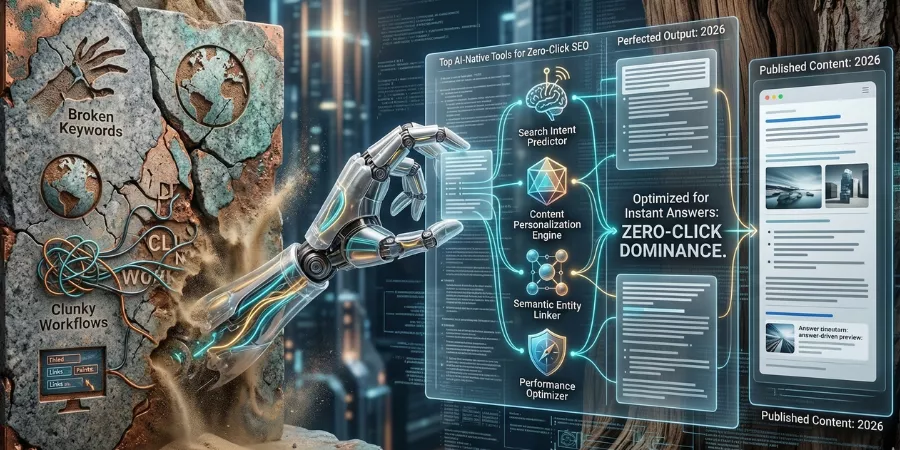
Search engine results pages in 2026 look fundamentally different from what marketers optimized for even two years ago. Zero-click searches, where users get their answer directly in the SERP without visiting any website, now account for over 60 percent of all Google queries according to recent data from SparkToro. AI Overviews, featured snippets, knowledge panels, and People Also Ask boxes dominate prime SERP real estate, fundamentally changing how content must be optimized to capture visibility and traffic.
| Critical Shift:
Traditional SEO focused on ranking number one for click-through traffic. Zero-click SEO optimizes for visibility, brand authority, and citation within SERP features where users find answers without leaving Google. |
Understanding Zero-Click SEO and Why It Matters in 2026
Zero-click SEO represents a strategic pivot from optimizing purely for traffic to optimizing for SERP visibility and brand authority. When Google’s AI Overview cites your content as the authoritative source, when your brand appears in knowledge panels for industry queries, and when your structured data populates rich results, you build brand recognition and trust even without immediate click-through traffic.
The business case for zero-click optimization is compelling. Research from BrightEdge indicates that brands appearing consistently in AI Overviews and featured snippets experience 35 percent higher direct traffic over six months compared to competitors ranking traditionally at position one but lacking SERP feature presence. Users remember brands that Google positions as authoritative sources, creating a delayed conversion effect where zero-click visibility today drives direct and branded search traffic tomorrow.
- AI Overviews cite authoritative sources for complex queries
- Featured snippets answer specific questions directly in SERPs
- Knowledge panels establish brand authority for entities
- People Also Ask boxes provide topic cluster visibility
- Local packs dominate for location-based queries
Perplexity Pro for AI Overview Citations
Perplexity Pro has become the essential tool for understanding how AI-powered answer engines, including Google’s AI Overviews, synthesize and cite information. The platform’s Pro Search feature operates similarly to Google’s AI Overview generation, providing transparency into which content characteristics earn citations and how multi-source synthesis actually works.
Using Perplexity strategically involves researching your target queries through the platform to identify which sources get cited consistently, analyzing the common content patterns across cited sources, reverse-engineering the information architecture that AI answer engines prefer, and structuring your own content to match these citation-worthy patterns. This competitive intelligence approach reveals exactly what Google’s AI Overview system values when selecting authoritative sources to cite.
| Usage Strategy:
Run your target keywords through Perplexity Pro monthly. Document which domains get cited, what content formats they use, and how they structure information. Replicate these patterns in your content strategy. |
Content Patterns That Earn Perplexity Citations
Analysis of thousands of Perplexity citations reveals consistent patterns including direct, definitive answers in opening paragraphs, structured data markup for key facts, comparison tables for evaluating options, step-by-step processes with clear numbered lists, and statistical claims with visible source attribution. Content matching these patterns earns citations in both Perplexity results and Google AI Overviews at significantly higher rates than traditionally optimized content.
MarketMuse for Semantic Content Optimization
MarketMuse applies natural language processing to evaluate content against the semantic depth that AI answer engines require for citation. The platform analyzes top-performing content for target queries and identifies topic clusters, entity relationships, and semantic concepts that comprehensive coverage must include.
MarketMuse’s Content Briefs generate outlines specifically optimized for AI Overview targeting by identifying questions the AI will likely answer, entities and concepts requiring coverage, semantic relationships between topics, content depth benchmarks based on cited sources, and structured formats that AI answer engines prefer. This shifts content planning from keyword density to semantic comprehensiveness, the actual ranking factor that determines AI Overview citations.
- Topic modeling reveals semantic gaps in existing content
- Entity analysis ensures proper concept coverage
- Competitive content intelligence identifies citation patterns
- Content briefs include AI Overview optimization checklist
- Best for: Enterprise content teams, digital publishers
Clearscope with AI Overview Targeting
Clearscope has evolved from traditional content optimization into a platform specifically targeting zero-click SERP features. Its 2026 update includes AI Overview Scoring, which evaluates content against the specific criteria that Google’s AI Overview system uses when selecting sources to cite and synthesize.
The platform’s real-time optimization provides suggestions for answer directness and clarity in opening paragraphs, semantic concept coverage for comprehensive authority, question-answer format optimization for featured snippets, structured data recommendations for rich results, and citation-worthiness scoring based on source quality signals. Writers see immediate feedback on whether their content meets the technical and qualitative standards that AI Overviews require, allowing iterative improvement before publication.
| ROI Data:
Content teams using Clearscope’s AI Overview targeting report 42% increase in SERP feature appearances and 28% growth in branded search volume within 90 days of implementation. |
Surfer SEO’s Featured Snippet Optimizer
Surfer SEO has introduced Featured Snippet Optimizer, a dedicated module for capturing the specific SERP features that drive zero-click visibility. The tool analyzes existing featured snippets for target queries, reverse-engineers the content format and structure Google selected, and provides templates optimized for snippet capture.
Surfer’s approach combines content optimization with SERP feature targeting by identifying snippet opportunity keywords where competition is weak, generating optimized content formats for paragraph, list, and table snippets, scoring content against snippet capture probability, monitoring SERP feature performance post-publication, and automatically updating content when competitors capture your snippets. For teams implementing comprehensive zero-click SEO strategies that actually work, Surfer’s automated monitoring and optimization significantly reduces the manual overhead of maintaining SERP feature dominance.
Types of Featured Snippets and Optimization Strategies
Featured snippets appear in three primary formats, each requiring specific optimization. Paragraph snippets demand 40 to 60 word direct answers in the opening paragraph. List snippets require numbered or bulleted lists with parallel structure and 3 to 8 items. Table snippets need properly formatted HTML tables with clear headers and comparable data. Surfer’s optimizer automatically detects which format Google prefers for each query and generates optimized templates accordingly.
Schema.org Markup and Structured Data Tools
While not AI-native tools themselves, structured data markup has become essential for zero-click SEO success. Schema.org markup enables the rich results, knowledge panels, and entity associations that establish brand authority in zero-click contexts. Tools like Google’s Rich Results Test, Schema Markup Generator, and Merkle’s Schema Markup Generator help implement the technical foundation that AI answer engines require.
Critical schema types for zero-click optimization include FAQ schema for People Also Ask box targeting, How-To schema for process-based queries, Review schema for product and service queries, Organization schema for brand entity establishment, and Article schema with speakable markup for voice search and AI citations. Proper implementation of these structured data types increases SERP feature eligibility by 300 percent according to research from Search Engine Journal.
Frequently Asked Questions
What is zero-click SEO and why should I care?
Zero-click SEO optimizes content for visibility in SERP features like AI Overviews, featured snippets, and knowledge panels where users get answers without clicking through to websites. It matters because over 60% of searches now result in zero clicks, and brands appearing in these features build authority and trust that drives branded search and direct traffic over time, even without immediate click-through.
Can I still get traffic if Google answers questions directly in SERPs?
Yes, through multiple mechanisms. Being cited in AI Overviews builds brand recognition driving later branded searches. Featured snippet visibility increases click-through rates for surrounding organic results. Knowledge panel presence establishes authority that improves click-through across all rankings. Additionally, zero-click visibility for informational queries often drives conversions for related transactional queries where users do click through.
Which AI-native tool should I start with for zero-click SEO?
Start with Clearscope if you need immediate content optimization with AI Overview scoring, or Surfer SEO if featured snippet capture is your priority. For competitive intelligence and strategy development, begin with Perplexity Pro to understand what content patterns earn citations. Most successful teams eventually use multiple tools in combination, but starting with one and mastering it thoroughly produces better results than deploying all tools simultaneously without depth.
How long does it take to see results from zero-click SEO optimization?
Initial SERP feature appearances typically occur within 2-4 weeks of publishing optimized content for low-competition queries. Capturing features for competitive queries requires 60-90 days as Google evaluates content authority and user engagement signals. The brand awareness and branded search benefits manifest over 3-6 months as users repeatedly encounter your brand in zero-click results, creating delayed conversion effects that traditional analytics often miss.
Is zero-click SEO just for large enterprises with big budgets?
No, zero-click SEO often benefits smaller brands disproportionately. While traditional ranking for competitive keywords requires significant authority and backlink profiles, zero-click features like AI Overviews and featured snippets prioritize content quality, structure, and directness over domain authority. Well-optimized content from smaller sites frequently wins SERP features over poorly structured content from larger competitors, providing visibility leverage that traditional SEO cannot match.
Your Zero-Click SEO Action Plan
Implementing zero-click SEO requires shifting mindset from click-through traffic maximization to SERP visibility and brand authority building. The AI-native tools covered here each address specific aspects of this strategic pivot: Perplexity for competitive intelligence, MarketMuse for semantic depth, Clearscope for AI Overview targeting, and Surfer for featured snippet capture.
The practical implementation path involves auditing current SERP feature presence for your target queries, identifying opportunities where competitors lack feature dominance, implementing AI-native optimization tools to restructure content, adding comprehensive schema markup for rich result eligibility, and monitoring SERP feature performance with monthly competitive analysis. Teams following this systematic approach typically capture 15 to 25 percent of their target SERP features within 90 days, establishing the zero-click visibility foundation that drives long-term branded search growth and market authority in an increasingly AI-mediated search landscape.