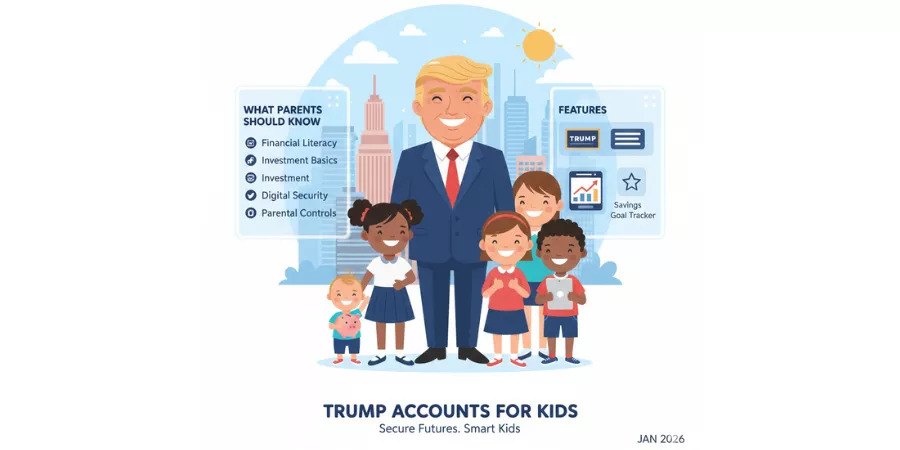
Parents nowadays have to make more financial decisions than ever before. One of such policies that has attracted considerable attention is Trump Accounts for Kids. These accounts promise to give kids a head start financially from the day they were born. So, it would be a good idea for families to learn about Trump Accounts, their workings, and what parents need to consider before opening one if they want to make the best possible decision regarding their children’s financial future.
Trump Accounts are a creation of the One Big Beautiful Bill Act of 2025 and are going to be implemented starting 4th July 2026. The objective is straightforward: children should be entitled to grow their wealth through market investments starting from birth.
Many factors matter to families such as the age, eligibility, type of investment, contribution limits, tax treatment, and long-term planning.
This article outlines exactly how Trump Accounts operate and what parents need to know right now to make the most of this new opportunity.
What are Trump Accounts?
Trump Accounts for Kids are a new type of savings and investment account for minor children, insured by the federal government, and meant to help kids learn about money early and make wealth over a long time.
Such accounts are very close to traditional IRAs in how they operate, only they have specialized children’s rules. The government issues a baby gift of seed money to each US infant born in designated years, and after that, parents get the whole contribution capacity.
Unlike a usual IRA where the account holder, and only the account holder, can contribute from their earned income, Trump Accounts allow for the financial input of parents, relatives, friends, employers, and even charitable organizations for a child’s future. Families all over the country have been fascinated by the long-term possibilities of these accounts.
Who Qualifies for a Trump Account for Kids
Eligibility is straightforward. A child must:
- Be a S. citizen.
- Have a Social Security number.
- Be under 18 years old when the Trump Account is opened.
The most attractive feature is the one-time federal seed payment. Children born between January 1, 2025 and December 31, 2028 qualify for a $1,000 government contribution when the account is established before the year they turn 18. This contribution is automatic once parents open the account and does not count against annual contribution limits.
For children outside that birth window, parents can still open a Trump Account, but the federal $1,000 seed money does not apply. Even so, contributions from family and other sources remain valuable to build early savings.
How to Open a Trump Account
Parents or legal guardians have several ways to set up a Trump Account for a child:
- IRS Form 4547: Submitting this form to accompany a tax return notifies the government that a child’s Trump Account should be created.
- Dedicated Online Portal: It is expected that the portal will be operational by the summer of 2026, enabling households to open accounts directly.
There’s no need to hold on. A lot of financial advisors suggest that parents submit Form 4547 along with their 2025 tax return so that the account will be set up to receive contributions as soon as the program kicks off in July 2026.
How Trump Accounts Work: Savings and Investment Rules
What sets Trump Accounts apart from other savings tools is how the money is invested and protected.
Tax Advantages and Investment Growth
Trump Accounts are tax-advantaged, which implies that the investment earnings grow without being taxed until that time when withdrawals are made. However, there are significant differences when compared to a traditional IRA:
- Contributions from employers or the federal government are exempt from taxes.
- Contributions from family and friends are made with after-tax dollars and will be subjected to taxes upon withdrawal.
- After the age of 18, if funds are withdrawn, for tax purposes they are considered as traditional IRA withdrawals.
Investment Options
Money in Trump Accounts should be put into low-cost mutual funds or exchange-traded funds (ETFs) that track broad U.S. stock indexes, such as the S&P 500. This reduces speculation and promotes long-term growth through the overall performance of U.S. companies instead of individual stocks.
The main point of this investment strategy is to grow money exponentially through many years. If people keep adding money to the account and the markets do well, a Trump Account can become a pretty big nest egg when a child turns into an adult.
Contribution Limits and Who Can Contribute
Parents should know the contribution rules:
- Up to $5,000 total per child per year from all contributors combined.
- Employers can contribute up to $2,500 per year toward an employee’s child’s account.
- Government and charitable contributions do not count toward the $5,000 li
Anyone can contribute: parents, relatives, friends, and employers. This flexibility is one of the reasons many financial planners see Trump Accounts for Kids as a powerful tool for early wealth building.
When Families Can Use Trump Account Funds
The funds which exist in Trump’s accounts are designated for usage throughout his life. People can access their funds from the account after they reach 18 years of age but this access comes with specific rules. The account establishes a traditional IRA system which becomes active when the account holder turns 18 years old.
At that point, the funds can be used for a range of purposes:
- Education expenses
- First-time home purchase
- Start-up capital for a business
- Long-term savings or retirement planning
Parents should weigh their long-term goals when planning contributions and should consider how these accounts fit into broader financial planning.
What Parents Should Know Before Opening an Account
Here are some practical issues every parent should consider:
- Costs and Charges: Even after the caps on expenses are low, Trump Accounts could have the investment fees related to the selected funds. Investigate how charges can eat up your returns in the long run.
- Financial Goals: Ask yourself what you want the account to do. Most families reform their Trump Accounts for education or housing purposes. Some families, however, might think it is better to focus on their retirement and diversified investments besides these accounts.
- Tax Impact: Understand how your contributions will affect your taxes both now and in the future. Your own contributions to your employer’s plan can qualify for immediate tax benefits for working parents.
- Market Risk: Investment accounts are at the mercy of market performance. Generally, saving money over the long run is one of the ways that help lessen the negative effects of volatility; however, the risk is still there. The market will go up and down and you should be prepared for that.
Conclusion
Trump Accounts for Kids offer parents an innovative means to prepare for their children’s futures financially. They utilize a combination of initial government funding, the option for family and community to contribute regularly, and the potential for wealth generation through investment in the market over time.
Hence, familiarity with the mechanism of such accounts and awareness of the points of consideration for parents before starting one is vital for the children’s financial benefit for years to come.
Families should keep an eye on the launch process in 2026, prepare documentation, and consult a financial advisor to integrate Trump Accounts into broader planning. The sooner you understand the mechanics, the sooner you can act with confidence and purpose.
Frequently Asked Questions About Trump Accounts
What are Trump Accounts?
Trump Accounts are tax-advantaged savings and investment accounts for children under age 18 created by the One Big Beautiful Bill Act (OBBBA) of 2025. They are intended to help families begin building financial assets for their children early.
These accounts function like a custodial individual retirement account (IRA) for kids. A parent, guardian, or custodian opens and manages the account on behalf of the child until they turn 18.
Who is eligible for a Trump Account?
A child qualifies if they:
- Are a S. citizen, and
- Have a valid Social Security number, and
- Are under 18 years old when the account is established.
Only one Trump Account may be opened per child. Additional contributions can be made by parents, relatives, friends, or employers.
Is there free money in a Trump Account?
Yes. Children born between January 1, 2025 and December 31, 2028 are eligible for a one-time $1,000 federal contribution into their Trump Account when it is opened.
This is often called the seed contribution because it gives each eligible child a starting balance in their account before any additional deposits from family or other contributor
When can you open a Trump Account?
Trump Accounts are not open yet. The program officially begins accepting initial deposits on July 4, 2026.
Before that, parents can file IRS Form 4547 with the 2025 tax return so the account exists when the program launches
Who can open a Trump Account?
Parents or legal guardians are the only people who can open a Trump Account for a child, but others can contribute money to it once it exists.
After opening, family members, friends, and even employers (under certain limits) can contribute funds to help the account grow.
How much can be contributed to a Trump Account each year?
Total contributions from all sources (parents, relatives, friends) are capped at $5,000 per year per child. Employers may contribute up to $2,500 of that amount.
Federal seed money and charitable donations do not count toward the annual contribution limit.
When can money be withdrawn from a Trump Account?
Money generally cannot be withdrawn before age 18. This lock-in rule helps the funds grow over time.
After age 18, the account automatically becomes similar to a traditional IRA and then can be used for long-term goals such as education, home purchase, business start-up, or retirement savings
How are Trump Accounts taxed?
- Contributions by the federal government or employers are not taxed as income to the child when deposited.
- Contributions by family members and friends are made from after-tax dollars and are not deductible.
- Withdrawals after age 18 are taxed like traditional IRA distributions.
This means families will pay income tax on the money when the child takes it out in the future.
What investments are allowed inside a Trump Account?
Funds in Trump Accounts are required to be invested in low-cost index mutual funds or exchange traded funds (ETFs) that track a broad U.S. stock market index.
The investment choice is limited, which is intentional. It protects the account from speculative, high-risk investments and ensures long-term market exposure.
How do Trump Accounts compare to other savings options like 529 plans?
Trump Accounts share some features with retirement accounts like IRAs but differ from dedicated education accounts like 529 plans. Some differences:
- 529 plans offer tax-free withdrawals for qualified education expenses.
- Trump Accounts grow tax-deferred and are taxed when withdrawn after age 18.
- Trump Accounts allow broader use after age 18 (education, home, retirement, etc.).
Each option has strengths; choosing depends on financial goals and family priorities.
Can employers help fund Trump Accounts?
Yes. Employers can contribute to Trump Accounts on behalf of their employees’ children, up to a $2,500 annual limit per child.
Some major employers, including Bank of America and JPMorgan Chase, have pledged support and even matching contributions to encourage participation.
Are Trump Accounts suitable for every family?
Trump Accounts are new and powerful, but not the only option. Some families may still prefer traditional custodial accounts, 529 education plans, or Roth IRAs depending on their goals.
Financial planners recommend evaluating how Trump Accounts fit into a household’s overall saving strategy before making decisions.
Where can I find official Trump Accounts information?
The official Trump Accounts site is trumpaccounts.gov. There you will find enrollment details and updated guidance as the program launches in 2026.
Parents should also watch IRS announcements and tax guidance related to Trump Accounts as regulations continue to roll out.
Are Trump Accounts guaranteed to grow?
No. Growth depends on market performance. Index-based investing historically trends upward over decades, but short-term dips are possible.
Can Amazon or other non-family members contribute?
Yes. Anyone, including employers and friends, can contribute within the annual limits.
Is the $1,000 contribution automatic?
Only for eligible children born between 2025 and 2028 whose parents open the Trump Account.