
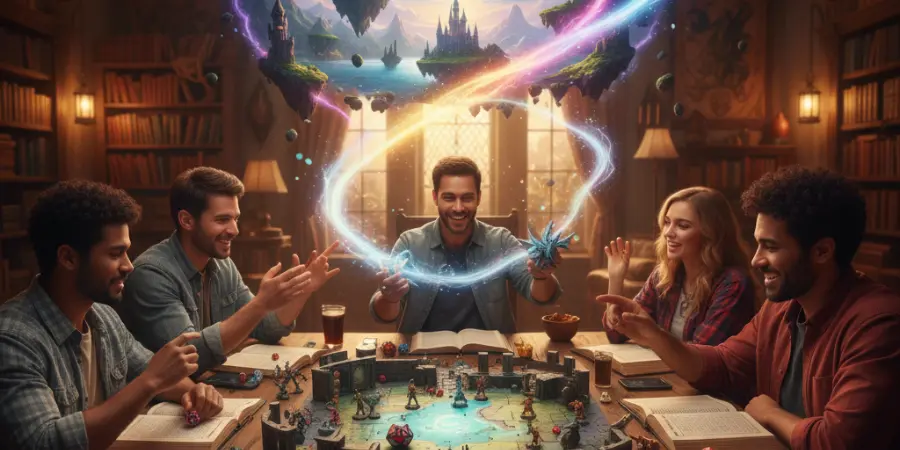
Tabletop role-playing games represent a unique fusion of collaborative storytelling, strategic gameplay, and boundless imagination, where players assume fictional characters and navigate epic adventures guided by dice rolls and shared narrative creation. Once relegated to basement gatherings and niche gaming circles, TTRPGs have exploded into mainstream consciousness, reshaping entertainment culture and creating vibrant global communities united by their passion for interactive storytelling.
Understanding Tabletop Role-Playing Games
At their essence, tabletop role-playing games create structured frameworks for collaborative fiction. Players adopt the personas of unique characters—ranging from valiant knights and cunning rogues to spacefaring explorers and occult investigators—while a Game Master orchestrates the narrative, portraying supporting characters and adjudicating rule interactions. This dynamic produces emergent storytelling where player choices genuinely influence plot trajectories and world development.
The mechanical foundation rests on several interconnected elements. Character sheets document numerical representations of abilities, skills, and equipment, translating narrative concepts into quantifiable game mechanics. Dice rolls introduce probability and unpredictability, determining action success or failure while maintaining dramatic tension. The Game Master synthesizes these mechanical outcomes with narrative description, transforming abstract numbers into vivid story moments that advance the collective tale.
Sessions typically unfold episodically, with each gathering presenting challenges, social encounters, and exploration opportunities. These individual sessions connect into extended campaigns that can span months or years, allowing character development arcs and intricate plot threads to mature organically through sustained play.
The Historical Evolution of Role-Playing Games
The genealogy of tabletop role-playing games traces back to military strategy simulations and miniature wargaming traditions. Kriegsspiel, a 19th-century Prussian military training exercise, established foundational concepts of referee-adjudicated scenarios and probabilistic outcomes. These strategic gaming traditions evolved through the mid-20th century as hobbyists adapted wargaming principles for recreational purposes.
The pivotal transformation occurred through experimental sessions run by Dave Wesely in the late 1960s. His “Braunstein” games introduced individual player objectives and character-specific goals rather than team-based military command, planting seeds for role-playing’s emergence. Dave Arneson built upon these innovations while developing Blackmoor, a fantasy-themed campaign that emphasized individual character progression and personal storytelling.
Gary Gygax and Dave Arneson collaborated to formalize these concepts into Dungeons & Dragons, published in 1974 as the world’s first commercial tabletop role-playing game. This landmark release established genre conventions—character classes, experience point progression, dungeon exploration, and fantasy archetypes—that would define the medium for decades. D&D’s commercial success demonstrated viable markets for role-playing products, catalyzing industry formation.
The subsequent decades witnessed explosive diversification. Games like Traveller (1977) transported players to science fiction universes, while Call of Cthulhu (1981) adapted horror literature into investigative gameplay. Mechanical innovation flourished as designers experimented with alternative resolution systems, moving beyond D&D’s class-and-level framework toward point-buy character creation and narrative-focused mechanics. This creative ferment established TTRPGs as legitimate artistic medium capable of exploring diverse genres, themes, and play styles.
Contemporary TTRPG Play Experiences
Modern tabletop role-playing accommodates diverse participation formats and player preferences. Traditional face-to-face gatherings remain popular, with groups meeting regularly around kitchen tables or in dedicated gaming spaces. These in-person sessions preserve social intimacy and physical props like miniatures, maps, and specialized dice that enhance tactile engagement.
Digital platforms have dramatically expanded accessibility and participation options. Virtual tabletops like Roll20 and Foundry VTT replicate physical play through browser-based interfaces featuring digital character sheets, integrated dice rollers, and dynamic mapping tools. Video conferencing enables geographically dispersed players to maintain regular campaigns, dissolving geographical barriers that historically limited group formation.
Game systems have proliferated to serve specialized interests and mechanical preferences. Dungeons & Dragons maintains market dominance, particularly its fifth edition, which balances mechanical depth with accessibility for newcomers. Pathfinder appeals to players seeking intricate character customization and tactical combat resolution. Call of Cthulhu serves horror enthusiasts with investigation-focused mechanics and sanity systems. Powered by the Apocalypse games prioritize narrative collaboration over simulation, while OSR (Old School Renaissance) titles resurrect early D&D’s deadly simplicity.
Campaign structures vary considerably based on group preferences and scheduling realities. Extended campaigns develop complex storylines across dozens of sessions, allowing deep character exploration and world-building. One-shot adventures provide complete narrative experiences in single sessions, ideal for introducing newcomers or exploring unfamiliar systems without extended commitments.
The Broader Cultural Impact of TTRPGs
Tabletop role-playing games cultivate distinctive social and creative benefits extending beyond entertainment value. The collaborative nature demands communication, negotiation, and collective problem-solving as players coordinate strategies and navigate challenges together. This shared investment in fictional worlds creates genuine bonds among participants, with gaming groups often developing into lasting friendships maintained through years of regular play.
Creative development emerges naturally through TTRPG participation. Players exercise improvisational skills by responding spontaneously to unexpected narrative developments. Character portrayal encourages empathy development as participants inhabit perspectives divergent from their own identities. Game Masters develop narrative construction abilities, learning to balance preparation with flexibility while managing group dynamics and pacing dramatic tension.
Educational and therapeutic applications have gained recognition among professionals. Teachers employ TTRPGs to develop literacy skills, collaborative learning, and creative expression in classroom contexts. Therapists utilize role-playing frameworks to address social anxiety, autism spectrum challenges, and trauma processing through structured fictional scenarios that provide safe exploration spaces.
The contemporary TTRPG renaissance owes considerable debt to streaming platforms and actual-play content. Shows like Critical Role transformed private gaming sessions into public entertainment, demonstrating role-playing’s dramatic potential to massive audiences. These productions demystified TTRPG play for curious observers while showcasing diverse play styles and game systems, effectively serving as extended tutorials that lowered entry barriers for prospective players.
Frequently Asked Questions
Q: Do I need expensive materials to start playing TTRPGs? A: Most systems require only rulebooks (often available as PDFs), basic dice sets, and writing materials. Many publishers offer free introductory rules, making initial investment minimal.
Q: How long does a typical TTRPG session last? A: Session length varies by group preference, typically ranging from 2-4 hours. Some groups play shorter weekly sessions while others prefer extended monthly gatherings.
Q: Can TTRPGs be played solo? A: While traditionally group activities, solo RPG systems and journaling games enable single-player experiences through specialized mechanics and prompts.
Q: Are TTRPGs only for fantasy settings? A: TTRPGs span all genres including science fiction, horror, mystery, western, superhero, and contemporary settings. Systems exist for virtually any fictional premise.
Q: What’s the difference between tabletop RPGs and video game RPGs? A: TTRPGs offer unlimited creative freedom through human Game Masters who adapt to player choices, whereas video games operate within programmed parameters despite sophisticated mechanics.
Conclusion: The Enduring Magic of Shared Stories
Tabletop role-playing games occupy a distinctive cultural space where structured gameplay mechanics merge with boundless narrative possibility, creating experiences simultaneously competitive and collaborative, strategic and improvisational. Their resurgence in digital spaces demonstrates fundamental human desires for meaningful social connection and participatory storytelling that transcends technological mediation.
As gaming culture continues evolving, TTRPGs adapt while preserving core appeals: the thrill of collaborative creation, the satisfaction of character development, and the joy of shared adventures with trusted companions. Whether you’re drawn to tactical combat, intricate mysteries, or dramatic character arcs, the diverse TTRPG landscape offers entry points for every interest and play style.