
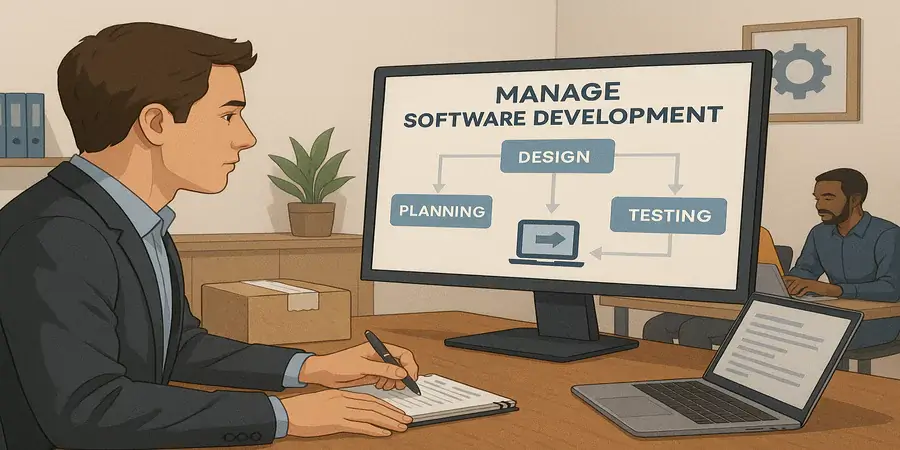
The transition from writing code to managing software development teams requires fundamentally different skills than technical proficiency alone provides. Successful engineering managers balance competing demands delivering features quickly while maintaining code quality, empowering team autonomy while ensuring alignment with business objectives, and managing technical debt while meeting aggressive deadlines. The Standish Group’s CHAOS Report consistently shows that only about 30% of software projects succeed in delivering on time, on budget, and with planned functionality. Understanding what distinguishes successful software development management requires examining both the technical workflows and human dynamics that determine project outcomes.
Establishing Technical Foundation and Architecture Decisions
Software development management begins before your team writes the first line of code, with architectural decisions that constrain or enable effective development throughout the project lifecycle. The choice between monolithic architecture, microservices, or serverless approaches fundamentally affects team structure, deployment complexity, and scalability characteristics.
Architecture Decision Framework:
| Architecture Type | Best For | Management Implications |
|---|---|---|
| Monolithic | Small teams, rapid prototyping | Simple deployment, coordination bottlenecks at scale |
| Microservices | Large teams, independent scaling | Complex orchestration, enables autonomous teams |
| Serverless | Event-driven workloads | Reduced infrastructure management, vendor lock-in risk |
Technology stack selection involves balancing factors beyond pure technical merit team expertise, hiring market realities, ecosystem maturity, and long-term maintainability all influence which frameworks position your project for success. Choosing cutting-edge technologies may attract talented developers but risks betting your project on immature ecosystems with incomplete documentation. Established technologies offer stability but may struggle attracting developers who perceive older stacks as career-limiting.
Technical debt management represents perhaps the most challenging balancing act in software development. Completely preventing technical debt proves impossible in real projects facing market pressures, but allowing debt to accumulate unchecked eventually cripples development velocity. Successful managers establish explicit technical debt tracking, allocate regular time for addressing high-priority debt, and communicate cost-benefit trade-offs to stakeholders in business terms rather than technical jargon.
Implementing Agile Methodologies Beyond Ceremonial Practice
Agile software development has become orthodoxy in the industry, yet many teams practice “Agile theater” performing ceremonies without embracing the principles that make iterative development effective. Real Agile implementation requires cultural changes beyond adopting Scrum or Kanban frameworks, with teams genuinely embracing working software over comprehensive documentation and responding to change over following rigid plans.
Essential Agile Practices:
- Sprint Planning: Refine backlog items near the top with detailed acceptance criteria; leave lower-priority items intentionally vague until needed
- Daily Standups: Focus on progress toward sprint goals and identifying blockers, not status reports to managers
- Retrospectives: Create psychological safety for honest discussion of what’s working and what needs improvement
- Backlog Refinement: Ongoing process ensuring upcoming work has sufficient detail for accurate estimation
Sprint planning effectiveness depends on product backlog quality, which requires ongoing refinement rather than one-time specification. Well-maintained backlogs contain user stories sized appropriately for completion within sprints, with acceptance criteria defining “done” specifically enough that developers and stakeholders agree on outcomes without ambiguity.
Daily standups commonly devolve into status report sessions where team members recite activities to managers rather than coordinating among themselves. Effective standups focus on progress toward sprint goals, with the team collectively problem-solving when issues threaten commitments. Managers should resist using standups for status gathering and instead facilitate peer coordination while remaining alert for morale issues or recurring obstacles.
Managing Distributed Teams and Remote Development
The shift toward distributed software development fundamentally changes management approaches. Asynchronous communication becomes essential when team members work across multiple time zones, requiring explicit documentation practices and decision-making processes that don’t depend on everyone being available simultaneously. Tools like GitHub pull requests with detailed descriptions, design documents in shared repositories, and recorded architecture discussions create persistent context remote team members can reference regardless of time zone.
Successful remote development managers establish clear communication norms:
- Urgent production issues: Immediate response expected
- Slack/team chat: Response within hours during working hours
- Email: Response within 1-2 business days
- Documentation updates: No immediate response required
Building team cohesion proves more challenging when developers lack informal office interactions. Deliberate virtual social time helps distributed teams develop the trust and rapport that enable difficult technical conversations and honest feedback. However, opt-in approaches work better than mandatory “fun” activities that team members may resent.
Code Review, Quality Assurance, and Continuous Integration
Code review practices significantly impact both software quality and team dynamics. Effective review processes catch bugs, share knowledge, and maintain consistent style without demoralizing developers or creating bottlenecks. Reviews emphasizing learning and improving collective code ownership build collaborative cultures, while reviews focused purely on finding mistakes create adversarial dynamics.
Code Review Best Practices:
| Practice | Guideline | Why It Matters |
|---|---|---|
| PR Size | 400-500 lines maximum | Defect detection drops dramatically beyond this |
| Review Time | Within 24 hours | Maintains development momentum |
| Tone | Constructive suggestions | Builds psychological safety |
| Blocking Issues | Distinguish must-fix from nice-to-have | Prevents bottlenecks while maintaining quality |
Pull request size substantially affects review effectiveness, with research showing that defect detection rates drop dramatically as changes exceed 400-500 lines of code. Managers should encourage frequent small merges over infrequent large changes, establishing team norms around breaking work into reviewable increments.
Continuous integration and deployment infrastructure transforms from optional tooling to essential management leverage. Automated testing catching regressions before code reaches production prevents the quality death spiral where developers spend increasing time debugging failures instead of building features. However, maintaining comprehensive test suites requires dedicated effort that competes with feature development, making test investment another balancing act requiring explicit prioritization.
Stakeholder Management and Scope Negotiation
Software development managers serve as buffers protecting engineering teams from constant priority shifts and scope changes while ensuring legitimate business needs receive appropriate technical responses. This requires translating technical constraints into business terms stakeholders understand explaining that “refactoring the authentication system” means “reducing security vulnerability risk and enabling faster feature development.”
Scope creep represents one of the most common reasons software projects fail. Effective scope management requires treating requirements as negotiable rather than fixed, with explicit prioritization forcing stakeholders to choose between competing features when timeline constraints make implementing everything impossible. The MoSCoW method provides structure:
- Must have: Critical features without which the project fails
- Should have: Important but not vital features
- Could have: Desirable features if time permits
- Won’t have: Features explicitly excluded from current scope
Managing up influencing organizational leadership decisions often determines whether development teams have the time, resources, and support needed for success. This involves choosing battles strategically, building credibility through consistent delivery, and framing requests in terms of organizational objectives rather than engineering preferences.
Measuring Success Beyond Feature Delivery
Traditional software metrics like lines of code written or bugs fixed often measure the wrong things, incentivizing behaviors that harm overall project health. Modern development management requires identifying leading indicators predicting future problems while they’re still addressable.
Key Performance Indicators:
- Velocity Trends: Declining story points per sprint suggest accumulating technical debt or team morale issues
- Code Churn: Frequently changing files indicate design problems needing refactoring
- Deployment Frequency: Elite teams deploy multiple times daily
- Lead Time for Changes: How quickly can you implement changes? Elite: hours; Good: days
- Time to Restore Service: Elite: under one hour
- Change Failure Rate: Elite: under 15% of changes cause production issues
These “Four Keys” metrics from Google’s DORA research distinguish high-performing software teams. While achieving elite performance isn’t realistic for every team, these metrics establish clear targets and identify which capabilities require improvement for accelerating delivery without sacrificing reliability.
Building Sustainable Development Practices
Software development management ultimately aims to create conditions where talented engineers can do their best work consistently rather than achieving occasional heroic efforts followed by burnout. This requires establishing sustainable practices around reasonable work hours, explicit prioritization preventing context-switching overload, and psychological safety enabling teams to acknowledge problems honestly.
Emerging capabilities like using an llm for software development to enhance code generation, automated testing, and documentation represent tools for improving productivity, but they don’t eliminate fundamental management challenges. Technology can amplify good management but won’t compensate for unclear requirements, poor communication, or misaligned incentives that create conditions for project failure regardless of tools employed.
The most successful development managers recognize that sustainable velocity beats temporary speed, that team retention matters more than individual heroics, and that investing in process improvements and technical health creates compounding returns that tactical feature shortcuts can never match.
ALSO READ: Ways a Nearshore Software Development Company Can Optimize Your Budget