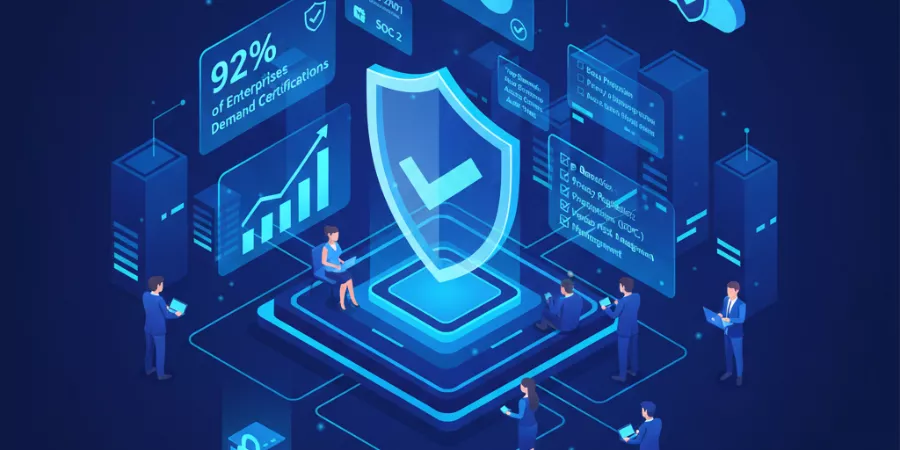
Enterprise SaaS buying has changed, and SaaS providers are now judged by compliance maturity. Ten years ago, teams chose tools based on features and UI. Today, the deal often depends on security compliance, especially SOC 2.
That shift is driven by two forces:
- SaaS sprawl inside every organization
- A real-world surge in costly breaches and regulatory pressure
IBM reports the global average cost of a data breach reached USD 4.88 million in 2024, which is why SOC 2 becomes non-negotiable in enterprise deals. That single number explains why enterprise buyers ask security questions before they even ask about pricing.
This article breaks down the latest SaaS security compliance statistics, what enterprises demand today, and how security leaders evaluate modern SaaS vendors.
Why SaaS Security Compliance Became a Deal Requirement
Enterprise customers are under pressure to prove three things:
- Customer datais protected
- Access is controlled
- Risk is governed, audited, and repeatable
For SaaS providers, compliance is no longer a checkbox. It is a vendor selection filter, and SOC 2 is often the first proof buyers demand from independent third-party auditors.
Okta’s Businesses at Work 2024 shows a sharp increase in compliance tool adoption, including 120% year-over-year growth in data compliance tools and related security tools. That is a strong signal: enterprises are funding compliance programs and tooling, fast.
Key SaaS Security Compliance Statistics (Enterprises Pay Attention To)
Here are the stats shaping SaaS buying decisions right now.
1) Breach cost is pushing compliance budgets upward
IBM’s 2024 breach research reports:
- USD 4.88Maverage global breach cost (record high)
- Major impact from business disruption and unmanaged data sources (shadow data)
This is why procurement teams demand proof of security controls before contract signature, because breaches can cause financial loss and reputational damage.
2) SSPM adoption is rising because SaaS risk sits outside classic security stacks
The Annual SaaS Security Survey Report shows SSPM adoption jumped from:
- 17% in 2022
- to 44% in 2023
That growth matters because it reflects a common enterprise realization: IAM, CASB, and SIEM alone do not cover every SaaS misconfiguration and SaaS-to-SaaS exposure.
3) SaaS threats stay persistent, even for mature organizations
Cloud Security Alliance highlights that even large organizations experience SaaS breaches and that SaaS application security is a major concern across industries.
For enterprise buyers, this validates a simple stance:
If risk is constant, compliance needs to stay continuous.
What Enterprises Demand From SaaS Vendors in 2026
Enterprise SaaS security requirements have matured. Buyers now evaluate SaaS providers through a compliance lens that includes audits, governance, controls, ongoing proof, and stricter compliance requirements across legal, procurement, and security teams.
: Below are the non-negotiables enterprises expect, starting with SOC 2 readiness.
Security Compliance Frameworks Enterprises Expect
SOC 2 Type II compliance (trust, controls, evidence)
While SOC 2 Type II is the gold standard, many vendors start with Type I first for B2B SaaS, especially in North America, and it is governed by the American Institute of Certified Public Accountants under System and Organization Controls reporting and widely recognized as a security framework for enterprise vendor validation.
Type I validates whether controls are designed properly at a point in time across criteria like Security, Availability, Confidentiality, Privacy, and Processing Integrity through a SOC 2 audit, giving buyers clarity into your audit process.
Enterprises usually demand either Type 1 or Type II depending on deal stage:
- SOC 2 Report availability (Type II) with a formal audit reportthat procurement can review internally.
- Up-to-date audit period coverage
- Clear mapping to security controls: access control, change management, monitoring, incident response
Many SaaS companies pursue SOC 2 Type 1 because it directly supports enterprise sales cycles.
ISO 27001 certification (global security management standard)
ISO 27001 signals structured governance through an ISMS (Information Security Management System) backed by documented risk assessment practices.
Enterprises value ISO 27001 because it supports recognized security standards across industries.
- global compliance alignment
- risk management maturity
- standardized control coverage
Modern SaaS vendors increasingly pair ISO 27001 with SOC 2 to satisfy both global and US enterprise expectations.
GDPR, data privacy compliance, and data residency commitments
For every Software as a Service (SaaS) supplier dealing with personal data of EU citizens, protecting customer data becomes contract-critical and the GDPR imposes obligations that influence contract negotiations. Companies require:
- explanation of the legal basis for processing.
- rules for data retention.
- management of requests from data subjects.
- preparedness for notification in case of a security breach.
- provision for hosting in the region and data residency options if needed.
Besides, a lot of enterprise contracts that are situated outside the EU follow the model of GDPR-type terms as the default privacy baselines.
Access Control and Identity Security Requirements for SaaS
Enterprise SaaS security compliance is impossible without identity security, which is why SaaS providers must prioritize SSO, MFA, and RBAC.
MFA enforcement and phishing-resistant authentication
Okta’s analytics depict a steady transition toward the utilization of more robust authentication methods and the enhancement of security measures in various organizations.
- The expectations of large companies are:
- MFA implemented for every user with the highest privileges
- MFA offered to all users
- anti-phishing measures (security tokens, passwords, FIDO2)
SSO integration and centralized identity governance
The expectations of the enterprise SaaS purchasing groups are as follows:
- SAML 2.0 / OIDC functionality to be supported
- Automatic user management through SCIM
- Implementation of role-based access control (RBAC)
- Application of least privilege model
Single Sign-On and SCIM together lessen the risks of new employee failing to get access, and also they help to minimize the number of unauthorized user accounts and to be ready for the audit.
Privileged access management for admin actions
Enterprises increasingly treat admin access as a separate compliance tier:
- time-based privileged access
- approval workflows
- session logging
- admin action audit trails
This demand increases when SaaS tools touch finance, healthcare, identity, payroll, or customer records.
Data Protection Controls Enterprises Audit in SaaS Platforms
Encryption at rest and encryption in transit
Enterprise SaaS security compliance expects:
- TLS enforced in transit
- strong encryption at rest
- key management clarity
- separation of tenant data
Encryption language alone is insufficient. Buyers ask how encryption is implemented, monitored, and audited by SaaS providers.
Backup, disaster recovery, and resilience evidence
Compliance reviews often include:
- RPO and RTO targets
- backup retention timelines
- restore testing frequency
- failover readiness
IBM’s breach insights repeatedly highlight the real-world cost of disruption. Enterprises want proof that SaaS resilience reduces downtime risk.
Secure data deletion and retention policy enforcement
Enterprises demand:
- configurable retention policies
- deletion verification
- export support for data portability
- proof that deleted customer datastays deleted
This requirement shows up in procurement checklists because regulated industries carry retention obligations and audit exposure.
Continuous Monitoring, Logging, and Audit Readiness
Compliance is no longer annual. Enterprises expect near-real-time visibility, even after SOC 2 is completed.
Audit logs that are detailed, exportable, and tamper-resistant
SaaS providers must offer audit logs that include:
- sign-ins
- permission changes
- admin activity
- API token events
- security setting changes
- data access events where applicable
Enterprises also want:
- log streaming to SIEM
- standard formats
- retention controls
Incident response expectations and breach readiness
Enterprises require:
- documented incident response plan to handle security incidents
- defined SLAs for response and notification
- evidence of tabletop exercises
- clarity on customer communication process
CSA emphasizes that SaaS platforms are frequent targets and that SaaS breaches impact large organizations.
SaaS Misconfiguration Risk and SSPM Growth
SaaS risk often comes from configuration drift, excessive permissions, shadow apps, and unmanaged integrations.
SaaS-to-SaaS integrations increase the attack surface
Enterprises demand visibility into:
- OAuth grants
- third-party app permissions
- token usage
- connected applications
These integrations deliver productivity, yet they also create lateral movement paths across SaaS environments.
SSPM has become an enterprise requirement
The Annual SaaS Security Survey Report identifies rapid SSPM growth, reinforcing that enterprises see SaaS posture management as essential for modern compliance and governance.
Enterprises now ask vendors:
- Do you support SSPM monitoring?
- Can we control risky configurations?
- Can we detect unusual access patterns?
The Enterprise SaaS Compliance Checklist (What Buyers Ask in Security Reviews)
Below are the questions enterprise procurement and security teams use to evaluate SaaS providers during SaaS vendor evaluation, including SOC 2 evidence checks.
Compliance and audit proof
- SOC 2 Report available for review?
- ISO 27001 certificate issued by accredited body?
- Penetration testing frequency and summary reports, along with a recent SOC 2 audit timeline?
- Security policy documentation available to support a compliance audit?
Identity and access security
- SSO support (SAML, OIDC)?
- MFA enforcement options?
- SCIM provisioning support?
- Admin permissions model and RBAC?
Data protection and privacy
- Data encryption methods and key management?
- Tenant isolation architecture?
- Data retention and deletion workflows?
- Data residency and regional hosting options?
Monitoring and detection
- Audit logs included and exportable?
- SIEM integrations supported?
- Alerts for risky events?
- Security event response process?
Vendor risk and governance
- Sub-processor list and change notifications?
- SLAs for uptime and incident response?
- Business continuity documentation?
- Secure SDLC and vulnerability management process?
Why Compliance Tools and Security Controls Are Growing Inside Enterprises
Okta’s dataset shows compliance tools are accelerating in adoption across organizations.
This aligns with what SaaS buyers experience:
- more vendor assessments
- more security questionnaires
- more evidence requests
- shorter tolerance for vague answers
What enterprises really want is simple: repeatable trust and long-term customer trust.
How SaaS Vendors Can Win Enterprise Deals Faster With Compliance Readiness
If you sell SaaS to enterprises, security compliance becomes part of revenue and a long-term compliance journey.
Build a compliance evidence pack
Include:
- SOC 2 Report+ ISO artifacts
- architecture diagrams
- data flow diagrams
- penetration test executive summary
- incident response plan overview
- sub-processor disclosures
Make security controls visible and configurable
Enterprises reward SaaS vendors who provide:
- SSO + SCIM by default
- MFA enforcement controls
- granular admin roles
- audit logging with export options
- strong default security settings
Treat compliance like product quality
Compliance should improve usability, not slow it down, even during a SOC 2 audit cycle.
The best SaaS security compliance programs feel invisible to regular users and powerful to administrators.
Future Trends in SaaS Security Compliance (2026 and Beyond)
Based on enterprise behavior and security research, these trends are shaping what comes next:
Continuous compliance replaces annual compliance
Buyers increasingly want ongoing evidence, driven by breach impact and expanding SaaS surfaces.
SaaS security posture becomes a board-level metric
SaaS security compliance reporting is moving upward, from IT teams to risk leadership, because financial impact is measurable.
SaaS governance expands across the entire business
SSPM growth indicates that SaaS security is no longer isolated to security teams. It becomes shared across IT, risk, procurement, and compliance.
Final Takeaway
Enterprises demand SaaS security compliance because the stakes are high and measurable. Breach costs remain severe, SaaS sprawl continues, and audit scrutiny keeps growing.
If a SaaS vendor proves SOC 2 readiness:
- SOC 2 and ISO readiness
- identity-first controls
- audit visibility
- privacy and data protection maturity
- continuous monitoring and governance
Then enterprise buyers move faster, trust deeper, and renew longer with those SaaS providers.