
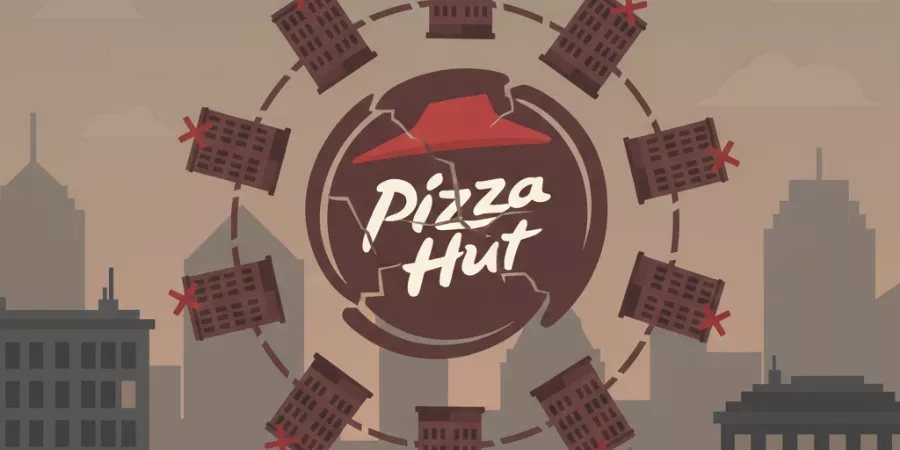
Pizza news moved fast this week when executives confirmed targeted closures. The announcement clarified that pizza hut closing locations is no longer rumor. Yum! Brands has told investors it will shutter roughly 250 outlets in the United States during the first half of 2026 as part of a strategic review and a reset of the brand.
What this means is simple and urgent. The phrase pizza hut closing locations captures both a short-term operational decision and a wider signal: one of the oldest national pizza players is trimming its footprint to stop losses and reposition the brand. The company framed the move as the removal of pizza hut underperforming stores and part of a program dubbed “Hut Forward.”
The Hard Numbers
Executives said the closure count would be about 250 units, a meaningful number for a chain that operates thousands of restaurants across multiple markets. Multiple outlets reported the same figure, explaining that the closures represent roughly 3 to 4% of Pizza Hut’s U.S. footprint. That is why headlines read pizza hut closing 250 locations in the US and why investors and local communities are paying attention.
The board pointed to declining sales as a reason for the move. Put plainly: pizza hut sales decline has been building for more than a year, and same-store results showed a drop in late 2025 and into early 2026. Yum! Brands described the closures as a way to remove the most unprofitable units and to help the overall franchise network return to growth.
Why This Happened: Economics and Competition
There are three linked forces behind the closures.
- First, foot traffic and order volume fell in many local markets. When stores do not meet break-even targets they become candidates for closure. That is why company statements emphasize pizza hut underperforming stores.
- Second, competition intensified. Domino’s, regional chains, delivery-only brands, and independent pizzerias have all taken share in certain neighborhoods. That competitive pressure shows up in the numbers as pizza hut same store sales drop and as a more general pizza industry downturn in markets where consumers cut discretionary spend.
- Third, changing customer habits and technology investments matter. Consumers now expect fast, low-cost delivery, slick digital ordering, and frequent new product drops. Where Pizza Hut’s local operators could not keep pace, executives flagged those units as likely to be included among closures described in public statements as pizza hut closing locations.
The Corporate Angle: what Yum! Brands said
Yum! Brands has publicly acknowledged the problem and is leading a formal review of options for the brand. Executives described the closures as targeted, and they paired the announcement with a plan to invest in marketing and systems for better-performing units.
Analysts called this a classic rationalization: prune weak stores, support the core, and consider strategic transactions if needed. The company framed many of the closures under the label yum brands pizza hut closures.
Local Impact: Franchisees, Employees, and Customers
When headlines use pizza hut closing locations the immediate effect is local. Franchisees will lose revenue from closed outlets, workers face layoffs or transfers, and regular customers lose a nearby option.
From a community perspective, these closures feed broader pizza restaurant closures statistics that analysts track for commercial real estate and labor forecasts. Storefronts in marginal markets are most at risk. For many towns, a Pizza Hut shutter is a signal of hard times in that particular retail corridor.
Industry Ripple Effects
Closures of this scale create measurable reverberations.
Investors and competitors watch for patterns. If pizza hut closing 250 locations in the US is just the start, other chains could follow, increasing the rate of fast food pizza closures across the sector. Alternately, a successful reset could stabilize competition and slow closures elsewhere.
Analysts will track three specific metrics closely: same-store sales trends, franchisee churn, and the speed of new-store openings. The metric pizza hut same store sales drop captured on quarterly calls will determine whether closures stop or accelerate.
The Strategic Pivot: Hut Forward and Beyond
Yum! Brands described a program intended to reposition the chain. That program includes marketing support, technology upgrades, and a review of franchise agreements. The stated goal is to turn the headline pizza hut closing locations into a smaller, healthier system with higher average unit volumes.
That does not guarantee a quick fix. Turning around a national brand requires time and coordinated investment. If investors lose patience, the company might consider selling the brand, a move that would reshape the conversation from closures to yum brands pizza hut closures as part of a strategic transaction.
What This Means for Consumers
For customers, the change is tangible. If a local store closes, delivery areas shrink, menu prices may rise as operators cover fixed costs, and loyalty programs may lose punch in affected markets. The short-term effect is a worse selection for consumers near closed locations, which contributes to headlines about broader pizza restaurant closures.
The long-term effect depends on how well the brand invests in remaining stores. Better menus, faster delivery, and improved digital ordering could make the surviving locations better than before. If that does not happen, the result is a sustained pizza industry downturn in markets where price and convenience dominate choice.
Media Marratives and Misinformation Risk
Headlines that scream pizza hut closing locations are attractive, but they can mislead if readers assume widespread collapse. The reality is targeted closures in a large system. Reporting makes a point: closing 250 units is serious, but it is not equivalent to Domino’s vanishing or to an extinction-level event for pizza chains. Still, the move feeds a narrative about restaurant chain struggles that is easy to amplify.
It is essential to look beyond the headline. Analysts recommend checking earnings call transcripts, regulatory filings, and official company statements to separate strategic pruning from systemic failure.
The Economic Backdrop: Why Many Chains are Reassessing Footprints
The broader economy plays a role. Rising costs, higher wages, and shifting discretionary income influence whether a local unit survives. These pressures have led to an uptick in fast food pizza closures across secondary markets in recent quarters.
While one brand prunes, others double down on franchising and aggressive promotions. That tug-of-war creates a volatile market for pizza operators. The industry is watching the impact of pizza hut closures on pizza industry closely because the decisions made now will shape pricing and service models going forward.
What Franchisees Should Consider Now
Operators in at-risk markets should take three steps immediately.
- First, analyze local sales data against market benchmarks. If your store resembles the publicly discussed pizza hut underperforming stores, act to cut costs and increase average order value.
- Second, invest in customer acquisition through targeted promotions. Winning a few percentage points of market share can be the difference between inclusion and exclusion from lists of pizza hut closing locations.
- Third, open lines of communication with corporate and fellow franchisees. The coming months will require coordinated action if the network is to stabilize.
The Outlook: Is This a One-time Rationalization or the Start of a Larger Trend?
That depends on execution. If the company successfully modernizes and lifts the average unit economics, the closures could be a painful but productive reset. If same-store sales continue to slide and the program fails to deliver, the phrase pizza hut sales decline may reappear with new numbers, and the closure tally could rise.
At present, analysts treat the announced closures as targeted and proportional to the size of the system. Still, investors and operators will watch metrics like pizza hut same store sales drop every quarter for signals that the strategy is working.
Conclusion
The headlines are blunt: pizza hut closing locations and pizza hut closing 250 locations in the US are accurate descriptions of an announced program to shutter roughly 250 underperforming units. Those closures are a symptom of weaker sales, intensified competition, and the need to modernize an older system. They also matter beyond the brand because large-scale retrenchment feeds a broader conversation about pizza industry downturn, fast food pizza closures, and restaurant chain struggles.
For communities, franchisees, and customers, the coming months will test whether the brand can turn painful cuts into long-term strength. For analysts and competitors, the closures will be another data point in a shifting industry. The core question remains: will the investments tied to the closures create a healthier, more modern chain, or will the public narrative of yum brands pizza hut closures deepen into something more consequential for the whole pizza sector?