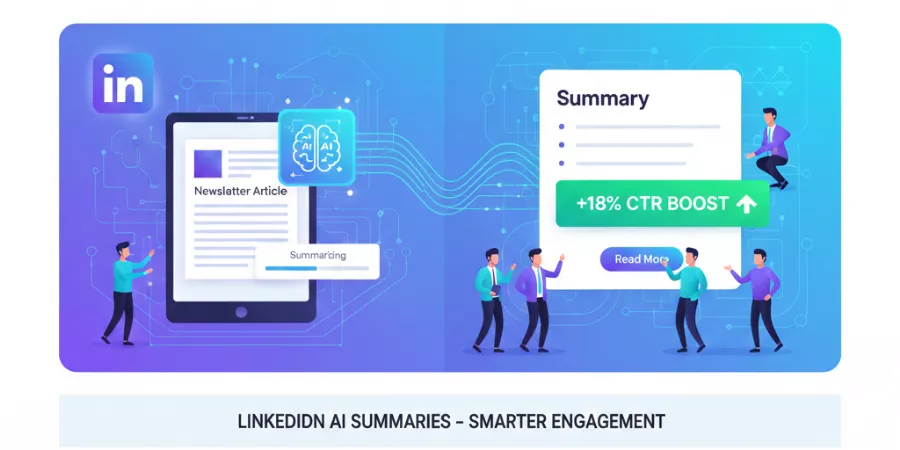
LinkedIn has launched an innovative AI-powered feature that’s transforming newsletter performance on the platform. The professional networking site now automatically generates 50-word article summaries that appear alongside newsletter content, and early data shows impressive results with click-through rates increasing by an average of 18%.
For B2B publishers, content marketers, and digital magazine creators like Global Publicist 24, this development represents a significant opportunity to improve content discovery and audience engagement on the world’s largest professional network.
What Is LinkedIn’s AI Summarization Feature?
The new tool uses advanced natural language processing to automatically extract key points from newsletter articles and create compelling preview text. When users scroll through their LinkedIn feed, they encounter these AI-generated summaries before deciding whether to engage with the full content.
Unlike traditional meta descriptions that publishers write manually, LinkedIn’s AI analyzes entire article content, identifies the most important information, and crafts previews specifically designed to maximize reader interest and clicks.
The feature is currently rolling out to LinkedIn newsletter publishers globally, with availability expanding throughout February and March 2025. Publishers don’t need to take any action to enable it—the AI automatically generates summaries for all published newsletter content.
Why This Matters for B2B Content Publishers
This AI summarization tool creates several strategic advantages for professional content creators:
Improved Content Discoverability
LinkedIn’s algorithm favors content with higher engagement rates. When AI-generated summaries boost click-through rates, the algorithm responds by showing that content to broader audiences.
Better CTR translates directly into increased organic reach, helping newsletter posts appear in more feeds without additional promotional investment.
Significant Time Savings
Publishers no longer need to manually craft compelling preview text for every LinkedIn newsletter post. The AI handles summarization automatically, freeing content teams to focus on article creation rather than distribution optimization.
For publishers managing multiple newsletters or posting frequently, this time savings compounds significantly. A team publishing five newsletters weekly saves approximately 2-3 hours per week previously spent on preview text optimization.
Consistent Quality Standards
AI-generated summaries maintain professional formatting and tone consistency across all posts. This prevents the quality variations that naturally occur when different team members write preview text manually.
Consistent preview quality reinforces brand professionalism and improves overall audience perception of your publication.
Mobile User Optimization
Mobile devices account for 57% of LinkedIn’s user base. The 50-word summary format provides ideal information density for mobile screens, giving users enough context to make decisions without overwhelming small displays.
Mobile users particularly benefit from concise, scannable previews that communicate value quickly.
How LinkedIn’s AI Creates Effective Summaries
Analysis by digital marketing professionals reveals several patterns in how LinkedIn’s summarization algorithm prioritizes content:
Opening Paragraph Emphasis
The AI weights content from the first 100-150 words most heavily when generating summaries. Information in your opening paragraph has the highest probability of appearing in the AI-generated preview.
This creates a clear optimization opportunity: structure your article openings to include the most compelling hooks, statistics, and value propositions.
Keyword Density Recognition
Terms appearing multiple times throughout an article are more likely to be included in AI-generated previews. The algorithm interprets repeated keywords as central to the article’s theme and message.
However, this doesn’t mean keyword stuffing. Natural repetition of core concepts through varied phrasing works better than forced keyword insertion.
Action-Oriented Language Selection
LinkedIn’s AI favors sentences containing strong verbs, specific numbers, and concrete outcomes over vague generalizations or abstract concepts.
Compare these examples:
Generic:Â “This article discusses important marketing trends”
Action-Oriented:Â “Discover three tactics that increased campaign ROI by 34%”
The AI gravitates toward the second style because it communicates specific, measurable value.
Professional Topic Relevance
Content directly related to professional development, business strategy, career advancement, and industry trends receives prominence in AI summary generation.
LinkedIn’s algorithm understands its audience seeks professional value, so it prioritizes previewing information most relevant to career-focused users.
Optimization Strategies for Publishers
To maximize effectiveness of LinkedIn’s AI summarization feature, B2B publishers should implement these tactical improvements:
Structure Opening Paragraphs Strategically
Think of your first 150 words as a standalone summary. Include:
- Your article’s primary value proposition or key insight
- One compelling statistic or data point
- Your target audience and their benefit
- A hint of the solution or information provided
This structure ensures that even if a reader only sees the AI-generated summary, they understand your article’s value and feel motivated to click through.
Use Clear, Professional Business Language
Avoid jargon, idioms, complex sentence structures, and overly creative language in opening sections. The AI performs best with straightforward, professional business communication.
Save creative flourishes and industry-specific terminology for later in your article after the opening summary section.
Include Specific Numbers and Metrics
Statistics, percentages, dollar amounts, and quantifiable results catch AI attention and make summaries more compelling to readers.
Examples of effective number usage:
- “Increase LinkedIn engagement by 47%”
- “Save 3 hours weekly with this automation”
- “Generate 250% more qualified leads”
- “Reduce customer acquisition cost by $42”
Numbers provide concrete evidence of value and naturally attract both AI selection and human attention.
Write Strong Topic Sentences
Begin each paragraph with a clear topic sentence summarizing the main point. This organizational structure helps AI understand your article hierarchy and extract the most important information.
Well-structured content with obvious topic sentences also improves readability for human audiences, creating dual benefits.
Optimize Your First 150 Words Specifically
Given the AI’s emphasis on opening paragraphs, treat this section as critical real estate. Write and rewrite your first 150 words until they include:
- Primary keyword naturally integrated
- Main argument or thesis clearly stated
- Key benefit explicitly communicated
- Specific, action-oriented language
Consider drafting your opening paragraph last, after completing the full article, to ensure it accurately and compellingly summarizes your entire message.
Early Success Stories from Indian Publishers
Several Indian B2B publishers report positive results from LinkedIn’s AI summarization feature:
TechNext India Case Study
This technology-focused newsletter saw average CTR increase from 4.2% to 5.1% within two weeks of the feature rollout—a 21% improvement in click performance.
“The AI summaries are actually better than our manually written previews,” admits founder Arjun Mehta. “They’re more concise and action-oriented than what our team typically produced.”
TechNext India subsequently restructured their editorial process to optimize opening paragraphs specifically for AI extraction, leading to further engagement improvements.
Marketing Insights Weekly Results
Mumbai-based newsletter covering digital marketing trends experienced a 23% increase in average read time alongside higher CTR.
The publication attributes this to better-qualified traffic. When AI summaries accurately represent article content, readers who click through have genuine interest and engage more deeply with the material.
Competitive Advantage Through AI Optimization
As LinkedIn emphasizes newsletter content as a core platform feature, publishers who understand AI summarization optimization gain significant advantages.
The platform’s 900+ million professionals represent valuable audiences for B2B content. Improved visibility through better CTR translates directly into:
- Faster subscriber growth
- Higher engagement rates
- Increased brand authority
- More business development opportunities
- Greater professional networking potential
Publishers who master this optimization early establish competitive moats that later entrants struggle to overcome.
Technical Implementation Considerations
For publishers using various content management systems, consider these technical optimization tactics:
Schema Markup Implementation
Add Article schema markup to help LinkedIn’s AI better understand your content structure, authorship, and key themes.
Proper schema implementation signals important content elements like:
- Main headline and subtitle
- Author information and credentials
- Publication date and update history
- Article category and tags
Clean HTML Structure
Remove excessive formatting, unnecessary div wrappers, and complex CSS that might interfere with AI content extraction.
LinkedIn’s AI works best with semantic HTML that clearly indicates content hierarchy through proper heading tags, paragraph tags, and list elements.
Mobile-First Content Design
Ensure articles display properly on mobile devices since LinkedIn’s predominantly mobile audience affects both human readers and how effectively AI can parse your content.
Mobile optimization includes:
- Responsive images that load quickly
- Short paragraphs readable on small screens
- Touch-friendly navigation elements
- Fast page load times
Fast Loading Performance
Page speed affects both user experience and how efficiently AI tools can crawl and analyze content. Slow-loading pages may result in incomplete AI analysis and less effective summaries.
Optimize images, minimize JavaScript, use content delivery networks, and implement caching to ensure fast page loads.
Comparison with Manual Meta Description Writing
Publishers often wonder whether AI-generated summaries outperform manually crafted meta descriptions. The data suggests AI summaries excel in several areas:
| Factor | AI-Generated Summaries | Manual Meta Descriptions |
|---|---|---|
| Consistency | High – same quality every time | Variable – depends on writer |
| Time investment | Zero – fully automated | 5-10 minutes per article |
| Keyword optimization | Automatic based on content | Requires SEO knowledge |
| Mobile optimization | Perfect for all screen sizes | May exceed ideal length |
| A/B testing capability | Limited – LinkedIn controls | Full control for manual testing |
The main advantage of manual meta descriptions remains customization and A/B testing capability. Publishers who want maximum control over messaging may prefer writing custom previews, but most benefit from AI automation’s consistency and efficiency.
Future Developments to Watch
LinkedIn continues investing heavily in AI features for content creators. Upcoming developments likely include:
Personalized Summaries:Â AI-generated previews customized based on individual user interests and professional backgrounds.
Multi-Format Support:Â Summarization expanding beyond text to video content, podcasts, and document uploads.
Performance Analytics:Â Detailed metrics showing how AI summaries perform compared to manual previews.
Language Expansion:Â Support for non-English content as LinkedIn grows internationally.
Publishers who stay current with these developments and adapt optimization strategies accordingly will maintain competitive advantages in LinkedIn’s evolving content ecosystem.
Key Takeaways for B2B Publishers
LinkedIn’s AI article summarization represents a significant opportunity for professional content creators. The 18% CTR improvement demonstrates real business impact that translates into audience growth and engagement.
Success requires:
- Optimizing opening paragraphs for AI extraction
- Using clear, professional language with specific metrics
- Structuring content with strong topic sentences
- Maintaining mobile-first design principles
- Monitoring performance and iterating based on results
Publishers who implement these strategies position themselves for sustained success on LinkedIn’s platform regardless of future algorithm changes.