
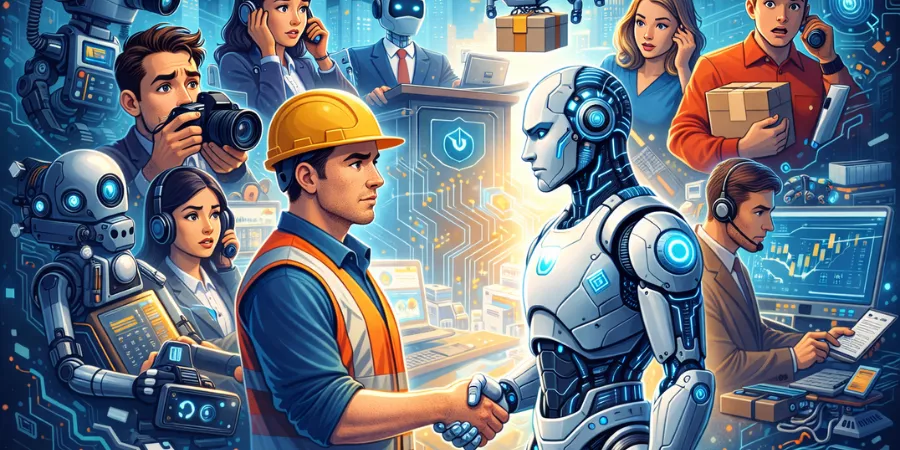
AI is replacing jobs faster than most people expected, and the disruption is no longer limited to factory floors or call centers. White-collar roles, creative work, and skilled office jobs are all being affected.
Goldman Sachs estimates AI could displace the equivalent of 300 million full-time jobs globally. McKinsey projects that 30% of US work hours could be automated by 2030. The IMF says nearly 40% of global jobs will face significant AI job disruption in the coming years. These numbers come from institutions that governments and major corporations rely on for planning, not from speculative tech blogs.
The jobs most at risk are the ones built on repetitive tasks, rule-based decisions, and high-volume information processing. AI handles that work faster, cheaper, and without breaks.
Here are the 10 jobs AI will replace by 2030:
- Data entry clerks
- Customer service representatives
- Telemarketers
- Bookkeeping and basic accounting clerks
- Routine content writers and copywriters
- Translators handling standard documents
- Travel agents
- Cashiers
- Legal assistants doing routine research
- Graphic designers producing templated work
Each section below covers what the role involves, why AI targets it specifically, what tools are already doing the work, and what the realistic outlook looks like.
What Types of Jobs is AI Most Likely to Replace?
AI does not replace work randomly. It follows money and friction.
The roles disappearing fastest share a few common traits. They involve the same steps repeated every day. They follow rules that can be written down. They deal mostly in information, reading it, sorting it, moving it somewhere else. And they are expensive enough that companies feel the pressure to cut them, but not so specialized that replacing them is complicated.
Think of it this way. If someone could hand you a 500-page document and a clear rulebook, and you could produce a predictable output every time, that job is exactly what automation software was built for.
According to research published through MIT and ARXIV, around 80% of the US workforce will see at least 10% of their daily tasks affected by large language models. Most of those people will not lose their jobs outright. But the nature of the work will shift, the headcount will thin, and the skills that mattered 5 years ago will matter less.
Which Jobs Will AI Replace by 2030?
1. Will AI Replace Data Entry Clerks?
What they do: Type information from physical documents, forms, and records into digital systems. Verify entries and keep databases updated.
Why AI replaces it: Optical character recognition, natural language processing, and automation tools read, extract, and enter data faster than any human team, with fewer errors and no fatigue. If the work is predictable and rule-based, software handles it cheaper every time.
Already happening: Tools like UiPath, Microsoft Power Automate, and Google Document AI are handling data extraction and entry at scale. Banks, insurance companies, and hospitals have been quietly deploying these systems for years, not as a pilot, as standard practice.
The World Economic Forum estimates more than 7.5 million data entry jobs will be eliminated by 2027, making it the largest projected job loss in any single profession.
Outlook: These roles will largely disappear from large organizations by 2030. Smaller companies will be the last holdouts, but the direction is not in question.
2. Will AI Replace Customer Service Representatives?
What they do: receive questions, solve complaints, and accept requests, via telephone, email, and live chat.
Why AI replaces it: AI chatbots have now become able to have multi-turn conversations, get the whole history of accounts, do refunds, and solve problems entirely without a human being involved. The quality difference between AI and a live agent has already reduced quite significantly over the past two years alone.
Already happening: In 2024, Klarna claimed that its AI assistant was already performing the work of 700 full-time employees and that the response time per request was reduced to less than 2 minutes. Approximately 80,000 jobs in the US were eliminated in the period 2022-2024, which involve customer service jobs. This is one of the white-collar categories that is at high risk of automation by AI noted by Goldman Sachs.
Outlook: Query processing can be virtually completely automated. The human component will be reduced to toil and trouble multiplications and emotional sensitive discussions, a small aspect of the workforce as we know it in the present day world.
3. Are Telemarketers at Risk From AI Automation?
What they do: Call potential customers, pitch products or services, and attempt to generate sales or schedule appointments.
Why AI replaces it: AI voice agents make calls, handle objections, follow scripts, and adapt tone, around the clock, at scale, with no commission and no turnover. Some are already difficult to distinguish from a human caller.
Already happening: Companies like Synthflow, Bland AI, and Retell AI are deploying AI voice agents for outbound sales in real estate, insurance, and SaaS. This profession already had some of the highest attrition rates in any industry. AI is finishing what poor working conditions started.
Outlook: Near-complete automation of cold calling and script-based outbound sales within three to 5 years. One of the fastest-moving disruptions on this list.
4. Will AI Replace Bookkeepers and Accounting Clerks?
What they do: Record financial transactions, reconcile accounts, prepare basic reports, and manage payroll data.
Why AI replaces it: Most bookkeeping follows fixed rules, categorize this, flag that, reconcile these columns. That is precisely the kind of work automation software handles without error or delay. With AI layered on top, anomaly detection, reporting, and the entire financial close cycle now run with minimal human input.
Already happening: QuickBooks, Xero, and FreshBooks auto-categorize transactions and flag discrepancies. Larger organizations use platforms like Workiva and BlackLine that automate entire close processes. Goldman Sachs listed bookkeepers and accounting clerks among the most exposed occupations in their analysis of over 800 job types.
Outlook: Entry-level bookkeeping is already largely gone at major firms. Tax strategy, financial advisory, and audit judgment will remain, but those roles represent a small fraction of the people currently working in accounting support.
5. Will AI Replace Content Writers and Copywriters?
What they do: Write product descriptions, templated blog posts, SEO articles, email newsletters, and social media captions, mostly following repeatable formats.
Why AI replaces it: Large language models produce this type of content instantly and at scale. For companies generating high volumes of formulaic writing, the economics are impossible to argue with. The Associated Press has used AI to auto-write financial stories since 2014. Most readers never noticed.
Already happening: ChatGPT, Gemini, Jasper, and Copy.ai are already integrated into content pipelines at agencies and e-commerce companies globally. The WEF projects a 31% decline in writing roles by 2030 as AI absorbs the commodity end of the market.
Outlook: Writers producing generic, research-light, templated content face serious displacement. Writers who bring original reporting, distinct voice, or genuine subject expertise will still find work, but in a smaller, more competitive market.
6. Are Translation Jobs Being Replaced by AI?
What they do: Convert written content from one language to another, documents, websites, manuals, and routine business communications.
Why AI replaces it: DeepL, Google Translate, and GPT-4 now produce translations for standard documents accurate enough for most business purposes, with no human review required. Research tracking translator employment has found a measurable correlation between AI tool adoption and declining demand for routine translation work.
Already happening: Website localization, product manuals, and standard business correspondence have largely shifted to AI-powered tools at companies of all sizes. The professional translator’s market has narrowed quickly.
Outlook: Literary translation, certified legal translation, and culturally nuanced content will hold on. Standard document and commercial translation work has largely moved to AI and is not coming back.
7. Will AI Replace Travel Agents Completely?
What they do: Research and book flights, hotels, tours, and complete itineraries for individuals and businesses.
Why AI replaces it: AI travel tools now aggregate options across hundreds of sources, personalize recommendations based on stated preferences, and produce complete multi-stop itineraries in seconds, tasks that used to take a human agent hours.
Already happening: Google Travel, Booking.com’s AI assistant, and platforms like Mindtrip are handling complex trip planning end-to-end. Corporate travel management is moving toward fully automated booking systems. The internet removed the general-purpose travel agent in the 2000s. AI is now removing the ones who survived by handling complexity.
Outlook: The high-end luxury travel consultant, the person with personal relationships at specific properties and genuinely hard-to-replicate expertise, will persist in a narrow segment. For most general travel work, the role is going.
8. Are Cashier Jobs Being Automated Away?
What they do: Scan items, process payments, handle returns, and assist customers at checkout.
Why AI replaces it: Self-checkout removed the need for a dedicated cashier in most grocery and retail environments a decade ago. Amazon Go stores took it further, computer vision tracks items automatically, and customers walk out without scanning or stopping at all.
Already happening: Amazon has licensed its Just Walk Out technology to airports, stadiums, and retailers globally. Walmart and Target have reduced checkout staffing steadily for years. Automation is projected to eliminate around 20 million retail and manufacturing jobs worldwide by 2030.
Outlook: Some human presence in retail will remain for assistance and experience. But the cashier as a large-scale employment category is in a structural decline that does not reverse.
9. Will AI Replace Legal Assistants and Paralegals?
What they do: Review documents, research case law, summarize legal precedents, and draft standard correspondence and contracts.
Why AI replaces it: Reading contracts, flagging relevant clauses, summarizing thousands of discovery documents, this is exactly the information-dense, pattern-recognition work that large language models handle well. It used to take teams of junior associates and paralegals days. AI does it in minutes.
Already happening: Harvey AI, Casetext (now part of Thomson Reuters), and LexisNexis AI Lexis+ are already in use at major law firms. Goldman Sachs specifically identified legal and administrative assistant roles as among the most exposed in their AI jobs analysis.
Outlook: The disruption is concentrated at the bottom of the legal career ladder, entry-level researchers, document reviewers, routine-task paralegals. Those roles are shrinking. Senior positions requiring client relationships and complex judgment will adapt. But the pipeline into those senior roles is narrowing.
10. Is AI Replacing Graphic Designers?
What they do: Create social media graphics, basic ad layouts, presentations, flyers, and templated marketing materials.
Why AI replaces it: Midjourney, Adobe Firefly, DALL-E, and Canva’s AI tools generate professional-quality visuals and layouts from a text prompt in seconds. Marketing teams that previously needed a designer for every asset now produce content in-house.
Already happening: Ad agencies use AI to generate dozens of creative variants daily. Social media managers handle content that once required a dedicated designer. The WEF projects a 17% decline in graphic design roles by 2030.
Outlook: Design as a discipline is not disappearing. Art directors, UX designers, brand strategists, and illustrators with genuinely distinctive styles will remain in demand. What is going on is the lower end, production design, templated content, basic ad variants, where AI is already faster and cheaper than any human.
Which Jobs are Safe From AI Automation?
The jobs surviving, and in some cases growing, through this shift share qualities that are genuinely hard to automate.
Skilled trades are one of the clearest examples. An electrician troubleshooting a wiring fault in an older building, a plumber solving a problem no diagram anticipated, an HVAC technician calibrating a system in a cramped attic, this is physical, contextual, unpredictable work. Robots cannot do it reliably. The WEF expects skilled trades demand to grow, not shrink, through 2030.
Nursing and direct patient care are similarly resistant. Medicine requires clinical judgment, yes, but it also requires physical presence, emotional attunement, and the ability to read a room in ways that matter. You cannot automate the hand that holds the patient’s hand at the end of a diagnosis.
Teaching, counseling, social work, these are relational at their core. The ability to read a person, adjust in real time, and create genuine connection is not a feature you can add to a language model.
And at the high end of technical fields, research scientists, complex engineers, product strategists, original thinking remains irreplaceable. AI is good at synthesizing what already exists. Creating what does not yet exist is still a human job.
How Can Workers Prepare for AI Job Automation?
This is not about becoming a machine whisperer or pivoting into something completely foreign. It is more practical than that.
Start using AI tools in whatever you do now. Not to replace your thinking, to extend it. The people who thrive through this transition will be the ones who understand how to work alongside these systems and know where the output needs a human to make it actually good. That skill is immediately valuable in almost any industry.
Move toward the parts of your role that require judgment. The more a job involves ambiguity, relationships, or decisions where the stakes are real and the context matters, the safer it is. If you can consciously shift more of your time and attention toward that kind of work, you are building a more defensible position.
The WEF estimates that 39% of existing skill sets will be outdated between 2025 and 2030. That is a significant rate of change. Short courses, certifications, and genuinely experimenting with new tools matter more right now than they would have five years ago.
Specialization protects in a way that breadth no longer does. Being generally useful at something AI can do at scale is a precarious position. Being the person with deep expertise in a specific domain, especially one involving trust, experience, or judgment, is much harder to displace.
Will AI Create More Jobs Than It Destroys?
It is worth pausing on the numbers before leaving you with the fear version of them.
The WEF’s Future of Jobs Report 2025, drawing on data from over 1,000 employers across 55 economies, projected 92 million job displacements by 2030, and 170 million new jobs created. Net gain of 78 million roles.
That is an optimistic read. It is not wrong. But it papers over the real difficulty, which is that the jobs lost and the jobs created are not in the same places, the same industries, or the same income brackets. The disruption is concentrated. A data entry clerk in a mid-sized insurance firm does not automatically transition into an AI engineering role.
The challenge is not the total number of jobs. It is the distance between the work that disappears and the work that replaces it, and how much support exists to close that gap.
That is a policy question as much as a personal one. But individuals cannot wait for policy. The shift is already underway.
Frequently Asked Questions: Jobs AI Will Replace
Will AI replace most jobs by 2030?
Not most jobs, but a significant portion of tasks within those jobs, and a real number of roles entirely. Goldman Sachs estimates the equivalent of 300 million full-time jobs could be automated globally. McKinsey suggests around 14% of workers worldwide may need to change career paths entirely by 2030. The realistic version is transformation at scale, concentrated in specific types of work, not a sudden disappearance of employment.
Which careers are safest from AI automation?
Skilled trades, electricians, plumbers, HVAC technicians, are among the most protected. Nursing, teaching, mental health care, and roles requiring complex judgment, physical dexterity, or genuine human relationships are also far more resistant to near-term AI replacement.
What industries will grow because of AI?
AI and machine learning roles themselves, cybersecurity, data engineering, renewable energy, and healthcare technology are all projected to grow strongly. The WEF lists green energy, care economy, and AI development as the fastest-growing employment areas through 2030.
How can workers prepare for AI job automation?
Start using AI tools now, in whatever work you already do. Learn where the technology falls short, that is where human value concentrates. Move toward roles requiring judgment, relationships, or creativity. Take the reskilling question seriously earlier rather than later; the workers who adapt fastest are already treating it as part of their job.
Will AI replace customer service jobs completely?
For routine, script-driven interactions, largely yes. The transition is already well advanced at major companies. High-stakes, emotionally complex, or relationship-dependent customer interactions will remain human-led for longer. But the overall size of the customer service workforce will continue to shrink.
What jobs feel safe right now but are actually at risk?
Bookkeepers, junior paralegals, routine translators, and basic graphic designers all still feel stable to many of the people in them. The disruption in these fields is real but often invisible until it happens quickly. Roles tied to high-volume, formulaic output are more exposed than they appear from the inside.
Key Takeaways
- Jobs AI will replace fastest are those built around repetitive, rule-based, or data-heavy tasks.
- Data entry, customer service, telemarketing, bookkeeping, and routine writing face the sharpest near-term displacement.
- PwC estimates up to 30% of jobs could be automated by the mid-2030s, the pace is already faster than most expected.
- 170 million new jobs will be created through 2030, according to the WEF, but they require different skills and sit in different industries than the ones disappearing.
- The workers who adapt fastest will be those who treat AI as a tool to extend their value, not a threat to wait out.
- The window to get ahead of this is still open, but not indefinitely