Who This Guide Is For
This analysis is for Indian equity investors evaluating IRFC shares and struggling to understand whether the stock’s current valuation justifies investment despite recent price momentum.
You’ll learn how to analyze railway financing economics, interpret IRFC’s financial metrics in proper context, and make informed decisions based on business fundamentals rather than short-term price movements.
The Current Market Situation
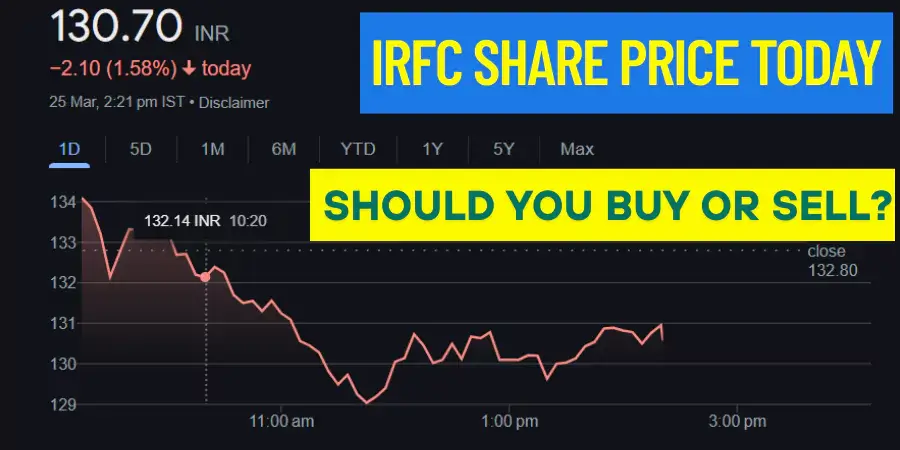
IRFC shares traded at ₹132.85 on today, representing a 2.45% intraday gain extending a six-session winning streak. The stock opened at ₹130.70 and reached an intraday high of ₹134.60.
Trading volumes hit 16.3 million shares with turnover of ₹2,165 crore. The volume-weighted average price (VWAP) stood at ₹132.92.
Recent Price Performance:
- 1-month: +3.64%
- 3-month: -12.63%
- 1-year: +18.2%
- 3-year: +467.42%
Market capitalization stands at ₹1.73 lakh crore, making IRFC one of India’s largest NBFCs by market value.
Understanding IRFC’s Business Model
Indian Railway Finance Corporation operates as a dedicated financing arm for Indian Railways’ rolling stock and infrastructure projects. The company raises funds through bonds and term loans, then lends to the Ministry of Railways at spreads generating net interest income.
Core Business Economics:
IRFC borrows at AAA credit ratings (backed by sovereign guarantee) at rates typically 50-100 basis points below commercial banks. It lends to Indian Railways at government-determined rates creating 1-1.5% net interest margins.
This model provides stability through government backing but limits growth to railway capital expenditure budgets. Unlike commercial banks facing credit risk and NPAs, IRFC’s loan book carries zero credit risk given the sovereign borrower.
The trade-off? Limited pricing power and growth constrained by government railway investment rather than market opportunities.
Key Financial Metrics Analysis
Valuation Multiples (Current):
- P/E Ratio: 26.54
- P/B Ratio: 3.37
- Dividend Yield: 1.13%
- EPS (TTM): ₹5.00
- ROE: 12.8%
Sector Comparison Context:
IRFC’s P/E of 26.54 significantly exceeds the NBFC sector average of 13.36, suggesting the market prices in substantial growth expectations or quality premium.
For comparison, REC Limited trades at P/E of 8.2x, PFC at 7.5x, and HUDCO at 12.3x. Even high-quality housing finance companies like LIC Housing Finance trade at P/E around 15-18x.
This valuation gap raises questions about sustainability. Either IRFC deserves premium multiples due to growth visibility and asset quality, or the stock has run ahead of fundamentals requiring correction.
Book Value Premium:
The 3.37x P/B ratio means investors pay ₹3.37 for every ₹1 of book value. For context, NBFCs typically trade at 1-2x book value unless demonstrating exceptional ROE (20%+) or growth (25%+ CAGR).
IRFC’s ROE of 12.8% doesn’t justify 3.37x P/B using standard Gordon Growth Model math. At 12.8% ROE and ~8% growth, fair P/B should be closer to 1.8-2.2x assuming 10-12% cost of equity.
Revenue and Profitability Trends
FY 2023-24 Financial Performance:
- Total Revenue: ₹26,600 crore
- Net Profit: ₹6,400 crore
- Net Interest Margin: 1.42%
- Cost-to-Income Ratio: 8.2%
Growth Analysis:
Revenue grew 12.3% YoY driven by expanding loan book to Indian Railways. The loan book stood at ₹4.95 lakh crore as of March 2024, up from ₹4.38 lakh crore previous year.
Net profit growth of 8.23% YoY lags revenue growth due to rising cost of funds. As interest rates increased through RBI’s monetary tightening cycle, IRFC’s borrowing costs rose while lending rates to Railways (government-determined) adjusted more slowly.
This NIM compression represents a key risk. If borrowing costs rise faster than lending rate adjustments, profitability suffers despite loan book growth.
Government Policy Impact
Navratna Status Implications:
IRFC’s March 2024 elevation to Navratna PSU status grants enhanced financial autonomy including:
- Investment powers up to ₹1,000 crore without government approval (vs. ₹500 crore previously)
- Joint venture formation authority
- Overseas office establishment rights
- Enhanced board decision-making powers
Practically, these powers matter less for IRFC than for manufacturing PSUs given its captive lending model. The company doesn’t need investment flexibility when its mandate remains railway financing.
The real benefit? Signaling effect demonstrating government confidence, which institutional investors interpret positively.
Railway Capital Expenditure Linkage:
India’s FY 2024-25 railway budget allocates ₹2.55 lakh crore for capital expenditure, up from ₹2.40 lakh crore previous year (6.25% growth).
IRFC finances approximately 60-65% of this capex, suggesting loan book growth of ₹90,000-95,000 crore in FY25. At current interest spreads, this translates to ₹1,300-1,400 crore additional net interest income, or ~8-9% profit growth assuming stable margins.
This government spending commitment provides revenue visibility that private sector lenders lack, explaining some valuation premium.
Diversification Strategy Evaluation
IRFC announced plans to diversify beyond core railway financing into:
- Renewable energy project financing
- Power sector infrastructure
- Mining equipment financing
- PPP infrastructure projects
Realistic Assessment:
While diversification sounds positive, execution faces challenges. IRFC’s core competency lies in managing government relationships and sovereign-backed lending, not credit underwriting for commercial projects.
Entering power project or mining financing requires credit analysis capabilities, sector expertise, and risk management systems that IRFC hasn’t historically needed. Building these capabilities takes years and involves inevitable learning-curve mistakes.
Most successful diversification comes from adjacent markets where existing capabilities transfer. For IRFC, metro rail financing or other government transport infrastructure makes more sense than jumping to mining or commercial power.
Investors should view diversification announcements skeptically until actual loan book composition changes and profitability from new segments materializes.
Dividend Policy and Shareholder Returns
IRFC declared an interim dividend of ₹0.80 per share in March 2025, representing 1.13% yield at current prices.
Dividend Sustainability Analysis:
At ₹0.80 dividend on ₹5.00 EPS, the payout ratio sits at 16%—extremely conservative for a mature financial institution with stable cash flows.
Comparable PSU financiers maintain 25-35% payout ratios. REC Limited pays ~30%, PFC around 28%. IRFC’s lower payout suggests either:
- Management retains earnings for growth (expanding loan book)
- Regulatory requirements limit distributions
- Conservative approach given government ownership
For income-focused investors, this 1.13% yield significantly underperforms 10-year government bonds at ~6.8% or even savings bank rates around 3-4%. The low yield means investors betting on IRFC must expect capital appreciation rather than income generation.
Valuation Framework and Fair Value Estimation
Discounted Dividend Model Approach:
Using current ₹0.80 annual dividend, 8% assumed growth, and 12% required return (appropriate for low-risk NBFC):
Fair Value = D₁ / (r – g) = ₹0.80(1.08) / (0.12 – 0.08) = ₹21.60
This suggests massive overvaluation. However, this model assumes dividend growth equals business growth—reasonable for mature businesses but not for those retaining most earnings for expansion.
P/E-Based Valuation:
If we assume IRFC deserves sector-average P/E of 13.36: Fair Value = 13.36 × ₹5.00 = ₹66.80
This implies 50% downside from current ₹132.85.
If we grant a 30% quality premium for government backing: Fair Value = 17.37 × ₹5.00 = ₹86.85
Still indicates 35% overvaluation.
P/B Justified by ROE:
Using P/B = (ROE – g) / (r – g) framework: P/B = (0.128 – 0.08) / (0.12 – 0.08) = 1.2x
Current 3.37x P/B implies market expectations of either:
- ROE expanding to 20%+ (unlikely given business model constraints)
- Growth accelerating to 12-15% sustainably (requires major capex increase or diversification success)
- Risk-free rate perceptions driving down required returns
None of these scenarios appear probable, suggesting valuation stretched relative to fundamentals.
Risk Factors Investors Must Consider
Interest Rate Sensitivity:
Rising rates hurt IRFC through two channels. First, higher borrowing costs compress margins when lending rates lag. Second, as a rate-sensitive stock, higher discount rates reduce present value of future earnings.
RBI’s repo rate currently at 6.5% may see cuts in 2025, which would benefit IRFC. However, structural inflation concerns could keep rates higher-for-longer than market expects.
Government Policy Dependence:
IRFC’s entire business depends on government railway investment decisions. Any fiscal constraints forcing capex reduction directly hurt IRFC’s growth regardless of company execution.
The March 2024 interim budget indicated strong railway spending commitment. However, economic slowdowns or fiscal pressures could force reallocation away from infrastructure.
Limited Growth Levers:
Unlike commercial banks that can expand through new products, geographies, or customer segments, IRFC grows only as fast as railway capex. This ceiling on growth potential argues for modest valuation multiples.
Liquidity and Free Float:
Government holds 86.36% stake in IRFC, leaving just 13.64% public float. This limited free float can exaggerate price movements as relatively small buy/sell orders move the stock significantly.
Higher volatility and potential illiquidity during market stress represent non-trivial risks that many retail investors underestimate.
Peer Comparison: IRFC vs. REC vs. PFC
| Metric | IRFC | REC Limited | Power Finance Corp | Sector Average |
|---|---|---|---|---|
| P/E Ratio | 26.54 | 8.2 | 7.5 | 13.36 |
| P/B Ratio | 3.37 | 1.4 | 1.3 | 1.8 |
| ROE | 12.8% | 17.2% | 16.8% | 15.6% |
| Dividend Yield | 1.13% | 4.8% | 5.2% | 3.4% |
| NIM | 1.42% | 2.8% | 2.6% | 2.3% |
| NPAs | 0.01% | 2.1% | 1.8% | 1.4% |
Key Observations:
IRFC trades at 3x+ premium to REC/PFC on P/E despite lower ROE and NIM. The only clear advantage: virtually zero NPAs thanks to sovereign borrower.
This NPA advantage might justify 20-30% valuation premium, but 200-250% premium appears excessive. Either REC/PFC are dramatically undervalued, or IRFC has run too far ahead of fundamentals.
For value-oriented investors, REC and PFC offer better risk-reward at current prices with higher yields, superior ROE, and reasonable valuations offsetting their moderate credit risk.
Investment Decision Framework
For Long-Term Investors (3-5 year horizon):
IRFC offers stable, government-backed business with moderate growth visibility. However, current valuation at 26.5x earnings and 3.37x book leaves little margin of safety.
Patient investors might wait for correction to 18-20x P/E (₹90-100 range) before initiating positions. At those levels, the risk-reward becomes more attractive even if growth proves modest.
For Income Investors:
The 1.13% yield makes IRFC unsuitable for income portfolios. Alternative PSU financiers like REC (4.8% yield) or even government bonds (6.8% YTM) provide far superior income with comparable safety.
For Growth Investors:
IRFC’s ~8% profit CAGR over next 3-5 years (based on railway capex projections) doesn’t justify growth stock valuations. True growth investors should look to private sector banks or NBFCs offering 15-20%+ growth potential.
For Momentum Traders:
The six-day winning streak and positive technical indicators might continue short-term. However, momentum strategies require strict stop-losses given valuation vulnerability to any negative news or broader market correction.
Action Steps for Current and Prospective Investors
If You Own IRFC:
- Calculate your cost basis and returns achieved
- If sitting on 50%+ gains, consider booking partial profits (30-50% position)
- For long-term holdings, set trailing stop-loss at ₹120 (10% below current) to protect downside
- Monitor quarterly results for NIM trends—any compression below 1.3% signals trouble
- Watch for insider transactions; any promoter selling would be major red flag given low float
If Considering Purchase:
- Avoid buying at current 26.5x P/E without correction
- Set buy limit orders at ₹100-105 (20x P/E) for value entry point
- Size positions at 2-3% maximum portfolio weight given single-sector concentration risk
- Compare with REC/PFC which offer better value-for-money currently
- Use systematic approach (SIP-style) if must invest now, averaging ₹10,000-20,000 monthly over 6-12 months
What to Monitor Quarterly:
- Net Interest Margin trends (target: maintain >1.35%)
- Loan book growth (should match railway capex ~6-8%)
- Diversification progress (actual lending outside railways, not just announcements)
- Borrowing cost vs. lending rate spread
- Any delays in Railway project implementations affecting repayments
Frequently Asked Questions
Q: Is IRFC a safe investment given government backing?
IRFC carries minimal credit risk due to sovereign borrower status, making loan defaults virtually impossible. However, “safe from defaults” doesn’t mean “safe from losses.” At current valuations, the stock faces significant downside risk if earnings growth disappoints or market multiples compress. Safety from credit risk doesn’t equal safety from valuation risk.
Q: What happens to IRFC if government reduces railway spending?
Reduced railway capex directly impacts IRFC’s loan book growth and profitability. A 10% cut in railway budget would translate to ~₹15,000-20,000 crore lower lending, reducing annual profits by ₹200-300 crore (3-5% impact). The stock would likely de-rate substantially given growth slowdown.
Q: How does IRFC compare to investing directly in Indian Railways stocks?
There’s no “Indian Railways stock” as it’s a government department. IRFC represents the closest pure-play on railway sector growth. Alternatives include rail equipment manufacturers (RVNL, Titagarh Wagons), construction companies (Ircon), or diversified PSUs with railway exposure.
Q: Should I buy IRFC for long-term wealth creation?
At 26.5x P/E with 8% growth, IRFC won’t generate outsized long-term returns unless valuation multiples expand further (already stretched). For wealth creation, focus on companies offering 15%+ sustainable growth at reasonable valuations. IRFC works better as portfolio stability anchor than growth driver.
Q: What’s the best time to buy IRFC shares?
Value investors should target 18-20x P/E (₹90-100 per share) or 2.0-2.5x P/B for entry. This provides margin of safety against execution risks and margin compression. Momentum investors can trade bounces but need strict stop-losses. Avoid buying into strength after 6-day winning streaks unless technical breakout confirmed with volume.
The Bottom Line
IRFC offers stable, government-backed business model with moderate growth visibility through railway sector expansion. The company benefits from AAA credit ratings, zero credit risk, and policy support for infrastructure development.
However, current valuation at 26.5x P/E and 3.37x P/B appears stretched relative to 8% growth profile and 12.8% ROE. The stock trades at 2-3x premium to comparable PSU financiers without commensurate profitability advantages.
Investment Stance: HOLD for existing investors with stop-loss at ₹120. AVOID new purchases at current levels. Consider REC or PFC as better value alternatives in the PSU financier space.
Wait for correction to ₹90-100 range before accumulating IRFC for long-term portfolios. At current prices, risk-reward skews unfavorably despite business quality.
ALSO READ: 5 Essential Habits of Successful Traders
About the Author
Rahul Sharma is a SEBI-registered research analyst with 12+ years of experience covering Indian public sector enterprises and financial services. He holds a CFA Charter and MBA in Finance from IIM Calcutta. Previously, Rahul worked as equity research analyst at Motilal Oswal and ICICI Securities, publishing research on 40+ PSU stocks. His analysis focuses on fundamental valuation, government policy impact, and risk-adjusted returns in the Indian equity market.
Disclaimer: This analysis is for educational purposes only and should not be construed as investment advice. Investors should conduct their own due diligence or consult SEBI-registered investment advisors before making investment decisions. The author does not hold positions in IRFC at the time of publication.