
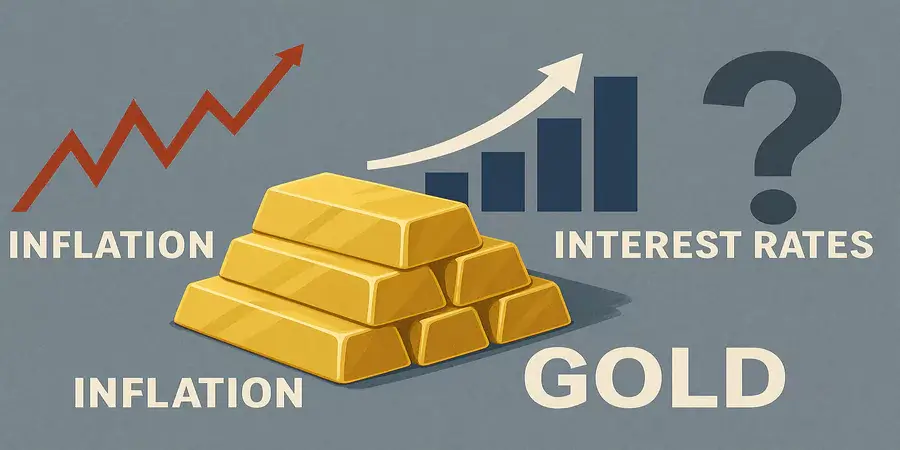
Gold’s price trajectory tells a story about investor anxiety and monetary policy consequences. When the Federal Reserve launched unprecedented quantitative easing in response to COVID-19 in March 2020, gold climbed from $1,580 per ounce to peak at $2,067 in August 2020 a 31% surge in five months. Yet when inflation actually materialized in 2021-2022, reaching 9.1% by June 2022, gold paradoxically declined, trading around $1,650-$1,850 throughout much of that period. This counterintuitive movement puzzled investors expecting gold to benefit from inflation, revealing that the relationship between gold and economic conditions is more complex than simple correlations suggest.
Understanding what actually drives gold trading requires moving beyond conventional wisdom that “gold rises during inflation” to examine the mechanisms through which inflation, interest rates, and uncertainty interact to influence gold demand. The metal’s behavior depends not just on inflation itself but on real interest rates the gap between nominal rates and inflation along with expectations about future monetary policy and the availability of alternative investments. Gold’s 2024 rally to record highs above $2,400 per ounce occurred despite relatively stable inflation and moderately high interest rates, driven instead by central bank purchases and geopolitical tensions, demonstrating that multiple factors simultaneously shape gold markets in ways that don’t always align with simplified narratives.
The Real Interest Rate Connection
Gold’s strongest and most consistent relationship is with real interest rates nominal interest rates minus inflation. This connection matters because gold generates no yield, making it less attractive when interest-bearing assets offer positive real returns. The relationship is inverse: when real rates fall, gold typically rises, and vice versa.
The mechanism works through opportunity cost. If a 10-year Treasury bond yields 5% while inflation runs at 2%, the real return is 3% investors earn actual purchasing power by holding bonds. Gold must appreciate at least 3% annually to match this return, making bonds more attractive. However, if that same 5% nominal yield faces 6% inflation, the real return is negative 1%. Investors lose purchasing power holding bonds, making gold’s zero yield suddenly competitive. In this scenario, gold only needs to hold its value (0% return) to outperform bonds losing 1% annually in real terms.
Historical data confirms this relationship. During the 1970s stagflation, nominal interest rates reached 14-15% by 1980, but inflation peaked at 13.5%, leaving real rates barely positive. Gold surged from $35 per ounce in 1971 to $850 in January 1980 a 24-fold increase. Conversely, during the 1980s and 1990s, Federal Reserve Chair Paul Volcker and successor Alan Greenspan maintained positive real rates averaging 3-4%, and gold declined from its 1980 peak to as low as $250 by 1999.
The 2020-2022 period illustrates why nominal inflation alone doesn’t predict gold prices. While inflation reached 9.1% in June 2022, the Federal Reserve raised rates aggressively from near-zero to 5.25% by mid-2023. Real rates, though negative during peak inflation, quickly turned positive as inflation fell faster than the Fed cut rates. Gold’s muted performance during peak inflation reflected forward-looking markets anticipating that real rates would rise as the Fed tightened policy which is exactly what happened.
Current gold markets in 2024-2025 reflect real rate dynamics alongside other factors. Ten-year Treasury yields around 4.5% against inflation near 3% create modestly positive real rates of 1.5%, which historically would pressure gold prices. Yet gold trades at record highs, indicating that other drivers central bank demand and geopolitical risk are overwhelming the interest rate headwind. This demonstrates that while real rates remain gold’s most reliable fundamental driver, they operate alongside multiple other factors that can temporarily dominate price action.
Inflation’s Nuanced Impact on Gold
The conventional wisdom that gold hedges inflation contains truth but requires significant qualification. Gold has preserved purchasing power over very long periods centuries and decades but performs inconsistently as an inflation hedge over shorter timeframes of months or even years. The Consumer Price Index and gold prices sometimes move together, sometimes diverge, and occasionally move in opposite directions, depending on what’s driving inflation and how monetary policy responds.
Long-term data supports gold as an inflation hedge over generational timeframes. An ounce of gold in 1920 cost approximately $20 and could purchase a quality men’s suit. Today, an ounce at $2,400 still purchases a quality men’s suit. Over that century, gold preserved purchasing power despite cumulative inflation of roughly 1,500%. This long-term preservation explains gold’s enduring appeal as a store of value across cultures and centuries.
However, shorter-term relationships prove more volatile. During the 1970s inflation surge, gold and CPI moved together dramatically both accelerating rapidly. Yet in 2021-2022, inflation reached 40-year highs while gold remained range-bound or even declined. The difference lies in monetary policy response and inflation expectations. In the 1970s, the Federal Reserve was slow to raise rates sufficiently to combat inflation, leaving real rates deeply negative for years. Investors anticipated persistent inflation and sought gold as protection. In 2021-2022, while the Fed was initially slow to react, markets eventually anticipated aggressive rate hikes that would control inflation proven correct as inflation fell from 9.1% to under 3% within 18 months.
The type of inflation also matters. Demand-driven inflation from economic overheating typically accompanies rising interest rates as central banks tighten policy, creating the real rate dynamics discussed above. Supply-shock inflation from energy price spikes or supply chain disruptions may see weaker gold responses if central banks hesitate to raise rates into supply-driven price increases. The 2021-2022 inflation combined both demand factors (fiscal stimulus, low rates) and supply factors (supply chains, energy), creating complex dynamics where gold’s response depended on which inflation driver dominated market expectations at any given time.
Gold also responds to inflation expectations as much as realized inflation. When the Federal Reserve announced unlimited quantitative easing in March 2020, inflation was actually falling due to COVID demand collapse. Yet gold rallied on expectations that massive monetary expansion would eventually cause inflation expectations that proved correct but took 12-18 months to materialize. Similarly, when inflation peaked in mid-2022, gold began recovering before CPI numbers actually declined, as markets anticipated that peak inflation had passed. This forward-looking behavior means gold often moves before inflation data confirms the trend.
Central Bank Policy and Gold Demand
Beyond interest rates and inflation, central bank behavior directly impacts gold markets through both policy decisions and direct gold purchases. Central banks are now the largest source of gold demand growth, with purchases reaching 1,037 tonnes in 2023 the second-highest annual purchase on record. This represents a dramatic shift from the 1990s and early 2000s, when central banks were net sellers of gold reserves.
The shift toward central bank accumulation reflects several motivations. Emerging market central banks, particularly China, Russia, Turkey, and India, have systematically increased gold reserves to reduce dependence on dollar-denominated assets and diversify reserve holdings. China’s central bank has been especially active, with reported gold reserves increasing from around 1,800 tonnes in 2015 to over 2,100 tonnes by 2024, though many analysts believe actual holdings are higher than officially reported. Russia dramatically increased gold reserves from 2014-2021 as a strategy to sanction-proof reserves, reaching over 2,300 tonnes before Ukraine war sanctions froze some access.
These central bank purchases create structural demand supporting gold prices independent of interest rate or inflation dynamics. When private investment demand weakens due to rising real rates as occurred in 2023-2024 central bank purchases can offset outflows from exchange-traded funds and other investment vehicles. This helps explain gold’s resilience and record prices despite modestly positive real rates that would typically pressure prices.
Monetary policy actions beyond interest rates also influence gold. Quantitative easing central banks purchasing government bonds and other securities expands money supply and raises inflation expectations, typically supporting gold prices. Quantitative tightening allowing bond holdings to mature without replacement has the opposite effect. The Federal Reserve’s QT program that began in 2022 removed over $1 trillion from its balance sheet, creating a modest headwind for gold that was overwhelmed by other supportive factors.
Currency effects also matter. Gold prices are typically quoted in dollars, so dollar weakness makes gold cheaper for foreign buyers while dollar strength has the opposite effect. When the Federal Reserve raises rates more aggressively than other central banks, the dollar typically strengthens, creating downward pressure on gold prices even if domestic real rates support gold. Conversely, coordinated global easing multiple central banks cutting rates simultaneously can support gold as the opportunity cost of holding non-yielding assets falls across currencies.
Geopolitical Uncertainty and Safe-Haven Demand
Gold’s safe-haven status represents its least quantifiable but often most powerful price driver. During periods of acute uncertainty wars, financial crises, political instability gold demand surges as investors seek assets perceived as secure stores of value independent of any government or financial system.
Recent history provides clear examples. Russia’s invasion of Ukraine in February 2022 sent gold from $1,900 to $2,050 within days as markets repriced geopolitical risk. While gold subsequently declined as real rates rose, initial safe-haven buying was immediate and substantial. Similarly, the October 2023 Israel-Hamas conflict triggered gold rallies as Middle East tensions raised concerns about oil supply disruptions and broader regional instability.
The COVID-19 pandemic’s early months demonstrated safe-haven dynamics at an extreme level. In March 2020, as lockdowns spread globally and financial markets seized up, gold initially fell paradoxically, as investors sold liquid assets including gold to raise cash and meet margin calls. However, once liquidity stabilized following central bank interventions, gold rallied sharply through summer 2020, reflecting both safe-haven demand and concerns about monetary policy consequences.
Banking sector instability also triggers gold buying. The March 2023 collapse of Silicon Valley Bank and subsequent Credit Suisse rescue generated a sharp gold rally to $2,050 as confidence in the banking system wavered. Though the crisis proved contained, gold’s response demonstrated how quickly safe-haven demand emerges when financial system stability comes into question.
This safe-haven function means gold can rally despite unfavorable real rate environments when uncertainty sufficiently elevates. Current elevated gold prices in late 2024 partly reflect ongoing geopolitical tensions Ukraine war, Middle East conflicts, US-China tensions that keep safe-haven premium embedded in prices even as real rates would otherwise pressure gold lower. Quantifying this premium is difficult, but market observers estimate geopolitical risk adds $100-200 per ounce to gold prices versus levels that purely real rate relationships would suggest.
Investment Vehicles and Market Structure
How investors access gold markets has evolved significantly, influencing price dynamics through different channels. Physical gold demand from jewelry, particularly in India and China, represents the largest segment of demand but tends to be price-elastic falling when gold prices rise above cultural comfort levels. Investment demand through exchange-traded funds, futures contracts, and other financial instruments is more volatile but increasingly drives short-term price swings.
Gold ETFs like SPDR Gold Shares (GLD) and iShares Gold Trust (IAU) hold physical gold backing their shares, making ETF flows directly impact physical demand. During the 2020 rally, ETF inflows added over 900 tonnes of gold demand roughly equivalent to 30% of annual mine production. Conversely, 2023 saw net ETF outflows of approximately 200 tonnes as rising real rates made gold less attractive relative to yielding assets. These flows directly affect prices as ETFs must purchase or sell physical gold to match share creation and redemption.
Futures markets on COMEX allow leveraged speculation and hedging, often generating price volatility that exceeds physical market dynamics. Large speculative positioning either long or short can create momentum moves as traders react to technical levels or positioning data. When speculative longs become crowded, subsequent unwinding can trigger sharp corrections even without fundamental changes. This technical dimension means gold sometimes moves based on positioning dynamics rather than inflation, rates, or uncertainty.
The rise of cryptocurrencies, particularly Bitcoin, has introduced a new competitor for “alternative asset” allocations. Some investors view Bitcoin as “digital gold” a store of value outside traditional financial systems. During periods when both gold and Bitcoin rally, it suggests broad appetite for alternatives to traditional assets. When they diverge gold strong while Bitcoin weak, or vice versa it indicates different drivers dominating each market. The correlation between gold and Bitcoin remains unstable, sometimes positive and sometimes negative, reflecting their different fundamental drivers and investor bases.
Market Outlook and Strategic Considerations
Gold’s current positioning reflects a complex interplay of cross-currents. Modest positive real rates create fundamental headwinds, yet record prices indicate other factors dominating. Central bank accumulation provides structural support unlikely to reverse quickly given geopolitical motivations. Elevated geopolitical tensions sustain safe-haven premiums. Meanwhile, potential Federal Reserve rate cuts in 2025-2026 could lower real rates and provide renewed fundamental support.
Looking forward, several scenarios could drive gold significantly higher or lower. A return to negative real rates either through inflation resurgence or aggressive rate cuts would likely support substantial gold gains, potentially pushing prices toward $2,800-3,000. Conversely, if inflation proves stubborn and real rates rise further, gold could correct toward $2,000-2,100 as the opportunity cost of holding non-yielding assets increases. Geopolitical developments either escalation or de-escalation of current tensions will influence safe-haven premiums substantially.
For those considering gold exposure, understanding these multiple drivers helps set realistic expectations. Gold rarely moves in straight lines, and periods of strength often give way to consolidation or corrections even when long-term fundamentals remain supportive. The relationship between gold and macroeconomic variables is strong over years and decades but can be overwhelmed by other factors over months and quarters. Diversification within precious metals including silver, platinum, or mining equities provides different exposure characteristics as industrial demand and production dynamics vary across metals.
Gold’s enduring role across millennia of human civilization suggests it will continue serving as a store of value and portfolio diversifier regardless of modern financial innovations. Yet its price at any given time reflects a complex dance between real rates, inflation expectations, central bank policies, geopolitical risk premiums, and investor positioning factors that don’t always move in concert and occasionally work at cross purposes. Understanding these dynamics rather than relying on simplified narratives about inflation or uncertainty provides a more sophisticated foundation for evaluating gold’s role in financial strategy.
ALSO READ: What Is CFD Trading and How Is It Impacting Today’s Financial Markets?