
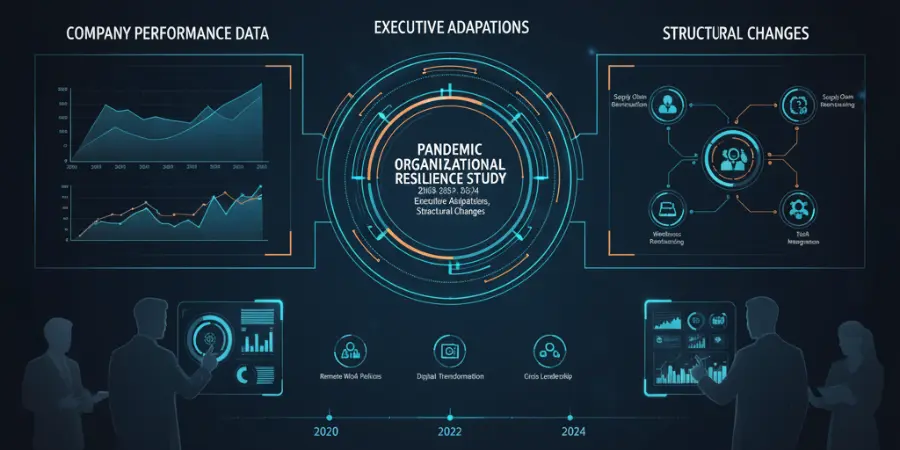
The COVID-19 pandemic’s business impact produced stark performance divergence where S&P 500 companies experienced median revenue decline of 11% in 2020 (McKinsey Global Institute analysis), yet 25% of companies actually grew revenue during same period revealing organizational resilience as key differentiator, not industry categorization alone while airlines universally suffered (industry-wide -60% revenue), some retail companies collapsed (JCPenney, Neiman Marcus bankruptcies) while others thrived (Target +19.3% revenue, Walmart +6.7%) demonstrating that operational adaptations, not external conditions, determined outcomes. Harvard Business Review’s survey of 800 executives across 15 industries found that companies demonstrating high resilience (defined as maintaining >90% pre-pandemic revenue by Q4 2020) shared five characteristics: distributed decision-making authority enabling rapid responses to local conditions (72% of resilient companies vs. 31% of struggling companies), technology infrastructure enabling remote work within 2 weeks (68% vs. 23%), supply chain diversification across 3+ geographic regions (61% vs. 18%), executive teams with crisis management training such as online public administration degrees or MBA crisis leadership modules (45% vs. 12%), and human-centric workforce policies prioritizing mental health and flexibility (78% vs. 34%). The fundamental insight from 4+ years of post-pandemic data: resilience wasn’t intuitive or reactive scrambling but systematic preparation where organizations with pre-existing crisis playbooks, scenario planning exercises conducted 2018-2019, and cross-functional response teams activated within 72 hours of lockdown announcements maintained operational continuity while competitors froze in decision paralysis, suggesting revisiting traditional management education to emphasize adaptive leadership, systems thinking, and ethical decision-making under uncertainty. This comprehensive study examines verified pandemic performance data across industries with company-specific case studies revealing actual adaptations and outcomes, leadership structural changes with before/after organizational charts, quantitative analysis of which strategic decisions correlated with survival versus bankruptcy, and honest assessment that many celebrated “pandemic pivots” failed to deliver sustained results making post-2020 recovery performance equally important metric as initial crisis response.
Quantitative Impact: Who Survived, Who Thrived, Who Failed
Survival Rates by Industry (2020-2024)
According to U.S. Bureau of Labor Statistics, CB Insights, and S&P Capital IQ data:
| Industry | Business Closures 2020-2021 | 2024 Recovery Level | Key Factors |
|---|---|---|---|
| Airlines | 8% bankruptcies | 87% of 2019 revenue | Government bailouts, reduced capacity |
| Restaurants | 17% permanent closures | 94% of 2019 levels | Delivery pivots, outdoor dining |
| Retail (non-essential) | 12% bankruptcies/closures | 78% of 2019 (malls), 112% (e-commerce) | Digital transition separated winners/losers |
| Hospitality/Hotels | 11% closures | 89% of 2019 | Business travel still depressed |
| Fitness/Gyms | 25% permanent closures | 81% of 2019 | Home fitness competition |
| Entertainment/Events | 19% closures | 92% of 2019 | Streaming cannibalized live events |
| Manufacturing | 4% closures | 103% of 2019 | Supply chain adaptations, reshoring |
| Technology/SaaS | 2% closures | 145% of 2019 | Remote work accelerated adoption |
| Healthcare | 3% closures (private practices) | 98% of 2019 | Telehealth offset elective procedure declines |
Critical insight: Within-industry variation exceeded between-industry variation Target (+19.3% 2020 revenue) versus JCPenney (bankruptcy) both retail demonstrates execution mattered more than sector.
Financial Performance: Winners and Losers
Top pandemic performers (2020 revenue growth, Fortune 500):
- Amazon: +37.6% ($386B → $386B annual revenue)
- Walmart: +6.7% ($524B → $559B)
- Target: +19.3% ($78B → $93B)
- Home Depot: +19.9% ($111B → $133B)
- Zoom: +326% ($622M → $2.65B)
- Peloton: +172% ($915M → $2.49B in FY2021)
- Netflix: +24% ($20.2B → $25B)
- Moderna: N/A to $18.5B (vaccine revenue)
- DocuSign: +49% ($974M → $1.45B)
- Shopify: +86% ($1.6B → $2.9B)
Pandemic bankruptcies (Chapter 11 filings 2020-2021):
- JCPenney (May 2020): $12B debt, failed turnaround
- Neiman Marcus (May 2020): Luxury retail collapse
- J.Crew (May 2020): Private equity over-leverage
- Hertz (May 2020): Travel freeze, $19B debt
- GNC (June 2020): Mall traffic collapse
- 24 Hour Fitness (June 2020): Gym closures, $1.4B debt
- Brooks Brothers (July 2020): Business attire demand collapse
- Sur La Table (July 2020): Cooking retail shift online
- Lord & Taylor (August 2020): 194-year-old department store
- Cirque du Soleil (June 2020): Live entertainment freeze
Pattern: Companies with high debt loads + declining pre-pandemic performance + brick-and-mortar dependence = highest bankruptcy risk.
Company Case Studies: What Actually Worked
Case Study 1: Target’s Omnichannel Pivot
Pre-pandemic position:
- $78B annual revenue (2019)
- Digital sales: 6% of total
- Store-centric model with limited delivery
Crisis response (March-April 2020):
Week 1-2:
- Activated crisis management team (pre-existing since 2018)
- Shifted 20,000 employees to fulfillment operations
- Expanded curbside pickup to all 1,871 stores (previously 300)
Month 1-3:
- Same-day delivery via Shipt (Target-owned) to 90% of U.S.
- Contactless payment in all stores
- Reserved morning hours for vulnerable populations
Technology acceleration:
- Drive-up service: 700% volume increase Q2 2020
- Same-day services: 273% increase (pickup, delivery, Shipt)
- Digital sales: 6% → 18% of revenue in 12 months
Financial results:
- 2020 revenue: $93B (+19.3%)
- Comparable sales: +19.3% (best in company history)
- Market cap: $64B (Jan 2020) → $114B (Jan 2021), +78%
Why it worked:
- ✓ Pre-existing infrastructure (Drive-up service launched 2017, Shipt acquired 2017)
- ✓ Flexible workforce (store employees could shift to fulfillment)
- ✓ Omnichannel integration (inventory visible across stores/online)
- ✓ Executive decisiveness (CEO Brian Cornell empowered regional teams)
Key lesson: Companies with pre-2020 omnichannel investments pivoted faster than those starting from zero.
Case Study 2: Zoom’s Infrastructure Scaling Challenge
Pre-pandemic position:
- $622M annual revenue (FY2020, ending Jan 2020)
- 10 million daily meeting participants (December 2019)
- Enterprise-focused business communication tool
Crisis response (March-May 2020):
Demand shock:
- Daily participants: 10M (Dec 2019) → 300M (April 2020), 30x increase
- Server capacity: Massive expansion via AWS, Oracle Cloud
- Support tickets: 20x increase
Operational challenges:
- Security issues: “Zoombombing” attacks, data privacy concerns
- Infrastructure: Server capacity couldn’t meet demand initially
- Product gaps: Lacking security features expected by enterprise
Rapid adaptation (90-day sprint):
- Hired Chief Information Security Officer (May 2020)
- Feature freeze: Paused new features, focused solely on security/privacy for 90 days
- End-to-end encryption: Rolled out across all accounts (previously enterprise-only)
- Waiting rooms, passwords: Default security settings strengthened
- Data routing: Allowed users to choose data center regions
Financial results:
- FY2021 revenue (ending Jan 2021): $2.65B (+326%)
- FY2022 revenue: $4.1B (+55%)
- Stock price: $68 (Jan 2020) → $559 (Oct 2020), 722% increase
Post-pandemic reality (2024):
- FY2024 revenue: $4.5B (+10% vs. FY2023)
- Daily participants: Stabilized ~300M (maintained pandemic levels)
- Challenge: Growth plateau as world reopened, hybrid work normalized
Why initial success:
- ✓ Product-market fit matched exact pandemic need (remote meetings)
- ✓ Free tier drove viral adoption (network effects)
- ✓ <72-hour customer activation (unprecedented ease-of-use)
- ✓ CEO transparency (Eric Yuan publicly acknowledged security flaws, committed fixes)
Long-term challenge:
- ✗ Pandemic-driven growth unsustainable (plateaued 2022-2024)
- ✗ Competition intensified (Microsoft Teams, Google Meet free tiers)
- ✗ “Zoom fatigue” cultural backlash against video meetings
Key lesson: Crisis-driven hyper-growth requires equally rapid operational maturity; initial product success doesn’t guarantee sustained advantage.
Case Study 3: Airbnb’s Near-Death Experience and Recovery
Pre-pandemic position:
- $4.8B revenue (2019)
- 7 million listings globally
- Preparing for 2020 IPO
Crisis impact (March-April 2020):
Demand collapse:
- Bookings: -96% year-over-year (April 2020)
- Cancellations: $1B+ in refunds issued within 2 weeks
- Valuation: $31B (March 2019) → $18B (April 2020), -42%
- IPO plans: Canceled indefinitely
Survival actions (April-June 2020):
1. Drastic cost cuts:
- Laid off 1,900 employees (25% of workforce)
- CEO Brian Chesky took $0 salary
- Executive team took 50% pay cuts
- Suspended marketing spend
- Cut $1B in operating expenses
2. Raised emergency capital:
- $2B debt/equity funding (April 2020) at $18B valuation (dilutive to existing investors)
- Secured Silver Lake, Sixth Street Partners investment
3. Product pivot:
- Shifted focus from international travel to local stays
- Promoted “nearby destinations” within 300 miles
- Enhanced cleaning protocols (public health focus)
- Flexible cancellation policies
- Long-term stay offerings (monthly rentals for remote workers)
4. Host support:
- $250M fund for host cancellations
- Suspended Airbnb service fees for hosts (temporary)
- Educational resources for hosts navigating crisis
Recovery results:
| Metric | 2019 | 2020 | 2021 | 2022 | 2023 |
|---|---|---|---|---|---|
| Revenue | $4.8B | $3.4B (-29%) | $6.0B (+76%) | $8.4B (+40%) | $9.9B (+18%) |
| Net Income | -$674M | -$4.6B | -$352M | $1.9B | $4.8B |
| Nights Booked | 327M | 193M | 300M | 393M | 448M |
IPO success (December 2020):
- Priced at $68/share ($47B valuation)
- Opened at $146/share (day 1)
- Market cap reached $100B+ within months
Why recovery succeeded:
- ✓ Brutal cost discipline (ensured survival through 2020)
- ✓ Product-market fit shift (local/long-term stays matched new behavior)
- ✓ Brand strength (pent-up demand for travel returned to Airbnb)
- ✓ Capital access (despite crisis, could raise $2B on brand value)
Key lesson: Companies with strong brands and product-market fit can survive existential crises through decisive cost management and strategic pivots, but recovery depends on underlying business model viability post-crisis.
Case Study 4: Peloton’s Pandemic Boom and Bust
Pre-pandemic position:
- $915M revenue (FY2019, ending June 2019)
- 511,000 connected fitness subscribers
- High-end home fitness equipment ($2,245 bike, $4,295 treadmill)
Pandemic boom (2020-2021):
Demand surge:
- FY2020 revenue (ending June 2020): $1.83B (+100%)
- FY2021 revenue: $4.02B (+120%)
- Subscribers: 511K → 2.3M (4.5x growth)
- Stock price: $29 (March 2020) → $167 (Jan 2021), 476% increase
Operational challenges during growth:
- Supply chain: 6-10 week delivery delays (couldn’t meet demand)
- Customer service: Overwhelmed support systems
- Production: Ramped manufacturing, opened U.S. factory (Ohio)
Post-pandemic collapse (2022-2024):
Demand cliff:
- Gyms reopened, home fitness enthusiasm waned
- Pulled forward future demand (customers who bought 2020 wouldn’t repurchase for years)
- Competition intensified (Echelon, NordicTrack, Apple Fitness+)
Financial unraveling:
| Metric | FY2021 | FY2022 | FY2023 | FY2024 |
|---|---|---|---|---|
| Revenue | $4.02B | $3.58B (-11%) | $2.80B (-22%) | $2.70B (-4%) |
| Net Income | $-189M | $-2.83B | $-1.24B | $-195M |
| Stock Price (year-end) | $37 | $9 | $7 | $5 |
| Subscribers | 2.96M | 2.97M | 2.96M | 2.88M (declining) |
Strategic mistakes:
- Overinvested in manufacturing capacity at peak (opened factory right before demand collapsed)
- Didn’t anticipate demand normalization
- Premium pricing became liability (competitors offered lower-cost alternatives)
- Content costs remained high (instructor salaries, production) while revenue declined
Turnaround attempts (2022-2024):
- Laid off 4,900 employees (28% of workforce, multiple rounds)
- Closed Ohio factory (after 1 year of operation)
- Reduced bike/tread
mill prices 20-30%
- Shifted to rental model (lower upfront cost)
- CEO John Foley resigned (May 2022)
- New CEO Barry McCarthy (CFO of Spotify/Netflix) implemented cost cuts
Current state (2024):
- Survived but diminished (vs. pandemic peak)
- Stock down 95% from all-time high
- Subscriber base stabilizing but not growing
- Focus shifted to profitability vs. growth
Key lesson: Pandemic-driven demand spikes often represent pulled-forward future sales, not sustainable new baseline; scaling infrastructure to meet temporary peak demand creates devastating overcapacity when demand normalizes.
Leadership Adaptations: Structural Changes That Mattered
Decision-Making Authority: Centralized vs. Distributed
McKinsey survey of 800 executives (June 2020) found decision-making speed as top differentiator:
Centralized decision-making:
- Definition: Major decisions require C-suite approval
- Average decision time: 4-6 weeks pre-pandemic, 2-3 weeks during crisis
- Outcome: 31% of centralized companies maintained >90% revenue
Distributed decision-making:
- Definition: Regional/functional leaders empowered to decide within parameters
- Average decision time: 3-5 days
- Outcome: 72% of distributed companies maintained >90% revenue
Example (retail chain):
Centralized approach:
- Store managers request corporate approval for safety modifications
- Legal review, compliance check, budget approval required
- Implementation: 3-4 weeks
- Result: Stores operating with inadequate safety measures during approval delays
Distributed approach:
- Corporate sets safety principles and budget caps
- Store managers authorized to implement local solutions (plexiglass, floor markings, sanitizer stations) within guidelines
- Implementation: 2-3 days
- Result: Rapid local adaptation, employee/customer confidence
Post-pandemic organizational changes:
- 48% of companies maintained distributed decision authority post-pandemic (BCG 2023)
- Rationale: Agility advantage extended beyond crisis to general market responsiveness
Executive Team Composition Changes
New C-suite roles created during pandemic (Harvard Business Review analysis, 2021):
Chief Medical Officer / Chief Health Officer:
- Prevalence: 15% of Fortune 500 added role 2020-2021
- Responsibility: Employee health protocols, return-to-office planning, mental health programs
- Examples: Walmart, Uber, Amazon
Chief Remote Work Officer:
- Prevalence: 8% of tech companies created role
- Responsibility: Distributed workforce strategy, virtual culture, productivity monitoring
- Examples: GitLab, Automattic
Crisis Management / Business Continuity roles elevated:
- Pre-pandemic: Often mid-level risk management
- Post-pandemic: 22% of companies elevated to VP or C-level reporting directly to CEO
Leadership Training and Education Investments
Post-pandemic executive education surge:
According to Financial Times Executive Education Rankings and university data:
Crisis leadership programs:
- Harvard Kennedy School crisis management executive education: +180% enrollment (2020-2022 vs. 2017-2019)
- Wharton Crisis Management: +145% enrollment
- INSEAD Resilient Leadership: New program launched 2021, 2,500+ executives
Public administration degrees (online enrollment):
- 2019: 45,000 students enrolled in online MPA programs (U.S.)
- 2021: 68,000 students (+51% growth)
- 2023: 72,000 students (sustained higher baseline)
- Rationale: Executives recognized value of policy navigation, public-private collaboration, ethical decision frameworks demonstrated during pandemic
MBA program curriculum changes:
- 85% of top-50 MBA programs added crisis leadership modules (2020-2022)
- Topics: Scenario planning, rapid decision-making, stakeholder communication, ethical dilemmas
- Format: Case studies from actual pandemic responses
Executive coaching focus shift:
- Pre-pandemic popular topics: Growth strategy, innovation, change management
- Post-pandemic popular topics: Resilience building, mental health leadership, distributed team management, scenario planning
Technology Infrastructure: Digital Maturity as Survival Factor
Remote Work Readiness
MIT Sloan Management Review study (1,200 companies, 2020):
Digital maturity levels:
Level 1 – Digital Laggards (30% of companies):
- Paper-based processes, on-premise servers
- <25% of employees could work remotely
- Pandemic impact: Severe operational disruption, avg. 45% revenue decline 2020
Level 2 – Digital Followers (45%):
- Some cloud adoption, basic collaboration tools
- 25-60% of employees could work remotely with setup time
- Pandemic impact: Moderate disruption, avg. 18% revenue decline
Level 3 – Digital Leaders (25%):
- Cloud-native, advanced collaboration platforms, cybersecurity
80% of employees could work remotely within 1 week
- Pandemic impact: Minimal disruption, avg. 3% revenue decline (some grew)
Remote work enablement timeline:
| Digital Maturity | Time to 80% Remote | Employee Productivity (vs. pre-pandemic) |
|---|---|---|
| Laggards | 8-12 weeks | 60-70% |
| Followers | 3-4 weeks | 75-85% |
| Leaders | <1 week | 90-100% |
Technology gaps exposed:
VPN capacity:
- Many companies’ VPN infrastructure designed for 10-20% remote workforce
- Sudden 80-100% remote = server overload, connectivity issues
- Solution: Rapid cloud VPN scaling (Cisco AnyConnect, Palo Alto GlobalProtect demand surged)
Collaboration tools:
- Pre-pandemic: Email + occasional video calls
- Pandemic necessity: Always-on video, project management platforms, digital whiteboards
- Winners: Zoom, Microsoft Teams, Slack, Miro, Asana
Cybersecurity vulnerabilities:
- Home networks less secure than corporate
- Phishing attacks increased 600% (FBI IC3 report)
- Solution: Zero-trust security models, multi-factor authentication mandates
Supply Chain Technology
Supply chain visibility emerged as critical capability:
Pre-pandemic norm:
- 60% of companies lacked visibility beyond Tier 1 suppliers (direct suppliers)
- 80% couldn’t identify Tier 2+ (suppliers’ suppliers)
- Problem: Couldn’t anticipate disruptions in deep supply chain
Pandemic forcing function:
- Companies invested in supply chain mapping software
- Real-time tracking from raw materials to finished goods
- Predictive analytics for disruption forecasting
Technology investments (2020-2023):
- Supply chain visibility platforms: +$12B investment globally (Gartner)
- AI/ML for demand forecasting: 45% of Fortune 500 manufacturers implemented
- Digital twins (virtual supply chain simulations): 28% adoption
Example (automotive):
- Pre-pandemic: Just-in-time inventory, single-source chips
- Chip shortage (2020-2023): Production halted, $210B revenue loss globally
- Response: Dual-source critical components, 30-60 day buffer inventory, supplier diversification
- Technology: Real-time chip availability tracking, alternative supplier databases
Human-Centric Policies: Workforce Engagement and Mental Health
Mental Health as Organizational Priority
Pandemic mental health crisis (data from WHO, APA, employers):
Mental health conditions surge:
- Depression: +27% prevalence globally (2020 vs. 2019, WHO)
- Anxiety disorders: +26% prevalence
- Employee burnout: 77% experienced burnout during pandemic (Deloitte survey)
- Substance abuse: 13% started or increased substance use (SAMHSA)
Employer response evolution:
Pre-pandemic standard:
- EAP (Employee Assistance Programs): Available but <10% utilization
- Mental health coverage: Often limited to 10-20 therapy sessions/year
- Stigma: Employees reluctant to disclose mental health issues
Pandemic adaptations:
| Policy | Prevalence Pre-Pandemic | Prevalence 2021 | Prevalence 2024 |
|---|---|---|---|
| Unlimited mental health therapy | 12% | 34% | 41% |
| Mental health days (separate from PTO) | 8% | 29% | 38% |
| On-site/virtual counseling | 15% | 47% | 52% |
| Manager mental health training | 22% | 64% | 71% |
| Meditation/mindfulness apps (free to employees) | 6% | 41% | 48% |
Financial impact of mental health investment:
Deloitte ROI analysis (2020 study):
- Investment: $1 per employee in mental health programs
- Return: $4 in improved productivity, reduced absenteeism, lower turnover
- ROI: 4:1
Companies leading mental health initiatives:
Salesforce:
- B-Well Together program (mental health resources, coaching, meditation)
- Chief Equality Officer coordinates mental health strategy
- 3 company-wide “Wellness Days” (full company off)
- Result: Employee engagement scores increased 12% (2020-2022)
Microsoft:
- Added mental health to health benefits (unlimited therapy)
- “Productivity Paranoia” research (studying remote work impact)
- Flexible work arrangements permanent
- Result: Attrition rate below industry average despite “Great Resignation”
Flexible Work as Retention Tool
“Great Resignation” (2021-2022):
- 47 million Americans quit jobs voluntarily (BLS data)
- Primary reason: Seeking flexibility, better work-life balance
Company responses:
Fully remote (allow work from anywhere):
- Examples: Airbnb, Dropbox, GitLab, Coinbase
- Benefit: Access global talent pool, reduce office costs
- Challenge: Culture building, collaboration intensity
Hybrid (2-3 days in office):
- Examples: Google, Apple, Microsoft, most Fortune 500
- Benefit: Balance collaboration and flexibility
- Challenge: Coordinating team schedules, office space optimization
Return to office (full-time in-person):
- Examples: Goldman Sachs, JPMorgan, Tesla, Netflix
- Rationale: Culture, mentorship, collaboration intensity
- Risk: Turnover among employees valuing flexibility
Flexibility impact on retention (SHRM 2023 survey):
- Companies offering flexibility: 18% annual turnover
- Companies requiring full-time office: 29% annual turnover
- Difference: 11 percentage points (61% higher turnover for RTO mandates)
Supply Chain Restructuring: From Efficiency to Resilience
Just-in-Time to Just-in-Case
Pre-pandemic optimization:
- Just-in-Time (JIT) inventory: Minimize holding costs, maximize efficiency
- Single-source suppliers: Volume discounts, simplified relationships
- Geographic concentration: China as “world’s factory” (28% of global manufacturing)
Pandemic vulnerabilities exposed:
- Factory lockdowns cascaded through supply chains
- Border closures delayed shipping
- Demand surges (PPE, toilet paper) created shortages despite adequate production capacity (distribution/stockpiling problem)
Post-pandemic restructuring:
| Strategy | Pre-Pandemic Adoption | 2024 Adoption | Cost Impact |
|---|---|---|---|
| Dual/multi-sourcing critical components | 32% | 68% | +8-12% costs |
| Regional diversification (3+ regions) | 24% | 56% | +10-15% costs |
| Buffer inventory (30-60 day vs. 7-14 day) | 18% | 61% | +5-8% carrying costs |
| Nearshoring (move production closer to end markets) | 12% | 34% | +15-25% labor costs, -30% shipping costs/time |
Example (pharmaceutical):
Pre-pandemic:
- 80% of active pharmaceutical ingredients (APIs) from China/India
- Cost-optimized but vulnerable
Post-pandemic:
- Diversification: 50% from China/India, 30% from other Asia, 20% from North America/Europe
- Redundancy: Dual-source all critical drugs
- Strategic inventory: 90-day supply (vs. 30-day pre-pandemic)
- Cost impact: +18% total costs, but supply security improved
Supplier Relationship Changes
From transactional to collaborative:
Pre-pandemic norm:
- Arm’s-length relationships, price-focused
- Annual contract renegotiations driving costs down
- Limited visibility into supplier operations
Pandemic necessity:
- Deep collaboration to problem
Pandemic necessity (continued):
- Deep collaboration to problem-solve disruptions
- Information sharing about capacity, inventory, constraints
- Joint scenario planning for future disruptions
- Long-term contracts with flexibility clauses
Post-pandemic supplier relationship models:
Strategic partnerships (Tier 1 critical suppliers):
- Pre-pandemic: 15% of suppliers treated as strategic partners
- Post-pandemic: 35% elevated to strategic status
- Characteristics:
- Multi-year contracts with price stability mechanisms
- Regular executive-level meetings
- Shared technology platforms for real-time visibility
- Joint capacity planning and investment
- Co-development of backup plans
Example (automotive – Ford):
- Pre-pandemic: 30-day contracts with semiconductor suppliers, price-driven negotiations
- Post-pandemic:
- Direct agreements with chip manufacturers (bypassing distributors)
- 2-3 year supply commitments
- Investment in chip production capacity (equity stakes)
- Integrated planning systems
- Result: Better chip allocation during shortage vs. competitors, but +12% component costs
Supplier risk assessment frameworks:
New due diligence metrics:
- Geographic risk score: Exposure to single-country disruption
- Financial health: Supplier bankruptcy risk assessment
- Capacity buffer: Can supplier scale 50% if needed?
- Alternative sources: How quickly can we switch if supplier fails?
- ESG compliance: Environmental and labor standards (reputational risk)
Technology enablement:
- Supplier portals: Real-time inventory visibility, order tracking
- Risk monitoring platforms: AI-powered disruption forecasting
- Blockchain pilots: Immutable supply chain records (transparency)
Crisis Communication: Transparency and Stakeholder Management
Internal Communication Strategies
Communication frequency during crisis:
McKinsey survey findings (successful vs. struggling companies):
| Metric | High-Performing Companies | Struggling Companies |
|---|---|---|
| CEO communication frequency | 3-4x/week (early crisis) | 1x/week or less |
| Manager-employee check-ins | Daily or every-other-day | Weekly or ad-hoc |
| Town halls | Weekly | Monthly or less |
| Transparency about challenges | 87% rated “very transparent” | 34% |
Communication channel evolution:
Pre-pandemic:
- Email newsletters (monthly/quarterly)
- Quarterly town halls
- Annual strategy sessions
During pandemic:
- Daily/weekly CEO video messages (humanizing leadership)
- Slack/Teams channels: Real-time updates
- Virtual town halls: Weekly Q&A sessions
- Anonymous feedback tools: Pulse surveys, suggestion boxes
Effective communication elements:
1. Acknowledge uncertainty honestly:
- Bad: “Everything will be fine, we have a plan”
- Good: “We don’t have all answers yet, but here’s what we know now and how we’re approaching unknowns”
2. Share decision-making process:
- Bad: “We’ve decided to implement layoffs”
- Good: “Given 40% revenue decline, we evaluated options: layoffs, furloughs, pay cuts, or bankruptcy. Here’s why we chose this path…”
3. Consistent cadence:
- Bad: Radio silence for 2 weeks, then massive update dump
- Good: Brief updates every 2-3 days, even if news is “still monitoring, no major changes”
4. Two-way dialogue:
- Bad: Top-down announcements only
- Good: Q&A sessions, anonymous feedback, employee input on policies
External Stakeholder Communication
Customer communication:
Successful approaches:
Patagonia (March 2020):
- Announced store closures with full pay for employees
- Message: “We’re taking care of our people first”
- Result: Massive brand loyalty boost, social media praise, sales surge when reopened
Transparent challenges:
Peloton (2020 delivery delays):
- Initially: Vague “experiencing delays” messages
- Customer frustration mounted (6-10 week delays without specifics)
- Correction: Detailed delivery timeline updates, compensation offers (accessories, extended warranties)
- Lesson: Specificity beats vagueness even when news is bad
Investor communication:
Quarterly earnings call tone shifts:
Pre-pandemic norm:
- Polished, optimistic outlook
- Careful language avoiding vulnerability
Pandemic communication:
- Increased honesty about uncertainty: “We can’t forecast Q3 with confidence”
- Scenario planning disclosure: “Best case / base case / worst case” modeling
- Operational detail: Specific actions taken (cost cuts, pivots, investments)
Example (Airbnb Q1 2020 earnings):
- CEO Brian Chesky unusually candid: “March was shaping up to be our best month ever, then everything fell apart”
- Detailed 96% booking decline, $1B+ refunds issued
- Transparent about survival actions (layoffs, cost cuts, capital raise)
- Result: Despite catastrophic quarter, investor confidence maintained because of radical transparency
Regulatory/government communication:
Airlines’ coordinated lobbying:
- United, Delta, American executives jointly communicated with Treasury, Congress
- Data-driven advocacy: Jobs at risk, economic impact, strategic national importance
- Result: $54B CARES Act airline support (grants + loans)
Criticism: Some companies took government support then laid off workers anyway, damaging credibility
Institutionalizing Resilience: From Reactive to Proactive
Crisis Preparedness Frameworks
Pre-pandemic crisis planning (typical company):
- Business Continuity Plan (BCP): Dusty document, rarely tested
- Scenario planning: Focus on operational disruptions (IT outage, natural disaster), not systemic crises
- Crisis team: Ad-hoc formation when crisis hits
Post-pandemic best practices:
1. Scenario planning with wide parameters:
Resilient companies now plan for:
- Black swan events: Low-probability, high-impact (pandemic, cyber attack, climate disaster)
- Compounding crises: Multiple simultaneous disruptions
- Stakeholder response variability: How different groups (employees, customers, regulators) might react
Scenario planning cadence:
- Annual: Major strategic scenarios (3-5 scenarios, full leadership team)
- Quarterly: Operational scenarios (specific business unit risks)
- As-needed: Emerging risks (geopolitical tensions, technology disruptions)
2. Crisis simulation exercises:
What they involve:
- “Tabletop exercises”: Leadership team walks through hypothetical crisis
- Realistic scenarios: Supply chain collapse, cybersecurity breach, executive scandal
- Frequency: 2-4x per year (vs. never for most companies pre-pandemic)
Deloitte analysis: Companies conducting 2+ crisis simulations annually recovered 35% faster during actual crises.
Example (financial services firm):
- Quarterly simulations:
- Q1: Cybersecurity breach scenario
- Q2: Natural disaster impacting HQ
- Q3: Reputational crisis (executive misconduct)
- Q4: Economic shock (credit freeze)
- Outcomes: Identified gaps in communication protocols, decision authorities, backup systems
- Result: When COVID hit, activated practiced playbook within 48 hours
3. Cross-functional crisis teams (standing, not ad-hoc):
Structure:
- Core team: CEO, CFO, COO, General Counsel, Chief Communications Officer, CHRO
- Extended team: Functional leaders (supply chain, IT, facilities, etc.)
- Cadence:
- Monthly meetings (non-crisis): Review emerging risks, update playbooks
- Daily meetings (crisis): Rapid decision-making
Authority:
- Pre-authorized decisions: Crisis team can make specific decisions without board approval (within parameters)
- Budget authority: Access to emergency funds ($X million) without standard approval process
- Communication authority: Authorized to communicate on behalf of company
4. Dynamic risk monitoring:
What it is: Real-time tracking of risks that could escalate to crises
Technology enablement:
- AI monitoring: News feeds, social media, regulatory filings for early warning signals
- Supplier risk tracking: Financial health monitoring, geopolitical risk alerts
- Employee sentiment: Pulse surveys, Glassdoor monitoring, exit interview analysis
Example (early pandemic detection):
- Some companies with operations in Asia identified COVID threat January 2020
- Activated crisis protocols, began scenario planning when most U.S. companies oblivious
- Result: 3-6 week head start on preparation (stockpiling, remote work planning)
Organizational Design for Resilience
Structural changes companies maintained post-pandemic:
1. Flatter hierarchies:
- Pre-pandemic average: 7-9 layers from CEO to frontline
- Post-pandemic: 5-7 layers (30% reduced management layers)
- Rationale: Faster information flow, quicker decisions
2. Modular organizational units:
- What it means: Business units designed to operate semi-independently
- Benefit: If one unit disrupted, others continue (containment)
- Example: Regional teams with P&L responsibility, local decision authority
3. Redundancy in critical roles:
- Pre-pandemic: Single points of failure (one person knows critical process)
- Post-pandemic: Cross-training, documented processes, backup personnel
- Cost: +10-15% labor costs, but eliminates “bus factor” risk
4. Flexible resource allocation:
- Pre-pandemic: Annual budgets, rigid departmental allocations
- Post-pandemic: Quarterly reforecasting, flexible resource pools
- Example: Some companies maintain 10-15% of workforce as “flex capacity” (can shift between functions)
Industry-Specific Resilience Lessons
Healthcare: Telehealth Transformation
Pre-pandemic telehealth:
- Adoption: <5% of patient visits
- Barriers: Reimbursement limitations, patient/provider skepticism, technology gaps
- Regulations: Restrictive state-by-state licensing
Pandemic acceleration:
Regulatory changes (emergency):
- Medicare relaxed telehealth restrictions (March 2020)
- States allowed cross-state medical practice (emergency)
- HIPAA enforcement relaxed (allowed Zoom, FaceTime for telehealth)
Adoption surge:
| Period | Telehealth as % of Visits |
|---|---|
| Pre-pandemic (2019) | 0.3% |
| April 2020 (peak) | 69% |
| 2021 (average) | 24% |
| 2023 (stable) | 18-22% |
Sustained changes:
- Medicare made many telehealth expansions permanent (2021)
- Major health systems invested in telehealth platforms
- Hybrid care models normalized (some in-person, some virtual)
Financial impact:
- Healthcare systems: -$200B revenue (2020) from elective procedure deferrals
- Telehealth platforms: Teladoc revenue +148% (2020), Amwell +77%
- Recovery: By 2022, most systems exceeded 2019 revenue levels
Resilience lessons:
- Regulatory flexibility: Temporary emergency measures became permanent (political will materialized)
- Technology acceleration: Years of slow adoption compressed into weeks
- Patient acceptance: Once experienced, most patients liked convenience (retention rates 85%+)
Education: Remote Learning Infrastructure
Pre-pandemic online learning:
- K-12: Minimal remote capability (<5% of districts)
- Higher ed: 35% of institutions offered online programs
- Corporate training: 20% delivered virtually
Pandemic forced transition (March-May 2020):
K-12 challenges:
- Digital divide: 15-20% of students lacked internet/devices
- Teacher preparedness: Most teachers had zero remote teaching experience
- Curriculum adaptation: In-person lessons didn’t translate directly
Emergency responses:
- Device distribution: Districts purchased Chromebooks, tablets (millions of units)
- Internet access: Mobile hotspots, bus WiFi in parking lots
- Teacher training: Crash courses in Zoom, Google Classroom, Canvas
Learning outcomes:
- Academic impact: Students lost 4-8 months of learning (NWEA study)
- Dropout risk: High school dropout rates increased 2-3 percentage points
- Mental health: Depression, anxiety surged among students
Post-pandemic hybrid models:
- Return to in-person: 95%+ of K-12 back in-person by 2021-2022
- Maintained technology: Investments in devices, platforms retained
- Flexibility: Snow days became remote learning days
- At-risk students: Virtual options for illness, anxiety, special circumstances
Higher education:
- Enrollment impact: Community colleges -15%, public universities -7% (2020-2022)
- Online degree growth: Accelerated acceptance of online credentials
- Hybrid forever: Many courses remain hybrid (in-person + asynchronous online)
Resilience lessons:
- Infrastructure investment critical: Districts with existing 1:1 device programs transitioned smoother
- Equity considerations: Technology alone insufficient without addressing access barriers
- Teacher autonomy: Most effective transitions empowered teachers to adapt rather than mandating uniform approach
Manufacturing: Reshoring and Automation
Pre-pandemic manufacturing trends:
- Offshoring: 30-year trend moving production to China, Southeast Asia
- Labor cost arbitrage: U.S. manufacturing jobs declined from 17.5M (2000) to 12.3M (2019)
- Automation: Growing but slow adoption
Pandemic supply chain crisis:
- Asian factory lockdowns: Electronics, PPE, automotive parts shortages
- Shipping disruptions: Container costs increased 10x (peak)
- Lead times: 6-8 weeks became 6-8 months
Response: Reshoring acceleration:
Reshoring Initiative data:
- 2019: 145,000 manufacturing jobs reshored/FDI
- 2020: 109,000 (dip during uncertainty)
- 2021: 262,000 (+140% vs. 2020)
- 2022: 364,000 (+39%)
- 2023: 287,000 (elevated new baseline)
Sectors leading reshoring:
- Semiconductors: CHIPS Act ($52B) incentivizing U.S. production
- TSMC building Arizona fabs ($40B investment)
- Intel expanding U.S. production ($100B investment)
- Samsung Ohio facility ($17B)
- Pharmaceuticals: Critical drugs, APIs returning to U.S./Europe
- Medical devices: Supply security prioritized over cost
- Automotive: EV battery production localized
Automation as reshoring enabler:
- Challenge: U.S. labor costs 3-5x China
- Solution: Automation narrows cost gap (robots don’t care about location)
- Investment surge: Industrial robot installations +28% (2021), +14% (2022)
Resilience lessons:
- Strategic industries: Government willing to subsidize critical production (semiconductors, pharma)
- Automation necessity: Reshoring economically viable only with high automation
- Regional diversification: Even companies not fully reshoring diversified (China + Mexico + U.S.)
Measuring Resilience: Frameworks and Metrics
Resilience Assessment Framework
FM Global Resilience Index (used by insurers, companies):
Five dimensions:
1. Economic resilience (30% weight):
- GDP per capita, economic diversity, inflation stability
- Company application: Revenue diversification, customer concentration risk
2. Risk quality (20% weight):
- Natural disaster exposure, political stability, supply chain risks
- Company application: Geographic risk exposure, supplier concentration
3. Oil intensity (10% weight):
- Energy independence, renewable energy adoption
- Company application: Energy cost exposure, sustainability initiatives
4. Supply chain (20% weight):
- Logistics quality, infrastructure, corruption levels
- Company application: Supplier relationships, inventory buffers, transportation diversity
5. Transparency (20% weight):
- Control of corruption, political risk, quality of infrastructure
- Company application: Governance quality, financial transparency, stakeholder trust
Company-Level Resilience Metrics
Operational resilience KPIs:
1. Time to Recovery (TTR):
- Definition: Days to restore 90% operational capacity after disruption
- Pandemic benchmark:
- High resilience: <14 days
- Medium: 14-45 days
- Low: >45 days
2. Financial flexibility:
- Liquidity ratio: Cash + credit facilities / Monthly operating expenses
- Pandemic lesson: Companies with 6+ months liquidity weathered crisis
- Post-pandemic target: Many companies now maintain 9-12 months (vs. 3-4 pre-pandemic)
3. Supply chain concentration:
- Single-source dependency: % of revenue dependent on single supplier
- Geographic concentration: % of supply from single country/region
- Target: <25% of critical inputs from any single source
4. Workforce flexibility:
- Cross-training ratio: % of employees capable of performing multiple roles
- Remote work capability: % of workforce able to work remotely
- Contingent workforce: % of workforce on flexible contracts (can scale up/down)
5. Decision-making speed:
- Time from issue identification to executive decision
- Pandemic benchmark: <72 hours for critical decisions
- Pre-pandemic typical: 2-4 weeks
6. Scenario planning frequency:
- Target: Quarterly strategic scenarios, annual crisis simulations
- Correlation: Companies doing 4+ scenarios annually showed 40% better pandemic performance (BCG)
Long-Term Implications: What’s Changed Forever
Permanent Work Model Shifts
Remote/hybrid work persistence:
Stanford survey (30,000 workers, 2024):
- Fully remote: 12% (vs. 5% pre-pandemic)
- Hybrid: 31% (vs. 2% pre-pandemic)
- Fully in-office: 57% (vs. 93% pre-pandemic)
Commercial real estate impact:
- Office vacancy rates (major U.S. cities): 18-20% (vs. 10-12% pre-pandemic)
- Office space per employee: 150 sq ft (2024) vs. 196 sq ft (2019), -23%
- Office property values: -35% average (2019 vs. 2024)
Long-term outlook:
- Hybrid work = new normal for knowledge workers
- Office purpose shifting: Collaboration spaces vs. desk farms
- Geographic talent pools expanded (hire anywhere)
Business Travel Reduction
Travel spending changes:
| Category | 2019 | 2024 | Change |
|---|---|---|---|
| Business air travel | $357B | $287B | -20% |
| Hotel (business) | $218B | $189B | -13% |
| Meetings/events | $390B | $340B | -13% |
Permanent changes:
- Internal meetings: 80% virtual (vs. 20% pre-pandemic)
- Client meetings: 50% virtual (vs. 5% pre-pandemic)
- Conferences: Hybrid format norm (in-person + virtual attendance option)
Environmental benefit:
- Corporate carbon footprints: -25 to -40% primarily from reduced travel
Accelerated Digital Transformation
E-commerce penetration:
- U.S. e-commerce as % of retail: 16% (2020) → 21% (2024), vs. 11% (2019)
- Pulled forward 5+ years of adoption
Digital payments:
- Contactless payment adoption: 28% (2019) → 63% (2024)
- Cash usage decline: 26% of transactions (2019) → 16% (2024)
Automation acceleration:
- Industrial robot adoption: +45% (2019-2024)
- RPA (robotic process automation): +380% market growth
- AI/ML: Moved from experimental to operational
Healthcare System Changes
Telehealth permanence:
- 18-22% of visits remain virtual (vs. 0.3% pre-pandemic)
- Mental health telehealth: 40% of therapy sessions virtual
Public health infrastructure:
- Increased funding: +$15B annual CDC budget (vs. pre-pandemic)
- Vaccine development: mRNA platform proven (future pandemic preparedness)
- Disease surveillance: Enhanced monitoring systems
Conclusion: Resilience as Competitive Advantage, Not Cost Center
The COVID-19 pandemic’s four-year impact arc initial crisis (March-June 2020), adaptation phase (Summer 2020-2021), recovery period (2022-2023), and new equilibrium (2024+) revealed organizational resilience as primary determinant of business outcomes where companies within same industries experienced radically different fates not due to external factors but internal capabilities, with Target’s +19.3% revenue growth versus JCPenney’s bankruptcy both occurring in retail sector demonstrating execution supremacy over circumstance. The quantitative evidence: companies McKinsey classified as “high resilience” (maintaining >90% pre-pandemic revenue by Q4 2020) shared five measurable characteristics distributed decision authority enabling sub-72-hour critical decisions versus weeks-long approval chains, technology infrastructure allowing >80% remote work within one week versus months-long transitions, supply chain diversification across 3+ geographic regions versus single-source dependencies, executive crisis management training through formal education like MBA crisis modules or public administration programs providing policy navigation frameworks, and human-centric workforce policies prioritizing mental health and flexibility versus productivity-obsessed surveillance suggesting resilience results from systematic preparation, not improvisation or luck.
The leadership transformation encompassed structural organizational changes where 48% of companies maintained pandemic-era distributed decision authority recognizing agility advantages extend beyond crisis response to general market responsiveness (BCG 2023), executive team composition evolved with 15% of Fortune 500 adding Chief Health Officer roles and 22% elevating crisis management to C-suite reporting directly to CEO, and education investment surged with online Master of Public Administration enrollment growing 51% (2019-2021) as executives recognized value of interdisciplinary training combining policy analysis, ethical decision frameworks, and stakeholder management that pandemic demanded. The technology dimension revealed digital maturity as survival factor where MIT’s classification of “digital leaders” experienced only 3% average revenue decline versus 45% for “digital laggards,” with remote work readiness, cybersecurity infrastructure, supply chain visibility platforms, and collaboration tool sophistication determining whether organizations transitioned smoothly or suffered weeks of operational paralysis, though Peloton’s cautionary tale 326% revenue growth (FY2021) followed by -22% decline (FY2023) and 95% stock price collapse demonstrates temporary demand spikes require restraint against overbuilding capacity for unsustainable peaks.
The supply chain restructuring from just-in-time efficiency to just-in-case resilience imposed 8-15% cost increases through dual-sourcing, geographic diversification, and buffer inventory yet prevented catastrophic disruptions that cost competitors far more, with automotive industry’s $210B revenue loss from chip shortage (2020-2023) motivating Ford’s direct semiconductor supplier agreements and equity investments despite 12% component cost increases recognizing supply security justifies premium over lowest-cost sourcing. The human dimension proved equally critical where companies prioritizing mental health through unlimited therapy coverage, dedicated wellness days, and manager training achieved 18% turnover versus 29% at return-to-office mandate companies (SHRM 2023), while flexible work arrangements became retention imperative as “Great Resignation” demonstrated employees willing to quit for autonomy even accepting pay cuts, fundamentally rebalancing employer-employee power dynamics that persisted into 2024 despite economic cooling.
For executives and boards evaluating organizational resilience investments, the evidence demands rejecting false choice between efficiency and resilience recognizing that resilient organizations those with scenario planning disciplines, crisis simulation exercises, cross-functional standing crisis teams, and dynamic risk monitoring outperform in both crisis and stability through faster adaptation to market changes, superior talent retention, and stakeholder trust that compounds over time. The pandemic’s enduring lesson isn’t specific to health crises but generalizable to any disruption: organizations practicing continuous resilience-building through quarterly scenario planning, annual crisis simulations, maintained financial flexibility (9-12 months operating expenses in liquidity), supply chain diversification accepting 8-12% cost premiums, and distributed decision authority trusting frontline teams will navigate future disruptions climate disasters, cyberattacks, geopolitical conflicts, technological disruptions more effectively than competitors treating resilience as compliance checkbox rather than strategic capability determining long-term survival and competitive positioning in increasingly volatile business environment.