Vision in business is often treated as a dramatic reveal, but there is another kind that matters more quietly. It is the discipline to protect clients when it costs you time, the refusal to write off someone because they seem inconvenient, and the willingness to build systems that last rather than headlines that fade.
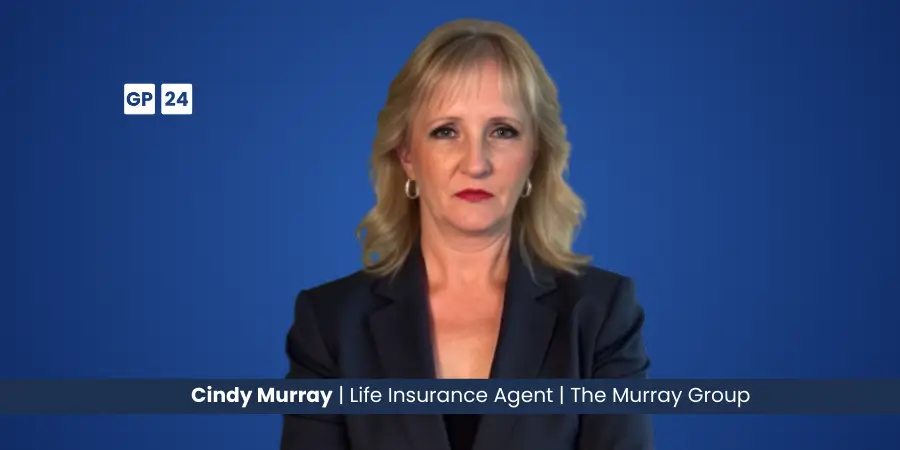
That practical restraint describes the work Cindy Murray does at The Murray Group. Her approach rejects spectacle and embraces repair. She treats ethical practice as a day job and leadership as a matter of proximity rather than posture. In short, her kind of foresight is less about prediction and more about making daily work better for real people.
Cindy’s claim to being a visionary is not rooted in disruption for disruption’s sake or in a desire to scale at any cost. It rests on something quieter: a conviction that the work of insurance, the slow business of protecting lives, incomes and dignity, rewards moral clarity and steady, hands-on leadership. That conviction, and the experiences that shaped it, come through plainly in her interview with Global24.
When Vision Is Rooted in Values
For Cindy, vision begins with a hierarchy of commitments. As she puts it simply, “God first, family second and career third…works every time.” That creed is not an afterthought; it is the governing logic for decisions both large and small. It informs how she defines leadership, how she treats clients and how she measures the success of The Murray Group.
A Career Forged in Public Responsibility
Her path to the private sector was paved in public service. Cindy spent thirty-three years in state government overseeing a major Health and Family Services budget. That tenure taught her the disciplines of stewardship, accountability, careful allocation of resources and an insistence that systems serve people. Those are not cosmetic credentials; they are the working habits she carried into entrepreneurship.
Choosing Reinvention over Retirement
Retirement, in Cindy’s story, was less a period of rest than a pivot. After leaving state government she tested the market, even posting her resume on Monster.com, and the result was almost comic in its bluntness: the site suggested truck driving or insurance. Cindy chose the latter.
“I like to work and enjoy seeing the outcomes for my clients – life insurance, annuities and/or Medicare,” she says, and the decision reads as pragmatic and curious rather than dramatic. Reinvention, for her, was continuity: the same ethic of public care redirected into individual service.
Ethics as a Business Imperative
What distinguishes The Murray Group is not novelty in product but rigor in practice. Cindy names a plain problem in the industry: too many agents treat prospective clients as inconveniences or filter them out because of health or life circumstances. She told the interviewer the gap that motivated her: a shortage of “scrupulous agents or agencies.
Some wouldn’t help certain prospects such as those with heart attacks, pregnant etc.” Her response was to build a firm where client inclusion and fairness are operational rules, not marketing copy. The company’s ambition is modest and consequential: to make ethical service a default.
Leadership Without Distance
Cindy’s style is managerial without the distance that often accompanies leadership titles. “Clients always come first. I virtually spend all my time working with clients/finding new ones,” she says, noting that she is “semi-retired” but deeply engaged. That proximity informs a philosophy she repeats more than once: leadership exists to elevate other people’s work, not to aggrandize the leader.
She is blunt about the cost of poor leadership, condescension, cruelty and political maneuvering, and candid about having experienced betrayal: after a promotion she was displaced from a job she valued, an episode she remembers with clear emotion. Those setbacks, she says, taught her the limits of formal authority and the importance of building work on principles rather than titles.
Technology with Boundaries
Cindy accepts technological change but resists absolutism. Her view on AI is pointed and pragmatic: “We are taking as much advantage of AI is the new future. BUT there will never be total AI because it cannot eliminate all staff. AI is not flexible enough, and it’s frustrating to talk to just a robot.” In her hands, technology is an efficiency tool, not a replacement for judgment or empathy. That stance maps onto a broader skepticism: innovation must serve clients, not the other way around.
Resilience Learned the Hard Way
Personal adversity threads quietly through Cindy’s narrative. She does not dramatize hardship, but she does not omit it: “I had to divorce a man we were married 17 years, and he cheated on me. Raised our young child mostly by myself. I heard he cheated on the one he did infidelity with the week of their wedding.”
Those sentences are stark in their plainness, and they matter because they illuminate how Cindy’s leadership was forged outside boardrooms, in kitchens, in nights on call, in the grind of parenthood. She counts those years as formative, and they explain the steadiness that now marks decision-making at The Murray Group.
The Discipline of Survival
Cindy’s version of visionary is not hopeful wish-making; it is disciplined realism. She advises would-be entrepreneurs to plan for durability: “Funding for operating I always recommend having enough money to support the business for 5 years with no other funding. Most agents don’t make it a year. And most new businesses don’t’ make it to 5 years because of funding and/or they can’t get enough support.” Her counsel is practical — hire competent financial advisors, accept the odds, and build processes that survive slow growth. That realism is itself a kind of vision: it sees the horizon not as immediate payoff but as sustained service.
The Measure of a Lasting Legacy
When asked about legacy, Cindy circles back to the same constants: fairness, ethics and helping others. “That I was fair and ethical, and that I helped helped as many people as I could,” she says. The language is modest, but the ambition is durable. For Cindy, to be visionary is to expand the moral space of an industry: to make it more patient, more inclusive and more accountable to the people it serves.
In an industry often tempted by scale and spectacle, Cindy Murray’s work reads as a reminder that vision can be small, precise and generous. It is a leadership of proximity and conviction, where technology is a partner, faith is a compass and integrity is the metric that lasts.