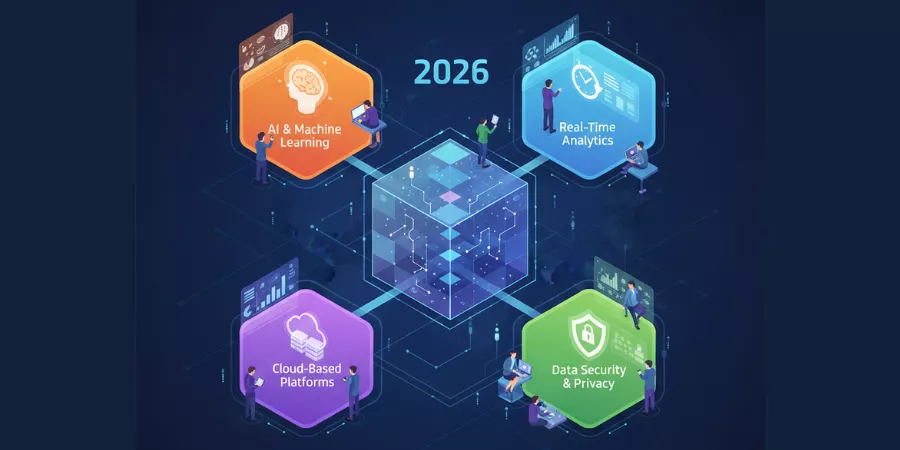
Data has always been valuable, but in 2026, the ability to analyze it in real time, at scale, and with AI-driven precision is the true competitive differentiator. As part of the evolving AI and tech investment landscape in 2026, big data analytics has matured from an IT initiative into a core business strategy that determines market winners and laggards. The organizations that understand and act on emerging analytics trends will define their industries for the next decade.
The State of Big Data in 2026
The volume of data generated globally is expected to reach 175 zettabytes by 2025, according to IDC research, with 2026 seeing the first widespread enterprise deployments capable of processing meaningful portions of this data in near-real time. Cloud data warehouses from Snowflake, Databricks, and Google BigQuery have democratized access to analytics infrastructure that previously required massive capital investment.
The democratization effect is significant: mid-market companies in retail, healthcare, and logistics now operate analytics capabilities that were reserved for Fortune 500 enterprises just five years ago. This leveling of the playing field is intensifying competition in every sector.
Trend 1: AI-Augmented Analytics and Automated Insights
The most transformative trend in big data analytics for 2026 is the deep integration of AI and machine learning into the analytics workflow. Rather than analysts querying databases and interpreting results manually, AI-augmented analytics platforms automatically surface anomalies, predict trends, and recommend actions. Tools like Tableau Pulse, Power BI Copilot, and ThoughtSpot use large language models to translate business questions into SQL queries and visualizations in seconds.
Companies tracking best AI stocks driving data infrastructure growth will notice that AI-augmented analytics is driving significant revenue acceleration for platforms that successfully embed generative AI into their core product. Salesforce’s Einstein Analytics and Microsoft’s Fabric platform are early leaders in this category.
Trend 2: Real-Time Streaming Analytics
Batch processing, the practice of analyzing data in scheduled overnight or hourly jobs, is rapidly giving way to continuous real-time streaming. Apache Kafka, Amazon Kinesis, and Google Pub/Sub enable organizations to act on data as it is generated rather than hours later. In financial services, this means fraud detection that intervenes within milliseconds. In e-commerce, it means dynamic pricing and inventory adjustments based on live demand signals.
Retailers using real-time analytics are reporting inventory cost reductions of 15 to 25 percent while improving product availability. Healthcare systems using real-time patient monitoring analytics are demonstrating measurable improvements in early deterioration detection, reducing ICU transfers and improving outcomes.
Edge Analytics: Bringing Intelligence Closer to Data Sources
A related development is edge analytics, where computational intelligence is pushed to the point of data generation rather than centralizing everything in the cloud. Manufacturing facilities, retail stores, and transportation networks are deploying edge devices that run AI inference models locally, reducing latency and bandwidth costs while enabling decisions that cannot wait for cloud round-trips.
Trend 3: Data Mesh and Federated Analytics Architecture
Enterprise data architecture is undergoing a philosophical shift from centralized data lakes to distributed data mesh models. Rather than funneling all organizational data into a single repository managed by a central team, data mesh principles assign ownership of data products to the business domains that generate them. Each domain maintains its own analytics infrastructure, interoperating through shared governance standards.
This architecture addresses the bottleneck problem that plagues centralized data teams, where business units wait weeks for analytics support. Understanding how AI tools transforming digital marketing analytics teams implement data mesh principles shows that distributed ownership with standardized APIs consistently outperforms centralized models in speed-to-insight metrics.
Trend 4: Predictive and Prescriptive Analytics Maturity
The analytics maturity curve progresses from descriptive (what happened) to diagnostic (why it happened) to predictive (what will happen) to prescriptive (what should we do). In 2026, leading enterprises are achieving prescriptive analytics maturity, where systems not only forecast outcomes but recommend specific actions and automatically execute approved responses.
Supply chain analytics is perhaps the most commercially impactful application. Companies with prescriptive supply chain analytics reduced disruption-related costs by an average of 35 percent during 2024 and 2025, according to Gartner research. The top IT stocks in data management category reflects this: vendors with prescriptive analytics capabilities command significantly higher valuations than pure descriptive analytics platforms.
Trend 5: Privacy-Preserving Analytics
Data privacy regulations, including GDPR, CCPA, and a growing number of sector-specific frameworks, are driving innovation in privacy-preserving analytics techniques. Federated learning enables model training across distributed datasets without centralizing sensitive information. Differential privacy adds mathematical noise to datasets to prevent individual identification while preserving aggregate analytical validity.
Healthcare and financial services are the primary adopters, but privacy-preserving techniques are spreading to any organization that handles personally identifiable information. Companies that solve the privacy-utility tradeoff, delivering powerful insights while maintaining regulatory compliance, are building durable competitive advantages.
The Strategic Imperative
Big data analytics in 2026 is not a technology initiative; it is a competitive necessity. Organizations that invest in real-time streaming capabilities, AI-augmented insight generation, and federated architecture are systematically outperforming peers who rely on legacy batch processing and centralized data warehousing. The trends described above are not emerging; they are arriving. The question for business leaders is not whether to modernize analytics infrastructure but how quickly to execute the transition.