What are AI data centers and why are companies investing billions?
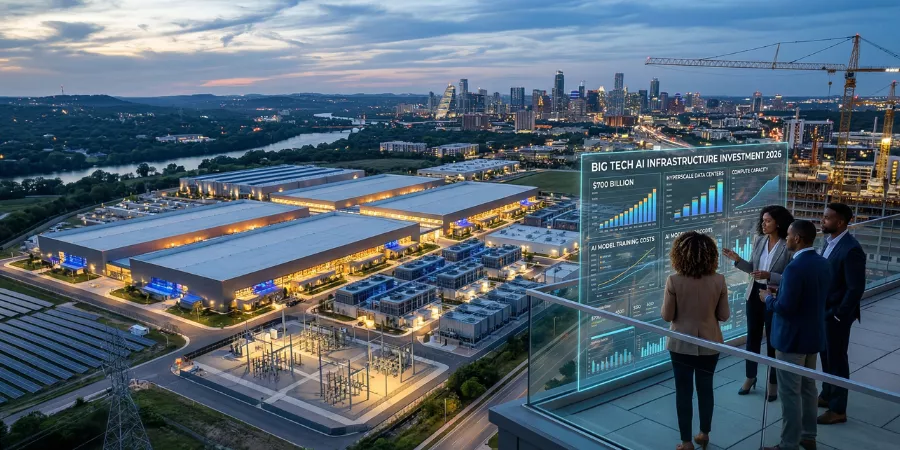
AI data centers are large facilities packed with specialized chips, GPU clusters, and cooling systems built specifically to train and run artificial intelligence models. In 2026, Google, Microsoft, Amazon, Meta, and Oracle are on track to spend a combined $650-700 billion on this infrastructure because AI computing demands are unlike anything traditional data centers were designed to handle.
Someone on Reddit’s r/technology asked a few months ago: “Why are Microsoft and Google spending more money on data centers than some countries spend on their entire national budgets? What is actually in these buildings?”
It is a fair question. The numbers are hard to process. Google alone plans to spend up to $185 billion on AI infrastructure this year. Amazon committed $200 billion. Meta between $115 and $135 billion. Microsoft roughly $145 billion. Together, just these four companies are heading toward $650 billion in capital spending in 2026 alone, a 74% jump from the year before, according to Bloomberg.
And it is not slowing down.
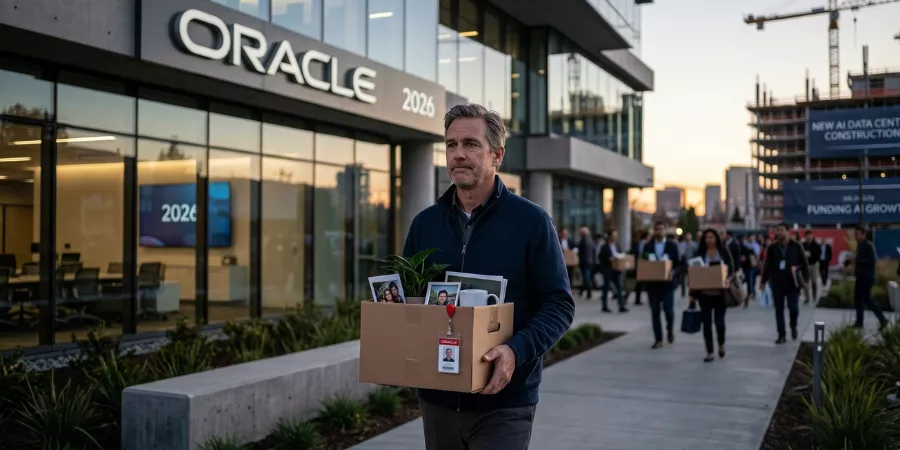
Then there is Oracle, which just this week executed what analysts at TD Cowen believe could be the largest layoff in the company’s 47-year history, somewhere between 20,000 and 30,000 employees cut via a 6 a.m. email, no warning, specifically to free up $8 to $10 billion in cash flow to fund its AI data center buildout.
A company posting 95% net income growth last quarter is still laying off nearly a 5th of its workforce because building AI infrastructure is that expensive.
Something fundamental is shifting. And at the center of it are AI data centers.
This article explains what they are, how they actually work, why companies are betting their balance sheets on them, and what the real costs look like, including the ones that rarely make headlines.
What is an AI Data Center?
Think of a traditional data center like a large public library. It stores information, retrieves it on request, and handles a predictable, steady flow of visitors. It runs on standard electricity, uses air cooling, and processes normal web traffic, emails, websites, app data.
An AI data center is something else entirely. It is closer to an industrial factory for computation. It runs AI workloads like training large language models, processing billions of image recognition requests, or running thousands of simultaneous AI inference tasks. These jobs require an enormous and sustained burst of computing power that ordinary servers simply cannot provide.
The AI data center meaning, stripped to basics: a facility purpose-built to handle high-performance computing for AI, using GPU clusters and specialized AI computing infrastructure rather than standard processors.
5 things that make AI data centers different:
- Run on thousands of GPUs, not standard CPUs
- Consume 10 to 100 times more power per rack than traditional servers
- Require liquid cooling systems, not just air
- Connect GPUs at ultra-high speed using specialized networking
- Cost hundreds of millions to over a billion dollars per campus to build
What is the Difference Between an AI Data Center and a Traditional Data Center?
| Feature | Traditional Data Center | AI Data Center |
| Primary chip | CPU (Central Processing Unit) | GPU (Graphics Processing Unit) |
| Power per rack | 5-15 kW | 80-140 kW |
| Cooling method | Air cooling | Liquid / immersion cooling |
| Main purpose | Storage, web apps, business software | Neural network training, AI inference |
| Cost to build | $10M-$50M | $500M-$10B+ |
| Power consumption | Moderate | Enormous – a single 10,000-GPU cluster uses 10–15 megawatts |
The fundamental gap is power density. A single NVIDIA H100 GPU draws 700 watts under full load. Eight of them in one server node draw 10 to 12 kilowatts. A rack of these draws up to 140 kilowatts. A 10,000-GPU training cluster consumes enough electricity to power a small town.
Traditional air cooling systems were never designed for this. The entire infrastructure model has to change.
How Do AI Data Centers Work – Step by Step
Step 1: The GPUs do the heavy lifting
The heart of any data center for AI is the GPU cluster. Unlike CPUs, which handle a few complex tasks at once, GPUs run thousands of smaller calculations simultaneously. That parallel processing ability is exactly what machine learning servers need to train AI models on massive datasets.
Step 2: High-speed networking connects everything
Training a large AI model does not run on one server. It runs across hundreds or thousands of GPUs at once, which means the networking between them has to be extremely fast. Technologies like NVIDIA’s NVLink and InfiniBand connect GPU clusters so data flows between chips in microseconds.
Step 3: Cooling keeps everything running
This is where AI computing infrastructure runs into its first major physical constraint. All those GPUs generate intense heat. Cooling accounts for 30 to 40% of total energy use in a data center. For AI-dense facilities, traditional air cooling no longer works. Liquid cooling pipes water or coolant directly to chips. Some facilities use immersion cooling, where servers sit in tanks of non-conductive fluid.
Step 4: Power delivery keeps the whole system alive
A modern AI campus can consume 500 megawatts to 1 gigawatt of continuous power, equivalent to the electricity needs of a small city. Microsoft added nearly a gigawatt of data center capacity in a single quarter. This is why tech companies are signing nuclear power agreements and long-term renewable energy contracts just to keep their AI server farms online.
Step 5: Data storage systems hold the training material
AI models train on petabytes of data. Data storage systems inside these facilities need to read and write that data fast enough to keep thousands of GPUs fed continuously. A bottleneck in storage shows up as idle GPUs, which is an enormously expensive waste.
Why are Google, Microsoft, Amazon, Meta, and Oracle Spending Billions on AI Data Centers?
The short answer is that AI has become the primary competitive battleground in technology, and compute is the scarce resource that determines who wins.
Every major AI product, ChatGPT, Gemini, Copilot, Llama, Grok, runs on physical hardware somewhere. The companies with more of that hardware can train better models, serve more users, and respond faster. The ones without it have to rent access from someone else, which means lower margins and less control.
Gil Luria, an analyst at DA Davidson, told Bloomberg that these companies view AI infrastructure as a winner-take-all market. None of them are willing to lose.
Here is what each company is building toward:
- Amazon ($200 billion): Expanding AWS cloud computing infrastructure globally. AI chips, robotics, and low-Earth orbit satellites are all part of the same buildout.
- Google ($175-185 billion): About 60 percent goes to servers and GPUs, 40 percent to data centers and networking. Powers Gemini, Search AI Overviews, and Google Cloud Platform.
- Meta ($115-135 billion): Building for its own AI products, recommendation systems, content moderation, generative AI across Facebook, Instagram, and WhatsApp. Meta’s $10 billion campus in Lebanon, Indiana, alone consumes 1 gigawatt of power. Meta has also committed to $600 billion in total data center investment by 2028.
- Microsoft ($145 billion): Powers Azure, Copilot, and its partnership with OpenAI. Analysts at Barclays project free cash flow will drop 28 percent this year before recovering in 2027.
- Oracle ($50 billion+ in 2026 alone): Tied to the $500 billion Stargate initiative with OpenAI. Oracle took on $58 billion in new debt in two months to fund its buildout, and then cut up to 30,000 employees on March 31 to make the math work.
The Oracle layoffs are the clearest signal yet of how seriously these companies are taking this bet. ORCL stock fell about 27 percent year to date before the layoffs, yet Oracle’s remaining performance obligations, basically contracted future revenue, hit $523 billion, up 433 percent year over year. The company has massive AI contracts. It just does not have the physical infrastructure to fulfill them yet.
What are the 4 Types of Data Centers?
AI infrastructure fits within a broader landscape of four main data center types:
- Enterprise data centers: Owned and operated by a single company for its own use.
- Colocation data centers: Third-party facilities that rent space and power to multiple clients.
- Hyperscale data centers: Massive facilities built by companies like Google, Amazon, and Microsoft, scaled to handle billions of users.
- Edge data centers: Smaller, distributed facilities placed close to end users for low-latency applications.
AI workloads run primarily in hyperscale data centers, though edge computing is growing as companies push AI inference closer to devices.
How Much Does it Cost to Build an AI Data Center?
Building a standard corporate data center might cost $10 to $50 million. A hyperscale AI campus is a different category entirely.
- A mid-size AI data center campus: $500 million to $1 billion
- A large campus like Meta’s Indiana facility: over $10 billion
- Oracle’s planned data center commitments across Texas, Wisconsin, and New Mexico: $156 billion.
The cost breakdown goes roughly like this:
- Land and construction: 20-30%
- Power infrastructure: 25-35% (substations, transformers, backup generators)
- IT equipment: GPUs, servers, networking: 40-50%
- Cooling systems: 10-15%
Power infrastructure is the most underestimated cost. Getting a gigawatt of power to a remote site requires years of grid interconnection work. In Northern Virginia, currently the world’s largest data center market, utility connection wait times now exceed three to five years for large-scale deployments. Power availability has replaced chip supply as the number-one infrastructure constraint in 2026.
What are the Biggest Challenges of AI Data Centers?
How Much Energy Do AI Data Centers Consume?
U.S. data centers currently consume about 4 percent of total national electricity, up from roughly 2 percent in 2020. By 2028, some projections put that figure between 8 and 12 percent. A January 2026 Bloom Energy report predicts U.S. data center energy demand will nearly double between 2025 and 2028, from 80 to 150 gigawatts. That is like adding the entire electricity demand of Spain in three years.
Training a large AI model can require 50 gigawatt-hours of energy, enough to power San Francisco for three days, according to a May 2025 study. A single AI prompt uses a small but nonzero amount of electricity every time. Multiplied across billions of daily queries, the aggregate is substantial.
The grid is struggling to keep up. Microsoft, Google, and Amazon have all signed nuclear power agreements specifically to secure long-term clean electricity for their AI facilities.
Why is Water Usage a Problem for AI Data Centers?
Cooling requires water. A lot of it.
Each 100-word AI prompt is estimated to use roughly one 500ml bottle of water, according to researchers at UC Riverside. A large data center can use up to 5 million gallons per day. U.S. data centers directly consumed 66 billion liters of water in 2023, and hyperscale facilities alone could consume up to 280 billion liters annually by 2028.
Training GPT-3 in Microsoft’s data centers reportedly evaporated 700,000 liters of fresh water. These are not abstract figures. Communities near data centers are already raising concerns about aquifer depletion.
Rising Electricity Costs for Everyone
When data centers draw massive amounts of power from regional grids, residential electricity rates go up. In parts of Northern Virginia, electricity prices jumped 267% over 5 years. A Carnegie Mellon University study estimates that data center expansion could raise the average U.S. household electricity bill by 8% by 2030, and by over 25% in the highest-demand regions.
In 2025-26, community opposition blocked or delayed $98 billion in data center projects according to research firm Data Center Watch. Google pulled a $1 billion Indianapolis project after intense local opposition.
Infrastructure Costs and Chip Supply
This dynamic played out clearly with Oracle. The company has signed massive AI contracts. It has customers. What it lacks is physical infrastructure to deliver, which is why it raised $58 billion in new debt in two months and cut up to 30,000 jobs in a single morning to generate the cash flow needed to build.
Multiple U.S. banks have reportedly raised lending costs or stepped back from financing certain data center projects as the debt loads have grown. Oracle’s total debt now exceeds $100 billion.
Examples of AI Data Centers Used by Big Tech
- Google operates data centers in 23 countries. Its Midlothian, Texas facility came online in late 2025. Google is directing roughly $175-185 billion in 2026 capital spending toward AI server farms and cloud computing infrastructure.
- Microsoft added nearly 1 gigawatt of new AI data center capacity in a single quarter of 2025. It has also signed a deal to use nuclear power from Three Mile Island, restarted specifically to supply data center electricity.
- Meta is building a 1-gigawatt campus in Lebanon, Indiana, described as one of the company’s largest infrastructure investments, costing over $10 billion. The company’s AI data centers power the recommendation systems on Facebook, Instagram, and WhatsApp simultaneously.
- Amazon operates over 100 data center locations globally through AWS. Its 2026 capital expenditure plan of $200 billion, the largest among the hyperscalers, covers AI chips, new regions, satellites, and robotics alongside traditional cloud computing infrastructure.
- Oracle is building data centers in Texas, Wisconsin, and New Mexico as part of its partnership with OpenAI in the Stargate initiative, a $500 billion project that, if completed, would represent one of the largest infrastructure investments in corporate history.
The Future of AI Infrastructure and Cloud Computing
A few things are becoming clear about where this is heading.
- Power will determine winners: By late 2026, data center occupancy in major markets is expected to exceed 95%, not because servers are full, but because electrical capacity is fully committed. Securing electricity contracts years in advance is now a strategic advantage, not a utility question.
- Liquid cooling becomes standard: Modern AI server racks require 100 to 140 kilowatts, making air cooling physically inadequate. Liquid cooling and immersion cooling are moving from experimental to standard deployment across new facilities.
- Nuclear and renewables fill the gap: Microsoft, Google, and Amazon have all signed nuclear power agreements. Small modular reactor (SMR) projects are being fast-tracked specifically for data center power supply.
- Regulation is coming: Ireland’s data centers already use 21% of the country’s national electricity, potentially reaching 32 percent by 2026. Multiple regions are now considering mandatory disclosure rules for energy and water consumption. Local moratoria are becoming more common.
- The tech layoff trend continues: Oracle is not an isolated case. As companies prioritize capital expenditure for AI data centers over headcount, workforce restructuring across tech, at Oracle, Meta, and others, reflects a reallocation of resources from human labor to physical AI infrastructure.
Key Takeaways
- Google, Microsoft, Amazon, Meta, and Oracle are on track to spend $650-700 billion on AI data centers in 2026.
- AI data centers use GPU clusters, not standard processors, the power and cooling requirements are fundamentally different from traditional data centers.
- A single 10,000-GPU training cluster consumes 10-15 megawatts of electricity, equivalent to powering a small town.
- S. data centers will consume up to 12% of national electricity by 2028, up from 4 percent today.
- Water use is an underreported problem, a large AI campus can use 5 million gallons of water per day.
- Oracle cut up to 30,000 jobs on March 31, 2026, specifically to fund its $156 billion AI infrastructure buildout.
- Power availability has replaced chip supply as the primary constraint limiting AI compute scaling in 2026.
- Every 100-word AI prompt consumes approximately 500 ml of water and a measurable amount of electricity.
Frequently Asked Questions
What are AI data centers? AI data centers are specialized facilities built to run high-performance computing workloads required by artificial intelligence. They use GPU clusters, advanced cooling systems, and high-speed networking rather than standard server hardware. They consume vastly more power and water than traditional data centers and are purpose-built to train and serve AI models at scale.
Who is building AI data centers? The primary builders in 2026 are Amazon, Google, Meta, Microsoft, and Oracle. Together these five companies are spending roughly $690 billion on AI infrastructure this year. Third-party data center operators like Equinix and Digital Realty also build and lease space to these companies.
What are the 4 types of data centers? Enterprise (single-company owned), colocation (shared, rented space), hyperscale (massive facilities for billions of users), and edge (small, distributed, close to end users). AI runs primarily in hyperscale facilities.
What is the difference between an AI data center and a traditional data center? The core difference is the hardware and power requirements. Traditional centers run standard CPUs at 5-15 kilowatts per rack. AI data centers run GPU clusters at 80–140 kilowatts per rack, require liquid cooling instead of air, and cost ten to one hundred times more to build and operate.
How much do AI data centers cost to build? A mid-size AI campus costs $500 million to over $1 billion. Meta’s Indiana campus exceeds $10 billion. Oracle’s total buildout commitments reach $156 billion. Power infrastructure, GPUs, and construction are the three largest cost drivers.
Why do AI data centers use so much energy? Training and running AI models requires sustained, parallel computation across thousands of GPUs simultaneously. A single H100 GPU draws 700 watts. Scale that to 10,000 GPUs and you have a cluster consuming 10-15 megawatts continuously, 24 hours a day.
What are the biggest challenges facing AI data centers? Power availability is the most immediate constraint in 2026, electricity is harder to access than chips. Water consumption is a growing environmental concern. Construction costs and community opposition are slowing projects. And the debt loads companies are taking on to fund these buildouts, Oracle’s now exceeds $100 billion, creating significant financial risk if AI revenue does not scale fast enough to cover the investment.