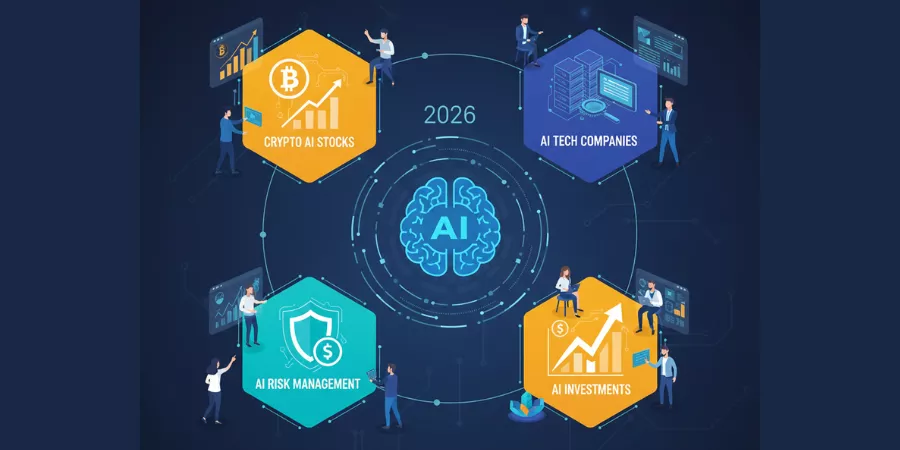
The year 2026 is not a distant horizon for investors; it is a high-stakes proving ground. Artificial intelligence has moved from boardroom buzzword to balance-sheet driver, cryptocurrency markets are maturing under new regulatory frameworks, and enterprise technology is rewriting the rules of capital allocation. For anyone serious about building wealth in the digital economy, understanding where these three forces intersect is no longer optional.
Why 2026 Is a Defining Moment for Digital Asset Investors
The global AI market is projected to surpass $900 billion by 2026, according to Grand View Research, while the broader digital economy, including blockchain, cloud infrastructure, and data services, is set to contribute more than 25 percent of global GDP. These are not speculative forecasts; they reflect deployment-stage realities already visible in earnings reports from Microsoft, Nvidia, and Alphabet.
Investors who waited for AI to ‘mature’ in 2023 and 2024 watched some of the most significant wealth-creation events of the decade pass them by. The window in 2026 is different: the technology is proven, the regulatory environment is clearer, and institutional capital is flowing in at scale.
Artificial Intelligence: From Hype to Hard Returns
AI’s investment story in 2026 centers on three pillars: semiconductor infrastructure, enterprise software integration, and autonomous systems. Nvidia continues to dominate GPU supply for AI training workloads, while challengers like AMD and domestic Chinese chip manufacturers are narrowing the gap. For investors seeking diversified exposure, looking beyond hardware to the best AI stocks in 2026 across software, cloud, and robotics layers offers more balanced risk profiles.
Enterprise AI adoption is accelerating fastest in financial services, healthcare, and manufacturing. Companies deploying AI-driven workflow automation are reporting productivity gains of 30 to 40 percent in specific functions, and this operational leverage is beginning to translate into margin expansion that equity markets are rewarding.
AI Investment Risks Worth Watching
Concentration risk remains the primary concern. A handful of hyperscalers, primarily Amazon, Microsoft, and Google, control the cloud infrastructure underpinning most commercial AI. Regulatory scrutiny around data privacy, algorithmic accountability, and antitrust behavior could introduce volatility. Diversification across the AI value chain remains the most prudent strategy.
Cryptocurrency: Maturity, Regulation, and New Opportunities
The crypto narrative in 2026 is defined less by speculative mania and more by institutional adoption. Bitcoin spot ETFs, approved in the United States in early 2024, catalyzed a sustained inflow of institutional capital that stabilized price discovery mechanisms. Ethereum’s continued transition to proof-of-stake has reduced its energy footprint by over 99 percent, improving its ESG profile among institutional investors.
Knowing which of the top cryptocurrencies to watch separates informed investors from reactive traders. Beyond Bitcoin and Ethereum, layer-2 scaling solutions and blockchain networks focused on real-world asset tokenization are emerging as high-conviction theses for 2026.
Big Data and Analytics: The Underrated Investment Frontier
While AI captures headlines, the infrastructure enabling it quietly creates extraordinary investment opportunities. The global big data analytics market is forecast to reach $745 billion by 2030, with the 2026 segment already showing compounding growth in healthcare analytics, supply chain intelligence, and financial risk modeling.
Companies leveraging big data analytics trends to build proprietary data moats are commanding premium valuations. Investors should evaluate data companies not just on revenue growth but on the defensibility of their data assets, the quality of their annotation pipelines, and their relationships with regulated industries.
Emerging Technologies Reshaping Investment Categories
Quantum computing, edge AI, spatial computing, and autonomous vehicles are graduating from research labs to commercial pilots in 2026. The leaders driving this transition are not always household names. Profiling emerging tech leaders who are redefining innovation reveals a pattern: they combine deep domain expertise with aggressive go-to-market strategies and strategic partnerships with established enterprises.
Defense technology, climate tech, and digital health are three sub-sectors where emerging tech leaders are attracting the most venture and growth-equity capital in 2026, often with government contracts that provide revenue visibility uncommon in early-stage technology.
IT Infrastructure: The Foundational Investment Thesis
Every AI application, every blockchain transaction, and every data analytics pipeline runs on IT infrastructure. Cloud computing, cybersecurity, and enterprise software remain structural growth areas. For investors seeking stability alongside upside, the top IT stocks for 2026 offer exposure to digital transformation trends with more predictable cash flow profiles than pure-play AI or crypto positions.
Managed security services, in particular, are benefiting from a surge in cyber threats that shows no sign of abating. Companies providing zero-trust architecture, endpoint protection, and AI-augmented threat detection are growing revenue at rates that justify premium multiples.
Building a 2026 Digital Economy Portfolio
Successful investors in 2026 are approaching the digital economy as an ecosystem, not a collection of isolated bets. A well-structured portfolio allocates across AI enablers, blockchain infrastructure, data analytics platforms, and IT security, with position sizes calibrated to risk tolerance and time horizon.
Thematic ETFs offer accessible entry points for retail investors, while direct equity positions in category leaders provide higher upside for those willing to conduct deeper due diligence. Regardless of vehicle, rebalancing discipline and staying current on regulatory developments in both AI and crypto will be essential to protecting gains.
Looking Ahead
The digital economy in 2026 rewards investors who combine conviction with curiosity. Artificial intelligence, cryptocurrency, and enterprise technology are not three separate stories; they are chapters of the same narrative about how digital infrastructure is becoming the foundation of global economic activity. Those who understand the connections between these trends, who they benefit, which companies execute best, and where regulatory risks lie, will be best positioned to capture the returns this decade has to offer.