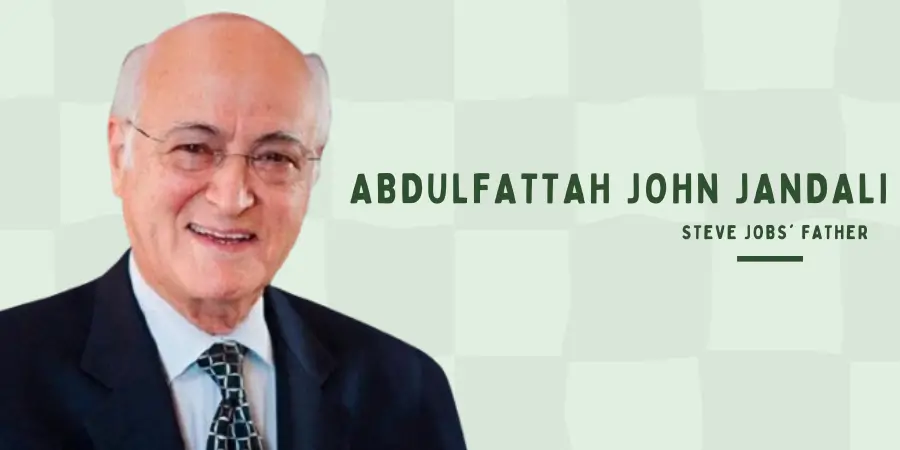
Abdulfattah John Jandali’s name often resurfaces whenever the story of Apple co-founder Steve Jobs is told. While Jobs became one of the most visionary leaders in the tech world, his biological father remained largely in the shadows. Their story is not one of conflict, but of distance, missed connections, and emotional complexity.
Many wonder how the man who gave life to one of technology’s greatest icons could remain absent, while others believe circumstances left him powerless to do otherwise.
Early Life and Background of Abdulfattah John Jandali
Abdulfattah John Jandali was born in Syria in 1931 into a prosperous family. Determined to expand his horizons, he moved to the United States to pursue higher education. While studying political science and business at the University of Wisconsin, Jandali met Joanne Schieble, a bright young student who would later become Steve Jobs’s biological mother.
Their relationship faced strong opposition from Schieble’s conservative family due to cultural and religious differences. Despite their love, external pressures forced them to give up their newborn son for adoption. This pivotal decision forever shaped their lives — and the future of Steve Jobs, who was adopted by Paul and Clara Jobs, the couple who nurtured his talents and dreams.
The Father-Son Bond That Never Developed
Although Jandali was Jobs’s biological father, he had no role in raising him. After the adoption, Jandali and Schieble eventually married and had another child — Mona Simpson, who later became a renowned author. But by that time, the opportunity to build a father-son relationship with Jobs had already vanished.
Years later, when Jobs discovered who his biological parents were, he chose not to pursue a relationship with them. Meanwhile, Jandali occasionally expressed regret about their estrangement but did little to change it. Some say he respected Jobs’s privacy, while others feel he avoided facing the emotional reality of their separation.
How the Public Views Abdulfattah John Jandali
Public opinion about Abdulfattah John Jandali has always been divided. Some people see him as a man who made painful but necessary choices, avoiding intrusion into Jobs’s carefully guarded personal life. Others criticize him for not trying harder to bridge the gap.
Even after Jobs became one of the most powerful figures in modern business, Jandali never attempted to reach out directly. He focused on his career in the restaurant and hospitality industry, living quietly and away from public attention.
When he finally spoke about Jobs in interviews years later, many questioned whether his regret was sincere or prompted by the media’s growing interest in Jobs’s origins.
The Unspoken Emotional Distance
The emotional distance between Steve Jobs and Abdulfattah Jandali remains one of the most puzzling aspects of Jobs’s personal story. Jandali later claimed that he refrained from contacting his son because he didn’t want to disturb his life. Yet, many believe that a father’s instinct should have driven him to try, regardless of the outcome.
Jobs himself once said he had no hard feelings toward his biological parents — but also no desire to build a relationship. That calm detachment reflected Jobs’s tendency to keep his personal world tightly controlled. Their mutual silence created an emotional void that continues to intrigue biographers and fans alike.
Legacy and Lessons from Their Story
The story of Steve Jobs is often celebrated for his brilliance, innovation, and relentless pursuit of excellence. However, the absence of Abdulfattah John Jandali adds a deeply human element — a reminder that even the most successful lives have unresolved emotional chapters.
Jobs acknowledged his biological father only as a fact of birth, not of influence. For many, this reveals how life’s direction is determined not only by blood but by the choices people make and the circumstances that define them.
Jandali’s quiet existence, marked by success in hospitality and lingering regret, contrasts sharply with the global legacy of his son — a man who revolutionized technology but left some personal connections untouched.
Final Thoughts
Abdulfattah John Jandali remains a controversial figure in Steve Jobs’s story — not because of wrongdoing, but due to the silence and separation that defined their relationship. Whether Jandali should have pursued reconciliation or whether Jobs should have opened the door will forever remain an unanswered question.
What endures is the mystery surrounding their emotional distance — a reminder that even in extraordinary lives, family stories can remain unfinished. The absence of a connection between father and son adds a poignant layer to one of the most fascinating biographies of the modern era.