
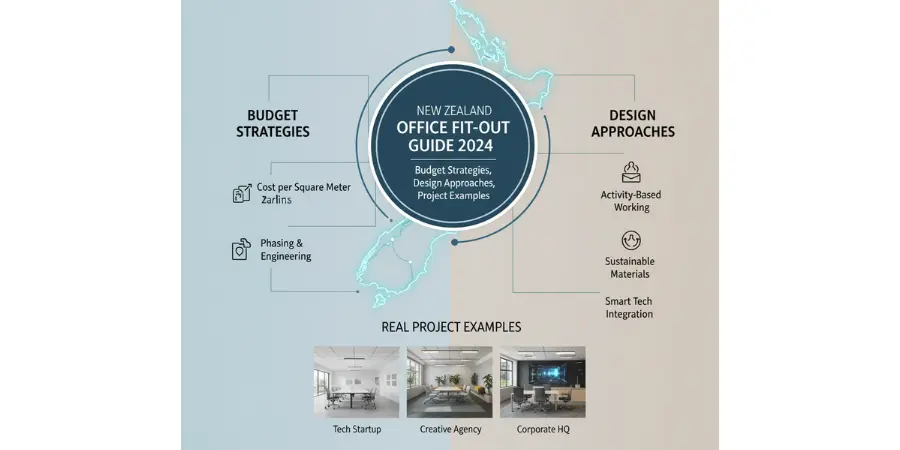
New Zealand commercial office fit-outs range from NZ$500-800 per square meter for basic refurbishments to NZ$2,500-4,000+ per sqm for premium CBD installations according to Rider Levett Bucknall’s 2024 Construction Cost Handbook, yet most businesses dramatically underestimate total project costs by focusing solely on furniture and neglecting essential infrastructure (electrical, data, HVAC upgrades), compliance requirements (NZ Building Code accessibility, fire safety), and professional fees (architects 8-12% of construction costs, project managers 3-5%) that collectively add 40-60% beyond base construction budgets. The Auckland and Wellington markets face additional pressure where commercial lease incentives (tenant improvement allowances) typically cover only NZ$200-400 per sqm leaving businesses funding NZ$300-2,000+ per sqm from operating budgets, while post-COVID hybrid work models complicate space planning where organizations reduce desk ratios from traditional 1:1 (one desk per employee) to 0.6-0.8:1 hot-desking configurations attempting to reduce real estate costs yet discovering savings offset by increased investment in collaboration spaces, technology infrastructure, and acoustics management. Space utilisation audits using occupancy sensors and workplace analytics reveal typical NZ offices operate at 40-60% utilization during business hours (per CBRE 2023 NZ Workplace Study) suggesting opportunity for 20-30% space reduction, yet downsizing decisions require balancing real estate savings against employee experience, recruitment/retention impacts, and flexibility for future growth creating tension between finance-driven space optimization and people-centric workplace strategies. This comprehensive guide examines verified NZ fit-out costs with project breakdowns, budget strategies comparing new furniture versus refurbished options like second hand stackable chairs available online (30-60% cost savings), design approaches balancing aesthetics with functionality, real Auckland/Wellington/Christchurch case studies with actual budgets and outcomes, and honest assessment revealing “budget fit-outs” requiring minimum NZ$50,000-80,000 investment (200-300 sqm space) making office renovation inaccessible for many small businesses despite marketing suggesting otherwise.
New Zealand Office Fit-Out Cost Benchmarks
Cost Per Square Meter Guide (2024)
According to Rider Levett Bucknall (RLB) NZ Construction Cost Handbook and Rawlinsons NZ Construction Handbook:
Basic Refurbishment (Cosmetic Updates):
- Cost range: NZ$500-800 per sqm
- Includes: Paint, carpet, basic lighting upgrades, minor furniture
- Excludes: Structural changes, mechanical upgrades, custom joinery
- Suitable for: Lease renewals, minor refreshes
Standard Fit-Out (Moderate Quality):
- Cost range: NZ$1,200-1,800 per sqm
- Includes:
- Partitioning (standard gypsum board)
- Mid-range furniture (Ikea Business, Freedom Contract)
- Basic kitchenette, breakout space
- Standard lighting, power, data
- Typical for: Small-to-medium businesses (50-200 sqm)
Premium Fit-Out (High Specification):
- Cost range: NZ$2,500-4,000 per sqm
- Includes:
- Custom joinery and storage
- Acoustic treatments (soundproofing, panels)
- High-end furniture (Herman Miller, Haworth, Steelcase)
- Advanced AV systems (video conferencing, collaboration tech)
- Branded design elements
- Typical for: Professional services (law firms, tech companies), CBD locations
Example calculations:
200 sqm office (20-25 employees):
- Basic: NZ$100,000-160,000
- Standard: NZ$240,000-360,000
- Premium: NZ$500,000-800,000
Cost Breakdown by Category
Typical standard fit-out (NZ$1,500/sqm) allocation:
| Category | % of Budget | Cost (200 sqm) | Details |
|---|---|---|---|
| Partitioning/Walls | 18% | NZ$54,000 | Gypsum board, glass partitions |
| Flooring | 12% | NZ$36,000 | Carpet tiles, vinyl, exposed concrete |
| Electrical/Data | 15% | NZ$45,000 | Power, lighting, data cabling |
| HVAC | 10% | NZ$30,000 | Air conditioning upgrades, ventilation |
| Furniture | 20% | NZ$60,000 | Desks, chairs, storage, breakout furniture |
| Kitchen/Breakout | 8% | NZ$24,000 | Appliances, benchtop, cabinetry |
| Joinery/Storage | 7% | NZ$21,000 | Built-in shelving, lockers |
| Painting/Decoration | 5% | NZ$15,000 | Paint, feature walls, branding |
| Professional Fees | 10% | NZ$30,000 | Architect, project manager, engineer |
| Contingency | 10% | NZ$30,000 | Variations, unforeseen issues |
| TOTAL | 100% | NZ$300,000 | NZ$1,500/sqm |
Budget Reduction Strategies: Where to Save Without Compromising Quality
Strategy 1: Refurbish Existing Furniture (30-50% Savings)
What to refurbish:
Desks:
- Sand and refinish timber tops (NZ$80-150 per desk)
- Replace laminate surfaces (NZ$120-200 per desk)
- Powder coat metal frames (NZ$50-100 per frame)
Cost comparison:
- New quality desk: NZ$800-1,200
- Refurbish existing: NZ$200-350
- Savings: NZ$500-850 per desk (60-70%)
Chairs:
- Reupholster fabric (NZ$120-200 per chair)
- Replace gas lift, castors, armrests (NZ$80-120)
- Deep clean mesh chairs (NZ$40-60)
Cost comparison:
- New ergonomic chair: NZ$400-800
- Refurbish existing: NZ$160-280
- Savings: NZ$240-520 per chair (60-65%)
When refurbishment doesn’t make sense:
- Structural damage (broken frames, cracked bases)
- Non-standard sizes (hard to source replacement parts)
- Poor original quality (cheap furniture not worth refurbishing)
Strategy 2: Second-Hand and Ex-Lease Furniture (40-70% Savings)
Reputable NZ second-hand suppliers:
Fil Furniture (filfurniture.co.nz):
- Ex-corporate furniture (banks, government agencies relocating)
- Quality brands: Vitra, Steelcase, Herman Miller at 50-70% off retail
- Warranty: 12 months on refurbished items
Regency Commercial Furniture:
- New Zealand’s largest second-hand office furniture retailer
- Locations: Auckland, Wellington, Christchurch
- Services: Delivery, installation, space planning
Corporate clearance sales:
- Monitor TradeMe, liquidation auctions
- Government agencies relocating (Ministry of Justice, IRD office moves)
- University/polytechnic surplus sales (end of academic year)
Cost comparison example:
25-person office furniture:
| Item | New (Qty) | Second-Hand (Qty) | Savings |
|---|---|---|---|
| Desks (25) | NZ$25,000 | NZ$10,000 | NZ$15,000 (60%) |
| Chairs (25) | NZ$15,000 | NZ$6,000 | NZ$9,000 (60%) |
| Meeting table (1) | NZ$3,000 | NZ$1,200 | NZ$1,800 (60%) |
| Meeting chairs (10) | NZ$4,000 | NZ$1,600 | NZ$2,400 (60%) |
| Storage units (10) | NZ$8,000 | NZ$3,200 | NZ$4,800 (60%) |
| TOTAL | NZ$55,000 | NZ$22,000 | NZ$33,000 (60%) |
Quality considerations:
- Inspect for structural integrity (sit in chairs, test drawer slides)
- Check for bed bugs/pests (especially upholstered furniture)
- Verify dimensions match your space
- Negotiate bulk discounts (typically 10-20% off for full office orders)
Strategy 3: Phased Fit-Out Approach (Spread Costs Over Time)
Phase 1 (Immediate/Essential):
- Workstations, task chairs (core functionality)
- Basic meeting room
- Kitchenette essentials
- Budget: NZ$80,000-120,000 (200 sqm)
Phase 2 (3-6 months later):
- Collaboration/breakout spaces
- Storage/filing systems
- Upgraded lighting
- Budget: NZ$30,000-50,000
Phase 3 (12-18 months):
- Acoustic treatments
- Branding/feature walls
- Upgraded AV systems
- Budget: NZ$20,000-40,000
Advantages:
- Manageable cash flow impact
- Learn from Phase 1 before committing to full design
- Adjust based on actual space usage patterns
Disadvantages:
- Disruption across multiple periods
- May lose design cohesion
- Some items more expensive when purchased separately
Strategy 4: Value Engineering with Design Team
What is value engineering? Process of achieving design intent at lower cost through material substitutions, design simplifications, or alternative construction methods.
Examples:
Original design: Custom millwork reception desk (NZ$15,000)
Value-engineered: IKEA kitchen cabinets with custom benchtop (NZ$4,500)
Savings: NZ$10,500 (70%)
Original design: Acoustic ceiling panels throughout (NZ$25,000)
Value-engineered: Strategic acoustic treatment in meeting rooms only + soft furnishings (rugs, curtains) elsewhere (NZ$12,000)
Savings: NZ$13,000 (52%)
Original design: Glass partitions (NZ$600-800 per linear meter)
Value-engineered: Gypsum partitions with glass inserts (NZ$350-450 per linear meter)
Savings: 40-50%
Working with architects/designers:
- Be transparent about budget constraints upfront
- Ask for 2-3 budget scenarios (ideal, standard, value)
- Request itemized quotes so you can selectively cut items
Space Utilization: Getting More from Less
Understanding Current Space Usage
Workplace occupancy study findings (CBRE NZ 2023):
- Average desk utilization: 42% (desks occupied 42% of work hours)
- Peak occupancy: Tuesday-Thursday 10am-3pm (65-75%)
- Monday/Friday: 30-40% occupancy (hybrid work impact)
- Meeting rooms: 35% utilization, but often booked and unused
Implications:
- Traditional 1:1 desk ratio oversupplies workspace
- Opportunity for 20-30% space reduction OR repurpose to collaboration zones
Hot-Desking and Activity-Based Working (ABW)
Model comparison:
Traditional (1:1 ratio):
- 25 employees = 25 desks
- 200 sqm total space (8 sqm per employee)
Hot-desking (0.7:1 ratio):
- 25 employees = 18 desks + 7 “hotel desks”/collaboration spaces
- 180 sqm total space (saves 20 sqm = NZ$24,000-36,000 in fit-out costs + ongoing rent)
Activity-Based Working:
- 25 employees = 15 assigned desks + 10 varied workspaces:
- 4 focus booths (quiet work)
- 3 collaborative tables (team work)
- 3 phone booths (calls)
- Same 200 sqm but optimized for work variety
Employee acceptance:
- High: Younger workforce (under 35), tech industry, frequently mobile employees
- Medium: Mixed-age workforce, requires change management
- Low: Senior staff accustomed to private offices, sectors with confidential work
Success factors:
- Technology: Desk booking apps (Robin, Condeco, Joan), collaboration tools
- Lockers: Personal storage (NZ$150-300 per locker)
- Change management: 3-6 month pilot, employee feedback loops
Real New Zealand Fit-Out Case Studies
Case Study 1: Wellington Tech Startup (Budget Fit-Out)
Company: 18-employee software company
Location: Wellington CBD (Te Aro)
Space: 150 sqm
Budget: NZ$75,000 (NZ$500/sqm)
Approach:
- Landlord contribution: NZ$30,000 (NZ$200/sqm incentive)
- Company investment: NZ$45,000
Costs:
- Furniture (second-hand):
- 15 desks from ex-bank fitout: NZ$6,000 (NZ$400 each)
- 18 task chairs (refurbished Steelcase): NZ$3,600 (NZ$200 each)
- Meeting table + 8 chairs: NZ$1,800
- Breakout furniture (sofas, stools): NZ$2,400
- Subtotal: NZ$13,800
- Construction:
- Paint (walls, feature wall): NZ$4,500
- Carpet tiles (selected areas, polished concrete elsewhere): NZ$8,000
- Basic partitioning (2 meeting rooms): NZ$12,000
- Kitchenette upgrade: NZ$6,000
- Subtotal: NZ$30,500
- Electrical/Data: NZ$8,000 (additional power, data points)
- Signage/Branding: NZ$3,200
- Professional fees (space planning only): NZ$4,500
- Contingency/misc: NZ$5,000
TOTAL: NZ$75,000 (on budget)
Timeline: 6 weeks (including furniture sourcing)
Outcome:
- Functional, modern space supporting hybrid work
- 30% under initial quotes from fit-out companies (who proposed NZ$105K-120K)
- Employees reported satisfaction with aesthetics, ergonomics
Trade-offs:
- No acoustic treatment (open-plan noise an issue)
- Basic lighting (no smart controls)
- Mismatched furniture aesthetics (second-hand from multiple sources)
Case Study 2: Auckland Accounting Firm (Premium Fit-Out)
Company: 45-employee chartered accountants
Location: Auckland CBD (Queen Street)
Space: 380 sqm
Budget: NZ$950,000 (NZ$2,500/sqm)
Approach:
- Professional, client-facing environment
- Partner offices, open-plan staff area, formal meeting rooms
Costs:
- Architecture/Design: NZ$76,000 (8% of construction)
- Construction:
- Partitioning (10 offices, 3 meeting rooms, glass walls): NZ$180,000
- Flooring (carpet, timber feature areas): NZ$65,000
- Ceiling (acoustic tiles, recessed lighting): NZ$55,000
- Custom joinery (reception desk, storage): NZ$85,000
- Subtotal: NZ$385,000
- Furniture (new, high-spec):
- 35 workstations (Haworth): NZ$105,000
- 45 task chairs (Herman Miller Aeron): NZ$90,000
- Meeting furniture: NZ$45,000
- Partner office furniture: NZ$60,000
- Reception furniture: NZ$25,000
- Subtotal: NZ$325,000
- Mechanical/Electrical: NZ$95,000
- Upgraded HVAC (individual zone control)
- LED lighting with daylight sensors
- AV systems (3 meeting rooms)
- Kitchen: NZ$35,000 (commercial-grade appliances, stone benchtop)
- Branding/Signage: NZ$18,000
- Project Management: NZ$28,500 (3% of construction)
- Contingency: NZ$28,500 (used NZ$22,000 for variations)
TOTAL: NZ$950,000
Timeline: 16 weeks construction + 4 weeks planning
Outcome:
- Highly professional environment supporting client confidence
- Acoustic performance excellent (private conversations in offices remain private)
- Energy efficiency: 25% reduction in electricity vs. previous office
- Recruitment advantage: Several candidates mentioned office quality as factor in accepting offers
ROI consideration:
- NZ$950K investment
- Lease term: 6 years (amortized: NZ$158K/year)
- Alternative: Basic fit-out NZ$400K, but estimated 10-15% higher turnover, harder recruitment
- Firm concluded premium fit-out justified by employee retention, client perception
Case Study 3: Christchurch Non-Profit (Sustainability-Focused Fit-Out)
Company: 22-employee environmental advocacy organization
Location: Christchurch (Addington)
Space: 200 sqm (converted warehouse)
Budget: NZ$140,000 (NZ$700/sqm)
Approach:
- Circular economy principles (reuse, refurbish, recycle)
- Low-VOC materials
- Energy efficiency
Costs:
- Furniture (100% second-hand/upcycled):
- 20 desks (ex-government office): NZ$4,000
- 22 chairs (refurbished): NZ$3,500
- Vintage meeting table (Trade Me): NZ$400
- Reclaimed timber shelving (made on-site): NZ$800
- Subtotal: NZ$8,700
- Construction (sustainable materials):
- Insulation (recycled wool): NZ$12,000
- Partitioning (reclaimed timber, salvaged glass): NZ$18,000
- Flooring (polished existing concrete): NZ$8,000
- Low-VOC paint: NZ$3,500
- Subtotal: NZ$41,500
- Mechanical/Electrical (energy-efficient):
- LED lighting throughout: NZ$15,000
- Heat pump (high-efficiency): NZ$12,000
- Solar panels (2kW array): NZ$8,000
- Subtotal: NZ$35,000
- Kitchen (second-hand appliances): NZ$4,500
- Design/Planning (architecture student project, pro bono): NZ$0
- Project Management (volunteer with construction background): NZ$0
- Trades/Labor: NZ$38,000
- Contingency/misc: NZ$12,300
TOTAL: NZ$140,000
Timeline: 10 weeks (included volunteer labor on weekends)
Outcome:
- Achieved 5-Star Green Star certification (fit-out)
- 85% waste diversion (materials reused or recycled)
- Energy costs 40% below comparable office
- Organization used fit-out as case study for circular economy advocacy
Challenges:
- Longer sourcing time (finding suitable second-hand items)
- Aesthetic compromises (mismatched furniture)
- Volunteer coordination required significant staff time
Compliance Requirements: Non-Negotiable Costs
New Zealand Building Code
Key sections affecting fit-outs:
Clause D1: Access Routes
- Accessible entry, corridors (min 1200mm wide)
- Accessible toilet (if >40 occupants or public-facing)
- Cost: NZ$8,000-15,000 for accessible toilet
Clause F: Fire Safety
- Sprinklers, smoke detectors, exit signage
- Fire-rated partitions (if creating new rooms)
- Cost: NZ$10,000-25,000 depending on changes
Clause G: Services and Facilities
- Ventilation, natural light
- Kitchen/bathroom facilities
- Cost: Variable, often NZ$15,000-40,000 for HVAC upgrades
Clause E: Moisture
- Waterproofing (kitchens, bathrooms)
- Cost: NZ$5,000-12,000
Building consent:
- Required for structural changes, plumbing, fire safety modifications
- Cost: NZ$2,000-5,000 (consent fees)
- Timeline: 4-8 weeks processing
Health and Safety
Health and Safety at Work Act 2015:
- Employer must provide safe workplace
- Ergonomic workstations (adjustable desks/chairs if requested)
- Adequate lighting (min 320 lux for office work)
- Temperature control (16-24°C comfort range)
WorkSafe NZ can inspect, issue improvement/prohibition notices if non-compliant.
Cost implications:
- Ergonomic furniture premium: +NZ$200-400 per workstation
- Lighting upgrades: NZ$80-150 per fixture
Sustainability in Office Fit-Outs
Green Star NZ Certification
What it is:
- Rating system for sustainable buildings/fit-outs
- Operated by New Zealand Green Building Council (NZGBC)
Levels:
- 4-Star: “Best Practice”
- 5-Star: “NZ Excellence”
- 6-Star: “World Leadership”
Categories scored:
- Energy (lighting, HVAC efficiency)
- Water (low-flow fixtures, rainwater harvesting)
- Materials (recycled content, FSC timber, low-VOC)
- Indoor Environment Quality (air quality, natural light, acoustics)
- Management (waste diversion, sustainable procurement)
Cost:
- Certification fees: NZ$4,000-10,000
- Incremental fit-out costs: +10-20% (sustainable materials, efficient systems)
- ROI: Lower operating costs (energy, water), employee health/productivity, corporate ESG goals
Circular Economy Strategies
Material reuse:
- Salvage existing partitions, doors, hardware
- Source reclaimed timber (architectural salvage yards: NZ$80-200 per sqm vs. new NZ$150-350)
Furniture leasing:
- Welled (nz.welled.co), Globelet offer furniture-as-a-service
- Monthly fee (e.g., NZ$80-120 per desk/month)
- Benefits: No upfront capital, upgrade flexibility, circular (returned for refurbishment)
- Cost comparison: 5-year lease (NZ$80/month × 60 months = NZ$4,800) vs. new desk (NZ$1,000) + resale value (NZ$200) = Net NZ$800 ownership. Leasing 6x more expensive BUT provides flexibility.
Waste management:
- Demolition: Separate gypsum, metal, timber for recycling (80%+ diversion achievable)
- Cost: Waste sorting +NZ$2,000-5,000 but reduces landfill fees
Selecting Fit-Out Professionals
Types of Service Providers
Design & Build (Turnkey):
- Single contractor handles design + construction
- Examples: Unispace, Axiom Workplaces, Area
- Pros: Single point of contact, fixed price
- Cons: Less design flexibility, potential quality trade-offs to protect margin
Architect + Separate Construction:
- Hire architect for design, tender construction separately
- Pros: Better design, competitive construction pricing
- Cons: Coordination complexity, finger-pointing if issues arise
Project Manager + Trades:
- PM coordinates individual trades (electrician, carpenter, painter, etc.)
- Pros: Maximum cost control, flexibility
- Cons: Time-intensive for client, requires construction knowledge
Vetting Fit-Out Companies
Check:
- Site Secure 1: Licensed Building Practitioners (LBPs) for structural work
- Insurance: Public liability (min NZ$2M), professional indemnity (if design included)
- References: Visit completed projects, speak to past clients
- Financial stability: Companies House records (avoid newly formed companies for large projects)
Contract structures:
- Fixed price: Best for well-defined scope, shifts risk to contractor
- Cost-plus: Actual costs + margin (10-20%), transparent but open-ended
- Schedule of rates: Hourly/daily rates for labor + materials at cost
Conclusion: Budget Constraints Require Strategic Trade-Offs, Not Compromised Safety
New Zealand office fit-out costs averaging NZ$1,200-1,800 per sqm for standard quality spaces reveal the substantial capital required where even modest 200 sqm offices demand NZ$240,000-360,000 investments, yet strategic approaches combining second-hand furniture (60% cost savings), phased implementation spreading expenses across 12-18 months, and value engineering with experienced design teams can reduce budgets to NZ$500-800 per sqm while maintaining functional, professional workspaces. The critical insight from real case studies: Wellington tech startup’s NZ$75,000 budget fit-out (NZ$500/sqm) succeeded through disciplined trade-offs accepting mismatched furniture aesthetics, foregoing acoustic treatment, and utilizing landlord contributions while Auckland accounting firm’s NZ$950,000 premium investment (NZ$2,500/sqm) delivered recruitment advantages and client confidence justifying 5x higher expenditure for professional services context requiring differentiated workplace experience.
The sustainability dimension adds complexity where Christchurch non-profit’s circular economy approach achieved NZ$700/sqm costs using 100% second-hand furniture and reclaimed materials while obtaining 5-Star Green Star certification, demonstrating environmental responsibility needn’t inflate budgets if sourcing timelines accommodate second-hand availability and volunteer coordination supplements professional labor. Yet compliance requirements NZ Building Code accessibility (NZ$8,000-15,000 per accessible toilet), fire safety systems (NZ$10,000-25,000), and building consents (NZ$2,000-5,000 plus 4-8 week delays) represent non-negotiable baseline costs that prevent fit-outs below approximately NZ$400-500 per sqm regardless of furniture economizing, establishing floor beneath which legitimate commercial fit-outs cannot descend without compromising safety or legal compliance.
For New Zealand businesses evaluating office fit-out investments, the evidence demands honest budget assessment acknowledging that “cost-conscious” approaches still require NZ$50,000-80,000 minimum for small spaces (150-200 sqm), professional fees consuming 10-15% of construction budgets provide value through compliance navigation and design optimization that DIY approaches cannot replicate despite upfront cost savings, and furniture decisions new (NZ$1,000-1,500 per workstation) versus refurbished (NZ$200-400) versus second hand options (NZ$150-600) fundamentally shape both initial budgets and long-term workplace aesthetics where mixed-source furniture strategies balance economy against visual cohesion, ultimately requiring businesses to prioritize: minimize capital expenditure accepting aesthetic compromises, invest in premium fit-outs as recruitment/retention tools, or pursue phased approaches managing cash flow while building workplace incrementally as organizational needs crystallize through occupancy experience.