
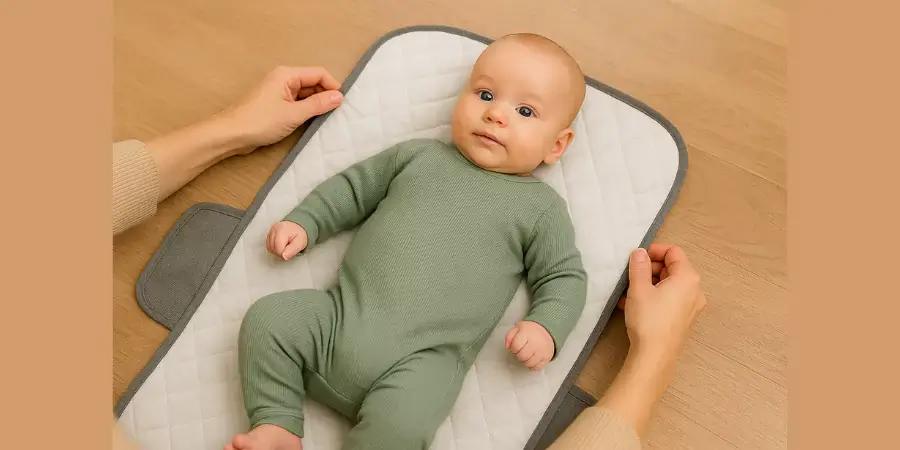
Every parent learns quickly that diaper changes happen everywhere except where you’d ideally want them to restaurant restrooms with questionable hygiene, airport terminal floors, the backseat of your car during road trips, or outdoor spaces without any facilities. A quality portable change mat transforms these challenging situations from stressful scrambles into manageable moments, but the market offers dozens of options with dramatically different features, quality levels, and price points. Understanding which characteristics actually matter in real-world use versus marketing hype helps you invest in gear that genuinely makes parenting easier.
Material Science: Beyond Basic Softness
The surface your baby lies on during changes matters more than many parents initially realize, particularly when you’re changing multiple diapers daily across various environments. Premium portable change mats typically feature multi-layer construction rather than single-material designs, with each layer serving specific functional purposes. The top contact layer should offer softness against your baby’s skin, but equally important is its durability against the friction created by dozens of daily uses and the chemical exposure from cleaning products you’ll inevitably need.
Natural fiber options like organic cotton or bamboo blends provide breathability and gentle texture, making them popular among parents concerned about chemical sensitivities or eco-friendly materials. These natural materials typically feel more comfortable against skin and avoid the plastic-like stiffness of fully synthetic options. However, they require waterproof backing layers to prevent moisture from seeping through a critical feature that protects both the mat itself and whatever surface sits beneath it. The most effective designs bond waterproof barriers directly to the fabric rather than relying on separate layers that might shift or separate with repeated folding and use.
Synthetic materials like polyester with polyurethane laminate (PUL) or thermoplastic polyurethane (TPU) coatings offer inherent waterproofing and exceptional durability. These materials withstand frequent cleaning without degrading, resist staining from diaper cream and bodily fluids, and maintain their structural integrity through hundreds of uses. Parents dealing with eczema-prone or sensitive-skinned babies should verify that synthetic materials meet Oeko-Tex Standard 100 or similar certifications, confirming they’re free from harmful chemicals despite being manufactured materials. The trade-off involves slightly less breathability compared to natural fibers, though this rarely matters for the brief duration of typical diaper changes.
Waterproofing and Maintenance: The Daily Reality Test
The difference between an adequate change mat and an exceptional one becomes apparent the first time you face a diaper explosion in a parking lot. Truly effective waterproofing means liquids bead on the surface rather than absorbing into the material, allowing you to wipe away messes quickly without the mat retaining odors or stains. Look for mats describing their waterproofing as “fully laminated” or “bonded waterproof layer” rather than those simply listing “water-resistant,” which often means the material slows liquid penetration without fully preventing it.
Edge sealing matters more than most parents initially consider. Liquids naturally flow toward edges during cleaning, and unsealed or poorly constructed seams create entry points where moisture can compromise the mat’s interior padding. High-quality mats feature sealed or welded seams rather than simple stitching, preventing these vulnerable points from becoming hygiene problems after repeated exposure to cleaning and use. You can test this by pressing firmly on the mat’s edges while it’s slightly damp quality construction should show no moisture seepage or dampness on the reverse side.
Cleaning methodology directly impacts long-term mat condition and hygiene maintenance. Most portable mats benefit from quick wipe-downs with baby-safe disinfecting wipes after each use, with deeper cleaning required weekly or after particularly messy changes. Machine-washable mats offer obvious convenience, but verify whether the manufacturer recommends air-drying versus machine-drying, as heat exposure can degrade waterproof coatings over time. Some parents keep two mats in rotation, allowing one to fully dry while using the backup a strategy that extends the lifespan of both mats compared to rushing the drying process or using a single mat repeatedly while slightly damp.
Portability Features That Actually Matter
The “portable” designation on change mats encompasses wildly different interpretations, from barely foldable padded platforms to ultra-compact designs that disappear into diaper bag corners. Your ideal portability depends heavily on how you typically use the mat parents who primarily change babies in their own car versus those relying on public transportation face different practical requirements. Understanding your specific use cases before purchasing prevents you from acquiring a mat that looks perfect but proves frustratingly impractical for your actual lifestyle.
Folding mechanisms range from simple trifolds to elaborate origami-like systems that compress into surprisingly small packages. Trifold designs offer straightforward operation and typically reopen to full size without creasing or creating uncomfortable ridges where your baby lies. More complex folding systems can achieve smaller packed dimensions but sometimes create weak points at fold lines that wear out faster than the mat’s primary material. Test the folding process yourself if possible mechanisms that require both hands or precise manipulation become annoyingly difficult when you’re simultaneously managing a squirming baby and gathering scattered supplies.
Weight considerations extend beyond the mat itself to include any attached storage or accessories. A mat weighing 200 grams feels negligible when you’re packing your diaper bag at home but becomes noticeably burdensome after carrying it alongside bottles, spare clothes, toys, and other baby gear throughout a full day out. Ultra-lightweight options sacrifice some padding thickness, creating a trade-off between comfort and portability that parents need to evaluate based on their priorities. If you’re primarily changing babies on relatively soft surfaces like car seats or carpeted areas, minimal padding suffices. Parents frequently changing on hard floors or outdoor surfaces benefit from thicker cushioning despite the additional weight.
Storage Integration and Organization Systems
Change mats incorporating built-in storage transform diaper changes from multi-component juggling acts into streamlined processes, particularly valuable during those frantic moments when your baby needs changing immediately and you’re simultaneously preventing them from grabbing inappropriate objects. The most functional storage designs position pockets or compartments where you can access them single-handed while keeping your other hand securely on your baby a safety consideration that matters tremendously once babies develop rolling and crawling mobility.
Pocket sizing and quantity require matching to your actual carrying habits rather than simply assuming more storage equals better design. Parents who carry fully-stocked diaper bags may need only minimal mat-integrated storage for immediate essentials like a single diaper and small wipe pack. Those practicing minimalist outing styles or using the mat as their complete changing station benefit from more extensive storage capable of holding multiple diapers, a full wipe container, diaper cream, and hand sanitizer. Consider whether your typical outings involve quick errands where minimal supplies suffice versus extended adventures requiring comprehensive backup supplies.
Closure systems for storage compartments impact both security and access speed. Zippered pouches provide maximum security, ensuring contents won’t scatter if the mat gets knocked over or falls from your diaper bag, but they require two-handed operation and extra seconds during urgent changes. Velcro closures offer one-handed access and faster operation but may gradually lose effectiveness after repeated opening and closing. Elastic or open pockets provide the quickest access but offer no security for items that might fall out during transport. Some parents appreciate mats offering multiple closure types, allowing them to match each pocket’s contents with the appropriate security level.
Safety Standards and Design Considerations
Safety in portable change mats extends beyond obvious concerns about non-toxic materials to include design elements that prevent common accidents or injuries. The mat’s base should feature non-slip material or texturing that helps it stay positioned on smooth surfaces rather than sliding around during use. This becomes particularly important on slick surfaces like restroom counters, car hoods, or glossy tabletops where even slight movement creates instability. Grip material typically consists of rubberized coating, silicone patterns, or textured fabric that increases friction without adding significant bulk or weight.
Size proportions matter more than many parents initially consider when evaluating change mats. Your newborn fits comfortably on a compact mat, but babies grow rapidly, and a mat that seems spacious at two months old may feel restrictively small by six months. Standard portable mats typically measure between 50-70 centimeters in length, adequate for babies up to approximately one year old depending on individual growth patterns. Parents planning to use the same mat throughout their child’s diaper-wearing years should invest in larger options, though these sacrifice some portability advantages. Some families maintain two mats a compact version for everyday outings and a more generous size for extended trips or home backup use.
Raised edges or subtle containment features help manage unexpected spills or movements during changes, though truly effective designs avoid creating stiff barriers that might press uncomfortably against your baby. Look for mats with slightly thickened or rolled edges that create a gentle boundary without requiring rigid plastic or hard materials. These subtle design elements prove particularly valuable during that unpredictable phase where babies suddenly learn to roll mid-change, creating moments of chaos that every parent eventually experiences regardless of how carefully they prepare.
Making Your Decision With Confidence
Selecting the right portable change mat ultimately requires balancing multiple factors based on your specific parenting circumstances rather than pursuing a single “perfect” option that works for everyone. Parents who primarily drive everywhere prioritize different features than those relying on public transportation or walking. Minimalist parents who carry only essentials value different storage configurations than those who prefer having extensive backup supplies immediately accessible. Understanding your genuine needs and typical usage patterns prevents you from either overspending on features you’ll never use or under-investing in a mat that proves frustratingly inadequate when you need it most.
The investment in a quality change mat pays dividends throughout your child’s diaper-wearing years, typically spanning two to three years of near-daily use across countless environments and situations. When you calculate the per-use cost of a durable, well-designed mat versus repeatedly replacing cheap alternatives that fail within months, the value proposition of investing in quality becomes clear. The right mat becomes such an integrated part of your parenting routine that you barely notice it working effectively, while the wrong choice creates ongoing frustration that compounds throughout thousands of diaper changes. Taking time to evaluate options carefully and match features to your actual lifestyle creates a foundation for more confident, stress-free parenting when dealing with one of childhood’s most frequent necessities.