When Twitch streamer “PixelPanda” commissioned a professional chibi avatar in 2023, she paid $350 for a fully rigged, expressive character that became her channel’s signature branding. When her friend opted for an AI-generated chibi using a $10/month tool, the result looked cute but lacked the personality and polish that made PixelPanda’s avatar memorable. Six months later, the friend commissioned a professional artist too essentially paying twice by starting with the cheaper option.
This scenario plays out constantly across social media, gaming, and creative communities. Chibi avatars those impossibly cute, stylized characters with oversized heads and simplified features have become ubiquitous as profile pictures, VTuber models, gaming characters, and merchandise designs. The proliferation of AI tools promising to transform photos into chibi art in seconds creates an illusion that professional-quality results are democratically accessible to anyone with a smartphone.
The reality proves more nuanced. AI chibi creators serve specific use cases effectively while falling short for others. Understanding what chibi art actually is, how different creation approaches compare, and which solution fits your specific needs prevents wasted time and money on tools that can’t deliver your vision.
Understanding Chibi: More Than Just “Cute Art”
Chibi (ちび) is a Japanese slang term meaning “short person” or “small child,” used in manga and anime to describe a specific artistic style characterized by exaggerated proportions and simplified features. The style emerged in Japanese comics and animation as a way to depict characters in comedic or emotional moments, emphasizing cuteness and expressiveness over realistic representation.
Defining Characteristics of Chibi Art
Exaggerated proportions: The head-to-body ratio typically ranges from 1:2 to 1:4 (compared to realistic 1:7-8 ratios). This creates the signature “large head, small body” appearance that defines chibi style.
Simplified facial features: Large, expressive eyes dominate the face, often taking up 25-40% of head space. Noses may be reduced to small dots or omitted entirely. Mouths are simplified into basic shapes expressing clear emotions.
Reduced detail: Anatomical complexity is simplified. Fingers may be suggested rather than individually defined. Clothing folds and textures are minimized to maintain clean, readable designs at small sizes.
Emphasize expressiveness: Despite simplification, chibi art prioritizes emotional clarity. A well-executed chibi conveys personality and emotion instantly through posture, facial expression, and gesture.
Rounded shapes: Soft, curved lines replace angular features. Even traditionally sharp elements (hair points, clothing edges) maintain gentle curves that enhance the cute aesthetic.
Understanding these principles helps evaluate AI-generated results. A tool that produces cute characters but lacks proper proportions, oversized heads, or simplified features isn’t creating true chibi art it’s making generic cartoon-style illustrations.
AI Chibi Generators: What They Do Well (And Where They Fail)
Dozens of AI-powered tools claim to transform photos into chibi avatars. These platforms use generative AI trained on thousands of chibi illustrations to produce stylized versions of uploaded photos. Understanding their actual capabilities versus marketing claims prevents disappointment.
How AI Chibi Tools Actually Work
These platforms employ neural networks trained on datasets of chibi illustrations, learning to recognize patterns in proportion, style, and aesthetics. When you upload a photo, the AI:
- Detects facial features and overall composition
- Interprets those features according to learned chibi style patterns
- Generates a stylized output matching chibi aesthetic conventions
- Applies customization options you’ve selected (hair style, clothing, accessories)
The quality varies dramatically based on training data quality, model sophistication, and how well your source photo matches the training set’s characteristics.
What AI Tools Do Well
Speed and accessibility: Generate chibi-style results in seconds rather than hours or days required for artist commissions. Perfect for quick social media profile updates or casual experimentation.
Cost-effectiveness for casual use: Free or low-cost options ($5-15/month subscriptions) make chibi avatars accessible for personal use without artist commission costs ($50-500+).
Iteration and experimentation: Try multiple styles, outfits, and poses quickly to explore options before committing to final designs.
Consistency for multiple characters: Generate a set of characters with consistent style for group projects, gaming clans, or family avatar sets.
Lowered technical barriers: No artistic skill required to produce cute, stylized results that work adequately for casual applications.
Where AI Tools Consistently Fail
Limited artistic control: Customization options are constrained to predefined selections. You can’t get “exactly this specific outfit” or “this precise expression” you’re limited to what the tool offers.
Generic results: AI generates variations on learned patterns rather than truly original creations. Results often feel samey across different users, lacking distinctive personality.
Inconsistency with complex requests: The more specific your vision, the less likely AI delivers satisfactorily. Complex clothing, specific poses, or unusual accessories often produce weird artifacts or simply don’t work.
Facial recognition limitations: AI struggles with photos taken at angles, poor lighting, multiple people, or non-standard facial features. Source photo quality dramatically affects results.
Lack of professional polish: AI-generated chibi art often works for profile pictures but looks amateurish when scaled up, printed on merchandise, or used in professional contexts.
No rigging for animation: Static images only no articulation for VTuber rigs, game sprites, or animated stickers without additional work.
Licensing ambiguity: Many AI platforms have unclear terms regarding commercial use, making it risky to use AI-generated avatars for business purposes without careful review.
Comparing Popular AI Chibi Creation Tools
Multiple platforms offer AI chibi generation with varying approaches, quality levels, and pricing structures.
PicLumen: Accessible Photo-to-Chibi Conversion
Best for: Casual users wanting quick chibi avatars for personal social media Pricing: Free tier with watermarks, premium plans $9.99-19.99/month Strengths: User-friendly interface, decent style variety, reasonable output quality Weaknesses: Limited customization depth, generic results, commercial use restrictions on free tier
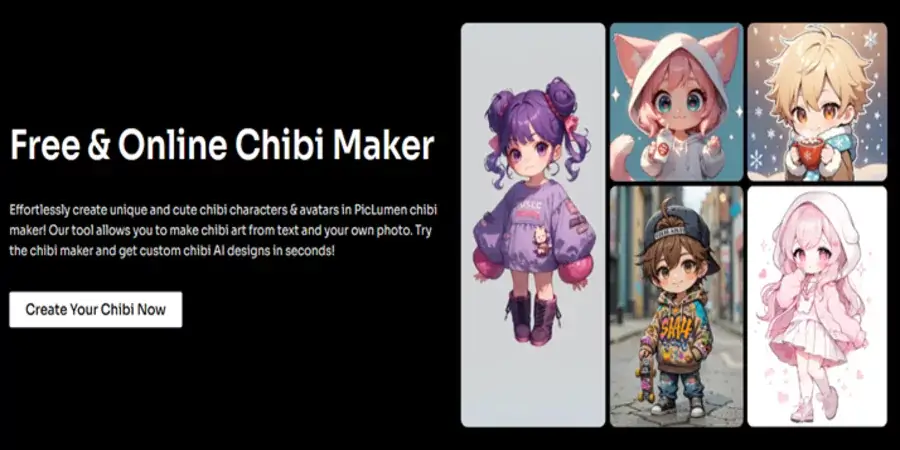
PicLumen’s chibi maker represents the typical photo-to-chibi converter upload a selfie, select style options, download result. The tool produces adequately cute results for casual use but lacks the customization depth or quality for professional applications.
The interface simplicity is both strength and limitation. You’ll get presentable results quickly, but creative vision beyond basic style selection proves impossible to execute.
Fotor AI Chibi Generator: Style Variation Focus
Best for: Users wanting diverse chibi style options Pricing: Free with limitations, Pro $8.99/month Strengths: Multiple distinct chibi styles, good facial feature recognition, decent customization Weaknesses: Lower resolution on free tier, occasional weird artifacts, limited pose options
Fotor emphasizes style variety you can generate the same source image in multiple aesthetic approaches from classic manga chibi to more Western cartoon-influenced styles. This flexibility helps find interpretations that match your preferences.
The tool’s facial recognition performs slightly better than basic competitors, capturing likeness more consistently even with imperfect source photos.
Chibify: Dedicated Chibi Creation Platform
Best for: Users specifically focused on chibi art rather than general AI art generation Pricing: $12.99/month or $99/year Strengths: Purpose-built for chibi with deep customization, consistent quality, commercial use license Weaknesses: Higher cost than competitors, still limited versus artist commissions
Chibify differentiates by specializing exclusively in chibi creation rather than offering it as one feature among many AI art styles. This focus delivers more consistent chibi-specific results with better understanding of proportion and style conventions.
The platform’s commercial use license (included in subscription) makes it more suitable for business applications like merchandise or branding, though reviewing exact terms remains essential.
Midjourney/Stable Diffusion: Advanced Prompt-Based Generation
Best for: Users with technical comfort using text-to-image AI for custom chibi creation Pricing: Midjourney $10-60/month, Stable Diffusion free (self-hosted) or various service pricing Strengths: Maximum creative control through prompting, highest quality potential, unique results possible Weaknesses: Steep learning curve, requires prompt engineering skills, inconsistent results without expertise
Advanced AI image generators like Midjourney or Stable Diffusion can create chibi art through careful prompting but require substantially more skill than photo-upload converters. Effective chibi generation demands understanding how to structure prompts describing chibi characteristics, art style references, and specific features.
Sample effective Midjourney prompt: “chibi anime character, full body, cute proportions, large head 1:3 ratio, simplified features, blue hair in ponytails, school uniform, pastel colors, white background, clean lineart, professional illustration –ar 2:3 –niji 5”
The learning curve is significant, but skilled users achieve far more distinctive and higher-quality results than simplified photo converters provide.
Character.ai, Mage.space, and Other Platforms
Numerous other platforms offer chibi generation as part of broader AI art tools. Quality, features, and pricing vary widely. Before committing:
- Test free trials or tiers to evaluate output quality
- Review commercial use licensing carefully
- Check resolution limits (many free tiers cap at low resolutions unsuitable for printing)
- Verify whether output quality matches examples shown (many platforms cherry-pick their best results for marketing)
Artist Commissions: When Human Creativity Beats Algorithms
For use cases requiring professional quality, distinctive personality, specific artistic vision, or commercial applications, commissioning artists typically delivers superior results despite higher upfront costs.
What Professional Artists Provide
Distinctive personality: Skilled artists infuse characters with unique qualities that reflect your personality, preferences, and vision rather than generating variations on training data patterns.
Exact specifications: Communicate precisely what you want specific clothing details, unique accessories, particular expressions, custom poses and receive artwork matching your vision.
Professional quality: Clean linework, proper proportions, cohesive color schemes, and overall polish that reads as professional illustration rather than AI-generated content.
Revisions and refinement: Artists provide revision rounds where you can request adjustments, ensuring final artwork meets your exact requirements.
Full rights and licensing: Clear ownership and usage rights, essential for commercial applications, merchandise, or business branding.
Rigging and animation compatibility: Artists can provide files properly structured for VTuber rigging, game sprite animation, or other technical applications.
Portfolio uniqueness: No one else has your exact character, whereas AI tools generate similar-looking avatars for multiple users.
Finding Quality Chibi Artists
Multiple platforms connect clients with commission artists:
Fiverr: Entry-level to professional artists, $25-200+ depending on complexity and artist experience. Easy to browse portfolios and compare prices.
VGen: Specialized platform for VTuber and gaming character commissions, $100-500+ for rigged models. High-quality artists specifically experienced in chibi style.
ArtStation/DeviantArt: Direct artist commissioning through portfolio browsing. Prices vary widely ($50-1000+) based on artist reputation and complexity.
Twitter/Instagram: Many chibi artists advertise commission availability through social media. Often more affordable than platform commissions but requires more vetting.
Skeb: Japanese commission platform connecting clients with artists, particularly strong for anime/manga styles including chibi. Language barrier can complicate but many artists accommodate English clients.
Commission Cost Expectations
Basic chibi bust (head and shoulders): $30-100 Half-body chibi: $50-150
Full-body chibi: $75-250 Fully rendered with background: $150-400 Commercial use license: Often +50-100% of base price VTuber-ready rigged model: $300-1500+ depending on complexity and animation layers
These ranges reflect typical pricing in 2025. Established artists with strong portfolios command premium prices, while newer artists offer competitive rates to build clientele.
When to Choose Artists Over AI
Commission professional artists when:
- Using chibi avatars for business/commercial purposes
- Creating VTuber or streaming personas requiring rigging
- Developing gaming characters or merchandise designs
- Wanting truly distinctive, one-of-a-kind character design
- Requiring specific artistic vision beyond AI tool limitations
- Needing professional quality that elevates your brand
The Hybrid Approach: AI Concept to Artist Refinement
A strategic middle ground combines AI tools’ speed and accessibility with artist expertise for polishing and customization.
Step 1: Generate AI concepts using tools like PicLumen, Fotor, or Midjourney to explore style options, test proportions, and identify direction you want.
Step 2: Commission artist refinement by providing AI-generated concepts as reference, asking artists to recreate and polish the design with professional quality and your specific customizations.
This approach reduces artist time (lowering costs) while ensuring final results achieve professional polish. Many artists accept “here’s an AI concept, make it professional” commissions at 30-50% reduced rates versus complete original designs.
The key: be upfront with artists about using AI references. Most appreciate having clear direction while applying their skills to elevate concepts into polished illustrations.
Use Case Analysis: Matching Tools to Applications
Different applications have different requirements for chibi avatar quality, customization, and licensing.
Social Media Profile Pictures
Best approach: AI generators (PicLumen, Fotor, Chibify) Why: Quick results, low cost, adequate quality for small profile image use, easy to change frequently Budget: Free-$15/month
For Instagram, Twitter, Discord, or other social platforms where avatars display at small sizes, AI-generated chibi avatars work perfectly well. The limitations that matter for larger applications (lack of polish, generic aesthetics) become invisible at profile picture scale.
VTuber/Streaming Characters
Best approach: Professional artist commission Why: Requires rigging for animation, needs distinctive personality, represents brand identity, used extensively Budget: $300-1500+
VTubing demands professionally created, rigged characters that can’t be achieved through AI generators. The character becomes your on-screen persona this isn’t the place to cut corners with generic AI art.
Gaming Characters/Sprites
Best approach: Professional artist (indie games) or art team (commercial games) Why: Requires consistency across multiple poses/expressions, animation compatibility, quality that matches game production values Budget: $200-500 per character for indie, art team salaries for commercial
Game characters require more than static images multiple expressions, poses, and often animation frames. Professional artists deliver the consistency and technical requirements gaming demands.
Merchandise (Stickers, Shirts, Prints)
Best approach: Professional artist commission with commercial license Why: Requires high resolution, print quality, clear commercial rights, professional aesthetics that justify product pricing Budget: $150-400+ including commercial license
Selling merchandise featuring chibi designs demands professional quality that commands reasonable pricing. AI-generated art on merchandise looks amateurish, limiting market appeal and price points you can justify.
Personal Gifts and Casual Use
Best approach: AI generators or budget artist commissions Why: Personal use doesn’t require commercial quality, focus on meaning rather than professional polish Budget: $0-100
Creating chibi avatars as personal gifts to friends or for casual enjoyment prioritizes accessibility and fun over professional quality. AI tools or affordable artist commissions both work well here.
Creating Effective Source Photos for AI Conversion
If using AI chibi generators, source photo quality dramatically impacts results. Optimize your source material for better AI interpretation.
Technical Photo Requirements
Lighting: Even, front-facing lighting without harsh shadows. Outdoor shade or soft indoor lighting works best.
Background: Simple, uncluttered backgrounds help AI focus on facial features rather than getting confused by complex environments.
Angle: Straight-on or slight angle shots work best. Extreme angles confuse facial detection algorithms.
Resolution: Higher resolution source photos provide more detail for AI processing. Aim for 1000+ pixels on the shortest dimension.
Focus: Sharp, well-focused photos capture facial features accurately. Blurry selfies produce blurry or distorted chibi results.
Composition Tips
Framing: Include head and shoulders in frame for best results. Too-tight crops or distant full-body shots work less well.
Expression: Smile or neutral expressions translate best to chibi aesthetics. Extreme expressions may produce weird results.
Hair visibility: Ensure hairstyle is clearly visible AI needs to understand hair shape, length, and style to recreate it accurately.
Accessories: If you want AI to incorporate glasses, hats, or other accessories, ensure they’re clearly visible and well-lit in source photo.
Single subject: AI tools work best with single-person photos. Multiple people in frame confuse feature detection.
Customization Strategies: Getting the Most from AI Tools
Within AI tools’ constraints, strategic customization choices improve results.
Style Selection
Most platforms offer multiple chibi style options classic manga, kawaii, fantasy, modern, etc. Test multiple styles with your photo to see which interpretion captures your likeness and aesthetic preferences best.
Don’t assume the default or first style offered is best. Spend time exploring style variations often you’ll find one that works significantly better for your specific features or desired aesthetic.
Hair and Outfit Customization
When tools offer customization, prioritize elements that most strongly express personality:
Hairstyle: Choose styles matching your actual hair or aspirational styles you’d wear if unconstrained by reality. Hair strongly communicates personality in chibi art.
Color schemes: Coordinate colors across hair, outfit, and accessories for cohesive aesthetics. Avoid too many competing bright colors that create visual chaos.
Accessories: Use sparingly one or two distinctive accessories (signature glasses, favorite hat, meaningful jewelry) add personality without cluttering the simplified chibi aesthetic.
Outfit style: Match the formality and style to intended use casual for gaming profiles, professional for business applications, fantasy for creative projects.
Expression and Personality
Some advanced AI tools offer expression options. Choose expressions matching how you want to present yourself:
- Friendly smile: Approachable, welcoming works for most social media applications
- Confident/determined: Good for gaming, competitive contexts, professional branding
- Playful/cheeky: Emphasizes fun personality, works well for streaming or casual contexts
- Neutral/serene: Professional, calm, appropriate for business applications
Legal and Licensing Considerations
Using chibi avatars commercially or publicly requires understanding rights and licenses.
AI-Generated Content Rights
AI platforms have varying policies regarding generated content ownership:
Personal use: Most platforms allow free or subscription-based generation for personal profile pictures and non-commercial applications without restrictions.
Commercial use: Many free tiers prohibit commercial use entirely. Paid tiers often include commercial licenses, but verify terms explicitly before using AI-generated avatars for business, merchandise, or monetized content.
Attribution: Some platforms require crediting the tool or maintaining watermarks for free tier usage.
Training data: Most AI tools reserve rights to use your generated content to improve their models, raising privacy considerations for sensitive applications.
Artist Commission Rights
Professional commissions typically operate under clear contracts specifying:
Personal use license: You can use the artwork for personal profiles, non-commercial projects, and private purposes.
Commercial license: Requires explicit agreement (usually at premium pricing) granting rights to use artwork for business, merchandise, or monetization.
Modification rights: Some artists retain rights to derivative works, meaning you can’t modify their artwork without permission.
Resale restrictions: Generally you can’t resell the artwork itself, though commercial licenses allow using it in products you sell.
Always clarify rights explicitly in writing before commissioning to avoid disputes about usage.
The Future of AI Chibi Creation
Generative AI continues evolving rapidly. Near-term developments likely include:
Improved consistency: Better facial recognition and style adherence producing more reliable results across diverse source photos.
Enhanced customization: Deeper control over specific elements exact outfit designs, precise expressions, detailed accessories reducing the gap between AI and artist customization.
Animation capabilities: AI tools that generate not just static images but basic animated chibi expressions or movements, expanding applications.
Style training: Tools allowing users to train models on specific artistic styles or reference images for more personalized results.
3D model generation: AI that creates 3D chibi models rather than just 2D illustrations, useful for gaming and VR applications.
However, fundamental limitations remain. AI generates variations on learned patterns rather than exercising true creativity. For applications demanding genuine originality, distinctive personality, or professional polish, human artists will continue providing superior results.
Making the Right Choice for Your Needs
Selecting between AI generation and artist commissions depends on your specific requirements:
Choose AI generators when:
- Budget is primary constraint ($0-15/month)
- Use case is casual/personal (social media profiles, fun experimentation)
- Speed matters (need results immediately)
- Quality threshold is modest (cute and recognizable is sufficient)
- You want to experiment with multiple styles easily
Choose artist commissions when:
- Quality and uniqueness matter (branding, professional use)
- Commercial applications require clear licensing
- Technical requirements exist (rigging, animation, specific file formats)
- Your vision is specific and detailed
- The character represents long-term investment (VTuber persona, game character, merchandise)
Consider the hybrid approach when:
- You have clear vision but struggle to communicate it
- Budget allows modest artist fees but full original design exceeds budget
- You want to explore options quickly before committing to final professional version
Conclusion: Tools Serve Vision, But Can’t Create It
AI chibi generators democratize access to cute, stylized avatar creation, making what once required artist commissions available to anyone with internet access. This accessibility creates value for casual users, social media enthusiasts, and those experimenting with digital identity.
However, democratized access doesn’t equate to professional quality or distinctive creativity. The difference between an AI-generated chibi and a professionally commissioned one becomes immediately apparent when viewed side-by-side one is cute and serviceable, the other is polished and memorable.
The wisest approach: match tools to applications. Use AI for casual needs where speed and cost matter more than distinction. Invest in professional artists when your chibi avatar represents your brand, generates revenue, or requires the creative vision and technical skill that only human artists provide.
Technology continues advancing, and AI capabilities expand constantly. But creativity, artistic vision, and the ability to translate personality into character design remain fundamentally human skills. Choose your creation approach based on what your specific application requires, not on assumptions that the newest AI tool has solved problems that still benefit from human expertise.