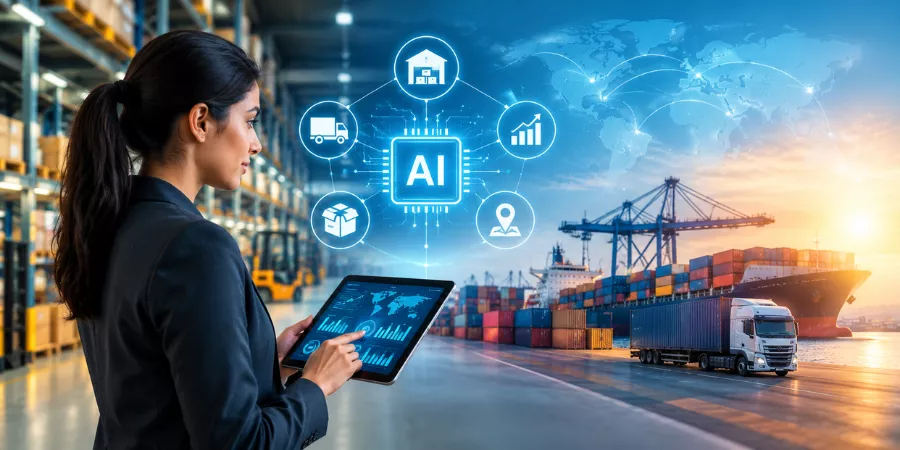
AI improves supply chains by spotting patterns that people and spreadsheets miss. It can forecast demand more accurately, suggest how much stock to hold and where, warn of delays before they hit, and automate routine planning work. The result is usually less waste, fewer empty shelves and faster decisions. But it works only as well as the data behind it, and it still needs experienced people to question its answers.
Anyone who has worked in a warehouse or a purchasing office knows the problem. Order too much and cash sits on a shelf, gathering dust or passing its expiry date. Order too little and customers go elsewhere. The balance between those two mistakes has always been hard to hold, and it has become harder as demand swings faster, suppliers sit further away and disruptions arrive without warning.
Why is Supply Chain Planning So Difficult?
Because so many moving parts depend on one another. A supplier runs late, a port is congested, a competitor launches a discount, the weather turns, and a plan made last month is suddenly wrong. Traditional planning methods often rely on averages from past sales and a few rules of thumb. They work reasonably well when conditions are steady, and poorly when they are not.
There is a human limit as well. A planner managing thousands of products across many locations simply cannot weigh every factor for every item. Something gets overlooked, usually the thing that later causes the stock-out.
How Does AI Improve Demand Forecasting?
This is where most businesses see the first real gain. Machine learning models can examine years of sales data alongside many other signals: seasonality, promotions, pricing, local events, weather, holidays and even social media trends. Instead of one average, they can produce forecasts for each product and each location, and they keep learning as new data arrives.
A grocery chain, for instance, might find that a particular store sells far more bottled water during a heatwave than the national pattern suggests. A good model picks that up and adjusts ordering before the shelves empty. Better forecasts matter because almost every other decision, from purchasing to staffing to transport, depends on them.
How Can AI Help with Inventory Planning?
Once demand is better understood, AI can help answer harder questions. How much safety stock does each item truly need? Which warehouse should hold it? When should an order be placed, given that the supplier’s delivery time changes from week to week?
Instead of setting fixed reorder points and leaving them for years, AI can adjust them continually based on actual variability. Slow-moving products can be trimmed, which frees up money and space. Fast movers can be protected. Many businesses also use AI to identify items likely to become obsolete, so they can discount them early rather than write them off later.
Can AI Make Supply Chains More Resilient?
It can help, though it is not a crystal ball. AI systems can monitor shipping data, supplier performance, news, weather and market conditions, and raise an alert when something looks risky. If a key supplier has been slipping on delivery times, or a storm is heading toward a major port, planners can react while there is still time to choose another route or source.
Some tools also run what-if simulations. What happens if this factory shuts for two weeks? What if fuel costs jump? Seeing the likely answer in advance does not prevent the problem, but it turns a panic into a plan. In my view, this is one of the most valuable uses and one of the least talked about.
What About Warehousing and Logistics?
Quite a lot. In warehouses, AI can suggest where to store items so that popular products are quicker to pick, and can help plan the best routes for staff or robots. In transport, route optimisation tools take account of traffic, delivery windows, vehicle capacity and fuel use, which can cut costs and emissions together.
Predictive maintenance is another useful application: sensors and models can signal that a vehicle or machine is likely to fail, so repair happens on a quiet day instead of in the middle of peak season.
How Does AI Help with Suppliers and Procurement?
Procurement teams are using AI to compare suppliers on price, reliability, quality and risk, and to flag unusual patterns in invoices or contracts. Language tools can summarise long contracts or draft routine purchase communications, saving hours. Better supplier insight also helps in negotiation, since a buyer who understands true costs and performance is in a stronger position.
What Are the Risks and Limits?
Plenty, and anyone selling AI as a miracle should be treated with caution.
Data quality is the first. If stock records are wrong, product codes are inconsistent or sales data is incomplete, even a clever model will produce poor results. Many projects stumble here, and cleaning data is rarely glamorous work.
Second, models can be confidently wrong. A sudden event with no historical precedent, such as a pandemic or a major conflict, can break forecasts that looked excellent the week before. People must stay in the loop, especially during unusual times.
Third, there is a trust and skills gap. Planners who do not understand why the system recommends something will often ignore it. Clear explanations and proper training matter as much as the algorithm itself.
Finally, cost and integration. Tools must connect with existing systems, and the business case should be tested before a large rollout, not after.
How Should a Business Get Started?
Choose one specific, painful problem. Perhaps it is chronic stock-outs on a few key products, or too much money tied up in slow sellers. Make sure the data for that problem is reasonably clean. Run a small pilot, compare its results with your current method over a few months, and be honest about the outcome. If it works, expand. If it does not, find out why before spending more.
Involve the people who do the work every day. They know which numbers are trustworthy and which rules of thumb hide real insight. The best results tend to come from planners and AI working together, with each checking the other.
Conclusion
AI will not remove the uncertainty from supply chains, because the world is simply too unpredictable. What it can do is shrink the guesswork: better forecasts, smarter stock levels, earlier warnings and quicker decisions. Businesses that treat it as a capable assistant, rather than an oracle, will carry less waste, disappoint fewer customers and recover faster when things go wrong. That is a quieter promise than the headlines suggest, though a far more useful one.