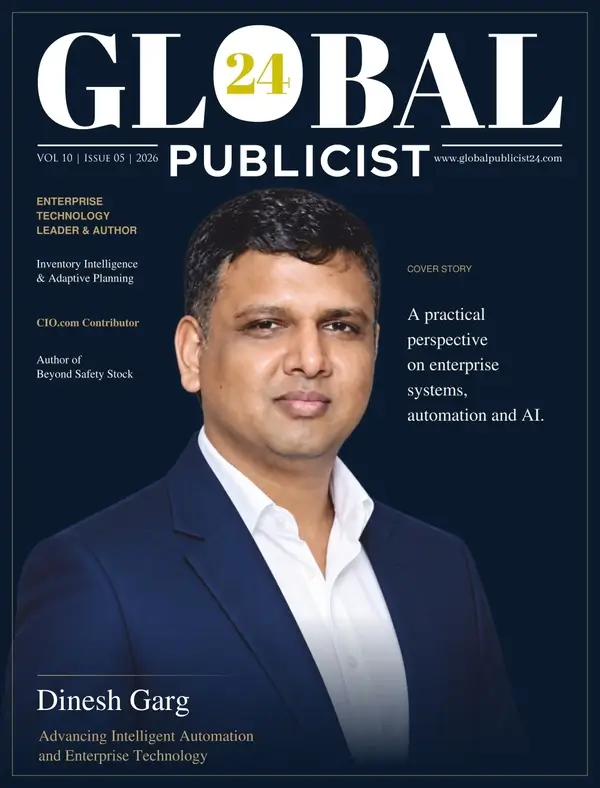
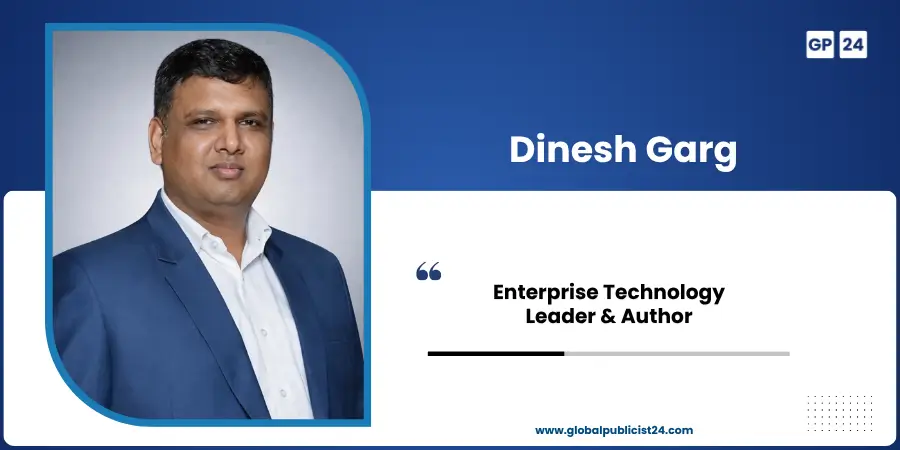
Dinesh Kumar Garg’s published work connects three themes: inventory intelligence, adaptive planning, and alignment between enterprise systems and operational reality.
As the author of Beyond Safety Stock: Rethinking Inventory and Planning in Modern Manufacturing and a CIO.com contributor, he examines how planning assumptions and inventory controls can evolve with changing conditions.
His January 2026 CIO.com article examines inventory drift and proposes continuous reconciliation as an architectural capability [1]. His April 2026 article explores how planning structures, lead times, and safety-stock assumptions can adapt to operational change [2].
Together, these perspectives support a clear focus: dependable inventory information and planning logic that reflects timing, variability, and execution context.
Garg’s Principle is central to his personal published work. The coauthored 2026 paper presents a deterministic, horizon-based framework for evaluating future inventory feasibility, with AI used to verify forecast inputs rather than replace the core decision logic [3].
His broader publications address IoT-enabled warehouse management, manufacturing execution systems, work-in-process inventory, and AI-supported supplier collaboration [4-7]. These subjects connect planning intelligence with the data and execution processes on which it depends.
His areas of expertise span enterprise applications, planning architecture, inventory intelligence, and applied AI for manufacturing. He brings these disciplines together through practical, business-focused technology thinking.
This profile presents personal views and public writing. It does not describe employer projects or internal results, or imply employer endorsement.
Turning IT Into a Value Engine
Dinesh’s leadership philosophy treats IT as a source of business value. He advocates evaluating technology through its contribution to practical outcomes, with attention to execution, usability, and clear measures of success.
This perspective places the business problem at the center of the discussion.
Instead of focusing on system efficiency alone, he began prioritizing minimum viable outcomes and business-critical processes. This shift helped him simplify complex ecosystems and focus on what truly drives impact.
He advocates applying this perspective to complex IT environments: simplify where possible, define value clearly, and design systems around practical business outcomes.
Leading With Clarity, Not Trends
In a space where digital transformation is often overpromised and under-delivered, his leadership approach is built on discipline and measurable outcomes rather than noise.
His leadership philosophy is anchored in three principles:
- Lead from the front
- Prioritize measurable business value.
- Drive purposeful innovation
In many organizations, IT is still treated as a cost center, while digital transformation initiatives often carry unrealistic ROI expectations. He believes every investment must be tied to either customer impact or technical debt reduction, with outcomes measured through real, quantifiable results. Transformation should not be driven by trends; it should be driven by clarity, discipline, and execution.
Automation, Which Simplifies Work
Automation is often discussed in terms of speed, but its real value shows up in how it reduces friction across systems and decisions.
Intelligent automation is transforming organizations across three dimensions:
- Eliminating manual data entry
- Reducing process fragmentation and hand-offs
- Enhancing decision intelligence, what to produce, buy, and when
While enterprise systems today capture vast amounts of data, they often introduce unnecessary complexity.
The real opportunity lies in simplifying execution while preserving compliance and quality.
AI is now enabling organizations to automate approvals, streamline workflows, and generate actionable insights, bringing both speed and precision to operations.
From Support Function to Strategic Driver
There is still a gap between what business leaders expect from technology and what it can actually deliver. Closing that gap defines the role of IT leadership today.
In 2026 and beyond, IT leadership must evolve into a core strategic function. Business leaders often
underestimate what technology can achieve, resulting in prolonged manual processes and missed opportunities. IT leaders must bridge this gap, translating business challenges into scalable, intelligent solutions and embedding technology into every strategic decision.
The future belongs to organizations where IT is not an enabler, but a driver of competitive advantage.
Automation’s Next Leap: From Tasks to Decisions
Automation is likely to extend beyond repetitive work to support decisions in real time. Enterprises may move toward more connected systems with less manual intervention. Automated data capture could support faster decisions.
As supply chains become more interconnected, real-time intelligence and resilience are likely to grow in importance. Automation may increasingly support decision orchestration alongside task execution.
The Real Barriers are Human
Technology rarely fails in capability. It fails on adoption, trust, and resistance. The biggest barriers are not technological; they are human:
- User resistance and job security concerns
- Lack of trust in automated systems
Even after implementation, organizations often continue manual validation due to low confidence. Successful transformation requires building trust through consistent outcomes, transparency, and strong change management.
Rethinking Inventory at Scale
Garg’s published work treats inventory intelligence as a question of both visibility and timing. Demand and supply timing matter alongside reliable balances.
His coauthored paper on Garg’s Principle presents a deterministic approach to identifying the lowest projected inventory position and evaluating the protection needed across that horizon [3].
His CIO.com writing extends this discussion to adaptive planning structures, including planning bills of material, lead times, and safety stock [2].
His papers on warehouse IoT, MES and WIP inventory address data capture, execution visibility, and inventory across production stages [4-6].
The common thread is alignment between planning assumptions, inventory information, and operational context. Across these publications, he advocates adaptive planning and inventory intelligence.
The views expressed are personal and do not represent any current or former employer.
AI Today, Autonomy Tomorrow
AI is already embedded in decision support, but its current role is still limited.
AI is currently in an early but rapidly evolving phase. Most organizations are using it for data summarization, dashboards, and decision support, often with human validation.
As capabilities mature, AI may support more autonomous planning systems. With appropriate controls and human oversight, these systems could improve decision speed, accuracy, and agility.
What Leadership Still Comes Down To
Despite all the technological changes, leadership fundamentals remain steady. Regardless of technological advancements, the core leadership skills remain unchanged:
- Emotional intelligence
- Practical judgment
- Clarity in decision-making
Technology evolves, but leadership is ultimately about aligning people, strategy, and execution.
Where the Real Opportunity Lies
Much of AI’s visible progress has happened in consumer-facing applications. The deeper transformation is still ahead.
He is particularly excited about the application of AI in industrial and manufacturing environments, where significant transformation opportunities still exist.
While AI has made strong progress in consumer and digital domains, further impact may come from its application to core production and supply chain systems.
His guiding principles remain:
- Customer-centric innovation
- Problem-first thinking
- Value-driven execution
Staying Relevant Without Chasing Trends
Keeping up with technology is less about speed and more about direction.
He focuses on understanding problems before technologies. Rather than chasing trends, he studies real-world challenges and determines how they can be solved.
This approach naturally leads to adopting or creating the right innovations, ensuring relevance and long-term impact.
Learning Beyond the Workplace
Perspective often comes from outside one’s immediate domain.
He draws inspiration from observing diverse perspectives, especially from leaders outside the technology domain. He also learns a great deal from his children.
Their ability to think without constraints is a powerful reminder of the importance of curiosity, creativity, and adaptability in problem-solving.
A DIRECT MESSAGE TO TECHNOLOGY LEADERS
There is no shortage of innovation. What is missing, in many cases, is intent.
He urges global CIOs, CTOs, and transformation leaders to focus on real impact, not perceived innovation. Do not invest in technology without clear, measurable benefits. Instead:
- Partner deeply with the business
- Understand real operational challenges
- Build strategic, value-driven roadmaps
Most importantly, maintain a strong technical foundation combined with business empathy, which is the key to sustainable transformation.
SELECTED WRITING & RESEARCH
Dinesh Kumar Garg | Adaptive Planning and Inventory Intelligence
[1] Inventory accuracy & execution architecture
Garg, D. Why your ERP still can’t solve inventory drift – and the architecture that will. CIO.com, January 23, 2026.
Open publication / source
[2] Adaptive planning structures
Garg, D. Why planning structures must evolve in modern manufacturing. CIO.com, April 22, 2026.
Open publication / source
[3] Garg’s Principle
Garg, D. K., & Bansal, D. K. Garg’s Principle: A Predictive Framework for Safety Stock Optimization and Over-Stock Reduction Across Forecast Horizons (2026). DOI: 10.48047/jocaaa.2026.35.03.23.
Open publication / source
[4] Warehouse intelligence
Garg, D. K. Warehouse Management System with IoT: A Comprehensive Guide (2025). DOI: 10.34218/IJCET_16_01_166.
Open publication / source
[5] Manufacturing execution
Garg, D. K. Manufacturing Execution Systems: A Comprehensive Guide to Selection and Implementation (2025). DOI: 10.34218/IJRCAIT_08_01_146.
Open publication / source
[6] Work-in-process inventory
Garg, D. K. Optimizing Work-in-Process Inventory Management: Modern Approaches and Best Practices (2025). DOI: 10.32628/CSEIT251112177.
Open publication / source
[7] Supplier collaboration
Garg, D. K. Transforming Supplier Collaboration Through AI and Retrieval-Augmented Databases (2025).
Open publication / source
EXPERTISE AT A GLANCE
Enterprise applications and ERP | Adaptive planning architecture
Inventory and WIP intelligence | Digital manufacturing and warehouse systems
Applied AI and decision support | Business-aligned technology roadmaps
BOOK & AUTHOR PROFILES
Beyond Safety Stock | Gurucool Publishing | ISBN 978-93-7602-016-4
CIO.com author profile
ResearchGate publications
Google Scholar author profile
PUBLICATION NOTE
This reading list connects the profile to public writing and research records. The views expressed are personal; no employer endorsement is implied.