Learning a new skill usually feels great for the first 10 minutes. Then, reality hits. Suddenly, that guitar sounds like a dying cat, or that coding language looks like ancient alien hieroglyphics. Sadly, most people quit right when the brain starts to sweat.
But anyone can learn fast if they know the right system. Books are basically cheat codes written by people who already did the hard work. Instead of spending 10 years failing, a person can spend 10 hours reading.
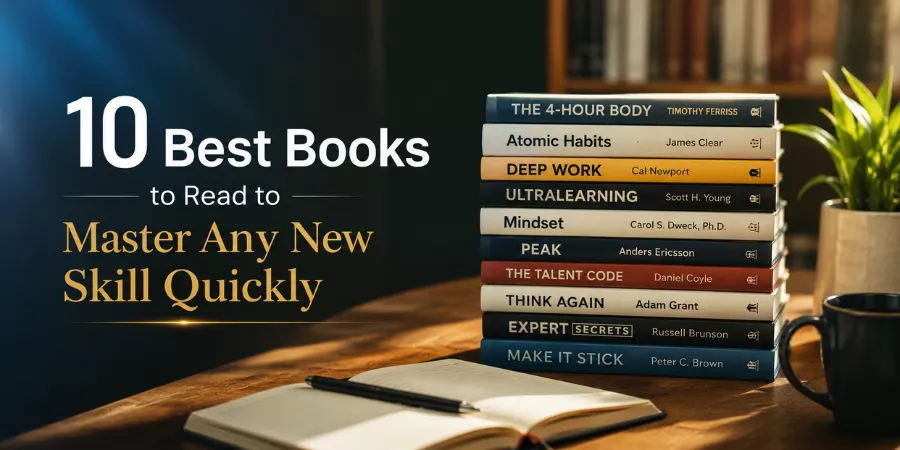
Below is a curated list of the best books to read to transform an absolute beginner into a master without losing all sanity.
1. Why is Mindset the Ultimate First Step?
Mindset: The New Psychology of Success by Carol S. Dweck
Before anyone can learn skill acquisition, they have to fix their brain. Carol Dweck explains that people fall into two categories: fixed mindsets and growth mindsets.
- People with a fixed mindset think they are born bad at math, so they never try.
- People with a growth mindset realize the brain changes constantly.
Dweck’s research shows that students who understand that intelligence can be developed drastically improve their grades. Without a growth mindset, a person will quit the moment a new task gets annoying. This is one of those fundamentally good books to read before starting any difficult journey.
2. Can You Really Learn Something in Only 20 Hours?
The First 20 Hours: How to Learn Anything… Fast! by Josh Kaufman
Most people think mastering a skill requires 10,000 hours. Josh Kaufman aggressively destroys that myth. The 10,000-hour rule is for becoming an Olympic athlete or a world-class grandmaster. To just become shockingly good at something, it only takes 20 hours of focused practice.
Kaufman breaks down accelerated learning into 4 easy steps:
- deconstruct the skill
- learn enough to self-correct
- remove distractions
- practice for 20 hours.
Want to play a few songs on the ukulele? 20 hours. Want to learn basic Spanish for a vacation? 20 hours. It is easily one of the most practical guides on this list.
3. How Do Small Rituals Create Massive Talent?
The Talent Code by Daniel Coyle
People look at top performers and assume they possess magical DNA. Daniel Coyle traveled to world-class talent hotbeds to prove that greatness is grown, not born. The secret sauce is a substance in the brain called myelin.
Every time a person practices deeply, myelin wraps around the neural pathways like electrical insulation. The thicker the myelin, the faster the signal moves. Coyle explains that deep practice, where a person operates right at the edge of their ability and constantly makes mistakes, is how skill is built. For anyone writing serious book reviews on talent development, this is a cornerstone text.
4. Why Does Deep Focus Beat Hours of Lazy Practice?
Deep Work: Rules for Focused Success in a Distracted World by Cal Newport
Trying to learn a skill while checking phone notifications every three minutes is entirely useless. Cal Newport introduces the concept of “Deep Work,” the ability to focus without distraction on a cognitively demanding task.
According to research conducted by Dr. Gloria Mark, it takes an average of 23 minutes and 15 seconds to regain deep focus after a single interruption. Newport provides a blueprint for building intense concentration. Mastering skills quickly requires high productivity, which means locking the phone in another room and working like a medieval monk.
5. How Do You Build Habits That Stick Permanently?
Atomic Habits by James Clear
Learning a skill requires practice, and practice requires a routine. James Clear explains that massive life changes do not come from giant leaps; they come from tiny, 1% improvements every day.
Clear outlines a beautiful 4-step framework:
- make it obvious
- make it attractive
- make it easy
- make it satisfying.
If a person wants to learn drawing, leaving a sketchbook on the pillow makes the habit obvious. With over 15 million copies sold globally, this masterpiece on personal development is essential for a reason.
6. What Is the Secret to Ultra-Fast Knowledge Absorption?
Ultralearning by Scott H. Young
Scott Young famously completed the entire four-year MIT computer science curriculum in just twelve months without attending a single class. He calls this “ultralearning,” an intensive, self-directed strategy for fast knowledge absorption.
Young provides nine core principles, including “Metalearning” (drawing a map of how the subject works before starting) and “Drilling” (isolating weaknesses ruthlessly). For anyone looking for good books to read that offer an aggressive, no-nonsense roadmap to genius, this is the gold standard.
7. How Can a Person Remember Everything They Read?
Moonwalking with Einstein by Joshua Foer
It is impossible to master a skill if the brain forgets everything instantly. Joshua Foer was an ordinary journalist who spent a year investigating memory champions. He ended up accidentally winning the U.S. Memory Championship himself.
Foer details ancient memory techniques like the “Memory Palace,” which uses spatial memory to store thousands of facts. This book proves that memory is a learned technique. It reads like a thrilling novel but functions as a masterclass in mental retention.
8. Why Does Mental Visualisation Help Muscle Memory?
Peak: Secrets from the New Science of Expertise by Anders Ericsson
Anders Ericsson is the actual psychologist whose research inspired the 10,000-hour rule. In Peak, he sets the record straight. Hours of practice do not matter if the practice is mindless.
Ericsson introduces “Deliberate Practice,” which requires a clear goal, immediate feedback, and intense focus on errors. He notes that top musicians and surgeons succeed because they build highly sophisticated mental representations of what perfect performance looks like.
“If you are not making mistakes, you are not practicing deliberately. You are just comforting yourself.” – An underlying truth of deliberate practice.
9. Can Tim Ferriss Really Teach Anyone to Deconstruct Skills?
The 4-Hour Chef by Timothy Ferriss
Do not let the title fool anyone; this is not just a cookbook. It is a massive, beautifully illustrated guide disguised as a cooking manual to teach the art of learning itself. Tim Ferriss uses cooking to explain his “DiSSS” framework: Deconstruction, Selection, Sequencing, and Stakes.
Ferriss explains how to find the 20% of blocks that give 80% of the results. He details how he learned languages in months and world-class kickboxing in a year. It is a chaotic, wildly entertaining look at modern skill building.
10. How Do Ancient Philosophical Rules Apply to Modern Learning?
Mastery by Robert Greene
By looking at the histories of famous people such as Benjamin Franklin, Leonardo da Vinci, and Mozart – Robert Greene finds out how they went through the apprenticeship and eventually came out as the top in their field.
Besides classic books to read recommendations, Greene talks a lot of psychology that it takes to master a skill. The main ideas of his writings are the so-called “deadly detours” that can kill all chances for one’s creative growth: complacency and false ego. His book has been a revelation and insight into both nature and a long-term commitment of man.
Which Books to Read First?
| Book Title | Core Concept | Best For |
| The First 20 Hours | Rapid Skill Acquisition | Absolute beginners who want fast results |
| Atomic Habits | Daily Systems & Routines | People who struggle to stay consistent |
| Deep Work | Monastic Distraction-Free Focus | Professionals with chaotic schedules |
| Ultralearning | Hardcore Knowledge Absorption | Students tackling complex academic topics |
Starting a new project without a strategy is a fast track to frustration. Picking up just one of these best books to read will completely change the way a person studies, works, and grows. The brain is fully ready to grow new pathways; it just needs the correct instructions.