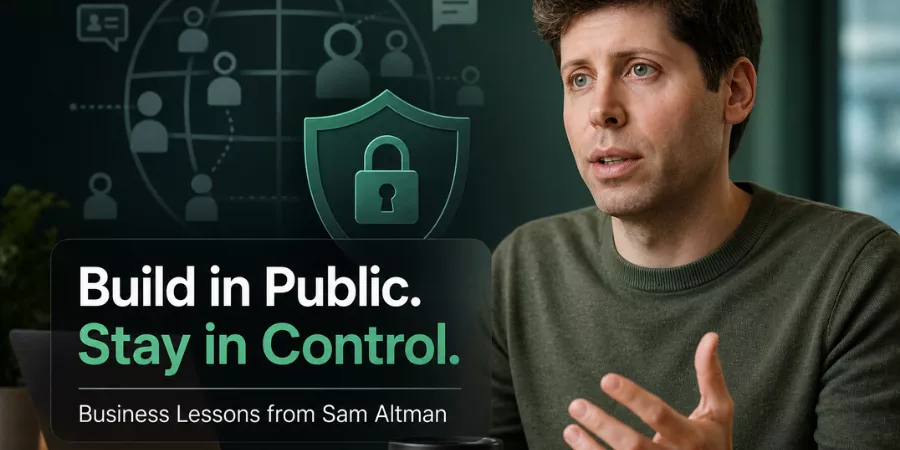
Sam Altman recently shared early OpenAI progress while competitors have kept everything behind closed doors. That transparency helped him in recruiting top-tier talent, attract investors, and build one of the most followed brands in technology history.
A 2023 Edelman Trust Barometer study found that 62% of people trust companies more when their leaders demonstrate transparent communication. Most founders fail to recognize that strategic openness exists as a narrow boundary which separates business advantages from public disclosure.
Quick answers:
- Building in public builds trust and accelerates growth
- The lessons from Sam Altman show sharing vision beats sharing secrets
- Founders should share direction, not details
- Authentic storytelling attracts talent, capital, and users
- Controlled transparency is a growth strategy, not a risk
What Does “Building in Public” Mean?
Building in public means sharing your startup journey openly, the wins, the pivots, the failures. Sam Altman has made this part of his founder’s branding strategy since Y Combinator days. He writes about startup philosophy, shares his mental models, and takes clear public stances on big ideas.
But he rarely posts a roadmap. He never leaks competitive details. The lessons from Sam Altman are less about radical openness and more about deliberate visibility.
There’s a difference. And most early-stage founders confuse the two.
Why Founders Fear Sharing (And Why That Fear Costs Them)
One of the most common early stage startup challenges is the fear of being copied. Founders hold back because they think visibility invites competition.
That logic is backwards.
According to Y Combinator data, over 90% of startups fail, and very few fail because someone stole their idea. Most fail because they built something nobody wanted, ran out of money, or could not attract the right people. Startup mistakes founders make are rarely about sharing too much. They are almost always about building in silence and discovering too late that the market does not care.
Sam Altman has said directly that execution matters far more than ideas. The lessons from Sam Altman on this point: sharing your thinking publicly forces clarity, attracts aligned collaborators, and builds momentum that isolation never can.
The Sam Altman Playbook: What He Shares
| What Altman Shares | What He Does Not Share |
| Vision and direction | Product roadmaps |
| Mental models on startups | Internal metrics |
| Views on AI and the future | Competitive strategy |
| Lessons from failures | Team or hiring details |
| Personal principles | Investor negotiations |
This table basically is the whole framework. The lessons from Sam Altman come down to one idea: share your thinking, not your tactics.
This is how founders grow on LinkedIn and Twitter without giving away the store. You become known for how you think, not just what you build.
How to Build a Personal Brand Without Overexposing Your Business
The creator economy for founders is real. Sam Altman built a massive audience before OpenAI became a household name, partly through his writing, his YC work, and his willingness to share opinions publicly. That audience became an asset.
Here is how to build one without risking your company:
- Share your learning, not your plans: Write about what you figured out last week. Talk about the mistake you almost made. This builds credibility without revealing competitive information.
- Talk about your market, not your product: Sam Altman talks about AI broadly, not OpenAI specifically. You can grow an audience as a founder by becoming the person people follow to understand your industry.
- Be specific about problems, vague about solutions: Describing the problem you are solving in vivid detail attracts customers and hires. Describing exactly how you are solving it helps competitors.
This is the core of how founders grow on Twitter and LinkedIn without making founder mistakes to avoid oversharing.
When Sharing Publicly Becomes a Risk
Oversharing on social media consequences are real for founders. Here are the situations where building in public crosses into dangerous territory:
- Sharing unreleased features before launch (competitors can move fast)
- Announcing pivots before your team knows (kills morale and trust)
- Publishing exact metrics that reveal your unit economics
- Posting fundraising details before terms are signed
- Signaling weakness publicly during a rough patch
A 2022 CB Insights study found that 38% of startups cite competitive pressure as a significant reason they fail. How much of that pressure comes from visibility they chose? That question is worth sitting with.
The lessons from Sam Altman include one underrated piece: he knows when to go quiet. During sensitive OpenAI developments, Altman says almost nothing. His openness is curated, and that curation is deliberate.
How Startups Grow Fast Using Public Momentum
Startup growth strategies that work in 2024 and beyond lean heavily on founder-led content. Here is why it works mechanically:
- Organic reach: A founder posting consistently on LinkedIn can reach tens of thousands of relevant people for free.
- Inbound hiring: Candidates apply to work for founders they follow and trust.
- Investor pipeline: Many VCs invest in founders they have watched for months before a pitch.
- Customer trust: Buyers feel safer purchasing from a founder whose thinking they understand.
Sam Altman’s leadership style includes using public communication as a strategic lever. He wrote extensively about startup lessons at YC. Those essays became a recruiting and fundraising tool that most marketing budgets cannot replicate.
This is how to build a successful startup with compounding advantages, your public presence becomes an asset that works while you sleep.
What Does Sam Altman Think About Startups? (The Actual Advice)
Sam Altman advice for founders is consistent across years of essays, interviews, and YC talks:
- Do things that do not scale early. Manual effort at the start teaches you more than any automation.
- Talk to users constantly. Why startups fail often comes down to building in isolation.
- Move faster than you think is safe. Speed is underrated as a competitive advantage.
- Hire slowly, fire quickly. One bad hire at a small company is a serious problem.
- Have a clear thesis. Sam Altman startup lessons always circle back to knowing exactly what you believe and why.
OpenAI CEO advice for entrepreneurs consistently emphasizes conviction. He says the best founders have strong views and share them. That clarity attracts people. Vagueness repels them.
A Simple Framework: The Founder Visibility Model
Not everything belongs on your LinkedIn. Here is a practical way to decide what to share:
Green zone – share freely
- Your opinions on industry trends
- Lessons from mistakes (without exposing vulnerabilities)
- Your hiring philosophy and culture
- Customer problems you are solving (in general terms)
Yellow zone – share carefully
- Traction signals (be specific but selective)
- Product direction (vision yes, roadmap no)
- Pivots (after they are complete, not during)
Red zone – do not share
- Investor terms and valuations
- Unreleased features
- Exact revenue or burn rate
- Internal team conflicts
Founder mistakes to avoid almost always come from the red zone. How to protect business ideas is less about secrecy and more about knowing which details actually matter if leaked.
How to Start Building in Public This Week
You do not need a polished strategy. Start simple.
- Write one post about the biggest thing you learned this month
- Share one opinion about your industry that most people are not saying
- Describe one problem your customer faces that keeps you up at night
The lessons from Sam Altman on this are pretty clear: start sharing your thinking before you feel ready. The founder who is known is always going to have an easier time raising, hiring, and selling than the one who builds in silence.
Founder branding strategy does not require perfection. It requires showing up consistently with something genuine to say.
Key Takeaways
- The lessons from Sam Altman are about strategic visibility, not maximum transparency.
- Share your thinking and vision; protect your tactics and roadmap.
- Building in public is one of the most effective startup growth strategies available today.
- Oversharing carries real risks, know your green, yellow, and red zones
- Founder-led content compounds over time and becomes a durable competitive advantage.
- Sam Altman startup lessons consistently show that clarity and conviction in public communication attract the right people and opportunities.
Frequently Asked Questions
Should founders share how much funding they raised? Generally fine after closing. During negotiations, silence is better.
Does building in public actually help with SEO and brand? Yes. Founder content creates backlinks, press mentions, and search visibility that product pages rarely generate alone.
How much is too much to share online? If sharing it could help a competitor or hurt your team’s morale, it belongs in the red zone.
What is Sam Altman’s advice on sharing startup ideas publicly? He believes ideas matter less than execution. Sharing your thinking builds momentum. Hoarding ideas rarely protects you.