Quick Summary: Writing better AI prompts means giving the tool a defined role, a clear task, audience context, a specific output format, and constraints where needed. The most effective prompts use role-based prompting, instruction clarity, and structured output formatting. When these elements are missing, AI produces generic results. When they’re included, output becomes precise, targeted, and far closer to what you actually need.
Most people who complain about AI don’t have a tool problem. They have a prompt problem.
Research from Nielsen Norman Group found that users who gave AI tools structured, context-rich prompts rated the AI response quality significantly higher than those using vague, one-line instructions, even when both groups used the exact same model. The tool didn’t change. The instruction did.
That’s the whole game. If you want to know how to write better prompts for AI, the answer is not a better subscription, it’s a better input.
This is your complete prompt writing guide: from first principles to advanced techniques, with real before-and-after examples across content writing, SEO, marketing, and business.
What You’ll Learn
- Why most AI prompts produce generic output (and the exact reason it happens)
- The 4-part framework for AI prompt writing that works across every tool
- Good vs. bad AI prompt examples, side by side
- Real use cases: AI prompts for content writing, SEO, marketing, and more
- Advanced prompt engineering techniques most professionals skip
- The most common mistakes and how to fix them immediately
Why AI Gives Generic Answers (And Why It’s Not the Tool’s Fault)
Type “write a blog on SEO” into any generative AI tool and you’ll get something that reads like it was written for nobody. Technically passable. Practically useless.
That’s not the AI being careless. That’s the AI doing exactly what you asked.
Why AI responses feel generic: Large language models predict the most statistically likely output based on your input. A vague prompt produces a vague output, not because the model is limited, but because you gave it nothing specific to work with. The model defaults to the most average, most middle-of-the-road version of whatever you asked for.
Most prompts fail for three reasons:
- No role or persona: The AI doesn’t know whose perspective to write from
- No audience definition: The content has no reader to speak to
- No format instruction: Output becomes an unstructured wall of text with no clear structure
The result? AI-generated content that feels generic, forgettable, and often takes longer to edit than it would have taken to write from scratch.
If you’ve been frustrated with AI output quality, this is where the problem starts, and where the fix begins.
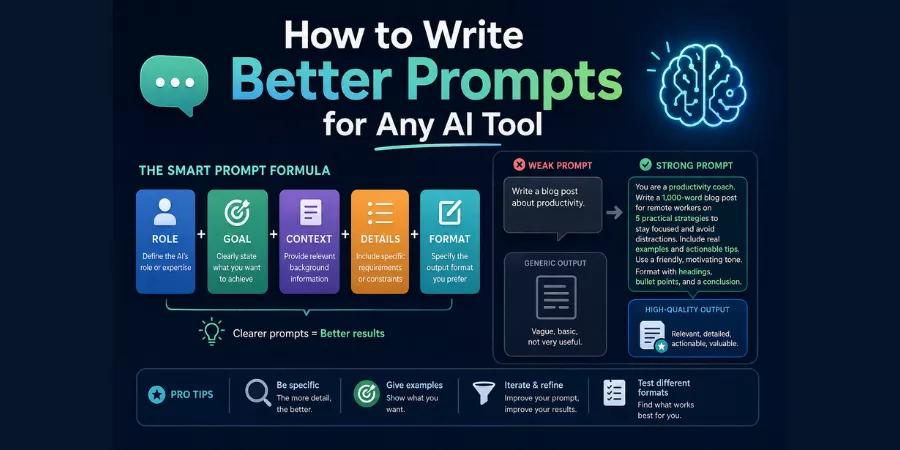
How to Write AI Prompts: The 4-Part Framework
This is your foundation. Whether you’re using ChatGPT, Claude, Gemini, or any other conversational AI tool, these four elements determine the quality of what comes back. Learn them once. Use them everywhere.
Part 1: Role (Who Should the AI Be?)
“Act as a senior content strategist with 10 years of B2B SaaS experience.”
Role-based prompting is one of the highest-leverage moves in AI prompt writing. Assigning a persona shifts the model from general-purpose mode into specialist mode. The vocabulary changes. The assumptions change. The depth of the response changes, often dramatically, with a single sentence.
This is the difference between asking “anyone” and asking an expert.
Part 2: Task (What Exactly Do You Want?)
Don’t hint. Don’t imply. State it directly, with specifics.
“Write a 1,200-word blog post explaining the difference between SaaS pricing models, per-seat, usage-based, and flat-rate, with pros and cons for each.”
Word count, topic scope, angle, deliverable, all in one sentence. The more explicit your task definition, the less the AI fills in with guesswork. This is basic instruction clarity, and it’s where most people underinvest.
Part 3: Context (Why Does This Exist, and Who Is It For?)
This is where 80% of people lose the output before they’ve started.
Context in prompts tells the AI:
- Who the reader is
- What problem they’re trying to solve
- What stage of awareness they’re at
- What outcome the content should drive
Without it, the model writes for a hypothetical average reader who doesn’t exist.
“The audience is early-stage startup founders with no technical background. They’re evaluating pricing models before their first product launch. The goal is to help them make a confident decision, not overwhelm them with theory.”
The prompt requires an assignment evaluation which identifies the correct way to present context information. The explanation which follows needs to show common knowledge to readers who have not studied the subject.
Part 4: Format (How Should the Output Look?)
Tell the AI how to present the information, not just what to say. Output formatting is what separates a raw response from something you can actually use.
Examples:
- “Use H2 and H3 headings throughout”
- “Add a comparison table for the three pricing models”
- “End with a 5-question FAQ targeting beginner questions”
- “Keep paragraphs under 4 lines for readability”
Structured prompts produce structured outputs. This single habit saves more editing time than any other change in your AI workflow.
Good vs. Bad AI Prompt Examples (This is Where it Clicks)
Bad Prompt
“Write about digital marketing.”
What you get: A 600-word surface overview that could have been written for a student, a retiree, or a Fortune 500 CMO, because it wasn’t written for anyone.
Good Prompt
“Act as a digital marketing consultant specializing in small business growth. Write a 1,000-word article for small business owners with under $5,000/month in marketing budget, explaining three strategies that reduce customer acquisition cost. Use plain language, include one real-world example per strategy, and end with a step-by-step action plan and a FAQ section.”
What you get: The document can be developed through targeted content development which defines specific reader requirements and establishes content boundaries and determines specific output requirements and uses existing work as its foundation.
Side-by-Side Comparison
| Dimension | Bad Prompt | Good Prompt |
| Audience clarity | None | Defined (small business owners, $5K budget) |
| Output depth | Surface-level overview | Specific strategies + real examples |
| Format | Unstructured block of text | Headings, action plan, FAQ |
| Editing time required | 30–45 minutes | 5–10 minutes |
| AI response quality | Low | High |
| Usefulness | Rarely publishable | Near-ready with light editing |
Why Specificity Improves AI Response Quality
AI doesn’t “think.” It predicts. Every output is a prediction based on what you gave it.
Think of it like a GPS. “Take me somewhere in New York” is technically a valid input, but not useful. “Take me to 320 W 57th St, New York” gets you there directly.
More precise input narrows the prediction space. Fewer assumptions. Better output.
This is why how to get better answers from AI is really a question about how to write better inputs. The model doesn’t improve, your instruction does. That’s the core principle behind prompt optimization.
The 5 Layers of High-Quality Structured Prompts
If you want consistently strong output, not occasionally good, but reliably useful, build your prompts around these five layers. This is the complete prompt structure that separates professional AI users from everyone else.
| Layer | What It Does | Example |
| Goal | Defines the end outcome | “Help readers confidently choose a pricing model” |
| Audience | Anchors voice, depth, and vocabulary | “Non-technical startup founders” |
| Constraints | Limits scope and prevents bloat | “800 words, no jargon, no academic citations” |
| Structure | Shapes the format before writing begins | “H2s, comparison table, FAQ at the end” |
| Examples | Shows what good looks like | “Here’s a sample intro. Match this tone.” |
You don’t always need all five. But the more layers you include, the less cleanup you do on the back end.
Real Use Cases: AI Prompt Examples for Writing, SEO, Marketing & More
This is where abstract frameworks become practical. Here are prompt engineering examples with output context across five real use cases.
Use Case 1: AI Prompts for Content Writing
Weak:
“Write a blog on fitness.”
Strong (AI prompts for content writing):
“Write a 1,200-word blog for working professionals aged 28–40 on staying fit with less than 45 minutes a day. Include realistic morning and evening routines, 3 diet tips that don’t require meal prep, and a section on the most common mistakes beginners make. Use conversational language and short paragraphs.”
The second prompt produces something an editor could publish. The first produces something nobody would read twice. This is AI prompt writing for beginners done right, specific, structured, audience-first.
Use Case 2: AI Prompts for SEO
Weak:
“Give me keywords.”
Strong (AI prompts for SEO):
“Give me 20 long-tail keywords for ‘home workouts for beginners’ targeting people who want routines without equipment. Include estimated search intent (informational or commercial) next to each keyword. Group them by topic cluster.”
Now you have a usable keyword set with intent baked in, not a random list of high-competition terms you can’t rank for. This is how to use AI tools effectively for SEO research.
Use Case 3: AI Prompts for Marketing
Weak:
“Write a product description.”
Strong (best ChatGPT prompts for content writing and marketing):
“Act as a direct-response copywriter. Write a 150-word product description for a $79 standing desk converter targeting remote workers with back pain. Lead with the pain point, highlight the top 3 benefits, and close with a specific, low-friction CTA. No filler language, no generic phrases.”
That’s the difference between a description that reads like a spec sheet and one that drives action.
Use Case 4: AI Prompts for Business Strategy
Weak:
“Help me grow my business.”
Strong (AI prompts for business strategy):
“Act as a startup growth advisor. Suggest 5 customer retention strategies for a B2B SaaS company with 200 users and 12% monthly churn. Focus on low-cost, high-impact actions that a two-person team can execute without a developer. Be specific and realistic.”
The first prompt produces a motivation poster. The second produces an action plan.
Use Case 5: AI Prompts for Productivity
Weak:
“Summarize this document.”
Strong (AI prompts for productivity):
“Summarize the following document in 5 bullet points, each under 25 words. Focus on decisions made, action items assigned, and deadlines. Skip background context. Format it so I can paste it directly into a Slack update.”
Same task. Completely different output. The structured prompt saves 15 minutes of cleanup per session.
What are the Common Mistakes that Kill AI Output Quality (And How to Fix Them)
These are mistakes. Most people make them without realizing.
- Mistake 1 – Vague Goals If you don’t know what “good” looks like before you prompt, the AI doesn’t either. Fix: Start every prompt with “The goal of this output is to…”
- Mistake 2 – No Audience Definition Content written for “anyone” is useful to no one. This is the single biggest reason why AI gives generic answers. Fix: Add one sentence describing exactly who the reader is before any other instruction.
- Mistake 3 – Multi-Task Overload “Write a blog, create a social caption, suggest hashtags, and give me a meta description,” one prompt, four tasks, four mediocre outputs. Fix: One prompt, one deliverable. Break complex projects into sequential steps.
- Mistake 4 – Accepting the First Draft AI output is a starting point, not a finish line. Treating it as final is where quality goes to die. Fix: Build review into your AI workflow. The first draft is raw material, not the product.
- Mistake 5 – Not Using Iterative Prompting If the output is close but not right, most people start over. Iterative prompting is faster and more effective. Fix: Follow up directly. “That’s too formal. Rewrite the intro in a more direct, conversational tone.” Each revision compounds the improvement.
Advanced Prompt Engineering Techniques Most People Don’t Use
Once the basics are solid, these techniques separate professionals from everyone else. This is prompt engineering for beginners who are ready to go further, and for experts looking to tighten their AI workflow.
1. Few-Shot Prompting: Show it What You Want
Zero-shot prompting means giving no examples and trusting the model to figure out what you mean. Few-shot prompting means showing it first, and it produces consistently better results.
“Here’s an intro I wrote that I like: [paste example]. Write the rest of the article in the same voice, direct, slightly informal, data-backed, no padding.”
Few-shot prompting examples consistently outperform description-only prompts in tone matching, format accuracy, and stylistic consistency. It’s one of the most underused ChatGPT prompt writing tips available.
2. Constraint-Based Prompting: Define What Not to Do
Constraints in AI prompts tell the model what to avoid. This is how you eliminate the predictable AI-isms that make output sound generated.
“Do not use: ‘in today’s fast-paced world’, ‘it’s important to note’, ‘leverage’, or ‘delve into.’ Avoid passive voice. Don’t open any paragraph with ‘This.’ Write like a sharp journalist, not a corporate memo.”
Constraint-based prompting techniques actively reduce the templated phrasing that readers tune out and AI detectors flag.
3. Step-by-Step Prompting: Build, Don’t Dump
Asking for a complete, polished output in a single prompt is the most common source of mediocre results. Build it in stages instead, this is iterative prompting in practice.
- Prompt 1: “Give me a 6-section outline for this article. No writing yet.”
- Prompt 2: “Write Section 2 from this outline. Aim for 250 words.”
- Prompt 3: “The intro buries the main point. Rewrite it to lead with the problem.”
Step-by-step prompting gives you control at every stage. Slower per session, faster overall, because far less time goes into fixing bad first drafts.
4. Role Stacking: Layer Multiple Personas
“Act as both a senior content strategist and a conversion copywriter. The strategist ensures the structure covers the reader’s full decision journey. The copywriter ensures every section ends with a clear reason to keep reading.”
Role stacking introduces productive tension between two professional perspectives, and often produces tighter, more intentional content than a single-role prompt.
5. Prompt Optimization Through Iteration
Prompt optimization isn’t about finding one perfect prompt. It’s about building a feedback loop.
Save prompts that work. Document what changed between a weak output and a strong one. Over time, you develop a personal library of best AI prompts for your specific use cases, reusable templates that consistently produce near-ready output.
This is exactly how to use prompt engineering in business actually works in practice: not theory, but tested, documented systems.
What Still Needs You (The Part Most AI Guides Skip)
Even a perfectly constructed prompt produces a first draft, not a finished piece.
AI operating on large language models will still:
- Generalize where your specific audience needs precision
- Hallucinate statistics, citations, or product details that sound correct but aren’t
- Miss industry nuance that only comes from experience
- Sound fluent but be factually wrong, coherence and accuracy are not the same thing
The edit is not optional. It’s where the real work happens. AI handles the skeleton. You supply the expertise, the accuracy check, and the human judgment.
That combination, structured prompt plus expert editing, is what actually produces content worth publishing. Use AI to move fast. Use your experience to make it accurate.
How to Use AI Tools Effectively: Your Action Plan
If you want better results starting with your next prompt:
- Stop writing one-line prompts: Every vague input is an open invitation for the model to guess.
- Use the 4-part framework: Role, task, context, format, as a checklist before every prompt.
- Add constraints: Tell it what to avoid, not just what to include.
- Break complex tasks into steps: One deliverable per prompt.
- Use iterative prompting: Follow up, refine, redirect. The third response is almost always better than the first.
- Edit with your expertise: AI generates the structure. You supply what makes it trustworthy and precise.
Key Takeaway
Better prompts don’t just improve AI response quality. They reduce editing time, eliminate wasted output, and make the difference between content that sits in a draft folder and content that gets published, ranked, and read.
The gap between average and excellent AI output is rarely the model.
It’s the instruction.
Write the instructions better. Get the output you actually need.
Frequently Asked Questions
What makes a good AI prompt?
A good AI prompt includes four elements: a defined role, a specific task, context about the audience and goal, and a format instruction. Constraints on what to avoid and examples of what “good” looks like make it stronger. When all of these are present, the model produces targeted, useful output without defaulting to generic filler.
How do you write effective AI prompts?
Start with the 4-part framework: role + task + context + format. Add constraints for what to avoid. Use few-shot prompting when tone matters. Break complex requests into sequential steps. Refine iteratively rather than starting over when the first draft misses.
What is prompt engineering in AI?
Prompt engineering is the practice of designing inputs that consistently produce high-quality outputs from AI models. It includes techniques like role-based prompting, few-shot prompting, zero-shot prompting, constraint-based prompting, task-based prompting, and iterative refinement. It’s a skill that improves with deliberate practice, not a fixed formula.
Why are my ChatGPT answers not good?
Because your prompts lack specificity. Vague input forces the model to assume — and AI defaults to the most average, middle-of-the-road version of whatever you asked for. Add a role, a defined audience, and a format instruction to your next prompt and compare the result directly.
How to write better prompts for ChatGPT?
The same 4-part framework applies across all tools. ChatGPT responds especially well to explicit role assignments, detailed context, and clear format instructions. Constraint-based prompting is particularly effective, telling it what phrases and patterns to avoid narrows output away from generic AI phrasing and closer to your actual voice.
Do longer prompts work better?
More complete prompts work better, not necessarily longer ones. A 40-word prompt that covers role, audience, task, and format outperforms a 300-word prompt that repeats the same vague request. Completeness is what matters. Length by itself doesn’t.
What is few-shot prompting?
Few-shot prompting means giving the AI one or more examples of the output style you want before asking it to generate. Rather than describing the tone or format, you show it. This significantly improves accuracy, especially for tone-matching, format replication, and style consistency. It’s one of the most underused prompt engineering techniques available.
What is zero-shot prompting?
Zero-shot prompting means giving the AI no examples, just an instruction. It works well for structured tasks with clear, objective requirements. When tone, voice, or specific formatting matters more, few-shot prompting produces more reliable results.
How can I improve AI output quality quickly?
Use the 4-part framework: role + task + context + format. Apply it to your next three prompts and compare the output to what you were getting before. Add constraints in the same session. Then iterate on the response instead of starting over.
What are the best AI prompts for content writing?
The best prompts for content writing include a specific audience, a defined topic angle, a word count, a format structure (headings, examples, FAQ), and constraints on tone and banned phrases. The more a prompt resembles a real editorial brief, the closer the output resembles something a real editor would accept.
Can prompt engineering improve SEO content?
Yes, when the prompt includes keyword intent, a defined target audience, a content format that matches search intent, and a clear goal. The prompt forms the structure. The structure determines whether the content aligns with what Google and readers are actually looking for.