The “Chatbot Era” of 2023 and 2024 felt like magic, but for most businesses, it quickly hit a ceiling. We’ve all been there: you ask a bot to summarize a meeting, and it’s great. You ask it to actually file the expense reports, reorder the low-stock inventory, and update the CRM simultaneously, and it stutters.
In 2026, the conversation has shifted.
We are moving from “AI that talks” to “AI that does.” This is the era of Agentic AI for enterprise workflows. Unlike the chatbots of yesterday that waited for a prompt, agentic AI systems are proactive. They don’t just suggest a response; they execute the multi-step processes required to finish the job.
According to Gartner, less than 5% of enterprise applications included task-specific AI agents in 2025. By the end of 2026, that number is projected to hit 40%. Whether it’s agentic AI for enterprise workflows managing a global supply chain or AI agents in business handling complex IT ticket resolutions, 2026 marks the year these systems became the primary engine of the digital enterprise.
Quick Checklist:
2026 is the year of agentic AI for enterprise workflows because three things finally converged at the same time:
- The AI is good enough now: Earlier models hallucinated too often to trust in autonomous systems. Current frontier LLMs can plan multi-step tasks, retain context, and invoke tools reliably enough to run real business workflows without constant human correction.
- The integration layer exists: Connecting AI to enterprise systems, ERPs, CRMs, databases, was the real blocker, not the AI itself. That problem is now solved. Pre-built connectors, API-first architectures, and low-code agent builder platforms mean companies can deploy agents without months of custom engineering.
- Business pressure is forcing action. Productivity expectations are up. Headcount budgets are flat or shrinking. Executives need to show AI ROI, not pilot results, actual ROI. Chatbots and copilots didn’t move the needle enough. Agents that autonomously execute workflows do.
The numbers demonstrate this: 57% of companies already have AI agents in production. Gartner projects 40% of enterprise applications will include agentic AI by the end of 2026. The market is moving from $7.6 billion in 2025 toward $50 billion by 2030.
Everything before 2026, chatbots, RPA, copilots, still needed a human at the center triggering each step. Agentic AI removes that bottleneck. That’s the shift, and 2026 is when it became operational at scale.
What is Agentic AI and How is it Transforming Enterprise Operations?
A chatbot responds. An AI agent acts.
That one distinction explains everything.
To understand why agentic AI for enterprise workflows is a breakthrough, we have to look at how it differs from what we’ve used before.
A standard chatbot is reactive. You provide an input, and it provides an output based on its training data. A “Copilot” is a bit more advanced; it sits alongside you, offering suggestions within a specific app like Word or Excel.
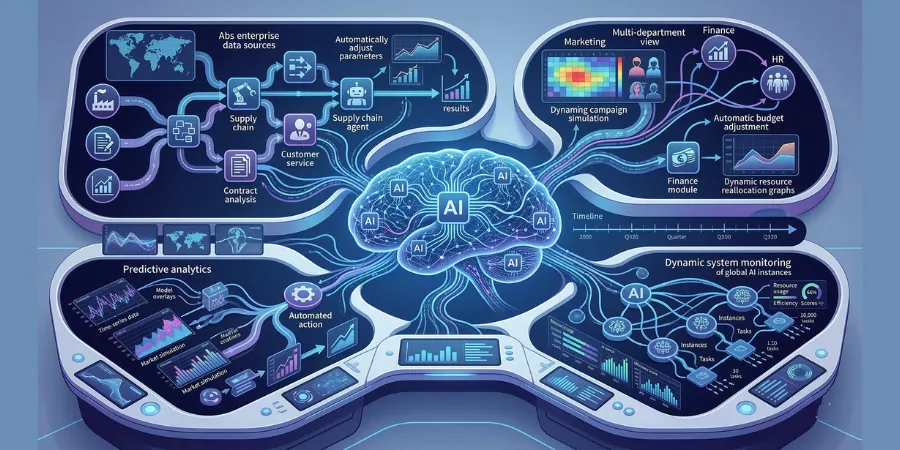
Agentic AI is different. It is goal-oriented. If you tell an agent, “Onboard this new hire,” it doesn’t just list the steps. It logs into the HR portal to create an ID, pings IT to provision a laptop, sends a welcome email, and schedules the first week of meetings.
The Core Components of an Agentic System:
- Perception: Understanding the environment (reading emails, scanning databases).
- Reasoning/Planning: Breaking a complex goal into smaller, logical steps.
- Action: Using “tools” or APIs to interact with software (Salesforce, SAP, Slack).
- Memory: Learning from past interactions to improve future execution.
This shift toward autonomous AI systems in enterprises is why Gartner predicts that by 2028, roughly 33% of enterprise software will include agentic AI, effectively automating 15% of daily business decisions that used to require a human click.
Think of the difference like this. A copilot gives you directions. An AI agent drives the car.
Why Can’t Chatbots and Traditional Automation Do it All?
For years, we relied on “Robotic Process Automation” (RPA). It was great for tasks that never changed, like copying data from a spreadsheet to a form. But RPA is brittle. If a website UI changes by even a few pixels, the automation breaks.
Chatbots, while smarter, still suffer from “silo syndrome.” They are often trapped inside a single browser tab or application. They can’t “see” across the whole company. Most importantly, they lack agentic AI automation capabilities, the ability to make a judgment call when a process doesn’t go exactly as planned.
In contrast, agentic AI for enterprise workflows allows for “dynamic orchestration.” If an agent encounters a broken link or a missing piece of data, it doesn’t just stop and throw an error. It reasons through a workaround, perhaps searching a different database or reaching out to a human colleague for the specific missing info.
How Agentic AI is Transforming Enterprise Workflows
The actual worth of agentic AI for enterprise workflows among users comes from its use in their everyday work activities. Here is how it is being deployed in 2026 across major departments.
Finance Automation
In finance, agentic AI for enterprise workflows examples include “Autonomous Auditors.” The agent performs real-time checks on all invoices whereas humans only examine ten percent of invoices for compliance. The system checks invoices against contracts while verifying goods receipt at the warehouse and processing payment which only notifies humans about actual discrepancies.
Example:
The old way: A finance team member manually matches invoices to purchase orders, flags exceptions, escalates discrepancies. Multiple people. Multiple systems. Hours of work.
The agentic way: An agent connects to the ERP, pulls invoice data, cross-references purchase orders, flags mismatches above a defined threshold, routes exceptions to a human, and logs every action for audit.
The finance team reviews the 12 exceptions – not 200 transactions.
Customer Support and Service Operations
We’ve moved past “I’m sorry, I didn’t understand that.” Modern enterprise AI agents in customer service can actually solve problems. If a customer wants a refund for a flight, the agent checks the cancellation policy, verifies the identity, processes the refund in the booking system, and sends a confirmation, all without a human agent ever touching the keyboard.
Example:
Danfoss (global manufacturer): Deployed AI agents for email-based order processing.
- 80% of transactional decisions fully automated
- Response time dropped from 42 hours → near real time
Supply Chain Intelligence
Supply chains are chaotic. An agentic workflow AI can monitor weather patterns, port delays, and inventory levels simultaneously. If it sees a storm approaching a key shipping lane, it can autonomously re-route shipments or contact alternative suppliers to ensure production doesn’t stall.
Example:
Ford: Using AI agents to accelerate vehicle design. Processes that previously took hours, stress tests, 3D renderings, simulation chains, now completed in seconds.
IT Operations and Cybersecurity
IT teams are using agentic AI for enterprise workflows to manage “self-healing” networks. When a server goes down, the agent doesn’t just alert a human; it spins up a backup instance, migrates the data, and then writes a report on why the failure happened in the first place.
Example:
Telus: Deployed AI across 57,000 team members. Average time saved: 40 minutes per AI interaction. At that scale, the productivity impact is structural, not incremental.
Software Development Workflows
Development is no longer just about writing code; it’s about managing the pipeline. An agentic AI workflow builder can now take a feature request, write the code, run the unit tests, fix any bugs found during testing, and prep the pull request for human review.
Example:
Amazon (Amazon Q Developer): Coordinated agents modernized thousands of legacy Java applications in a fraction of expected time.
Genentech (AWS): Agent ecosystems automate complex research workflows so scientists focus on drug discovery, not data processing.
As one senior technologist at Encora put it: “The engineer of 2026 will spend less time writing foundational code and more time orchestrating a dynamic portfolio of AI agents.”
Which Companies are Already Using Agentic AI?
The infrastructure for agentic AI for enterprise workflows is being built by the titans of tech. We are no longer in the “experimental” phase.
- Microsoft: With the evolution of Copilot Studio, Microsoft has created a robust agentic AI workflow builder. They are enabling “Team Copilots” that act as project managers for entire groups.
- Salesforce: Their “Agentforce” platform allows businesses to deploy enterprise AI agents that can handle sales prospecting and service cases autonomously within the CRM.
- Google Cloud: Through Vertex AI, Google provides an agentic workflow framework that lets developers “ground” their agents in their own corporate data, ensuring high accuracy.
- OpenAI: With the release of more advanced “reasoning” models, OpenAI has shifted focus toward agentic AI automation, allowing their models to use computer tools just like a human would.
These platforms are the “operating systems” for the new digital workforce, providing the agentic AI workflow tools necessary to scale.
What they all share: the same architectural insight. Agentic workflow frameworks must connect to real enterprise systems, ERPs, CRMs, databases, and need an orchestration layer to manage how agents hand off tasks to each other.
Google Cloud and Salesforce co-developed the Agent2Agent (A2A) protocol, an open standard allowing agents from different platforms to coordinate directly. That is infrastructure-level commitment, not a product roadmap slide.
Why 2026 is the Breakout Year for Agentic AI
If the technology existed in 2024, why is 2026 the tipping point? It comes down to three factors:
1. Maturity of LLMs (Large Language Models)
Earlier models were prone to “hallucinations,” making things up. By 2026, models have become significantly more reliable at “reasoning.” They can follow long chains of logic without getting lost, which is essential for agentic AI for enterprise workflows.
2. Multi-Agent Orchestration
We’ve realized that one “super-agent” isn’t the answer. Instead, the future of AI agents lies in “swarms.” You have one agent that is an expert in legal, another in finance, and a “manager agent” that coordinates between them. This agentic workflow vs agentic AI distinction is key: it’s not just about the intelligence of the model, but the structure of the work.
3. The “Integration Layer”
Most enterprise data used to be locked in silos. Over the last two years, companies have spent billions building “data fabrics” that allow AI to finally “see” across the whole company. Without this access, agentic AI for enterprise workflows would be like a genius office worker with their hands tied behind their back.
Where adoption stands right now:
- 57% of companies already have AI agents in production (G2, mid-2025)
- 22% are in active pilot
- By 2028, Gartner predicts 15% of daily business decisions will be made autonomously
- Market growing from $7.6B in 2025 → $50B by 2030
What Risks and Challenges Do Enterprises Face, and How to Solve Them
It isn’t all smooth sailing. As we deploy autonomous AI systems in enterprises, we face new hurdles.
- Governance and Oversight: Who is responsible if an agent makes a $50,000 ordering mistake? Companies are having to write new “Rules of Engagement” for their digital workers.
- The “Black Box” Problem: For an agentic workflow AI to be trusted, it must be explainable. If a loan is denied by an agent, the system must be able to show the exact logic path it took.
- Security Risks: “Prompt injection” is a real threat. If an external email can trick an agent into changing a bank routing number, the whole system is a liability.
- Hype vs. ROI: There is a lot of “agent-washing” happening. Not every script is an “agent.” CIOs are now demanding clear metrics on how agentic AI for enterprise workflows actually saves time or money.
Experts warn that many early projects may fail because companies try to automate processes that are already broken. You can’t fix a bad workflow by just throwing an agent at it.
“McKinsey found 89% of organizations still operate with industrial-age structures not designed for AI coordination. Dropping agents into those structures without redesigning the work is the fastest way to waste the investment.”
How Will Agentic AI Change the Future of Workflows?
What does the office of 2027 and 2028 look like? We are moving toward a “Human-in-the-Loop” model where humans act as supervisors and strategists.
In this future of AI agents, your job might not be to “do” the work, but to “curate” it. You will manage a fleet of enterprise AI agents, setting their goals, reviewing their output, and handling the “edge cases” that require true human empathy or complex ethical judgment.
We are seeing the rise of the agentic AI workflow tools that allow non-technical managers to build their own agents. This democratization means that the person who understands the business problem is the one who builds the AI solution.
Gartner’s 2035 forecast: Agentic AI generating close to 30% of enterprise application software revenue, surpassing $450 billion. This is not a technology that might arrive. It has arrived and is compounding.
Author’s Opinion
I believe 2026 is the definitive “breakout year” because we have finally moved past the honeymoon phase of chatting with AI. As an analyst, I see that the infrastructure, robust APIs and reliable reasoning models, has finally matured. We are no longer just asking questions; we are delegating entire multi-step departments to agentic AI for enterprise workflows.
To me, the shift from reactive bots to proactive agents represents the most significant leap in corporate productivity since the internet. In 2026, the competitive divide is clear: you are either orchestrating an autonomous digital workforce or you are falling behind.
| Metric | 2024 Chatbots (Reactive) | 2026 Agentic AI (Proactive) |
| Primary Goal | Response Accuracy | Outcome Completion |
| Workflow Scope | Single-step Q&A | Multi-step, Multi-tool Execution |
| Cost Impact | 20-30% Support Reduction | 35-60% Operational Savings |
| Efficiency Gain | ~15% Productivity Boost | 55%+ Efficiency Gain |
| Integration | Surface-level (Chat UI) | Deep (ERP/CRM/API Orchestration) |
| Human Role | Task Executor | Agent Supervisor (on-the-loop) |
Frequently Asked Questions
What is agentic AI in simple terms?
Agentic AI is AI that can act independently to achieve a goal. While a normal AI answers a question, an agentic AI completes a task by planning steps and using software tools.
How is agentic AI different from chatbots?
Chatbots are for conversation; Agentic AI is for action. A chatbot tells you how to book a flight; an Agentic AI actually books the flight, chooses the seat, and adds it to your calendar.
Which industries benefit most from agentic AI?
Finance, Logistics, Healthcare, and IT are leading the way because they involve high volumes of data and multi-step processes that require accuracy and speed.
Will AI agents replace human workers?
They are more likely to replace tasks than jobs. By handling the repetitive “drudge work,” agentic AI for enterprise workflows allows humans to focus on high-value strategy and creative problem-solving.
What tools are used to build enterprise AI agents?
Popular agentic AI workflow tools include Microsoft Copilot Studio, Salesforce Agentforce, LangChain, and various agentic workflow frameworks provided by AWS and Google Cloud.
Conclusion
The transition to agentic AI for enterprise workflows is more than just a software update; it’s a fundamental shift in how business is conducted. In 2026, the companies that are winning aren’t just using AI to write better emails, they are using it to run autonomous operations that are faster, cheaper, and more scalable than anything we’ve seen before.
The journey from “Chatbot” to “Agent” is the journey from a world where we work for our software to a world where our software works for us. As we move deeper into this decade, the “Autonomous Enterprise” will become the standard, and those who wait too long to integrate AI agents in business will find themselves left behind in the manual era.
The chatbot era is over. The agent era has started.