Between 2 and 5% of Japanese macaque mothers reject their newborns in the first 48 hours after birth. The statistic appears clinical until you understand what it means: most of these infants die. Cold. Hungry. Confused about why the world has turned its back before they have taken their first real breath.
One did not.
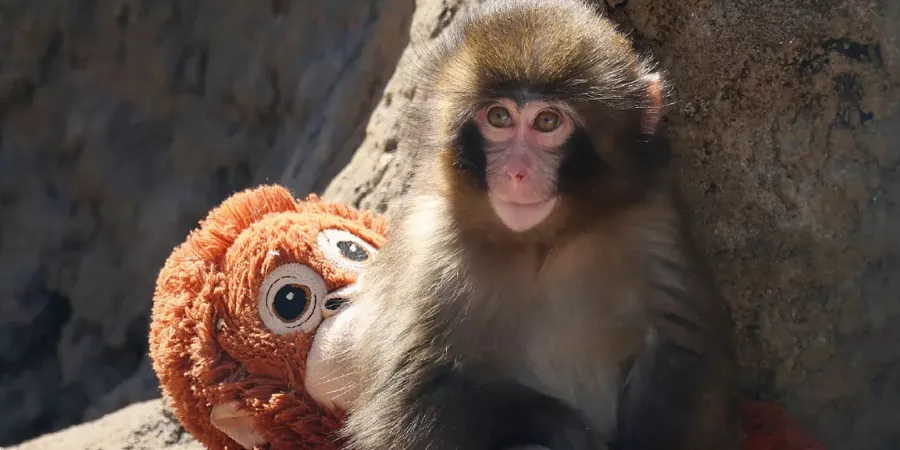
The photograph finds you during an unremarkable moment. You are scrolling, half-paying attention, when a wrinkled face stops your thumb mid-swipe. A seven-month-old macaque clutches an oversized orange plush toy, eyes dark and enormous. The caption says something about punch the monkey, and you expect a joke. Instead, you get pulled into something raw and real. This baby primate is fighting to survive, and somehow that fight has become your business too.
When a Mother Walks Away
July 26, 2025. Ichikawa City Zoo, a modest facility in Chiba Prefecture just outside Tokyo. The macaque enclosure hums with ordinary life. Mothers groom their young, fingers working through thick fur with the mechanical precision of long practice. Juveniles chase each other across sun-warmed rocks on what locals call Monkey Mountain, where around 60 Japanese macaques live in a carefully managed troop.
Birth happens. The mother cleans herself, stands up, and walks away.
The newborn cries. She keeps walking. When zookeepers gently place the infant near her, she pushes it aside. Not accidentally. Deliberately. An onlooker notices the abandoned baby and alerts staff. The monkey troop hierarchy behavior is not democratic. Everyone knows their rank, earned through aggression or inheritance or sheer survival. Mothers hold their babies close. That is how it works. That is how it has always worked.
Except when it does not.
The timing could not have been worse. July in Japan means sweltering heat, and the difficult birth during a heatwave likely played a role in the mother’s rejection. In a back room, away from the troop, a baby no bigger than your forearm lies wrapped in fabric, alone. This is punch the monkey, though the name means nothing yet. Right now, this abandoned baby monkey Japan will come to know intimately is just trying to make it through the next hour.
The punch the monkey story starts where no animal story should: with a mother who refused to look back. Zoo caretakers raising baby monkey remember the exact moment they understood. No amount of encouragement would work. She wanted no part of this.
Why was punch the monkey abandoned? The question claws at you because it violates something fundamental. The zoo staff believe the difficult birth during intense summer heat pushed the mother past her capacity to care. Maternal rejection does happen in nature, yes. First-time mothers panic. Stress unravels instinct. Illness disrupts hormones. But witnessing it breaks something inside the people who work with these animals every day. Knowledge does not make it easier.
The staff named him Punch, shortened from Panchi-kun in Japanese, after Monkey Punch, the manga artist who created Lupin the Third. The name carries a certain irony for an infant who has taken more than his share of hits from life.
The First Critical Days
When a Japanese macaque punch incident occurs and a mother physically refuses her offspring, the clock starts immediately. Without intervention, death comes fast. Hypothermia within hours. Dehydration shortly after. The infant lacks the ability to regulate temperature, find food, or even understand what has gone wrong. Nature is efficient about these things.
The team at Ichikawa City Zoo Monkey faced the decision every wildlife professional dreads. Let this play out as it would in the forests of Honshu, where no one intervenes and the weak simply disappear. Or step in, knowing that hand-raising a macaque infant is brutally difficult and often fails anyway.
They chose the harder path.
The day after birth, Punch was artificially fed, drinking milk from a baby bottle. Two caretakers took on the monumental task of becoming his world. What happened next turned this abandoned baby monkey Japan into something studied in zoological programs worldwide. The zoo caretakers raising baby monkey divided into shifts. Someone had to be there every moment.
Feeding schedules mimicked the natural nursing rhythm of macaque mothers, though bottles replaced warm bodies. Temperature control became obsessive because newborn macaques depend entirely on maternal warmth. The baby macaque emotional bonding process began in those first desperate days, though no one dared hope it would be enough.
An IKEA Solution to an Ancient Problem
The zookeepers tried everything. Rolled-up towels. Other stuffed animals. Nothing worked. Then someone had an idea. The IKEA Djungelskog, a bug-eyed orange orangutan plush toy that stood 14 inches tall, sold for about 20 dollars at the Swedish furniture store. The logic was simple, born from watching healthy macaque infants in the wild.
“This stuffed animal has relatively long hair and several easy places to hold,” zookeeper Kosuke Shikano explained. “We thought that its resemblance to a monkey might help Punch integrate back into the troop later on, and that’s why we chose it.”
They cling. Constantly. To fur, to skin, to anything that feels remotely like mother. Physical contact is not optional for these animals. It shapes brain development, regulates stress hormones, teaches the infant what safety feels like. Japanese baby macaques typically grasp their mothers to build muscle strength and for a sense of security. Punch needed something to hold.
The instant the stuffed orangutan toy monkey was placed near him, tiny fingers curled around it. The grip was fierce, instinctive. Punch held that plush toy the way evolution programmed macaque infants to grasp their mothers, and did not let go. He dragged it across the enclosure. He curled around it to sleep. He ate beside it. That image, a baby primate clutching fake orange fur for comfort, became the photograph that traveled continents.
The true story of punch the monkey japan lives in moments like this. Small, unglamorous, heartbreaking. Zoo animal emotional care sounds gentle until you understand what it demands. Macaque infants develop faster than human babies. Their needs are relentless. Feed them, yes. Keep them warm, obviously. But also: hold them for hours. Talk to them. Provide the constant stimulation a troop would naturally give. The caretakers were not just feeding an animal. They were trying to become a mother, a sibling, an entire social structure, for a creature wired to need all of it at once.
February 5, 2026: The Internet Discovers Punch
The staff at Ichikawa City Zoo Monkey posted a simple update on X, the social platform formerly known as Twitter. February 5, 2026. The text, written in Japanese, explained that a baby monkey carrying a plush toy could be seen on Monkey Mountain. His name was Punch. He was born July 26, 2025. Abandoned at birth. Hand-raised. Integrated into the troop on January 19, 2026. Please watch over his growth warmly.
The photo showed Punch bundled against his stuffed orangutan toy monkey, staring into the camera with eyes too large for such a small face. The post was meant for local supporters and documentation purposes.
It exploded overnight.
Within hours, viral baby monkey punch was everywhere. The image moved across platforms with the strange velocity that only the internet can generate. TikTok videos surpassed 30 million views. Instagram lit up. Fan art appeared on X and Reddit. The emotional story of abandoned monkey punch appeared in languages the staff did not speak, shared by people on continents they would never visit. The hashtag #がんばれパンチ, which translates to #HangInTherePunch, began circulating worldwide. Comment sections filled with strangers emotionally invested in a baby macaque they would never meet.
Fans even gave the stuffed orangutan toy monkey its own nicknames: Oran-Mama. Oran-Mother. IKEA, sensing something special, leaned into the moment. Their social media accounts across Japan, the United States, South Korea, and Chile posted images with captions like “Sometimes family is who we find along the way.” Sales of the Djungelskog orangutan plush spiked noticeably. The toy began selling out. IKEA Japan donated dozens of replacement plushies to the zoo.
Inside the facility, life continued at a different pace. The viral zoo animal japan phenomenon was noise. The real work happened in quiet observation areas where what happened to punch the monkey at Ichikawa zoo was still being written, moment by moment.
What the Science Says
Researchers who study animal abandonment behavior explanation have mapped patterns across primate species. Social stress cracks maternal instinct. Environmental disruption triggers rejection. Individual temperament plays a role we are only beginning to understand. Some mothers, human and otherwise, simply lack the capacity to nurture. We do not fully know why.
The japanese macaque punch case added data points to a growing body of research. How do hand-raised primates compare to mother-raised individuals across developmental markers? Which interventions actually work in those first critical weeks? Can zoos identify rejection risk before it happens?
Monkey troop hierarchy behavior matters more than casual observers realize. A mother’s rank determines her stress levels, her access to food, the support she receives from other females. Disrupt that hierarchy and infant survival rates plummet. The punch the monkey story fits these broader patterns, but each monkey abandoned by mother zoo case carries its own particular heartbreak.
The Brutal Truth About Belonging
January 19, 2026. After months of hand-raising, the moment arrived. Punch was carefully introduced to the troop on Monkey Mountain. Reintegration is essential for long-term development, zoo staff knew, but it can be socially brutal.
Japanese macaques operate within strict hierarchies. Juveniles typically learn their place through their mothers, who teach them the subtle language of rank, submission, and social navigation. Without his own mother to show him the ropes, Punch struggled. Videos began circulating that broke hearts across the internet. Punch tentatively approaching older monkeys, seeking connection. Being swatted away. Ignored. Shoved.
The monkey abandoned by mother zoo faced what abandoned children everywhere face: the desperate need to belong combined with the total lack of tools to make it happen.
By mid-February, a particularly painful video went viral. Punch approached another baby monkey, attempting to communicate, to play. The other infant avoided him. Punch sat down, apparently giving up. Then an adult female macaque grabbed him and dragged him across the enclosure. The footage was devastating. Millions watched. The outrage was immediate.
The zoo responded with a statement on February 20. The adult monkey who dragged Punch, they explained, was probably the mother of the baby monkey Punch had been bothering. She felt her own infant was being annoyed and reacted the way macaque mothers do, expressing something akin to “do not be mean.” In the video, Punch runs to his stuffed orangutan toy monkey after being dragged, seeking comfort. But moments later, he left the toy and went back to trying to communicate with other monkeys.
“The monkey that dragged Punch is probably the mother of the monkey with whom Punch tried to communicate,” the statement read. “She probably felt that her baby was annoyed by Punch and got upset.”
Viewers describing the interactions as bullying missed something crucial, the zoo staff insisted. This is how macaques teach social rules. Punch has been scolded many times. No single monkey has shown serious aggression toward him. He shows resilience and mental strength. He recovers quickly.
“In order to integrate Punch into other Japanese monkey troops, we anticipated that this kind of challenge may arise,” the statement continued. “Although Punch has been scolded many times by other monkeys, no single monkey has shown serious aggression toward him. While Punch is scolded, he shows resilience and mental strength. When you observe the disciplinary behaviors from other troop members toward Punch when he tries to communicate with them, we would like you to support Punch’s effort rather than feel sorry for him.”
Takashi Yasunaga, head of Ichikawa’s zoo and botanical gardens, described Punch as very outgoing. One keeper noted that despite occasional ostracizing, Punch was “mentally strong.” By February 12, the zoo reported that Punch was interacting with more macaques. There were still times when he got scolded, but he was learning the rules of the group.
Where Punch is Now
The lines outside Ichikawa City Zoo stretch longer than anyone expected. Huge lines, the staff called them in a February 15 statement, unprecedented crowds forming at the entrance. People travel from across Japan and beyond, hoping to catch a glimpse of a seven-month-old macaque and his orange plush companion. The zoo apologized for delays in entry. They had never seen anything like this.
Inside, Punch continues the slow work of becoming part of a troop. Hand-raised macaques follow no predictable timeline. Some never fully integrate. They live separate lives, neither wild nor entirely domesticated, existing in a category we do not have good language for. Others adapt in ways that surprise researchers who thought they understood these animals.
The outcome for punch the monkey is still unfolding. What we can say: the baby macaque emotional bonding that started with human hands has expanded to include other macaques. Progress comes in increments. A positive interaction, then a setback. Two steps forward, one back. During feeding times at noon and 3 p.m., Punch acts no differently than on any other day, staff report. He tries. He gets rejected. He tries again.
This is the unglamorous reality of zoo animal emotional care that viral photos never show. The punch the monkey phenomenon did something unexpected. It taught millions about work that usually happens behind closed doors. Viral baby monkey punch stopped being just an internet moment. It became a window into the exhausting, complex, deeply meaningful labor that zoological professionals do every single day.
People connected with the emotional story of abandoned monkey punch because the themes reach past species. Rejection. Survival. Belonging. The question of whether love and dedication can repair what nature broke. Whether you have a PhD in primate behavior or you just paused while scrolling through your phone, the true story of punch the monkey japan touches something recognizable.
What You Carry Forward
The photo is still on your phone if you want to find it. A seven-month-old macaque clutching an orange IKEA plush toy that has become a global symbol. You know more now. The July heatwave birth. The mother who walked away. The day-after bottle feeding. The zookeeper named Kosuke Shikano who chose the Djungelskog because of its long hair and easy grip. The February 5 post that changed everything. The unprecedented crowds forming outside a small zoo in Chiba Prefecture.
At Ichikawa City Zoo Monkey facility, punch the monkey keeps growing, keeps learning the intricate social world that macaques navigate without thinking. The story has no clean ending because life does not work that way. It continues, mostly without cameras, in the steady hands of people who chose the harder path.
The next time you see abandoned baby monkey japan stories or read about animal abandonment behavior explanation, Punch will be there in your memory. That behind every viral zoo animal japan moment lives a real animal with needs, with fear, with a shot at something better if humans choose to care.
You were scrolling through your phone. Now you carry this. The smallest lives tell the biggest stories. Compassion, applied with patience and knowledge, can write endings that seemed impossible at the beginning. That is not sentiment. That is what happened here. That is what continues to happen, one difficult day at a time, on Monkey Mountain.