
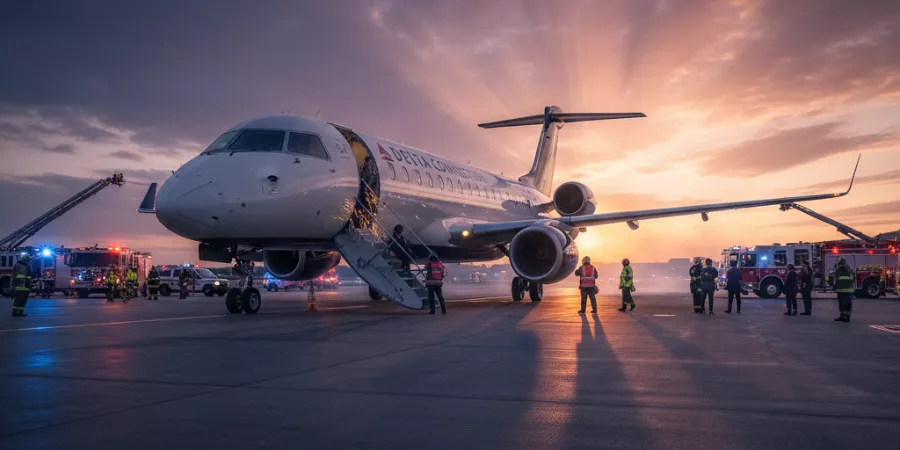
It was a Monday afternoon in Minneapolis, On July 7, 2025, and the passengers aboard the Delta Connection DL3543 Emergency Landing flight had every reason to expect the most unremarkable hour of their week. A short domestic hop from Minneapolis–Saint Paul International Airport to Chicago Midway International Airport. Coffee, maybe a podcast, and a clean landing by mid-afternoon. Instead, roughly ten minutes after wheels left the ground, something changed in the cockpit.
The crew detected an abnormal condition during climb. They acted quickly, turned the aircraft back, and declared an emergency. Within 37 minutes of departure, the Embraer 170-200LR was back on the ground at MSP, rolling to a stop with emergency services already staged and ready.
The Delta Connection DL3543 Emergency Landing drew attention not because it ended badly, it didn’t, but because of the precision and speed with which the crew handled an uncertain situation at altitude. What actually happened aboard that flight, and why do pilots declare emergencies even when the visible threat appears low? Both questions deserve a careful answer.
- The Delta Connection DL3543 Emergency Landing began when the flight departed Minneapolis–Saint Paul International Airport bound for Chicago Midway International Airport.
- An emergency was declared shortly after takeoff, prompting an immediate return to the departure airport.
- The aircraft landed safely with emergency services standing by as a precautionary measure.
- All passengers and crew exited the aircraft without injury.
- Aviation emergencies like this one are frequently precautionary, designed to protect passengers before a situation can escalate.
The FAA processes thousands of declared in-flight emergencies across commercial aviation each year. The vast majority end without injury or catastrophe. Understanding why these declarations happen, and what the industry does in response, gives passengers a more accurate picture of how safe modern commercial flight actually is.
What Happened on Delta Connection Flight DL3543?
The Delta Connection DL3543 Emergency Landing began at approximately 13:09 UTC on July 7, 2025, when Endeavor Air’s Embraer 170-200LR, registered as tail number N259SY, lifted off from Minneapolis–Saint Paul International Airport on a scheduled service to Chicago Midway. The aircraft was climbing normally when something on the flight deck demanded the crew’s immediate attention.
- The flight DL3543 left Minneapolis–Saint Paul International Airport to operate its planned route to Chicago Midway International Airport.
- The aircraft reached an altitude of 21,000 feet when the crew discovered an unusual situation which interrupted the aircraft’s ascent.
- The pilots used Squawk 7700, which serves as the universal transponder code for in-flight distress, to declare an emergency situation.
- The crew decided to return to Minneapolis rather than continue the flight, requesting priority landing clearance from air traffic control.
Reports confirm the aircraft turned back approximately ten minutes after departure and was given priority handling by ATC for its return. The Embraer touched down on runway 12R at MSP without incident. Emergency vehicles were positioned along the runway as standard precautionary protocol, not because a crash was imminent, but because that is exactly what Squawk 7700 is designed to trigger.
Passengers disembarked normally. The aircraft was immediately removed from service for inspection. No injuries were reported.
Timeline of the DL3543 Emergency Landing Incident
The Delta Connection DL3543 Emergency Landing timeline unfolded in under 40 minutes from takeoff to safe touchdown, a sequence that reflects how rapidly and effectively a trained crew can manage an in-flight abnormality when procedures are followed precisely.
- 13:09 UTC, DL3543 lifts off from Minneapolis–Saint Paul International Airport and begins its initial climb phase with no early indication of concern.
- Approximately ten minutes after departure, a technical alert is detected by the flight crew during the climb phase at around 21,000 feet.
- The crew contacts air traffic control and declares an emergency using Squawk 7700, initiating priority airspace handling.
- Airport fire trucks, emergency medical units, and rescue personnel are positioned along runway 12R, a fully automatic response triggered by the emergency code.
- The aircraft touches down safely on runway 12R, approximately 37 minutes after its initial departure.
- Passengers deboard without incident; reports confirm no injuries among passengers or crew and no need for emergency services to intervene.
From declared emergency to wheels on the ground, the operation was measured, professional, and executed exactly as the system is built to function. Emergency services stood down. The aircraft was taken out of service. And the people who boarded that flight walked away.
Why Did Delta Flight DL3543 Declare an Emergency?
This is the question most passengers naturally ask first. The answer sits at the intersection of aviation protocol and pilot judgment, and it’s worth understanding both sides of it.
- The Delta Connection DL3543 Emergency Landing was declared after the crew identified a possible pressurization anomaly or power-related system alert during climb, the exact technical cause was not publicly disclosed by Delta or regulatory authorities.
- Under FAA guidelines, pilots are trained to apply precautionary emergency landing aviation standards, meaning an emergency can and should be declared whenever a condition creates genuine uncertainty, not only when failure is confirmed.
- Pilots declare emergencies even in low-risk situations because doing so unlocks critical resources: cleared airspace, a held runway, and staged ground emergency teams.
- The specific technical cause of the DL3543 alert remains officially unconfirmed; neither Delta Air Lines nor the NTSB publicly disclosed a definitive finding as of available reporting.
In everyday language, the word “emergency” implies imminent catastrophe. In aviation, it means something more precise: a condition that warrants immediate and elevated attention. The system is deliberately designed this way. Declaring early costs very little. Waiting too long can cost everything.
The crew’s decision to return was not made in a vacuum. It was made by trained professionals applying the exact framework their regulators and airline have built over decades of incident analysis. That framework says: when in doubt, land.
Inside Aviation Safety Protocols During Emergency Landings
Most passengers have never heard of Squawk 7700, and that’s fine. It belongs to a layer of aviation infrastructure that operates quietly in the background of every flight, coming forward only when it’s needed. On DL3543, it was needed.
- Squawk 7700 is the universal four-digit transponder emergency code, broadcast automatically to all ATC radar in range the moment it is set by the flight crew.
- Priority landing clearance is granted almost instantly, other aircraft are rerouted, the destination runway is held, and emergency ground services are notified without any additional action from the pilots.
- Air traffic control coordination shifts immediately to emergency protocol, with the controller handling DL3543 giving the aircraft full priority over all other traffic in the sector
- Airport fire and rescue crews are positioned along the landing runway automatically, a response driven by the squawk 7700 emergency code itself, not a secondary manual call.
- Cabin crew follow structured passenger safety briefing procedures during the return, communicating calmly and clearly to minimize anxiety and prepare the cabin for a precautionary landing.
The automation built into this system matters enormously. In a high-workload cockpit environment, the flight crew cannot spend time manually contacting every agency that might be needed on the ground. Squawk 7700 does it for them, triggering airport emergency vehicles standby and priority landing aviation emergency clearance simultaneously, so the crew stays focused on flying.
Passengers aboard DL3543 likely had no direct awareness of most of this. The cabin experience during an emergency return is deliberately calm. That calm is the product of trained flight attendants following structured procedures, not a lack of seriousness about the situation.
Crew Response and Decision Making Under Pressure
There is a phrase that every commercial pilot knows from early in their training: aviate, navigate, communicate. It describes the priority order for managing any abnormal situation in the cockpit. Fly the aircraft first. Know where you are and where you’re going. Then communicate about it.
The crew behind the Delta Connection DL3543 Emergency Landing followed this sequence without apparent deviation. They identified an alert, controlled the aircraft, determined a course of action, return to Minneapolis, and then communicated it through the proper channels to ATC and, through the cabin crew, to passengers.
- Under FAA regulations and international aviation standards, the pilot in command holds complete and final authority during an in-flight emergency, no airline operations center, dispatcher, or passenger can override that authority.
- Standard Operating Procedures (SOPs) govern how crews respond to specific alerts, providing step-by-step electronic checklists so that responses are methodical rather than improvised under pressure.
- Returning to the departure airport early is nearly always safer than continuing a flight with an unresolved alert, airports are equipped, runways are clear, and ground support is immediately available.
- Cabin crew coordinate with the flight deck through established communication protocols, managing passenger behavior and preparing the cabin in parallel with the pilots managing the aircraft.
Pilots at Endeavor Air complete recurrent simulator training multiple times per year. These sessions specifically replicate abnormal and emergency scenarios so that real-world responses are practiced and automatic rather than reactive. The decision to turn back was not a panic move. It was a trained response applied in real time.
A calm cabin is a safer cabin. Flight attendants are trained to read a situation, receive information from the flight deck, and communicate it to passengers in a way that is clear without being alarming. Their composure is not performative, it’s functional.
Passenger Safety Measures During Emergency Returns
For the passengers aboard the DL3543 Minneapolis to Chicago flight, the sudden turn-back was almost certainly disorienting. One moment the skyline is fading into cloud cover; the next, the aircraft is banking back toward the airport. What was happening in the cabin during those minutes is worth understanding.
- Delta Connection DL3543 Emergency Landing passengers experienced a structured cabin communication process, flight attendants received guidance from the flight deck and relayed calm, clear information without alarming language.
- Seatbelt compliance was confirmed, loose items secured, tray tables stowed, and seats returned to upright positions as the cabin was prepared for the precautionary return.
- Medical readiness is staged onboard, FAA regulations require commercial aircraft to carry emergency medical kits, and flight attendants are trained in their use for passenger health events during flight.
- Precautionary landings like this one prevent escalation by removing the aircraft from a dynamic environment, altitude, weather variability, distance from medical facilities, and returning it to a fully equipped, ground-based response system
The outcome, delta dl3543 passengers safe after emergency landing, didn’t happen by chance. It reflected a layered system of preparation: the crew’s training, the aircraft’s onboard systems, the airport’s emergency readiness, and the airline’s protocols all working in coordination.
Precautionary landings often feel dramatic to those inside the aircraft. From a structural safety perspective, they represent aviation’s preventive architecture doing its job. The system didn’t fail on DL3543. It worked.
Delta Connection Safety Standards and Regional Flight Operations
Following the Delta Connection DL3543 Emergency Landing, questions naturally arose about what standards govern a regional carrier like Endeavor Air. Delta Connection is a brand, a commercial identity applied to regional flights operated under contract with Delta Air Lines. Endeavor Air, a wholly owned Delta subsidiary, is one of the largest regional carriers in the United States, with a fleet of Embraer 170 and 175 aircraft serving the broader Delta network.
- Regional carriers like Endeavor Air operate under the Delta Connection brand but are certified independently by the FAA under Part 121 air carrier regulations, the same regulatory framework governing mainline carriers like Delta, United, and American.
- FAA safety oversight applies equally to regional jets and wide-body aircraft, pilot training requirements, maintenance standards, and operational minimums do not differ based on aircraft size.
- Following the delta regional jet emergency landing, the Embraer was immediately removed from service for mandatory maintenance inspection as required under FAA airworthiness directives.
- Airline transparency following incidents like this is both a regulatory obligation and a passenger confidence matter, Delta and Endeavor Air’s ground response, injury-free outcome, and standard post-incident procedure reflect the kind of operational professionalism that supports long-term trust.
A pilot flying an Embraer 175 for Endeavor Air meets identical minimum flight hour requirements and completes the same simulator recurrency training as a pilot on a Delta Boeing 757. The regional designation refers to route structure, not safety tier. There is no lower tier.
What Happens After an Emergency Landing? Investigation and Maintenance Checks
Once the aircraft came to a stop and passengers had deboarded, the operational and regulatory clock started running. The work that follows an emergency landing is methodical, documented, and non-negotiable.
- The aircraft is immediately removed from service and undergoes a comprehensive inspection, maintenance engineers review flight data recorder logs, cockpit voice recorder data, and system-specific alerts from the flight that triggered the crew’s concern.
- Maintenance engineering teams work backward from the reported alert, inspecting the specific systems flagged and reviewing the aircraft’s full maintenance history to identify whether the condition was isolated or part of a recurring pattern.
- FAA regulations require airlines to file an Air Safety Report following any emergency declaration, this report documents the nature of the incident, the crew’s response, maintenance findings, and corrective actions, feeding into a national safety trend database.
- The aircraft does not return to passenger service until maintenance sign-off is complete, which in some cases involves review by the FAA’s Aviation Safety Inspector assigned to the carrier.
- Passengers affected by the DL3543 disruption are handled through the airline’s customer service protocols, rebooking, accommodation for missed connections, and applicable compensation under DOT consumer protection guidelines.
The post-incident process is not a formality. It is where aviation’s safety culture does much of its quietest and most important work. Every inspection, every report, every corrective action becomes data, data that informs maintenance schedules, crew training, and airworthiness directives across the entire fleet and, in some cases, across the entire industry.
Aviation Lessons From the DL3543 Emergency Landing
There is a version of this story that frames DL3543 as a near-miss. An aircraft climbs, something goes wrong, it scrambles back to the airport. That framing is technically accurate and almost entirely misleading. The Delta Connection DL3543 Emergency Landing is more accurately understood as a demonstration of aviation safety systems doing exactly what they were designed to do, catching a condition early, responding to it correctly, and returning everyone to the ground safely.
- The safety systems aboard the aircraft, pressurization monitoring, power management alerts, and crew alerting systems, detected a condition and flagged it before it could progress: exactly the function they exist to perform.
- Early decision making reduced risk at every level: the crew acted on an alert rather than waiting for confirmation of failure, which kept options open and the situation manageable.
- Pilot training and communication, both within the cockpit and between the flight deck and cabin crew, enabled a coordinated, calm response in a compressed timeframe, which is what simulator recurrency training is specifically built to produce.
The technical issue after takeoff aircraft that prompted the DL3543 return remains officially unconfirmed in its specific nature. But the crew’s response to it is entirely confirmed: swift, professional, and effective. That is the real takeaway.
Pilot declared emergency aviation protocol is not a last resort. It is a first tool, one that airlines train their crews to use early, precisely because early action expands options and limits risk. The DL3543 crew had those tools. They used them at the right moment. And everyone landed safely.
According to the Aviation Safety Network, 2023 recorded among the fewest fatal commercial aviation accidents in decades globally. That record is not accidental. It is the cumulative result of thousands of decisions like the one made over Minneapolis on July 7, 2025, decisions made by trained people who chose caution over continuation.
Conclusion
The Delta Connection DL3543 Emergency Landing resolved as well as any aviation incident can. No injuries. No fire. No structural damage. Passengers walked off the aircraft at Minneapolis–Saint Paul International Airport, emergency services stood down, and the story became one of a system performing exactly as designed rather than failing.
- The incident concluded with no injuries reported among passengers or crew, a direct result of fast crew decision-making and immediate ground response.
- Aviation emergencies declared as precautionary measures, as this one appears to have been, frequently resolve without any catastrophic outcome, reflecting the proactive nature of aviation safety culture.
- Modern commercial aviation’s safety record is built on exactly these kinds of decisions: acting early, landing promptly, and letting maintenance and regulatory processes do their work afterward.
- Passengers can take reassurance from events like DL3543, not because nothing went wrong, but because when something uncertain appeared, the people responsible for the aircraft responded correctly, completely, and without hesitation.
Aviation emergencies, more often than not, are precautionary acts rather than catastrophic ones. The word carries more weight in everyday language than it does in the operational reality of commercial flight. Pilots who declare early, land early, and hand the aircraft to maintenance teams are the pilots who keep the statistics moving in the right direction.
The aircraft returned safely to airport, and everyone aboard went home. In aviation, that is not a small thing, it is the whole point.