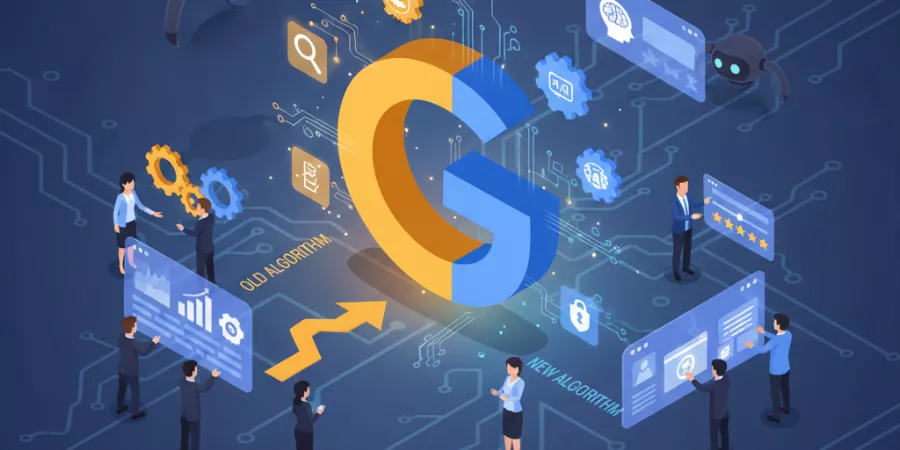
For businesses that depend on organic search traffic, Google algorithm updates are existential events. A single core update can move a website from the first page to obscurity overnight, or elevate a well-optimized site from page three to position one within weeks. As AI reshapes the AI and tech investment trends in 2026 landscape, Google is simultaneously deploying AI in its search infrastructure in ways that are fundamentally changing what it means to rank well and how organic traffic behaves.
The 2026 Google Search Landscape: Key Structural Changes
Google’s search results page in 2026 looks materially different from 2023. AI Overviews (formerly Search Generative Experience) now appear for a significant percentage of commercial and informational queries, answering user questions directly in the results page before the first organic listing. Featured snippets, People Also Ask boxes, and Knowledge Panels have been augmented with AI-generated content that synthesizes information from multiple sources.
The practical consequence for businesses is that zero-click searches, where users get their answer without visiting any website, are increasing. This makes winning AI Overview citations and featured snippet positions more valuable than ever, as these placements often generate clicks even in zero-click search environments because they establish brand authority and drive top-of-funnel awareness.
E-E-A-T: The Quality Signal That Now Drives Rankings
Google’s E-E-A-T framework, encompassing Experience, Expertise, Authoritativeness, and Trustworthiness, has evolved from a quality rater guideline into an algorithmic signal that directly influences rankings. In 2026, Google can assess E-E-A-T signals more algorithmically than before, using natural language processing to evaluate whether content demonstrates genuine expertise rather than surface-level topic coverage.
Experience is the newest and most actionable E-E-A-T dimension. Content that demonstrates first-hand experience, an author who has actually used the product they review, visited the location they describe, or implemented the strategy they recommend, consistently outperforms content written from secondary research alone. Understanding how AI tools transforming digital marketing can assist content production without undermining E-E-A-T requires a clear editorial framework.
Building Authoritative Content in 2026
Topical authority has replaced individual page optimization as the primary organic growth strategy. Websites that comprehensively cover a subject area, with interconnected content that addresses every relevant question a user might have, rank more consistently than sites optimizing individual pages in isolation. This is why internal linking strategies, pillar content architecture, and topic cluster development are the most impactful SEO investments a business can make in 2026.
The Helpful Content System: What Triggers Penalties
Google’s Helpful Content System, introduced in 2022 and significantly strengthened through subsequent updates, targets content created primarily for search engines rather than for human readers. In 2026, this system is more sophisticated and more aggressive. Sites with significant proportions of programmatically generated content, thin pages targeting keyword variants, or articles that cover topics outside genuine domain expertise are experiencing ranking suppression that was not present in earlier algorithm versions.
The most common patterns that trigger Helpful Content penalties include: covering topics purely because they have search volume rather than because they align with genuine business expertise, publishing AI-generated content at scale without substantive human editorial review, and creating multiple pages targeting slight variations of the same keyword without meaningfully differentiating the content.
Core Web Vitals and Page Experience in 2026
Page experience signals, including Largest Contentful Paint, Cumulative Layout Shift, Interaction to Next Paint, and HTTPS security, remain ranking factors in 2026. Google’s field data, collected from Chrome users, now provides more granular segmentation between mobile and desktop performance, with mobile performance weighted more heavily for queries that Google’s data indicates are primarily mobile-intent searches.
Leveraging big data analytics for SEO strategy enables businesses to identify which pages are losing organic traffic due to Core Web Vitals underperformance and prioritize technical optimization investments accordingly. Page experience improvements have a compounding effect: faster pages generate higher engagement rates, lower bounce rates, and more backlinks, all of which reinforce organic ranking improvements.
AI Overviews: How to Get Cited
Being cited in Google’s AI Overviews is the new coveted search position. Pages that earn AI Overview citations typically share common characteristics: they provide direct, well-structured answers to specific questions, use clear factual statements with supporting data, organize content with logical heading hierarchies that AI can parse easily, and demonstrate E-E-A-T signals that Google’s systems assess as authoritative.
Monitoring which queries trigger AI Overviews in your industry using tools like SE Ranking, Semrush, or Ahrefs’ AI Overview tracking feature helps identify content opportunities. Creating content specifically structured to answer the most common questions in your field, using concise definitions, numbered processes, and comparison tables, significantly increases the probability of AI Overview citations.
Local SEO and Google Business Profile Updates
For businesses with physical locations, Google Business Profile remains the most important local SEO asset. In 2026, Google has introduced AI-generated business summaries that appear in local pack results, synthesizing information from the business profile, reviews, and website content. Businesses with comprehensive profiles, recent high-quality reviews, and websites with consistent NAP (Name, Address, Phone) information appear more prominently in these AI-enhanced local results.
Tracking how YouTube analytics tools impacted by Google changes affect video visibility in search results is also relevant for businesses using YouTube as a content channel, as Google increasingly surfaces YouTube content in main search results for how-to and review queries.
Building an Algorithm-Resistant SEO Strategy
The businesses most resilient to Google algorithm changes share a consistent strategic posture: they optimize for users first and search engines second. Their content is genuinely helpful, their expertise is real and demonstrable, their website technical performance is strong, and their authority is earned through genuine industry engagement rather than manipulative link schemes.
This approach does not just protect against algorithm updates; it builds the kind of organic presence that compounds over time regardless of how Google’s systems evolve. In an era where AI is reshaping both search infrastructure and content production, the businesses that will consistently capture organic traffic are those that invest in genuine quality, demonstrable expertise, and exceptional user experience rather than chasing algorithmic shortcuts that each successive update eliminates.