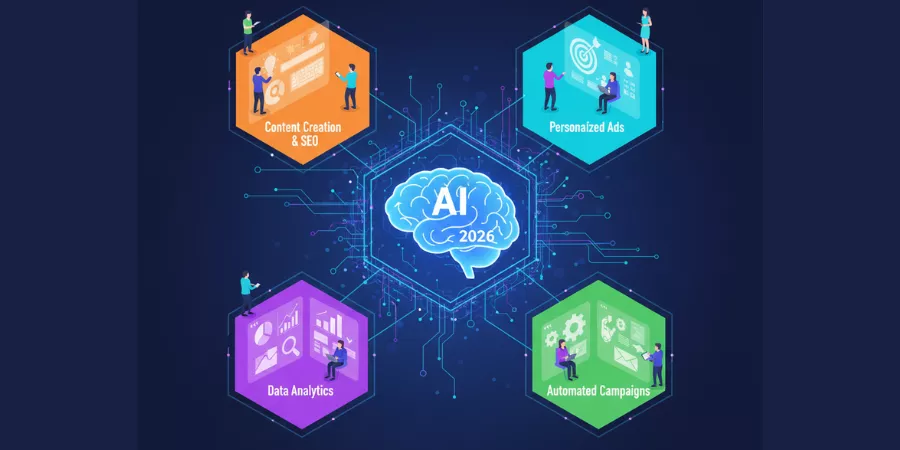
Digital marketing in 2026 has a before and after. Before AI tools became integral to campaign execution, marketing teams spent the majority of their time on production: writing copy, designing creatives, segmenting audiences, and analyzing campaign results manually. After, these same teams are spending their time on strategy and creativity because AI has automated the production layer with a quality and speed that exceeds what most human teams could achieve. As one of the most visible manifestations of broader AI and tech investment trends reshaping 2026, AI in digital marketing is not a future possibility; it is a current competitive requirement.
How AI Has Fundamentally Shifted Marketing Economics
The economics of digital marketing have changed dramatically. Cost per acquisition is declining for AI-optimized campaigns while conversion rates are improving. Meta’s Advantage+ AI system, Google’s Performance Max campaigns, and TikTok’s Smart Campaigns use machine learning to continuously optimize creative rotation, audience targeting, and bid strategies in real time, outperforming manually managed campaigns by 20 to 40 percent on key conversion metrics.
Marketing teams that previously required five to eight people to manage a full-funnel campaign are now running equivalent or larger programs with two to three specialists using AI tools for the production and optimization work. The productivity gain translates directly into competitive advantage: the same budget produces significantly more results when AI handles execution optimization.
AI Content Creation: Quality at Scale
Content marketing remains the foundation of organic digital strategy, and AI has transformed how content is researched, written, and optimized. Tools like Jasper, Writer, and Copy.ai enable marketing teams to produce high-quality blog posts, social media content, email sequences, and ad copy at five to ten times their previous output capacity.
The key insight in 2026 is that AI-generated content, when properly guided by subject matter expertise and reviewed for accuracy, is indistinguishable from human-written content in reader experience. The strategic advantage goes to teams that treat AI as a content engine that they direct and edit, rather than a replacement for editorial judgment.
AI for Video and Visual Content
Video content dominates engagement metrics across every major platform. AI video tools including Runway ML, Synthesia, and Pika Labs enable marketing teams to produce video content at a fraction of traditional production costs. Understanding how AI tools help YouTubers go viral translates directly to brand video strategy: the same AI-powered scripting, thumbnail optimization, and retention analysis that individual creators use applies equally to brand content strategies.
Personalization at Unprecedented Scale
Personalization has always been the goal of digital marketing but the technical barrier to true one-to-one personalization previously made it achievable only for enterprise companies with massive data science teams. AI has demolished that barrier. Tools like Klaviyo’s AI features, Salesforce Einstein, and Dynamic Yield enable mid-market companies to deliver personalized email content, website experiences, and product recommendations to individual users based on behavioral data.
E-commerce companies using AI-powered personalization are reporting conversion rate improvements of 15 to 35 percent and average order value increases of 10 to 25 percent. These are not marginal gains; they represent the difference between profitable growth and margin erosion in competitive markets. Using YouTube analytics tools for marketers alongside website personalization platforms reveals how audiences behave differently across channels and enables more cohesive cross-platform messaging.
AI-Powered Advertising Optimization
Paid advertising efficiency has improved dramatically with AI. Google’s Smart Bidding algorithms, which optimize bids in real time based on the likelihood of conversion for each individual auction, consistently outperform manual bidding strategies for most campaign objectives. Meta’s Advantage+ Creative system tests hundreds of creative combinations automatically, learning which visual and copy elements drive the highest conversion rates for specific audience segments.
Programmatic advertising, where ad inventory is purchased through automated real-time bidding, has reached a level of sophistication where AI systems are making micro-second optimization decisions that improve campaign efficiency continuously. Marketers who understand how to structure campaigns to maximize AI learning, providing sufficient conversion data, appropriate audience signals, and clear optimization objectives, generate dramatically better results than those who constrain AI systems with overly rigid targeting parameters.
Predictive Analytics and Customer Lifecycle Management
AI predictive analytics tools are enabling marketing teams to anticipate customer behavior rather than simply react to it. Churn prediction models identify customers likely to lapse before they do, enabling proactive retention campaigns. Propensity models identify the prospects most likely to convert, allowing sales and marketing resources to concentrate on high-probability opportunities.
Understanding the implications of Google algorithm changes every marketer must understand alongside customer lifecycle AI tools creates a comprehensive marketing intelligence system. Organic search performance and paid acquisition efficiency both feed into lifetime value models that help teams allocate budgets with much greater precision than historical averages allow.
Implementation Strategy for AI Marketing Tools
Successful AI marketing integration follows a consistent pattern: start with one high-impact use case, measure results rigorously over 60 to 90 days, then expand to adjacent applications based on proven ROI. The teams that try to implement AI across their entire marketing stack simultaneously typically struggle with change management and fail to extract maximum value from any single tool.
The highest-impact starting points are typically AI-powered email personalization, because email lists are owned assets where AI improvements directly affect revenue, and AI-assisted content production, because content output quality and volume are immediately measurable. From these foundations, teams can systematically add AI capabilities in paid advertising, SEO, social media, and customer analytics.
The Competitive Consequence of Delayed Adoption
Marketing organizations that delay AI adoption in 2026 are not maintaining the status quo; they are falling behind competitors who are compounding AI advantages month by month. The performance gap between AI-optimized marketing programs and traditional approaches is widening, not narrowing. The time to implement strategic AI marketing capabilities is not after the competitive landscape has shifted further; it is now, while early adopter advantages remain available to organizations willing to invest in learning and implementation.