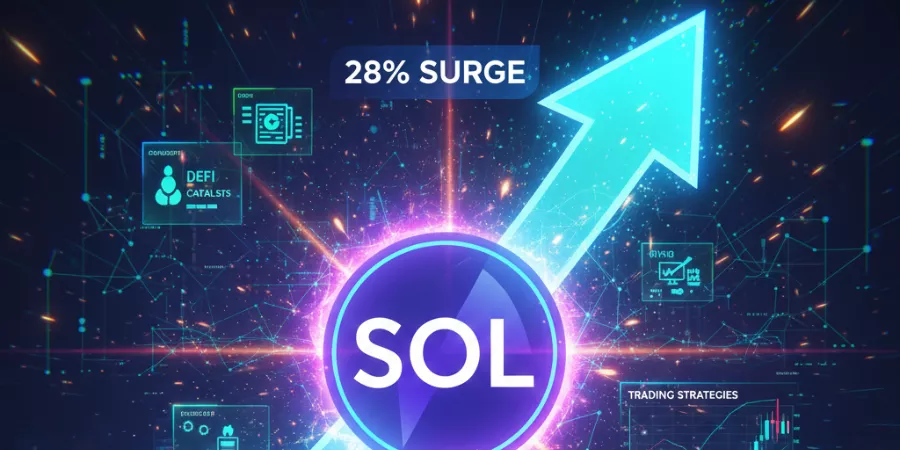
Solana (SOL) has emerged as the standout performer in the latest cryptocurrency market rally, posting impressive 28% weekly gains to reach $185 as of February 10, 2026. The surge leads a broader altcoin rally that has seen Ethereum gain 12% and various DeFi tokens post double-digit returns, even as meme coin mania from January has cooled significantly.
For cryptocurrency traders, DeFi investors, and blockchain technology enthusiasts, understanding the catalysts driving Solana’s outperformance and the strategic implications for portfolio allocation is essential in navigating the volatile altcoin market.
Solana’s Spectacular Weekly Performance
Solana’s 28% weekly gain from $144 to $185 represents one of the strongest performances among major layer-1 blockchain platforms. The rally accelerated sharply between February 7-9, with daily gains exceeding 8% on multiple occasions.
Trading volumes on centralized exchanges including Binance, Coinbase, and Kraken surged to $4.2 billion daily, more than triple Solana’s typical volume levels. This volume surge indicates genuine buying interest rather than low-liquidity volatility.
Price Action Analysis
From a technical perspective, Solana’s rally exhibited several characteristics of sustainable bullish momentum:
Volume Confirmation: Each daily price advance was accompanied by above-average volume, suggesting institutional accumulation rather than retail speculation.
Clean Breakouts: SOL broke through multiple resistance levels with minimal retracement, indicating strong underlying demand at each price level.
Relative Strength: Solana significantly outperformed Bitcoin’s 6% weekly gain and Ethereum’s 12% advance, demonstrating independent positive catalysts beyond general crypto market sentiment.
The SOL/BTC trading pair gained 20% over the week, and the SOL/ETH pair gained 14%, confirming Solana’s outperformance wasn’t merely tracking overall cryptocurrency market moves.
Catalysts Driving Solana’s Surge
Multiple fundamental factors converged to fuel Solana’s impressive rally:
Major DeFi Protocol Launches
The primary catalyst for Solana’s surge was the announcement and launch of several major decentralized finance protocols choosing Solana as their deployment platform.
Jupiter DEX Aggregator Expansion: Jupiter, Solana’s leading decentralized exchange aggregator, announced a major version upgrade with improved liquidity routing and expanded token support. The upgrade increases capital efficiency for traders and reduces slippage on large transactions.
Marinade Finance V2 Launch: Marinade, one of Solana’s largest liquid staking protocols with over $780 million in total value locked (TVL), launched its version 2 platform with enhanced yield strategies and improved validator distribution.
Phoenix Protocol Mainnet: Phoenix, a new order-book based DEX, officially launched on Solana mainnet, bringing traditional finance-style limit orders and advanced order types to Solana’s DeFi ecosystem.
These protocol launches demonstrate Solana’s growing maturity as a DeFi platform and validate the network’s technical capabilities for supporting sophisticated financial applications.
Network Activity Surge
Solana network metrics showed substantial increases coinciding with the price rally:
| Metric | Previous Week | Current Week | Change |
|---|---|---|---|
| Daily Active Addresses | 1.2 million | 2.1 million | +75% |
| Daily Transactions | 45 million | 78 million | +73% |
| NFT Trading Volume | $12 million | $31 million | +158% |
| DeFi Total Value Locked | $2.4 billion | $3.1 billion | +29% |
These on-chain metrics demonstrate real usage growth rather than purely speculative price appreciation. When network activity and price move in tandem, it suggests sustainable fundamental support for valuations.
Institutional Interest Signals
Several institutional developments contributed to positive sentiment around Solana:
Grayscale Solana Trust Inflows: Grayscale’s Solana Trust reported net inflows of $47 million during the week, indicating institutional investors are accumulating SOL exposure through regulated investment vehicles.
Venture Capital Funding: Solana ecosystem projects announced $180 million in venture capital funding across multiple projects, demonstrating continued institutional confidence in the platform’s long-term potential.
Corporate Treasury Allocations: Two publicly-traded companies announced adding Solana to their treasury reserves, following the Bitcoin corporate treasury trend but extending it to alternative layer-1 platforms.
Technical Upgrades and Roadmap
Solana’s technical development roadmap provided additional positive catalysts:
Firedancer Client Progress: Jump Crypto’s Firedancer validator client, designed to dramatically improve Solana network throughput and reliability, announced successful testnet milestones with mainnet deployment expected in Q2 2026.
State Compression Launch: Solana’s state compression technology officially launched, reducing costs for NFT and data storage applications by over 90%. This technical improvement expands Solana’s addressable use cases significantly.
Priority Fee Mechanism: Improvements to Solana’s transaction priority fee system reduced congestion during high-activity periods, addressing one of the network’s historical pain points.
Broader Altcoin Market Performance
While Solana led altcoin gains, the broader cryptocurrency market showed diverse performance:
Ethereum: Steady 12% Gain
Ethereum, the second-largest cryptocurrency and Solana’s primary competitor for DeFi activity, posted solid 12% weekly gains to reach $3,450.
Ethereum’s rally was driven by:
Successful Dencun Upgrade: The Dencun upgrade significantly reduced layer-2 transaction costs through “blob” transactions, making Ethereum scaling solutions more economically viable.
ETF Inflows: Ethereum spot ETFs saw $340 million in net inflows during the week, demonstrating continued institutional accumulation.
DeFi Activity: Ethereum’s DeFi TVL increased from $48 billion to $52 billion, showing healthy ecosystem growth.
Despite solid performance, Ethereum underperformed Solana on a relative basis, with the SOL/ETH ratio climbing to multi-month highs around 0.0536.
Layer-1 Alternatives: Mixed Results
Other alternative layer-1 blockchain platforms showed varied performance:
| Platform | Weekly Gain/Loss | Price | Notable Developments |
|---|---|---|---|
| Cardano (ADA) | +8% | $0.68 | Hydra scaling testnet launch |
| Avalanche (AVAX) | +6% | $42 | Institutional subnet announcements |
| Polkadot (DOT) | +4% | $8.90 | Parachain auction results |
| Algorand (ALGO) | +11% | $0.31 | FIFA partnership expansion |
| Near Protocol (NEAR) | +9% | $6.40 | Chain signatures feature launch |
While most layer-1 platforms posted positive returns, none matched Solana’s 28% surge, indicating Solana-specific catalysts rather than broad category rotation.
DeFi Tokens: Selective Strength
Decentralized finance governance tokens showed varied performance based on platform-specific developments:
Uniswap (UNI): +15% on Uniswap v4 development progress and fee switch governance discussions
Aave (AAVE): +18% following GHO stablecoin expansion and new market launches
Maker (MKR): +7% as DAI stablecoin market cap crossed $5.5 billion
Compound (COMP): +5% with steady protocol growth
Curve (CRV): +9% following resolution of previous governance concerns
Meme Coins: Cooling Off Period
In contrast to January 2026’s meme coin frenzy, dog and cat themed tokens experienced significant cooling:
Dogecoin (DOGE): -2% as speculative interest waned
Shiba Inu (SHIB): -4% following extraordinary January gains
Pepe (PEPE): -8% as profit-taking accelerated
Bonk (BONK): -12% despite Solana’s strong performance
This divergence between fundamental DeFi-driven rallies and meme coin corrections suggests market maturation and rotation toward projects with real utility and revenue generation.
Solana vs. Ethereum: The Competition Intensifies
Solana’s outperformance has reignited debate about layer-1 blockchain competition and market share dynamics:
Transaction Speed and Cost Comparison
Solana maintains significant advantages in transaction throughput and costs:
| Metric | Solana | Ethereum (Layer-1) | Ethereum (Layer-2) |
|---|---|---|---|
| Transaction Speed | 65,000 TPS theoretical / 3,000 TPS actual | 15-30 TPS | 2,000-4,000 TPS |
| Average Transaction Cost | $0.00025 | $2-8 | $0.01-0.50 |
| Block Time | 400ms | 12 seconds | 2-4 seconds |
| Finality Time | ~13 seconds | ~15 minutes | Variable |
These technical advantages make Solana particularly attractive for high-frequency applications like DEX trading, NFT minting, and gaming where low latency and minimal costs are essential.
Developer Activity and Ecosystem
Ethereum retains advantages in developer mindshare and ecosystem maturity:
Developer Count: Ethereum maintains approximately 4,000 monthly active developers compared to Solana’s 2,500, though Solana’s developer base is growing faster.
Protocol Maturity: Ethereum’s DeFi protocols have longer track records and have processed significantly more transaction volume, providing confidence in battle-tested smart contracts.
Liquidity Depth: Ethereum’s DEX liquidity pools are typically 3-5x deeper than equivalent Solana pools, resulting in better execution for large trades.
Institutional Comfort: Traditional finance institutions generally show greater familiarity with Ethereum, making it easier to secure partnerships and institutional capital.
Network Reliability Considerations
Historical network stability remains a differentiating factor:
Solana’s Challenges: Solana experienced multiple network outages in 2022-2023, though network reliability has improved dramatically since early 2024. Zero major outages have occurred in the past 12 months.
Ethereum’s Track Record: Ethereum mainnet has maintained continuous operation since 2015 with no network-wide outages, providing confidence for mission-critical applications.
Recent improvements to Solana’s validator software and upcoming Firedancer implementation are addressing historical reliability concerns, potentially neutralizing this Ethereum advantage.
Trading Strategies for Altcoin Volatility
Solana’s 28% weekly surge exemplifies the extreme volatility characteristic of altcoin markets. Traders can employ several strategies to capitalize on or protect against this volatility:
Momentum Trading Approach
For traders comfortable with high risk, momentum strategies can capture explosive altcoin rallies:
Entry Signals:
- Breakout above previous resistance with high volume
- Relative strength vs. Bitcoin exceeding 1.5x over 3-7 days
- On-chain metrics showing accelerating network activity
- Positive fundamental catalysts announced
Position Management:
- Initial position size: 2-5% of portfolio
- Trailing stop loss: 12-15% below entry
- Partial profit taking: 30% of position at +30% gain, 30% at +60% gain
- Hold remaining 40% with trailing stop
Exit Signals:
- Momentum divergence (price rising but volume declining)
- Relative strength vs. Bitcoin falling below 1.0x
- Negative fundamental developments
- Technical resistance rejection with high volume
Options Strategies for Volatility
Sophisticated traders can use cryptocurrency options to manage risk during volatile altcoin rallies:
Protective Puts for Long Positions
If holding Solana from lower levels, purchase out-of-the-money puts to protect against sudden corrections:
Example Structure:
- Long 100 SOL at $145 average cost (current price $185)
- Buy 100 SOL $165 puts expiring in 30 days
- Put premium cost: approximately $8 per SOL ($800 total)
- Breakeven protection at $157 (current price minus put premium)
This structure locks in minimum profit while maintaining upside participation if the rally continues.
Covered Call Writing
Generate income from SOL holdings during consolidation periods:
Example Structure:
- Long 100 SOL at current price $185
- Sell 100 SOL $210 calls expiring in 14 days
- Call premium collected: approximately $6 per SOL ($600 total)
- Willing to sell at $210 (13.5% above current) plus keep $600 premium
This strategy works best when expecting sideways to moderately bullish price action rather than explosive continued gains.
Straddle Strategy for Uncertain Direction
If expecting significant volatility but uncertain about direction:
Example Structure:
- Buy $185 call expiring in 30 days (cost ~$15)
- Buy $185 put expiring in 30 days (cost ~$12)
- Total cost: $27 per SOL
- Profitable if SOL moves beyond $158 or $212 (current ± premium)
This strategy profits from extreme moves in either direction, making it suitable for anticipated high-volatility events like major protocol launches or network upgrades.
Portfolio Allocation Considerations
Solana’s strong performance raises questions about appropriate portfolio allocation to altcoins:
Risk-Based Allocation Framework
Conservative cryptocurrency portfolios:
- Bitcoin: 60-70%
- Ethereum: 20-25%
- Altcoins (including Solana): 10-15%
- Cash/Stablecoins: 5%
Moderate cryptocurrency portfolios:
- Bitcoin: 40-50%
- Ethereum: 25-30%
- Altcoins (including Solana): 20-25%
- Cash/Stablecoins: 5-10%
Aggressive cryptocurrency portfolios:
- Bitcoin: 25-35%
- Ethereum: 20-25%
- Altcoins (including Solana): 35-45%
- Cash/Stablecoins: 5-10%
Within altcoin allocations, diversification across multiple layer-1 platforms, DeFi protocols, and infrastructure projects reduces platform-specific risks.
Rebalancing Discipline
Solana’s 28% weekly surge likely pushed portfolios overweight in SOL relative to target allocations. Disciplined rebalancing prevents excessive concentration risk:
Rebalancing Trigger: When any single asset exceeds target allocation by more than 5 percentage points, trim position back to target and redeploy proceeds into underweight positions.
Example: If Solana target allocation is 8% of portfolio but now represents 13% after the rally, sell 5 percentage points worth and redistribute to Bitcoin, Ethereum, or other underweight positions.
This mechanical approach enforces “buy low, sell high” discipline by systematically taking profits from outperformers and adding to underperformers.
DeFi Opportunities on Solana
Beyond simply holding SOL tokens, Solana’s DeFi ecosystem offers multiple yield and investment opportunities:
Liquid Staking Protocols
Stake SOL while maintaining liquidity through liquid staking tokens:
Marinade Finance: Deposit SOL, receive mSOL (Marinade SOL) liquid staking token earning 6-7% APY while mSOL can be used in other DeFi protocols.
Lido on Solana: Similar structure with stSOL liquid staking token, offering 5.5-6.5% APY with deep liquidity on major DEXs.
Jito: Stake with MEV (maximal extractable value) rewards included, earning 7-8% APY through combination of staking and validator MEV capture.
Liquid staking allows earning staking rewards while maintaining ability to trade or use tokens in DeFi applications, superior to traditional locked staking.
Decentralized Exchange Trading
Trade tokens efficiently on Solana DEXs:
Jupiter: Aggregates liquidity across all Solana DEXs, automatically routing trades for best execution and lowest slippage.
Orca: Concentrated liquidity DEX with intuitive interface, suitable for both simple swaps and advanced liquidity provision.
Raydium: Integrated with Serum order books, offering both automated market maker (AMM) and order-book trading styles.
Yield Farming Opportunities
Provide liquidity to earn trading fees and incentive rewards:
SOL-USDC Pools: Relatively stable pairs earning 15-25% APY through trading fees and protocol incentives on platforms like Orca and Raydium.
Stablecoin Pools: USDC-USDT pairs earning 8-12% APY with minimal impermanent loss risk.
Blue-Chip Token Pools: SOL-ETH, SOL-BTC wrapped asset pairs earning 20-35% APY with higher impermanent loss risk but exposure to multiple quality assets.
Warning: Yield farming carries smart contract risk, impermanent loss risk, and protocol-specific risks. Never commit more than 10-20% of crypto portfolio to experimental DeFi protocols.
Regulatory Considerations for Indian Investors
Indian cryptocurrency investors must navigate specific regulatory and tax considerations when trading altcoins like Solana:
Tax Treatment
30% Flat Tax Rate: All cryptocurrency gains, including Solana profits, are taxed at 30% with no deductions for expenses or losses from other trades.
1% TDS on Transactions: Tax Deducted at Source applies to trades exceeding ₹10,000 annually in value, affecting liquidity and trading strategies.
No Loss Set-Off: Cryptocurrency losses cannot offset other cryptocurrency gains or other income categories, creating tax inefficiency for active traders.
Reporting Requirements: All cryptocurrency holdings and transactions must be reported in income tax returns, with penalties for non-compliance.
Strategic Tax Considerations
Hold Period Irrelevant: Unlike equity investments where 12+ month holding periods reduce tax rates, cryptocurrency is always taxed at 30% regardless of holding period. This eliminates any tax advantage for long-term holding vs. active trading.
Transaction Efficiency: Since 1% TDS applies to transaction values, frequent trading incurs ongoing TDS deductions. Ensure trades generate sufficient profit to justify TDS and transaction costs.
Year-End Planning: Unlike equities where loss harvesting creates tax benefits, cryptocurrency losses provide no tax advantage. Focus on maximizing profitable trades rather than realizing losses for tax purposes.
Technical Analysis: Key Levels for SOL
From a technical trading perspective, several key price levels merit monitoring:
Resistance Levels
$190-195 Zone: Previous resistance from January 2025 where significant selling occurred. Breaking above this zone convincingly would signal continuation of bullish trend.
$210-215 Zone: Major resistance representing all-time high area from late 2024. Significant psychological level where profit-taking pressure will intensify.
$250 Level: Psychological round number and extension target if current rally extends, representing approximately 35% gain from current levels.
Support Levels
$175-180 Zone: Recent breakout level that should now function as support. Holding above this zone on any pullback would indicate healthy consolidation.
$160-165 Zone: Previous resistance that should provide strong support on deeper corrections, representing approximately 12% below current price.
$145-150 Zone: Major support representing the launch point of the current rally. Breaking below this level would indicate the bullish trend has failed.
Risk Factors and Challenges
Despite strong performance, several risks could derail Solana’s rally:
Technical Vulnerabilities
While network stability has improved, any significant outage or technical failure would severely damage confidence and likely trigger sharp price corrections.
Competitive Pressure
Ethereum’s layer-2 ecosystem continues advancing with solutions like Arbitrum, Optimism, and Base offering improved scalability at lower costs, potentially reducing Solana’s competitive advantages.
Regulatory Uncertainty
The SEC has previously indicated Solana may be classified as a security under U.S. law. Adverse regulatory developments could impact U.S. exchange listings and institutional adoption.
Market Correlation
During broader cryptocurrency market corrections, altcoins typically fall harder than Bitcoin. A significant Bitcoin correction would likely result in Solana declining more than 1.5-2x Bitcoin’s percentage drop.
Key Takeaways for Cryptocurrency Investors
Solana’s impressive 28% weekly rally demonstrates the explosive potential and extreme volatility of altcoin investments:
Fundamental Drivers Matter: Solana’s outperformance was driven by genuine protocol development, increasing network usage, and expanding DeFi ecosystem, not just speculation.
Volatility Management Essential: Use appropriate position sizing, stop losses, and options strategies to manage the extreme volatility inherent in altcoin trading.
Diversification Reduces Risk: Avoid over-concentration in any single altcoin. Maintain balanced allocations across Bitcoin, Ethereum, and selected altcoins.
Monitor On-Chain Metrics: Network activity, DeFi TVL, and developer activity provide leading indicators of sustainable value vs. temporary speculation.
Tax Planning Critical: For Indian investors, 30% flat tax rate and 1% TDS significantly impact after-tax returns. Factor these costs into trading strategies.
Stay Informed: Altcoin markets move rapidly on technical developments, partnership announcements, and ecosystem growth. Follow credible sources including Global Publicist 24 for ongoing analysis.
Solana’s rally exemplifies how layer-1 blockchain platforms with strong technical foundations and growing ecosystems can generate exceptional returns, while also demonstrating the volatility and risk management requirements essential for altcoin trading success.