The way businesses provide customer support and conduct voice call operations and create contextual support solutions has been transformed by artificial intelligence-powered conversational agents. The voice-first conversational AI system from Poly AI established a new standard because it enables customers to interact with its system through humanlike voice-based dialogues that handle customer service inquiries and appointment scheduling and self-service tasks.
Poly AI has demonstrated successful results yet certain teams do not consider it as their ideal solution. Some organizations require basic software that enables them to create bots without needing programming skills. The other customers seek voice AI solutions designed for small businesses with clear pricing models.
The third group requires solutions that combine chatbot automation with voice-first AI systems and customer service platform connections. The year 2026 brings a critical opportunity to investigate suitable budget-friendly alternatives of Poly AI which offer solutions that meet current and future needs.
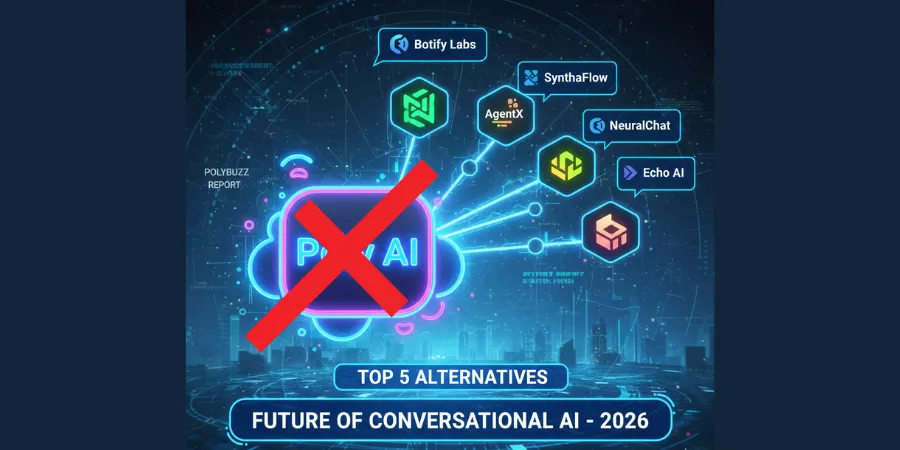
This article evaluates the 5 most important Alternatives to Poly AI which will be most relevant in 2026 because it examines powerful AI-based dialogue systems that you can use to replace or work with Poly AI.
What is Poly AI?
Poly AI (also known as PolyBuzz) is a British technology company and conversational artificial intelligence platform that builds advanced voice and chatbot assistants for businesses. It was founded in 2017 by researchers from the University of Cambridge and has become known for creating natural, human-like AI voices that handle real customer conversations over phone and digital channels.
Poly AI core functions use conversational AI technology which combines natural language processing (NLP) and speech recognition and machine learning technologies to process user spoken and written language while determining their intent and providing human-like responses. Poly AI voice agents demonstrate advanced capabilities because they can accurately handle unexpected interruptions and sudden topic changes and natural human language dialogue patterns, unlike traditional IVR systems, which depend on users to choose from predefined menu options and follow predefined responses.
Businesses use Poly AI voice assistants to handle customer support calls and create reservations and bookings and perform account lookups and handle billing and payments inquiries and manage appointment scheduling and other tasks. The agents provide 24/7 service which decreases waiting periods while allowing human employees to concentrate on demanding customer service tasks.
The multiple sectors which Poly AI serves include banking and hospitality and insurance and retail and telecommunications. The system provides personalized caller support through its ability to work with enterprise systems that include CRM platforms. The conversational AI platform of Poly AI enables businesses to automate customer interactions through voice assistants which simulate human speech and understand natural language, resulting in more effective customer support while reducing business expenses.
1. Voiceflow = Best No-Code Conversational AI
If you are thinking about something that frees you from heavy technical overhead, Voiceflow delivers a compelling answer.
Voiceflow enables companies to create, evaluate, and implement voice and text-based conversational automation through its no-code AI agent building platform. The system enables users to interact with AI through multiple channels which include web chat and phone bots and messaging platforms and smart speakers. Voiceflow’s visual editor allows users to transform their concepts into actual dialogues without needing an engineering team.
Why it stands out as a Poly AI alternative:
- The system enables users to design AI conversations through its interface without needing any programming knowledge.
- The platform enables teams to manage their entire process from bot development through deployment.
- The system provides combined voice and chat capabilities through a single platform.
- The system offers straightforward pricing which developers can compare to tailored enterprise pricing.
Features
- Visual, no-code conversational AI builder for voice and chat.
- Multi-channel support: web chatbot, phone voice bot, messaging.
- Knowledge base integration and templates.
- Collaboration tools for co-development.
Advantages
- Extremely user-friendly drag-and-drop interface.
- Free starter plan for early testing.
- Works for small businesses and large teams alike.
Disadvantages
- Less powerful NLP than deep enterprise engines like Kore.AI.
- Not ideal for highly complex, context-driven enterprise voice bots.
- Voice quality tied to underlying TTS models you choose.
Voiceflow works for companies of all sizes and shines when your focus is on rapid conversational automation development.
2. Kore.ai = Best Enterprise Conversational Suite
Enterprises that require advanced conversational AI platforms which provide governance features and scaling capabilities will discover that Kore.ai serves as an essential solution. The platform Kore.ai functions as a multipurpose conversational AI solution which businesses use for their customer service needs and internal support requirements and their automated contact center operations and cross-platform virtual assistant service.
The system provides advanced development tools which enable users to build natural language understanding capabilities and design dialogue systems and perform analytical work and ensure adherence to business regulations.
What makes Kore.ai a strong alternative to Poly AI:
- ai provides advanced natural language processing capabilities together with dedicated intent management systems which enable organizations to handle their most challenging operational requirements.
- The system provides support for multiple communication channels which include voice interactive systems and chatbot systems and email communication and social media platforms.
- The system includes governance capabilities which enable large enterprises to maintain regulatory compliance requirements.
- The system supports different deployment options which include cloud and private cloud and on-premise installation.
Features
- Enterprise conversational AI platform for voice, chat, and self-service.
- Advanced NLP and intent recognition.
- Drag-and-drop flow builder plus pro-code options.
- Templates and connectors for enterprise systems.
Advantages
- Strong omnichannel support across voice, chat, and digital.
- Extensive integration options with CRM and contact center systems.
- Enterprise governance, analytics, and compliance.
- Rated highly for support and setup ease by users.
Disadvantages
- Steep learning curve for non-technical users.
- Pricing is custom and generally expensive.
- Implementation can be slower for simple use cases.
Kore.ai is not the lightest tool on the list, but it is ideal for global enterprises needing a unified conversational AI solution that goes well beyond just voice.
3. Replicant AI = Best for Automated Voice Customer Support
For teams seeking AI voice automation specifically tailored to customer service calls, Replicant AI is a standout alternative.
Replicant automates common customer support requests which customers make through phone calls to assist human teams in managing more complex customer interactions. The system employs sophisticated machine learning technology to expand its operational capacity while handling multiple incoming requests simultaneously.
Why Replicant AI is worth considering:
- Reasons to evaluate Replicant AI include its ability to expand call center automation capabilities through its management of incoming calls without requiring human operators.
- The system provides workflows that agents can use to direct their work processes while maintaining their current operational structure.
- The customization workshops enable you to adapt the agent functionality according to your unique business requirements.
Features
- Conversational AI focused on Tier 1 customer service automation.
- Contextual understanding of multi-intent voice interactions.
- Self-service automation for calls, SMS, and chat.
- Integrations with CRM and support systems.
Advantages
- Designed for high-volume customer service teams.
- AI learns from human conversations, improves over time.
- Positive CSAT impacts reported by enterprise customers.
Disadvantages
- Setup and installation can be technically complex.
- Less frequent updates compared to some competitors.
- Pricing not transparent; perceived as expensive.
Replicant is often the go-to choice when the goal is voice AI automation rather than broad conversational experiences across chat, email, or social.
4. Smallest AI = Best High-Value Voice AI for SMBs
Speed to value and cost-effective voice automation establish Smallest AI as the most suitable solution for smaller teams and growing businesses. The company provides voice conversational agents which can manage incoming calls and assist with call routing while enabling human escalation. The company offers affordable solutions through its straightforward pricing systems which enable customers to use multiple languages in their voice support systems.
Key reasons Smallest AI is a rising Poly AI alternative:
- Lower starting pricing per minute than traditional enterprise voice bots.
- Supports different languages and accents.
- Ideal for businesses with call automation needs that do not justify high enterprise fees.
Features
- Modular voice AI with low latency and real-time interaction.
- Custom phone number provisioning and list management.
- Integrations with CRM and support platforms.
- Supports real-time interruption and contextual handling.
Advantages
- Flexible pay-as-you-grow pricing.
- Transparent costs with no hidden fees.
- Designed for small, medium, and growing businesses.
Disadvantages
- May lack some enterprise-level governance tools.
- Less established in comparison to enterprise vendors.
- Feature set can feel basic compared with Kore.AI or Replicant.
Pricing
- Starter $99/month, Pro $299/month, Enterprise custom.
- Compliance including HIPAA, GDPR, PCI DSS available.
Smallest AI’s strength lies in balancing accessible pricing with real voice automation.
5. Retell AI = Best for Real-Time Voice Experience
Retell AI is designed for real-time, context-aware voice conversations and positions itself as a fast-deploy alternative to voice AI solutions like Poly AI.
Retell focuses on building customizable AI voice agents with transparent pricing that lets teams roll out phone-based conversational automation rapidly. It is built with a voice-first architecture that aims to deliver humanlike turn-taking and sub-second response times.
What sets Retell AI apart:
- Voice-first design for phone and telephony bots.
- Simple pay-as-you-go pricing models.
- Faster agent iteration with quick testing and deployment capabilities.
Features
- LLM-powered voice agent automation with WebSocket streams.
- 24/7 voice call automation and routing with intent detection.
- CRM integration and context preservation on handoffs.
- Analytics and performance dashboards.
Advantages
- Realistic and low-latency voice conversations (~600 ms).
- Pay-as-you-go model with transparent per-minute pricing.
- Free tier with demo credits.
- Enterprise-grade compliance options.
Disadvantages
- Requires technical skill for setup and API work.
- Cost adds up with telephony, LLM, and voice model fees.
- Not as intuitive for non-technical users.
Pricing
- Pay-as-you-go: ~$0.07+/min for voice, ~$0.002+/msg for chat.
- Includes $10 in free credits and free concurrent calls on trial.
- Enterprise options offer scaling and managed services.
Retell works well for development teams that value speed and flexibility when building voice AI solutions.
Side-by-Side Summary
| Platform | Best For | Pricing Type | Ease of Use | Enterprise Support |
| Voiceflow | No-code conversational bots | Tiered plans | Easiest | Moderate |
| Kore.AI | Omni-channel enterprise | Custom high | Harder | Excellent |
| Replicant AI | High-volume CS automation | Custom | Moderate | Strong |
| Smallest AI | Scalable voice automation | Tiered | Moderate | Basic to Moderate |
| Retell AI | Pay-per-minute voice AI | Usage-based | Tech-leaning | Strong |
Choosing the Right Poly AI Alternative
Having options is one thing. Knowing which one fits your situation best is something else. The smart approach is to match your business goals with the strengths of each platform.
- If you want rapid conversational bot creation without engineers, Voiceflow is the best starting point.
- If your organization needs enterprise-grade governance, analytics, and multi-channel AI, ai leads the pack.
- If your priority is phone-focused customer service automation, Replicant AI and Retell AI are worth trialing.
- For businesses that need affordable voice automation with scalable capabilities, Smallest AI fits that niche.
The world of conversational AI alternatives in 2026 is vibrant and competitive. Poly AI is strong at delivering sophisticated voice solutions, but these Alternatives to Poly AI offer a range of choices based on pricing structure, deployment flexibility, and the level of technical skill required to build and maintain AI agents.
What to Look for in a Conversational AI Platform
When evaluating alternatives to Poly AI, be clear about metrics that matter:
Humanlike Interaction
A platform must be able to understand and respond naturally to context and intent rather than giving scripted responses. Natural language processing (NLP), sentiment analysis, and voice customization matter here.
Integration Flexibility
Your choice should integrate with your CRM, customer support tools, contact center platform, and telephony systems easily. The best platforms offer connectors and APIs that minimize manual overhead.
Scalability
Look for bots that scale gracefully. Whether you have ten calls per day or ten thousand, your AI customer support platform must adapt without breaking workflows or ballooning costs.
Transparent Pricing
Transparent pricing is no longer optional. Hidden costs create unpredictable bills. Tools like Smallest AI and Voiceflow are setting expectations with clear, usage-based models, which are easier to forecast.
Customization
From simple FAQs to complex multi-turn service dialogues, your AI should let you tweak conversations, responses, and routing logic without deep technical dependencies.
Conclusion
Business leaders and product teams today cannot ignore the impact of conversational AI on customer engagement, operational efficiency, and automation. Poly AI changed the game by offering humanlike voice assistants. Still, the best alternatives to Poly AI in 2026 will be those that let you tailor conversational AI to how your customers speak and how your operations run.
This year’s top five Alternatives to Poly AI offer robust solutions whether you are a startup planning your first AI agent, a medium-sized business automating calls, or a global enterprise managing multichannel support. The right fit depends on your priorities, but you now have choices that are both powerful and adaptable.
Pick the platform that aligns with your business model, and start building AI conversations that feel natural, reduce friction, and elevate your customer experience.
You are not just replacing automation. You are choosing how people feel heard when they interact with your brand.