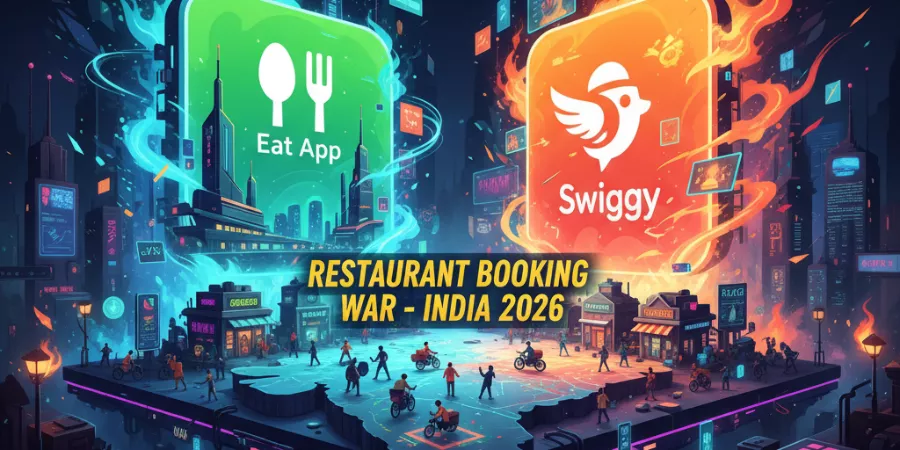
India’s dining culture has evolved fast. From weekend brunch lines to fully booked date-night spots, people want one thing before they step out: certainty. That certainty comes from a restaurant reservation app that actually works.
That is exactly where Eat App is placing its bet.
Dubai-based Eat App has officially stepped deeper into the Indian market with two major moves: an acquisition of ReserveGo and a partnership with Swiggy. Together, these moves signal something bigger than a simple expansion. They point to a shift in how restaurants will manage reservations, customer data, and table demand in the coming years.
Why India’s Restaurant Reservation Market Is Heating Up
Dining out in India has always been a mix of walk-ins, phone calls, and personal contacts. Yet consumer behavior is changing. Guests want speed, confirmation, and convenience. Restaurants want fewer empty tables and better predictability.
India’s food service industry is expected to cross $85 billion by 2028, with dine-in contributing over half of the value.
That scale creates pressure on restaurants. Managing a full restaurant takes more than good food. It takes control over bookings across multiple platforms.
This is where restaurant reservation software becomes essential.
The Real Challenge: Reservations Are Coming From Everywhere
Indian restaurants do not depend on just one channel for bookings anymore. Reservations flow in from:
- Swiggy
- Zomato
- EazyDiner
- Direct walk-ins
- Phone calls and WhatsApp bookings
The result is chaos behind the scenes.
A modern restaurant wants one dashboard that brings everything into a single flow. That means the need for restaurant booking software that can organize, sync, and help teams act fast when tables change.
This is why Eat App’s focus on reservation aggregation stands out.
Eat App’s Big Move: ReserveGo Acquisition
To speed up their growth, Eat App made the strategic decision to buy out ReserveGo, a company focused on the Indian market and founded in 2022 by Vijayan Parthasarathy.
ReserveGo had already established a strong position in the area of restaurant bookings. Parthasarathy said that the platform had an average of 5 million reservations per month for the last year with no downtime at all.
Such performance is important in India, where peak dining hours are short and the customers can easily be lost due to delays.
Through this acquisition, Eat App gets more than just a customer base. It receives a deep understanding of the local market, a strong operational capacity, and a product that is already well adapted to the Indian reservation patterns.
Swiggy Partnership: The Growth Engine Eat App Needed
What makes this announcement so strong is that Eat App is actually not going to India by itself.
It has made a collaboration with Swiggy to not only market its solution to restaurants but also to increase the adoption through upselling.
The tie-up has already assisted Eat App in India to go past 2,000 restaurants with more than 8 million covers expected to be served by the end of the year through different platforms.
Swiggy’s Dineout channel alone is said to have catered to 23.8 million covers in 2025, which indicates the enormity of the potential market.
This is not just a partnership announcement for restaurants; it’s a new trend of restaurant growth tools where reservations, promotions, and guest insights are merged.
Introducing GroMax: Reservation Management Plus Growth
Eat App and Swiggy are marketing this combined solution in India as GroMax.
GroMax includes reservation management plus add-ons like restaurant promotions on Meta and Swiggy.
This matters because many restaurant owners do not want yet another tool that just tracks bookings. They want a system that increases business outcomes. A growth-driven restaurant reservation system becomes far easier to justify when it also helps restaurants attract guests and build loyalty.
Swiggy is staying away from building the product directly, yet its sales teams are sharing inputs on what features restaurants want in the Indian market.
That combination of global product capability plus local market feedback is what creates momentum.
Funding Fuel: Eat App Raises $10 Million Series B Extension
Expansion at this scale needs capital, and Eat App raised a $10 million Series B extension led by PSG Equity through its portfolio company Zenchef SAS.
This extension is even larger than Eat App’s original $6 million Series B round from 2022.
With this, Eat App has raised over $23 million in total funding to date.
Funding matters here because India is competitive. Winning depends on speed, distribution, partnerships, and product depth.
Why Restaurants Actually Need Reservation Aggregation
Many people think restaurant reservations are simple: book a table, show up, eat, leave.
Restaurant teams know the real story.
Reservation management includes:
- Table mapping and seating control
- Capacity planning during peak hours
- Guest preferences and repeat customer notes
- Reducing no-shows
- Handling large groups
- Managing walk-ins alongside pre-bookings
Without a solid online reservation system for restaurants, teams lose time in coordination and guests face avoidable delays.
If Eat App can offer a clean way to connect Swiggy-led demand with reservation control, restaurants get a clear advantage.
India Focus: From Global Presence to Local Scale
Eat App has operated for over a decade and built presence in over 92 countries, serving more than 5,000 restaurants globally.
Yet in the last 12 months, India became a central focus, helping Eat App scale to over 2,000 restaurants in the country.
Previously, UAE was its biggest market, followed by the US, UK, and Saudi Arabia.
Eat App CEO Nezar Kadhem compared India’s current growth stage to what Dubai saw years ago, where infrastructure tools helped restaurants professionalize operations and scale smoothly.
That makes sense. India is filled with ambitious restaurants that want operational consistency, guest delight, and revenue control.
Who Eat App Is Up Against in India
This is a high-potential market, yet competition is intense.
TechCrunch reported multiple competitors, including global players like SevenRooms, TableCheck, and OpenTable, along with local brands like Petpooja and Posist.
On top of that, many restaurants still depend on walk-ins or do reservations through informal channels.
This creates a split market:
- Premium restaurants that live on bookings
- High-volume outlets that rely on walk-ins and quick table turnover
Parthasarathy pointed out that the top 200 restaurants in India depend heavily on reservations, while the next few thousand focus more on capacity management across channels.
That is a major product design challenge.
What Needs to Happen for Eat App to Win
Reservation aggregation alone will not convince every restaurant. Industry executives told TechCrunch that standalone reservation aggregation will struggle to attract restaurant owners.
So what will work?
Eat App will need to prove measurable value through:
- Better table utilization
- Higher covers served per day
- Stronger guest retention
- Smarter promotional targeting
- Clear insights from reservation data
If GroMax delivers growth outcomes along with operational control, Eat App becomes more than a tool. It becomes a growth layer for dine-in brands.
Restaurants love systems that reduce stress and raise revenue in the same breath.
The Bigger Picture
India’s restaurant market is moving toward a more structured, data-driven model. Diners want convenience. Restaurants want visibility. Platforms want engagement.
Eat App’s India entry, powered by ReserveGo’s scale and Swiggy’s reach, feels like a strategic attempt to build the default reservation infrastructure for modern Indian dining.
For diners, it could mean smoother bookings and fewer disappointing full-house surprises.
For restaurants, it could mean control over demand, stronger guest experience, and a smarter way to grow.
And for India’s dining economy, it signals something exciting: reservations are shifting from a side-feature to a core business engine.
If Eat App executes well, India could become its defining growth story.