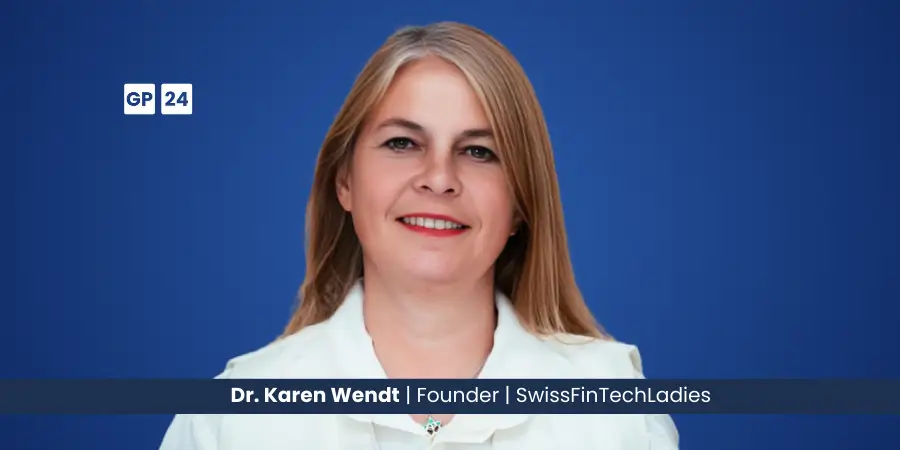
In the gleaming corridors of global finance, where trillion-dollar decisions determine the fate of nations, one woman is quietly orchestrating a revolution. Dr. Karen Wendt, Founder of SwissFinTechLadies, stands at the vanguard of a movement that will fundamentally reshape who controls capital, how wealth is allocated, and what kind of future our financial systems will build.
Her journey from a young woman told she couldn’t do mathematics to a globally recognized leader in impact investing and women’s financial empowerment is not merely an inspirational personal story it’s a blueprint for systemic transformation. With decades of experience in project finance, infrastructure investment, and mergers and acquisitions, Dr. Wendt has operated at the highest levels of global finance, witnessing firsthand how capital decisions shape societies for generations.
What distinguishes Dr. Wendt in an industry dominated by profit maximization is her revolutionary insight: impact is not separate from financial reality it is delayed financial reality. This deceptively simple principle challenges the fundamental assumptions of modern capitalism and offers a path toward finance that serves both prosperity and purpose.
Going Where She Was Told She Didn’t Belong
Every revolutionary journey begins with an act of defiance. For Karen Wendt, that defiance was born in a family that held a seemingly benign but deeply limiting belief: women could not do mathematics and therefore could not work in finance. This wasn’t hostility; it was simply accepted truth, the kind of assumption that shapes destinies without ever being questioned.
Precisely because of that assumption, young Karen made a decision that would define her trajectory. She would enter not just finance, but the most technical, analytical, and male-dominated areas: project finance, infrastructure investment, and mergers and acquisitions. These weren’t mere career choices; they were deliberate acts of challenging systems that had predetermined her limitations.
The environments she chose were unforgiving. In project finance, numbers don’t lie, and decisions are irreversible. Infrastructure investments play out over decades. M&A requires analytical precision where billions hang on accurate valuation. These were arenas where competence couldn’t be hidden either you understood the mathematics or you failed.
From those early choices, Karen learned two fundamental lessons that became the bedrock of her philosophy: first, where you are fearful, there is the way growth exists precisely where conventional wisdom tells you not to go. Second, complex systems whether companies, capital networks, or societies cannot be reduced to a single metric. The obsession with singular measurements was itself a form of blindness preventing true understanding of value and risk.
The Revelation: Pricing the Invisible
During her distinguished career, Dr. Wendt observed a pattern that would fundamentally alter her understanding of finance. Time and again, companies and assets were valued based on earnings, contracts, and balance sheets elegant models that appeared to capture everything relevant to investment decisions.
But something was always missing. Consequences for people, ecosystems, and future generations were invisible in valuation models. They were dismissed as “externalities” a convenient term meaning “not our problem.” Until, inevitably, they exploded.
Environmental liabilities materialized during ownership transitions. Social consequences created reputational damage that destroyed brand value. Governance failures erupted in regulatory penalties. And always, the impact surfaced at the worst moment during exits, when reality could no longer be hidden.
“Impact is priced only once at the moment of exit,” Dr. Wendt realized. “Risks can remain hidden for years. But when ownership changes, reality surfaces, and it suddenly affects valuation.”
This wasn’t a moral observation; it was a financial one. Impact wasn’t separate from finance it was delayed financial reality that conventional models failed to capture. This recognition revealed that the traditional framework of liquidity, return, and risk was incomplete. There was a fourth dimension: impact.
“Impact is not ideological; it is delayed financial reality,” she articulated. “Ignoring it compromises long-term performance, innovation, and resilience.”
SwissFinTechLadies: Infrastructure for Transformation
Armed with decades of experience and clarity about what needed to change, Dr. Wendt founded SwissFinTechLadies from a conviction: women must become investors, not merely beneficiaries of investment.
Throughout her career, she had witnessed a structural imbalance that weakened the financial ecosystem. Women were positioned as consumers, founders seeking capital, or philanthropists but rarely as capital allocators making investment decisions. This wasn’t just inequitable; it was economically irrational. Women control or influence massive global wealth, yet their participation in capital allocation remained minimal.
Dr. Wendt designed SwissFinTechLadies as an enabling platform, not a gatekeeper. “We provide women with access to science-driven deal flow, co-investment structures, investor readiness programs, and curated networks,” she explains. The goal: transform women into “investosumers” people who invest in what they buy, use, and believe in, transforming financial influence into action.
This wasn’t about creating separate women-only circles as empowerment theater. It was about fundamentally changing who sits at capital allocation tables, ensuring that half of humanity’s perspectives inform how trillions of dollars get deployed.
Leadership: Designing Conditions for Intelligence to Emerge
Dr. Wendt’s leadership philosophy represents a fundamental departure from command-and-control approaches that still dominate finance. “Leadership, for me, is not about hierarchy or control,” she emphasizes. “It is about designing conditions in which intelligence can emerge.”
In complex financial systems, no single person can predict outcomes with certainty. Markets are dynamic, technologies evolve, and black swan events arrive without warning. Effective leadership is about enabling learning across organizations, decentralizing decision-making, and maintaining emotional agility under pressure.
She defines her approach as “courageously enterprising” combining boldness with systematic thinking. It requires intellectual humility to acknowledge what you don’t know, patience to let adaptive processes unfold, and the ability to tolerate ambiguity without rushing to false certainty. Most importantly, it demands knowing when to intervene and when to let systems evolve.
When SwissFinTechLadies was founded, her leadership was necessarily hands-on curating every deal, structuring networks, guiding each investor. Today, her role is more architectural: designing self-organizing systems, mentoring autonomous leaders, and overseeing strategic growth. “My focus is on adaptive capacity, resilience, and long-term sustainability rather than short-term results.”
The Four Principles
Dr. Wendt has crystallized her decision-making framework into four non-negotiable principles:
First: Financial sustainability is non-negotiable. “Anything that is not financially sustainable is not sustainable at all.” Impact without financial viability is temporary, creating dependencies that collapse when funding dries up.
Second: Science matters. Evidence beats opinion. Science-driven deal flow means evaluating opportunities based on evidence rather than charisma, connections, or narratives. This protects against cognitive biases that plague investing.
Third: Impact is a financial category. Whether acknowledged or not, impact affects value. Making it explicit in valuation isn’t ideological activism; it’s better risk management and more accurate pricing.
Fourth: People are systems, not resources. Understanding people as systems means recognizing they have growth capacities and emergent properties that can’t be captured in org charts. Leadership becomes about creating networks of competence and trust.
These principles are applied consistently from boardroom capital deployment to mentoring individual women investors navigating their first angel investments.
Milestones That Signal Real Change
When asked about achievements, Dr. Wendt doesn’t point to media coverage or awards. She identifies structural changes indicating genuine transformation: educating women to become angel investors, creating investor circles where women co-invest and share expertise, integrating science-driven deal flow, and shifting women from financial literacy to investment fluency.
Each milestone reinforces the core mission: women must participate fully in capital allocation, not as token representatives but as competent, confident decision-makers shaping financial flows that determine societal outcomes.
Family Offices and Generational Alignment
Dr. Wendt has developed particular expertise with family offices, recognizing them as uniquely positioned actors in capital transformation. Created for eternity and designed to operate across generations, family offices are naturally suited for impact-driven strategies requiring decades to manifest.
She observes fascinating generational divergence: older generations often separate profit from purpose pursuing returns while doing good through separate foundations. Younger generations want integration investments generating competitive returns while creating positive impact.
“This generational tension is a signal, not a problem,” Dr. Wendt notes. It’s evidence of paradigm shift. Family offices are often momentum investors once aligned, they move decisively, combining patient capital with substantial scale. That’s why SwissFinTechLadies values partnerships with them, serving as bridges between generations.
Technology as Infrastructure
In discussions about fintech, blockchain, and AI, Dr. Wendt maintains refreshing pragmatism. “AI, blockchain, and decentralized systems are not ideologies they are infrastructure,” she emphasizes. Their value depends entirely on application.
AI enables evidence-based investing, reduces bias, and strengthens risk management but can also perpetuate bias if trained poorly. Decentralized systems introduce transparency and distributed intelligence but can create coordination problems if governance is weak.
“The future is hybrid: centralized institutions for stability, decentralized networks for participation and alignment.” Most importantly, “technology must enable access, not create exclusion. It is a tool for resilience, not a substitute for strategy.”
The Great Wealth Transfer: A Once-in-History Moment
Dr. Wendt has positioned SwissFinTechLadies at the center of what may be the century’s most significant economic event: trillions of dollars shifting from older to younger generations over the next two decades.
“This is not just a financial event it is a structural opportunity to reshape capital flows,” she emphasizes. Wealth transfer represents a moment when capital’s direction can be redirected, when investment priorities can be reconsidered, when assumptions guiding previous generations can be questioned and replaced.
“Women are central to this transformation. To capitalize on it, they must become capital allocators, not passive inheritors or silent custodians.” The Great Wealth Transfer creates permission for change a generational handoff when asking “should we invest differently?” becomes natural rather than challenging.
Timing is critical. The transfer is underway, and patterns established early will persist for decades. Women who develop investment fluency now will shape capital allocation for generations.
500 Vanguards for Wealth
From analyzing the Great Wealth Transfer and decades identifying transformational leaders, Dr. Wendt articulates a powerful vision: 500 Vanguards for Wealth a small, decisive group of women who will define capital allocation’s future.
These vanguards will be courageous willing to invest before consensus forms. They’ll be enterprising seeing opportunities others miss, building rather than merely participating. They’ll be early adopters acting on strong-enough evidence, learning from experience, adapting strategies. Most importantly, they’ll combine financial acumen, scientific literacy, and systems thinking.
“They invest before consensus forms, shaping capital flows and designing resilient, regenerative networks,” Dr. Wendt explains. These aren’t passive investors following recommendations. They’re active capital allocators making primary investment decisions, identifying early-stage opportunities, and providing networks and expertise that accelerate growth.
The 500 Vanguards will create demonstration effects, build networks connecting capital to overlooked opportunities, mentor next cohorts, and normalize women’s participation in capital allocation.
Challenges and Unprecedented Opportunities
Despite progress, Dr. Wendt remains clear-eyed about structural barriers. Access to capital remains restricted, informal networks still dominate deal flow, and assumptions about credibility persist. Yet she emphasizes that “internalized limitations remain the largest barrier women’s own doubts about investment capabilities, hesitation to claim expertise, and tendency to wait until feeling ‘fully prepared.'”
But opportunities are unprecedented. Digital finance, green fintech, AI-driven platforms, and science-based ventures reward exactly the skills where women excel: long-term thinking, interdisciplinary integration, systems focus, and stakeholder consideration.
The fastest-growing sectors healthcare technology, education innovation, sustainable infrastructure, financial inclusion align with areas where women have deep domain knowledge and personal experience. The future favors capabilities women possess; the question is whether women will claim opportunities or defer to others.
Daily Disciplines of Transformational Leadership
Behind Dr. Wendt’s strategic vision lie daily practices sustaining clarity and intellectual rigor. She reads scientific papers, not just business publications, grounding herself in evidence. She reflects daily, creating space for integration. She surrounds herself with people who challenge her intellectually. She protects time for strategic thought as non-negotiable.
“Vision without discipline is fantasy; discipline without vision is stagnation. Leadership requires both.” The integration of bold vision and rigorous discipline defines sustainable leadership that maintains momentum across decades.
The Hardest Lesson: Patience Amid Urgency
When asked about her most difficult leadership lesson, Dr. Wendt doesn’t hesitate: “Patience is the hardest lesson. Systemic change does not move at the speed of ambition.”
Transforming who controls capital requires shifting deeply embedded structures, challenging generational assumptions, and changing behaviors reinforced by decades of practice. This demands endurance, consistency, and “courage to move early, often alone. The ability to act before the world is ready is central to transformative leadership.”
The Question That Defines Our Moment
As SwissFinTechLadies evolves into a global ecosystem, Dr. Wendt’s influence extends far beyond direct activities. She’s become a prominent voice at finance conferences, an advisor to family offices, and a thought leader shaping conversations about finance’s role in addressing climate change, inequality, and social challenges.
“SwissFinTechLadies is evolving into a global ecosystem where women allocate capital consciously, collaboratively, and competently,” she explains. “This is not a movement; it is an infrastructure for the future.”
Dr. Wendt makes a bold prediction: “Impact assets will increasingly outperform profit-only markets and women will lead this shift.” As externalities become internalized through regulation and investor demands, companies managing impact proactively will outperform those treating it as afterthought.
Yet for all her achievements, what truly defines Dr. Wendt is her conviction that finance is ultimately about human choices. “Finance is not about money. It is about who we become as we allocate resources.”
The Great Wealth Transfer is underway. Capital is moving, power is shifting, and opportunity is available for those bold enough to claim it. “The question is no longer whether women are ready,” Dr. Wendt concludes. “The question is who will step forward first.”
For the 500 Vanguards who answer with action, who develop investment fluency while others defer, who build networks while others wait the next decades will offer unprecedented opportunities to shape not just their own financial futures but the allocation of trillions of dollars determining planetary futures.
Dr. Karen Wendt has built the infrastructure, articulated the vision, and demonstrated the possibility. The invitation is extended. The moment is now. The only remaining question is: who will be among the 500?